 6
6
Gigabyte G-Power 2 Pro Review
Value & Conclusion »Performance
The system being used to test the heatsink is as follows:| CPU: | Intel E6850 Core2 Duo |
|---|---|
| Clock speed: | 9 x 333 MHz = 3.0 GHz, Memory at DDR2-667 |
| Motherboard: | Asus P5W DH Deluxe |
| Memory: | 2 x 1GB G.Skill F2-6400PHU1-2GBHZ |
| Video Card: | Sapphire HD 2900XT PCI-e |
| Harddisk: | 4 x 250 GB Seagate 7200.10 in Matrix Raid 0/5 |
| Power Supply: | ThermalTake ToughPower 750W |
| Case: | Lian Li PC-A10B |
| Software: | Windows XP Pro SP2, Catalyst 7.10 |


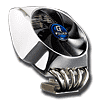
At stock speeds the G-Power 2 Pro does very well at both 12V and 5V, only being beaten out by the Zerotherm Nirvana 120 Premium.


When the CPU is overclocked and the voltage is increased, the G-Power 2 Pro has a little harder time keeping up. This is probably due to the fact that the heatpipes are are single-sided, which tend to not perform as well as dual-sided heatpipes. Still the performance is decent, and it is only 4 degrees behind the leaders.
Fan Noise
To measure fan noise we used an IEC Type 2 sound level meter on the dBA setting. Measuring distance was 10 cm from the heatsink fan hub. The short distance of 10 cm is necessary to get proper readings with very silent fans. All fans were tested outside of the case at 12V supplied by a lab PSU. On fans that come with a fan controller or allow control of fan speed in any other way, "low" and "high" indicate the settings on the fan controller.
When the fan is run at full speed it is rather loud. Fortunately, Gigabyte has included a power adapter that allows the fan to run at 5V, which quiets the fan down considerably. In fact, at 5V the fan was the quietest so far in the test group. Since most motherboards are capable of supplying the full 12V to the CPU fan, it would have made more sense to allow the power adapter to supply 7V instead of the 12V. This would allow one more option for power users to get the right balance between performance and noise.
Apr 25th, 2024 01:56 EDT
change timezone
Latest GPU Drivers
New Forum Posts
- The TPU UK Clubhouse (24784)
- (Anti) SFF fun house (349)
- Github comments used to push malware via Microsoft repo urls (1)
- What's your latest tech purchase? (20337)
- The Official Linux/Unix Desktop Screenshots Megathread (694)
- XFX RX470 8GB no video and error 43 (27)
- Cinebench crashed my PC. My Wi-Fi stopped working, and I keep getting a "Please wait" screen when I boot up my PC. (31)
- im new to throttelstop and i think i messed it up by copying others any hints would be very much aprreciated (1)
- Aida64 cache mem OC (7)
- I am getting artifacting when I change Windows security settings. Is my GPU failing, or is this just a Windows issue? (10)
Popular Reviews
- Fractal Design Terra Review
- Thermalright Phantom Spirit 120 EVO Review
- Corsair 2000D Airflow Review
- Minisforum EliteMini UM780 XTX (AMD Ryzen 7 7840HS) Review
- ASUS GeForce RTX 4090 STRIX OC Review
- NVIDIA GeForce RTX 4090 Founders Edition Review - Impressive Performance
- ASUS GeForce RTX 4090 Matrix Platinum Review - The RTX 4090 Ti
- MSI GeForce RTX 4090 Suprim X Review
- MSI GeForce RTX 4090 Gaming X Trio Review
- Gigabyte GeForce RTX 4090 Gaming OC Review
Controversial News Posts
- Sony PlayStation 5 Pro Specifications Confirmed, Console Arrives Before Holidays (116)
- NVIDIA Points Intel Raptor Lake CPU Users to Get Help from Intel Amid System Instability Issues (106)
- AMD "Strix Halo" Zen 5 Mobile Processor Pictured: Chiplet-based, Uses 256-bit LPDDR5X (101)
- US Government Wants Nuclear Plants to Offload AI Data Center Expansion (98)
- Windows 10 Security Updates to Cost $61 After 2025, $427 by 2028 (84)
- Developers of Outpost Infinity Siege Recommend Underclocking i9-13900K and i9-14900K for Stability on Machines with RTX 4090 (84)
- TechPowerUp Hiring: Reviewers Wanted for Motherboards, Laptops, Gaming Handhelds and Prebuilt Desktops (78)
- AMD's RDNA 4 GPUs Could Stick with 18 Gbps GDDR6 Memory (74)