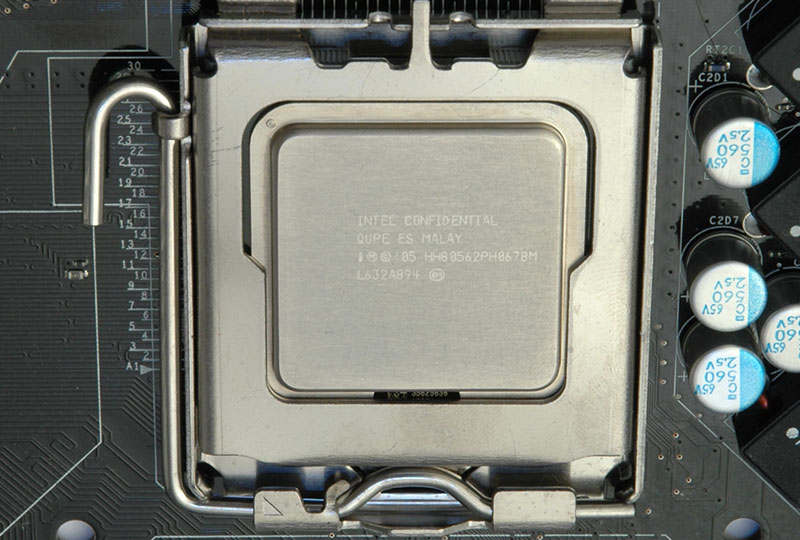
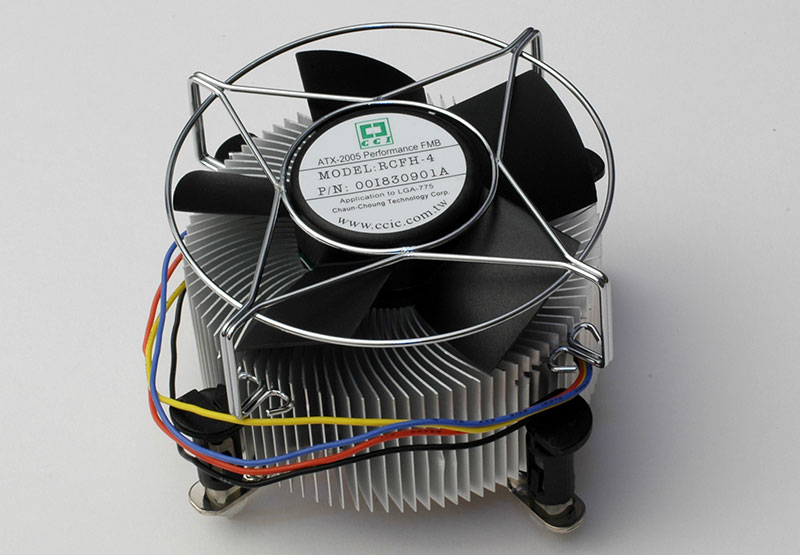
We received the test kit at the office in a large brown box. Inside waited some basic instructions, as well as the motherboard with the CPU already mounted, and Intel’s stock heatsink.
Intel QX6700
Intel’s Core 2 Extreme is to be considered the first Quad-core CPU out on the market. Below are its main features:
Brand ID
Intel Core 2 Extreme
Processor number
QX6700
Core Frequency
2.66 GHz
System bus frequency
1066 MHz
TDP
130 W
Stepping
B-3
Number of CPU cores
4
L2 Cache
8MB (2x 4MB)
CPUID
06F7
Core to bus ratio limit
10:1
Max Processor Input Voltage
1.350V
PECI Enabled
Yes
Enhanced Intel Speed Step Technology (EIST)
Yes
Extended HALT State (C1E) Enabled
Yes
Execute Disable Bit (XD) Enabled
Yes
Intel 64 Technology
Yes
Intel Virtualisation Technology
Yes
Package/Socket
FC-LGA775
Well, what is under the heatspreader? Intel’s engineers have managed to squeeze two E6700 cores under one IHS – a marvelous feat that offers quad-core performance today. After all, it makes a lot of sense from Intel’s stand point – instead of spending a lot of money on developing one die with four cores in it, it is much easier to put together two dies, each with two cores. Also, Intel can pick the best E6700 chips for its QX6700 CPUs, and not have to worry about refining the manufacturing process as it would with a whole new core. Worth noting is also the massive amount of L2 cache – 8 MB in total, 4 MB per die, 2 MB per core.
Below, you can see what the two cores look like in real life:
Intel Bad-Axe 2
I won’t go into a lot of detail with the motherboard that was used. It was supplied as part of the test kit, and is Intel’s top-of-the-line motherboard, utilizing the 975X chipset. The Bad-Axe 2 features numerous improvements over its predecessor, mainly in the overclocking segment. Most importantly, it supports Core 2 Quad CPUs.
Our Bad-Axe 2 motherboard was a pre-production sample. This meant that it did not have automatic fan control, so the fan had to be set to a specific percentage in the BIOS. Retail boards can control the fan speed automatically depending on temperature. I also hope that Intel provides a better manual with their retail motherboards, we only received a simple poster explaining the main features and a simplified diagram of how to put together a computer.
Heatsink
We received Intel’s stock heatsink for testing. “Stock” may not be the correct word however. Intel has gone as far as redesigning the heat sink for Quad-core CPUs. It has expanded in almost every direction; the increase in height is especially noticeable. To cool the processor, Intel has strapped-on a rather loud fan that spins at 5000 RPM.
 14
14