 3
3
Winchip DDR2 1200 MHz 2 GB Kit Review
Value & Conclusion »Test Setup
| Test System | |
|---|---|
| CPU: | Intel E6300 Conroe 1.8 GHz, 2 MB Cache |
| Motherboard: | ASUS P5B Deluxe BIOS 1004 Intel P965 C1 |
| Video Card: | PowerColor X800XL Pro 16 PCI-E |
| Harddisk: | Samsung P80 80 GB |
| Power Supply: | Ultra V-Power 450W |
| Software: | Windows XP SP2, Catalyst 7.6 |
Performance & Overclocking
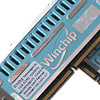
The first thing done, when testing this memory is simply running it at the rated speed. Starting with 1200 MHz and CL5-5-5-15 and 2.45V, the system booted right away. Note that I had to use 0.05V more than mentioned on the sticker. Winchip actually allows a +/- 0.1V to run this memory at the intended speed. The second step meant pushing the memory, to see how far it would go. Keeping the 2.45V setting and using a little active cooling, we I managed to raise the speed to 1240 MHz, while keeping the same timings. This may not seem much, but considering the bleeding edge of the memory, the small overclocking result was to be expected.The next step meant dropping the memory to CL4-4-4-8 and trying various speed settings. Starting with the standard 1066 MHz, I was able to run the Winchip memory at 2.25V. This was then raised back to the maximum, while keeping the CL4 rating. The results were quite impressive with 1172 MHz at which it then ran stable on the Asus P5B. This is almost the rated speed, but at tighter timings.
The third step meant tightening the timings to CL3-2-2-4, which is the minimum the mainboard allows. The memory was set to 533 MHz and the voltage lowered as much as possible. The memory really loves and needs a bit more than default, as it only ran stable at 2.25V with these settings. To see how far I was able to take the timings, the voltage was raised back to the 2.45V and the MHz slowly raised to a whooping 640 MHz at CL3-2-2-4. Trying 667 MHz at these settings resulted in a non-booting system.
The timings were then loosened a bit to 3-3-3-4. while the voltage was kept at maximum. The results are 898 MHz at these settings. This is certainly very impressive.
| Winchip DDR2 1200 MHz 2 GB Kit | ||||||||
|---|---|---|---|---|---|---|---|---|
| CPU Clock & Memory Ratio | Memory Speed | Memory Timings | Everest Read | Everest Write | Everest Latency | Quake 3 Timedemo | 3DMark 2001SE | SuperPi Mod 1M |
| 7 x 310 1:2 | 620 MHz | 5-5-5-15 2.45V | 8299 MB/s | 5517 MB/s | 56.1 ns | 428.1 fps | 26979 | 24.63 s |
| 7 x 300 1:2 | 600 MHz | 5-5-5-15 2.45V | 8016 MB/s | 5377 MB/s | 58.2 ns | 418.2 fps | 26485 | 25.45 s |
| 7 x 320 3:5 | 533 MHz | 4-4-4-8 2.25V | 8231 MB/s | 5812 MB/s | 55.5 ns | 438.7 fps | 27598 | 23.88 s |
| 7 x 293 1:2 | 586 MHz | 4-4-4-8 2.45V | 7992 MB/s | 5333 MB/s | 58.3 ns | 409.6 fps | 26299 | 25.95 s |
| 7 x 299 2:3 | 448 MHz | 3-3-3-4 2.45V | 7609 MB/s | 5429 MB/s | 45.3 ns | 416.1 fps | 26344 | 25.59 s |
| 7 x 320 4:5 | 400 MHz | 3-3-3-4 2.45V | 7248 MB/s | 5799 MB/s | 68.1 ns | 429.9 fps | 26173 | 24.64 s |
| 7 x 320 1:1 | 320 MHz | 3-2-2-4 2.45V | 6365 MB/s | 5787 MB/s | 77.4 ns | 425.5 fps | 25690 | 25.00 s |
| 7 x 266 1:1 | 266 MHz | 3-2-2-4 2.25V | 5352 MB/s | 4836 MB/s | 92.2 ns | 354.2 fps | 23287 | 30.02 s |


This graph shows you at a quick glance which clock frequencies you can expect at which voltage. Please note that each individual module overclocks different, the results here can only be seen as an indicator of performance.
Apr 23rd, 2024 22:50 EDT
change timezone
Latest GPU Drivers
New Forum Posts
- Flashing lenovo BIOS (1)
- CPB Enabled Boot Loop (10)
- Upgrade Build (106)
- Official Board Game Discussion (9)
- TPU's Nostalgic Hardware Club (18461)
- The TPU UK Clubhouse (24771)
- Sexy Mechanical Keyboard Thread (485)
- Realtek Modded Audio Driver for Windows 10/11 - Only for HDAUDIO (5688)
- What's your latest tech purchase? (20319)
- Post your Cinebench 2024 score (449)
Popular Reviews
- Fractal Design Terra Review
- Corsair 2000D Airflow Review
- Thermalright Phantom Spirit 120 EVO Review
- Minisforum EliteMini UM780 XTX (AMD Ryzen 7 7840HS) Review
- ASUS GeForce RTX 4090 STRIX OC Review
- NVIDIA GeForce RTX 4090 Founders Edition Review - Impressive Performance
- ASUS GeForce RTX 4090 Matrix Platinum Review - The RTX 4090 Ti
- MSI GeForce RTX 4090 Suprim X Review
- MSI GeForce RTX 4090 Gaming X Trio Review
- Gigabyte GeForce RTX 4090 Gaming OC Review
Controversial News Posts
- Sony PlayStation 5 Pro Specifications Confirmed, Console Arrives Before Holidays (116)
- NVIDIA Points Intel Raptor Lake CPU Users to Get Help from Intel Amid System Instability Issues (106)
- AMD "Strix Halo" Zen 5 Mobile Processor Pictured: Chiplet-based, Uses 256-bit LPDDR5X (101)
- US Government Wants Nuclear Plants to Offload AI Data Center Expansion (98)
- Windows 10 Security Updates to Cost $61 After 2025, $427 by 2028 (84)
- Developers of Outpost Infinity Siege Recommend Underclocking i9-13900K and i9-14900K for Stability on Machines with RTX 4090 (84)
- TechPowerUp Hiring: Reviewers Wanted for Motherboards, Laptops, Gaming Handhelds and Prebuilt Desktops (74)
- Intel Realizes the Only Way to Save x86 is to Democratize it, Reopens x86 IP Licensing (70)