Monday, August 10 2009
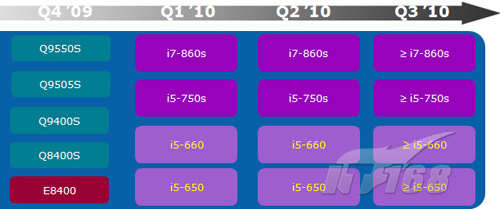
Intel is weeks away from letting loose its first socket LGA-1156 processors, starting with a series of quad-core models, namely Core i5 750, Core i7 860, and Core i7 870. According to the latest roadmaps, dual-core derivatives of the Westmere architecture, will arrive in early 2010. IT168 sourced details of the model numbers Intel chalked out, based on roadmap excepts. An older report detailed all six models based on the "Clarkdale" core, including three in the Core i5 series, two in the Core i3 series, and one in the Pentium Dual-Core series. Let's try to make sense of this branding structure.
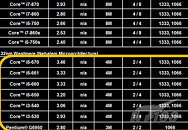


To begin with, Core i3 series dual-core processors differ from Core i5 in lacking three features: Intel Trusted eXecution Technology (TXT), a set of features that enhance security using hardware-based mechanisms. More on TXT can be read here. The second feature Core i3 lacks is Virtualization Technology for Directed I/O (VT-d), an enhancement to the virtualization capabilities (details here. Core i3 however, does feature VT-x, the regular hardware virtualization features found on today's Intel processors. The third and more relevant feature Core i3 lacks is Turbo Boost technology, a feature that assesses processor load, powers-down one of the two cores, and overclocks the active core, all automatically, and on the fly. This feature holds even more importance in quad-core and multi-socket quad-core machines, but may come handy nonetheless.
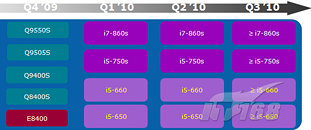


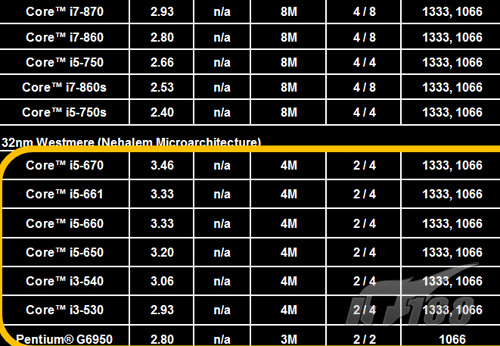
Here's what the lineup stands at:
  • Core i3 530 -2.93 GHz
  • Core i3 540 -3.06 GHz
  • Core i5 650 -3.20 GHz, with Turbo Boost speed of 3.43 GHz
  • Core i5 660 -3.33 GHz, with Turbo Boost speed of 3.60 GHz
  • Core i5 670 -3.43 GHz, with Turbo Boost speed of 3.73 GHz
Core i5 models have their model number series beginning in the 600 series, and take off where the 500 series Core i3 processors leave (next to Core i3 530, is Core i5 640). Price-wise, Core i3 dual-core processors tentatively range between US $123~$143, while Core i5 dual-core ones between $176~$284. All these processors feature two cores, and HyperThreading technology enabling four logical CPUs (threads). Each core has a dedicated L2 cache of 256 KB, while a 4 MB L3 cache is shared between two cores.

Finally, Intel's first sub-$100 Pentium dual-core offering based on this architecture will be called Pentium G6950. Clocked at 2.80 GHz, its feature-set is nearly identical to that of the Core i3, except for that it has 3 MB of available L3 cache, and HyperThreading is excluded from the feature-set. All Clarkdale based processors so far, carry TDP rating of 73W.

Source: IT168
posted by btarunr - 8:20 PM |  Related News

User comments
by lemonadesoda (August 10th - 8:30 PM) - Reply
Thanks for making a great effort on bringing all this info together. :toast:

However, as a sign of "exhaustion" with over-SKUing, re-branding, even misbranding of s-1366/1156 I have to say, I have lost interest in piecing this jigsaw puzzle together. Perhaps Intel should reflect on that; if members of the enthusiast community are now somewhat disinterested at best, and confused at worst... then this will have negative customer-lifetime-value impact.

Yes, I still love Intel CPU's, and yes, I will continue to buy their premium platforms, but no, I have lost all interest in decyphering their SKU mess.
by Imsochobo (August 10th - 8:48 PM) - Reply
Let's try to make sense of this branding structure.


Impossible !

those dualcore with HT can be scary for amd!
by toyo (August 10th - 8:57 PM) - Reply
Nonetheless a few more buck for Intel, milked from the guys that will find out that "OMG, I have a core i7 - wait a sec, it's just a i5 wanting so much a i7 badge that is happy with it even if it is only by name", the same going for the i3s that suddenly are i5 - with only 2 cores (the kind of cores that "real man" use)... pfff... one of us said before "Brand them by the socket" I say what a wise and simple decision would that have been, branding by socket and "real cores". All these moves just smell like the big bad (wolf) company trying to get a little more green. I thought Intel were selling CPUs&stuff, not names&schemes.
by mudkip (August 10th - 9:11 PM) - Reply
I don't understand intel anymore jezus...even more confusing than nvidia?!
by thezorro (August 10th - 9:39 PM) - Reply
this rebranding is a nightmare.
whats wrong with intel
by 1Kurgan1 (August 10th - 10:59 PM) - Reply
3.46ghz... Finally there will be no more screaming about highest clock speeds :p Wonder what the prices will be on these things.
by btarunr (August 10th - 11:04 PM) - Reply
by: 1Kurgan1
3.46ghz... Finally there will be no more screaming about highest clock speeds :p Wonder what the prices will be on these things.
i5 670 (3.43 GHz) may cost $283.
by mudkip (August 10th - 11:10 PM) - Reply
by: btarunr
i5 670 (3.43 GHz) may cost $283.
Even more expensive than the i7 920
by btarunr (August 10th - 11:11 PM) - Reply
by: mudkip
Even more expensive than the i7 920
Yup. i7 860 costs more than i7 920 as well.
by hat (August 10th - 11:24 PM) - Reply
What's the difference between the i3 and dual core i5? Turbo?
by toyo (August 11th - 12:07 AM) - Reply
i3 vs i5, from the article:
To begin with, Core i3 series dual-core processors differ from Core i5 in lacking three features: Intel Trusted eXecution Technology (TXT), a set of features that enhance security using hardware-based mechanisms. More on TXT can be read here. The second feature Core i3 lacks is Virtualization Technology for Directed I/O (VT-d), an enhancement to the virtualization capabilities (details here. Core i3 however, does feature VT-x, the regular hardware virtualization features found on today's Intel processors. The third and more relevant feature Core i3 lacks is Turbo Boost technology, a feature that assesses processor load, powers-down one of the two cores, and overclocks the active core, all automatically, and on the fly. This feature holds even more importance in quad-core and multi-socket quad-core machines, but may come handy nonetheless.
by NastyHabits (August 11th - 12:23 AM) - Reply
Lucky me. I'm currently too poor to care. I7 that doesn't use the 1366 socket? What? Maybe I'll figure it out later.
by mudkip (August 11th - 12:37 AM) - Reply
by: NastyHabits
Lucky me. I'm currently too poor to care. I7 that doesn't use the 1366 socket? What? Maybe I'll figure it out later.
I think they should've reserved i7 for socket 1366 only.
by NastyHabits (August 11th - 1:37 AM) - Reply
by: mudkip
I think they should've reserved i7 for socket 1366 only.
I agree completely!

I think this is a deliberate attempt by Intel to confuse the public and milk a few extra bucks from the enthusiast crowd. Why else charge a 40% premium for unlocked processors as they do now?

Or maybe they realized that triple-channel memory is not all that they wanted it to be, so let's take the high end 1156 processors, call them i7 and charge accordingly. Bah! Humbug!
by Depth (August 11th - 1:43 AM) - Reply
by: mudkip
I think they should've reserved i7 for socket 1366 only.
Yep. The way I see it socket 1366 should be reserved for i7, i9 and upwards, while socket 1156 should be for i5, i3 and the iPhone.

I think they arranged for specialists from nVidia, Dell and a few other companies to come together and make the least understandable branding system possible. Good job!
by 1Kurgan1 (August 11th - 3:23 AM) - Reply
by: btarunr
i5 670 (3.43 GHz) may cost $283.


What is with Intel and their pricing? I just can't justify it. They seem to add a $1 onto the price for each 1mhz, and then if the multi is unlocked,tack on another few hundred. I would like to get an Intel rig, but I just can't swallow that price when I want to upgrade.

by: Depth
Yep. The way I see it socket 1366 should be reserved for i7, i9 and upwards, while socket 1156 should be for i5, i3 and the iPhone.

I think they arranged for specialists from nVidia, Dell and a few other companies to come together and make the least understandable branding system possible. Good job!


Why would they split up their sockets for high end to lower end chips. Why not come out with lower end chipsets for the same sockets. That way people can actually upgrade 1 peice at a time instead of swallowing a motherboard and cpu all at the sametime. That would be a far better marketing strategy and would probably net them more sales as people dont have to spend a ton at once. The real issue is they didn't take this route in the first place, and now they are switching it around and confusing people. I don't understand why they thought having a different socket for each stage of the "i" processors was a good idea, it's a horrible idea.
by btarunr (August 11th - 7:41 AM) - Reply
by: 1Kurgan1
What is with Intel and their pricing? I just can't justify it.
Intel does not want "justifiable" prices. It wants you to only buy one particular model, while overpricing the rest, and then coming up with a new, overpriced model, while slashing the price of the current overpriced model. Here's an example:

Intel wanted you to buy 65 nm Core 2 Duo chips even when E8400 arrived. So E8400 was priced $270. Later, it pushed E8400 to the $180 price point, and priced the the E8500 at $280. It now stands at E8600 being priced at $280, while E8500 and E8400 are pushed further inside. So, you are made to digest its inventories. If you want the best in the lineup, prepare to shell out more. Currently, Intel has three sweet spots drawn out:

Core i5 650 dual-core (3.20), priced at $176.
Core i5 750 quad-core (2.66), priced at $196. With HTT enabled, this chip would have you think twice before choosing i7 920, so they decided to disable it.
Core i7 920 quad-core (2.66), this chip is the shit, considering the next Lynnfield after i5 750, which is i7 860, is actually priced higher than this ($283).
by Paintface (August 11th - 8:18 AM) - Reply
does not look exciting at all to me, next upgrade will be a Phenom II 955 which is only 160 euros in Germany now, i cant see why it would be worth spending more on a cpu if you dont have benchmarking as a job
by kylzer (August 11th - 3:50 PM) - Reply
Ok i completely understand............
by AddSub (August 11th - 4:28 PM) - Reply
Looking at those CPU's I finally realized what the purpose was of having three mainstream platforms in production at the same time. And yes, LGA775, LGA1156, and even LGA1366 can be considered mainstream at this point since even Dell offers LGA1366 based desktops at this point. For under a $1000 for that matter. (Dell Studio XPS was available for $949 with a i7 CPU back in November of 2008.)

Anyways, I've come to the realization that Intel is really competing with itself at this point in the general consumer marketspace. (Not just high-end enthusiast marketspace, which is obvious by now.) Phenoms and the like are really not making any sort of real impact. I mean just according to that report released yesterday, (found here) Intel's market share in x86 CPUs has risen to 80.5% while AMD has fallen even further to a lowly 18.7%. At this point AMD can account for less than a fifth of the market share, which is spread about among various CPU lineups, all of which are woefully behind the times architecturally speaking. So, yeah, I can see the point in having all these different Intel platforms around. Unless they (AMD) can come up with something tangible and innovative, I can see that 18.7% chunk shrinking even further.
by WOOKZ (August 11th - 5:50 PM) - Reply
fell me glad i made a decision on i7 920 do and ram2ex asus at the right time got a good deal on both feeling quite chipper now
by Steevo (August 12th - 1:49 AM) - Reply
I think they are suffering poor yields and sales due to the slumping economy, so they throw a bunch of SKU's out and some rebadged chips to make them seem better, and have come up with some weird scheme of overclocking by downcoreign to make less heat, and all rated at 73W? A CPU that can run 3.74Ghz single core on 73W isn't horrible, but compared to other offerings?
by wolf (August 12th - 1:52 AM) - Reply
by: WOOKZ
fell me glad i made a decision on i7 920 do and ram2ex asus at the right time got a good deal on both feeling quite chipper now
I hear that mate. :toast:
by livehard (August 12th - 3:50 AM) - Reply
by: btarunr
Intel does not want "justifiable" prices. It wants you to only buy one particular model, while overpricing the rest, and then coming up with a new, overpriced model, while slashing the price of the current overpriced model. Here's an example:

Intel wanted you to buy 65 nm Core 2 Duo chips even when E8400 arrived. So E8400 was priced $270. Later, it pushed E8400 to the $180 price point, and priced the the E8500 at $280. It now stands at E8600 being priced at $280, while E8500 and E8400 are pushed further inside. So, you are made to digest its inventories. If you want the best in the lineup, prepare to shell out more. Currently, Intel has three sweet spots drawn out:

Core i5 650 dual-core (3.20), priced at $176.
Core i5 750 quad-core (2.66), priced at $196. With HTT enabled, this chip would have you think twice before choosing i7 920, so they decided to disable it.
Core i7 920 quad-core (2.66), this chip is the shit, considering the next Lynnfield after i5 750, which is i7 860, is actually priced higher than this ($283).
Couldn't have said it better myself. Intel has some good businessmen in the bowels of that company.
7956 Users online, 4.55 mbps
Quick Search
Already a member?
Username:
Password:
Register Here!
TechPowerUp on Facebook 
TechPowerUp on Google+ 
New Forum Posts
Popular Reviews

Latest VGA Drivers

ATI Catalyst 12.1 WHQL

XP32 | XP64 | W7 32 | W7 64

NVIDIA GeForce 285.58 WHQL

XP32 | XP64 | W7 32 | W7 64