| Wednesday, January 25th 2012 |

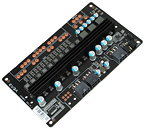
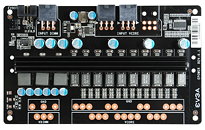
EVGA has now released the EPower Board, a VRM board which can be hooked up to a motherboard and/or graphics card (some soldering required) and provide more watts required for uber-overclocking.
This warranty-voiding device features a 10-phase main output, a 3-phase secondary output, digital PWM (for the main output), three 6-pin PCIe power connectors, plus EVBot and fan support. The EPower Board costs $99.99 and is "intended only for advanced users with electronics experience."
posted by Cristian_25H - 6:34 AM | Related News |
User comments
by Completely Bonkers (6:43 AM) - Reply
Serious hardcore product. Nice. To separate the men from the boys
In case it wasnt obvious, check the size of that thing. As "big" as a "small" Graphics Card.
+++++++++++
Installation

In case it wasnt obvious, check the size of that thing. As "big" as a "small" Graphics Card.
+++++++++++
Installation

Am i getting this right? This is an adjustable step-down regulator that replaces your onboard VRMs? Also, it doesn't seem to offer any automated voltage shuffling, ala CnQ or SpeedStep?
Would be cool to have one of these. Would be even cooler to know how to use it.
by: imitationIt states it supplies additional power, so it doesn't replace the onboard VRM's. This product isn't targeted towards people who use CnQ or SpeedStep.
Am i getting this right? This is an adjustable step-down regulator that replaces your onboard VRMs? Also, it doesn't seem to offer any automated voltage shuffling, ala CnQ or SpeedStep?
by: erockerYep :) It's targeted towards the exact opposite of that. To the people who deactivate everything that has to do with saving energy. No seriously, for extreme overclockers this thing is like god on a PCB but for everybody else it's useless and they'll most certainly ruin their graphics card with it.
It states it supplies additional power, so it doesn't replace the onboard VRM's. This product isn't targeted towards people who use CnQ or SpeedStep.
by: erockerWell, the instructions state (step 1) to disconnect the onboard inductors, rendering the whole VRM unit useless. Also, it states that you might need to manipulate your VGA VRM's "power good" line, since the onboard VRM got disconnected. If you connect two voltage sources in parallel, every minor difference in output voltage will result in a (theoretical) unlimited current from the source with the higher voltage to the one with lower voltage. In high-current setups, like CPU VRMs, trace resistance somewhat equalizes output voltage, but you'd still need some feedback for the additional voltage source to adjust itself to the onboard VRMs.
It states it supplies additional power, so it doesn't replace the onboard VRM's.
by: erockerAs if it wasn't obvious :D Lack of on-the-fly, precise automated voltage adjustment (CnQ or SS) results in what i wrote above.
This product isn't targeted towards people who use CnQ or SpeedStep.
by The Von Matrices (10:44 AM) - Reply
To me it seems that the 3 6-pin PCIe connectors would provide too little power for a high-end card. I know that this product isn't aimed at people who adhere to PCIe specifications, but wouldn't the 3 6-pin power connectors only be able to supply 225W, less than the 300W that 2 8-pin connectors on some stock cards can supply?
Also, does anyone else think it's kind of funny that they're soldering this board on a low end, old card (NVidia 8600 GT)?
this is something for the crazies on LN2, who need the extra power to break records.
by: Musselswe have a winner :laugh: but yeah this is for older cards that didnt have the power fore MORE Mhz on ln2 :cool:
this is something for the crazies on LN2, who need the extra power to break records.
by Cheeseball (12:15 PM) - Reply
Yup, you can tell it's for phase change and LN2 enthusiasts. Look at instruction number 13.
by Red_Machine (12:18 PM) - Reply
My RAMBUS-equipped Pentium 4 rig has a plug-in VRM board next to the CPU.
by badtaylorx (12:39 PM) - Reply
how long before someone uses this to get a cellery to 9GHz???
I need 2 of these :rockout:
One for my wifes Netbook and one for an old 9700non pro :rockout:
by: The Von Matrices8 pin connectors just add 2 extra grounds. 6 pins with high gauge wire are plenty.
To me it seems that the 3 6-pin PCIe connectors would provide too little power for a high-end card. I know that this product isn't aimed at people who adhere to PCIe specifications, but wouldn't the 3 6-pin power connectors only be able to supply 225W, less than the 300W that 2 8-pin connectors on some stock cards can supply? Also, does anyone else think it's kind of funny that they're soldering this board on a low end, old card (NVidia 8600 GT)?
by: Wile EActually, AFAIK, the 8-pin adds the requirement for 3 +12v wires. The 6-pin spec only calls for 2 +12v wires, though most higher end PSUs still use 3, and with 6+2 becoming the norm the 3 +12v wires are usually present. Not that any of this matters, anyone that knows how to use this device properly knows what their PSUs are really capable of and knows if their PSU's 6-pins are enough or not.
8 pin connectors just add 2 extra grounds. 6 pins with high gauge wire are plenty.
Nope. 3 12V+ on both 6 and 8 pin PCIe power connectors.
And I am looking directly at the 8 and 6 sticking out of my 580. They match the diagram.
And I am looking directly at the 8 and 6 sticking out of my 580. They match the diagram.they add an extra wire to an existing pin, is what he's saying. look up some pics, and you'll see two 12V wires to a single plug on most PSU's these days.
by: Wile ENope, go look up the spec, the 3rd +12v is optional on the 6-pin but required on the 8-pin. Like I said.:rolleyes: And any PSU that uses 6+2 connectors, like your Galaxy, will have all 3 because the connector has to follow the 8-pin spec.
Nope. 3 12V+ on both 6 and 8 pin PCIe power connectors. http://img476.imageshack.us/img476/3329/pcieplugdiagramoa5.png And I am looking directly at the 8 and 6 sticking out of my 580. They match the diagram.
by: MusselsWhat I mean is that the middle +12v pin is often missing completely.
they add an extra wire to an existing pin, is what he's saying. look up some pics, and you'll see two 12V wires to a single plug on most PSU's these days.
by HybridChiller (9:39 AM) - Reply
topic on Techpowerup forum about using the Untouchables :
http://www.techpowerup.com/forums/showthread.php?t=154308
by eidairaman1 (5:50 PM) - Reply
This is just a board hard overclockers have been making on their own for decades now
by TheMailMan78 (5:54 PM) - Reply
I wish I had disposable hardware to test this out with. Looks like something fun to learn.
by: eidairaman1Yeah, I remember seeing someone using the PWM cut off from an old 8800GTX to replace the one on, IIRC, a GTX570.
This is just a board hard overclockers have been making on their own for decades now
by HybridChiller (7:45 PM) - Reply
Use an VRM from a 8800gtx on a GTX570 ?
That really doesn't have any benefit.
But using VRM from 570 on a 8800gtx is good


