| Tuesday, September 2 2008 |

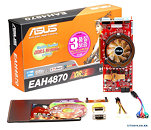
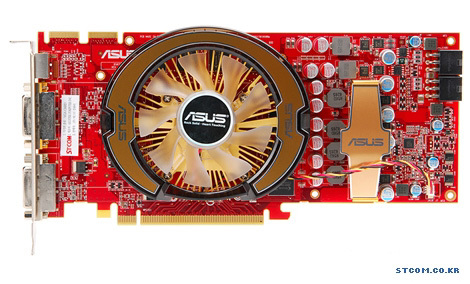
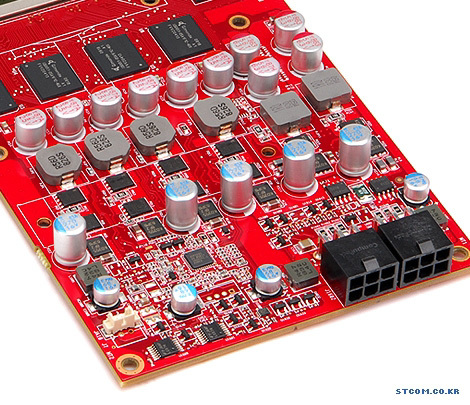
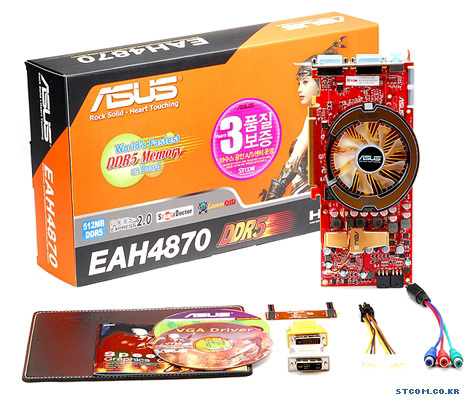
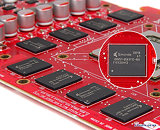
ASUS has released a non-reference version of the ATI Radeon HD 4870 graphics card. The model is called EAH 4870 D5 and it's main difference is the enhanced power circuitry. The card uses a 4 phase vGPU power circuit along with a 2 phase vMem circuit, making it similar to that of the PowerColor HD 4870 PCS+, while the reference design uses 3 + 2 phases. The PCB uses a 100% conductive polymer capacitor design. The same Qimonda memory chips as those used on reference design boards rounds up the card.
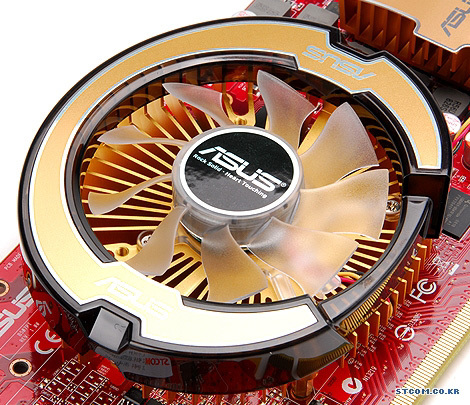
The card runs at reference speeds of 750 MHz Core / 900 MHz Memory. ASUS used its signature Glaciator Fansink cooler for the GPU, which can already be found on many of their other cards but decided to leave the memory chips without active or passive cooling. Expreview notes that the heatsink on the MOSFETs looks small and could be a cause for concern since temperatures of that zone of video cards in general could reach as high as 110 degrees Celsius. The card uses single slot expansion bracket though the card itself requires two slots worth space due to the heatsink. This release follows several other designs from the likes of Palit, PowerColor, etc., that have similar power circuitry, presumably to facilitate better overclocks though poor cooling designs implemented by these AIBs mar the effort put in to design these superior PCBs.
Source: STcom Korea
The card runs at reference speeds of 750 MHz Core / 900 MHz Memory. ASUS used its signature Glaciator Fansink cooler for the GPU, which can already be found on many of their other cards but decided to leave the memory chips without active or passive cooling. Expreview notes that the heatsink on the MOSFETs looks small and could be a cause for concern since temperatures of that zone of video cards in general could reach as high as 110 degrees Celsius. The card uses single slot expansion bracket though the card itself requires two slots worth space due to the heatsink. This release follows several other designs from the likes of Palit, PowerColor, etc., that have similar power circuitry, presumably to facilitate better overclocks though poor cooling designs implemented by these AIBs mar the effort put in to design these superior PCBs.
Source: STcom Korea
User comments
Made for overclockers by the sound of it, first thing they do is remove the stock cooler anyway...
I have the 3870 version of this. I was very pleased with it. I may look into getting this one, but i had my eyes on that palit one.
I do wish they would have put heat sinks on the memory though.
If Intel sells a QX9770 without a stock cooler (assuming anyone who buys a $1500 CPU would use aftermarket cooling), they might as well start selling video cards sans coolers. Unfortunately, installing a aftermarket cooler (before which, finding one that fits perfectly, cools well) is cumbersome. So they have to provide cooling that is sufficient. Going by the 4870 'fiasco', definitely OC'ed RV770s don't do well with even double slot cooling. Like what originally came up with SuperRV770 specs only cards with water-blocks or pre-fitted WC solutions can tame a RV770 at 850+ MHz.
by: btarunr;957330Finding a good cooler for the GPU is no problem. It's the VRM area that is always lacking, with regards to stock cooling for HD4870s. The only card I've seen so far with better than normal cooling is the Palit Sonic HD4870. Great non-reference PCB design along with a fairly sizable VRM heatsink.
If Intel sells a QX9770 without a stock cooler (assuming anyone who buys a $1500 CPU would use aftermarket cooling), they might as well start selling video cards sans coolers. Unfortunately, installing a aftermarket cooler (before which, finding one that fits perfectly, cools well) is cumbersome. So they have to provide cooling that is sufficient. Going by the 4870 'fiasco', definitely OC'ed RV770s don't do well with even double slot cooling. Like what originally came up with SuperRV770 specs only cards with water-blocks or pre-fitted WC solutions can tame a RV770 at 850+ MHz.
This offering from Asus looks like a total joke, as far as VRM cooling goes. I'd expect more from Asus...
I Think that would actually be a good idea, selling cards without coolers on them.
They'd have to put a cover over the GPU or could get badly damaged in transit. We all know retarded delivery people can be.
True but that doesn't mean it has to be a cooler....they could just put some kind of temporary something on there.
So is this card underclocked (700/900) due to the poor cooling round the VRM? Sounds like you'd be better off buying a reference 4870 and an Accelero S1!
by: jbunch07;957351I never said it had to be a cooler. ;)
True but that doesn't mean it has to be a cooler....they could just put some kind of temporary something on there.
will be interesting to see the noise and temperatures on this one, compared to palit one .
The card runs at reference speeds of 700 MHz Core / 900 MHz Memory.
The website you referenced states 750/900 not 700/900.
Temperatures as high as 110 °C around the VRM area were noted during the card's testing, with the provided heatsink not looking adequate.
I have found no such information from the link you provided.
while the reference design makes due with 3 + 2 phases
Interesting, I read 4+2 phase power from Tech Connect Mag and Game Star Hardware
Were are you getting your information from?
by: oli_ramsay;957379It isn't. See the source.
So is this card underclocked (700/900) due to the poor cooling round the VRM? Sounds like you'd be better off buying a reference 4870 and an Accelero S1!
btarunr was sloppy and typed "700" instead of "750"...
;)
I'm sorry. I fixed it.
by: EastCoasthandle;957412
[The card uses a 4 phase vGPU power circuit along with a 2 phase vMem circuit, making it similar to that of the PowerColor HD 4870 PCS+,] while the reference design makes due with 3 + 2 phases.
Interesting, I read 4+2 phase power from Tech Connect Mag
Were are you getting your information from?

EastCoasthandle,
You're getting tad entangled in your quotes...
by: EastCoasthandle;957412http://en.expreview.com/2008/09/02/asus-announces-non-reference-hd-4870-with-42-phase-power-module/#more-800
The website you referenced states 750/900 not 700/900.
I have found no such information from the link you provided.
Interesting, I read 4+2 phase power from Tech Connect Mag and Game Star Hardware
Were are you getting your information from?
by: btarunr;957419
http://en.expreview.com/2008/09/02/asus-announces-non-reference-hd-4870-with-42-phase-power-module/#more-800
Ok thanks.
Unfortunately, what might be anxious is the cooling system. No mention the weak-looking GPU cooler, the heatsink on the powering mosfets is too small. Since many dates show temperature of the power module can be up to 110+, Asus should pay more attention to it.
The mention of 110+ isn't directly talking about this card in particular but making a general statement. They make no mention of having the card or testing the card. But appear to just be making opinions on the announcement. Besides, high vreg temps (assuming they mean C and not F as they make no mention of it) can be accomplished on most video cards (be it ati or nvidia) if a combination of:
-high ambient temps
-an enclosed case
-little to no ventilation/active cooling
They didn't mention degrees Cecilius but that's understandable else they wouldn't have used "can be up to" because that's much higher than ~42 C. 110 F is ~42 C. Glaciator does look weak for a RV770 @ 750 MHz. Made an edit.
by: nafets;957344
Finding a good cooler for the GPU is no problem. It's the VRM area that is always lacking, with regards to stock cooling for HD4870s. The only card I've seen so far with better than normal cooling is the Palit Sonic HD4870. Great non-reference PCB design along with a fairly sizable VRM heatsink.
This offering from Asus looks like a total joke, as far as VRM cooling goes. I'd expect more from Asus...
More phases = cooler. They arent even using the digital VRMs so it wont even run that hot! VRMs are notorious for their heat production versus the normal mosfet + inductor + capacitors.
Volterra chips (which for no reason are called "digital") should be a bit more efficient than "the conventional PWM block". The problem with the Volterras is they're just single chips so all that waste power is concentrated on a single small chip which directly translates to a high temperature - but not necessarily a higher wattage of heat.
by: largon;957840
Volterra chips (which for no reason are called "digital") should be a bit more efficient than "the conventional PWM block". The problem with the Volterras is they're just single chips so all that waste power is concentrated on a single small chip which directly translates to a high temperature - but not necessarily a higher wattage of heat.
Looks like they are more expensive too. There can be 4 phase digital VRM like PowerColor did in their HD 4870 1GB (cooled by simple AL cooler). There are more powerful Vitec chips too, all they need is a cheap piece of aluminum with many fins on it . If this is the future, why company like ASUS makes change in reference design and uses capacitors?
by: btarunr;957314
that have similar power circuitry, presumably to facilitate better overclocks though poor cooling designs implemented by these AIBs mar the effort put in to design these superior PCBs.
Adding more phases to the power circuit reduces the individual component temps. The individual components are no longer working as hard. They don't need the same amount of cooling as a stock design on the phases.
As far as no cooling on the GDDR5, I'm starting to think the clock limits are reached before the temperature limits. Even the Palit card hit 1100MHz without problem (which is more than enough bandwidth anyway).
Does GDDR5 really run that much cooler?
urk.. Quimondas.. :(
by: Bjorn_Of_Iceland;958426Whats so bad about quimondas? Samsung arent providing AMD with any GDDR5 atm you know? Quimonda is the only supplier.
urk.. Quimondas.. :(
by: tkpenalty;958462And Hynix
Whats so bad about quimondas? Samsung arent providing AMD with any GDDR5 atm you know? Quimonda is the only supplier.
is this fan enough for high overclock , i don't think so
by: btarunr;957330Not to mention Most companies wont cover cards that have been modified (aka aftermarket cooling) your best to keep the stock cooler around incase of total failure.
If Intel sells a QX9770 without a stock cooler (assuming anyone who buys a $1500 CPU would use aftermarket cooling), they might as well start selling video cards sans coolers. Unfortunately, installing a aftermarket cooler (before which, finding one that fits perfectly, cools well) is cumbersome. So they have to provide cooling that is sufficient. Going by the 4870 'fiasco', definitely OC'ed RV770s don't do well with even double slot cooling. Like what originally came up with SuperRV770 specs only cards with water-blocks or pre-fitted WC solutions can tame a RV770 at 850+ MHz.
What is the difference in PWM block here PowerColor HD4870 PCS+ and here Powercolor HD 4870 1GB and finally stock here Sapphire HD 4870 . Asus are a bunch of greedy people.
With this extended power usage, you don't really need to risk it all with VoltMods (sorry W1z), especially if you are dealing with a good $300-$400 video card. But personally, I'm still disappointed about the power usage. But not for long, I hope. I am getting rumors in other forums that as referring to the 22nm Phenoms coming in mid/late 09', admins and co-workers from AMD are saying that they've noticed a lot of energy-efficiency in mind to the engineers OUTSIDE of the CPU-engineering department, which is not referring to the upcoming HD 4000 siblings. Could there be an upcoming power-saving revision to the present HD 4000 series, or are they just making more efficient chipsets for the next iPhone revision?:laugh:
As for this card, I;m still very impressed with the voltage. Get a Viva cooler from Coolermaster and you got yourself a $400 overclocking video card that will last for more than 6 months.
by: R_1;958642There is no difference.
What is the difference in PWM block here PowerColor HD4870 PCS+ and here Powercolor HD 4870 1GB and finally stock here Sapphire HD 4870 . Asus are a bunch of greedy people.
PowerColor HD4870 PCS+ is identical to Powercolor HD 4870 1GB , they're both AMD reference design upgraded from 3 to 4 phase vGPU as the reference board has an option for that.
by: PCpraiser100;958686:roll:
(...) I am getting rumors in other forums that as referring to the 22nm Phenoms coming in mid/late 09', (...)
No need to worry about AMD 22nm coming in 2009... Try year later than Intel 22nm @ 2012.
by: largon;958851
There is no difference.
PowerColor HD4870 PCS+ is identical to Powercolor HD 4870 1GB , they're both AMD reference design upgraded from 3 to 4 phase vGPU as the reference board has an option for that.
Exactly! That is my point too. Why bothering with this new ASUS "Bottom" HD 4000 series. :laugh:
does this card has the same bios as the asus reference cards? apparently when i flashed mine with the normal reference bios, my card doesn't work anymore.
Hello everybody i have a big problem, i have buy the eah4870 D5 for my crossfire just the second one, and i have flashed my card and finaly the bios is die. I need the original bios of this card to reflash this one. contact me please.
by: maxor1980;1054983Give this one a shot....
Hello everybody i have a big problem, i have buy the eah4870 D5 for my crossfire just the second one, and i have flashed my card and finaly the bios is die. I need the original bios of this card to reflash this one. contact me please.
http://www.techpowerup.com/vgabios/19112/Asus.HD4870.512.080626.html
Is it for new card 4870 from Asus?
After flash it's not the good bios, i need the last bios of the new card at page 1 first message.