 222
222
AMD Radeon HD 7970 GHz Edition 3 GB Review
Packaging & Contents »Introduction

AMD launches its newest graphics processor, the Radeon HD 7970 GHz Edition, in a desperate bid to reclaim the single-GPU performance crown from NVIDIA. The move sparks a sense of déjà vu, taking us back to mid-2009, when AMD created the Radeon HD 4890 to compete against the then cheapened GeForce GTX 260 Core 216. While the HD 4890 used a new, redesigned ASIC, the new HD 7970 GHz Edition sticks to the same one as the HD 7970.
The Radeon HD 7970 GHz Edition ships with about 13.5% higher GPU and 9% higher memory clock speeds, it gets its "GHz Edition" brand extension from its ≥1 GHz GPU clock speed. Radeon HD 7870 and Radeon HD 7770 are the other GHz Edition SKUs from AMD. Increased clock speeds aren't the only things new about the HD 7970 GHz Edition; it is also the first high-end AMD GPU to feature PowerTune with Boost, a similar-sounding feature to NVIDIA GPU Boost.

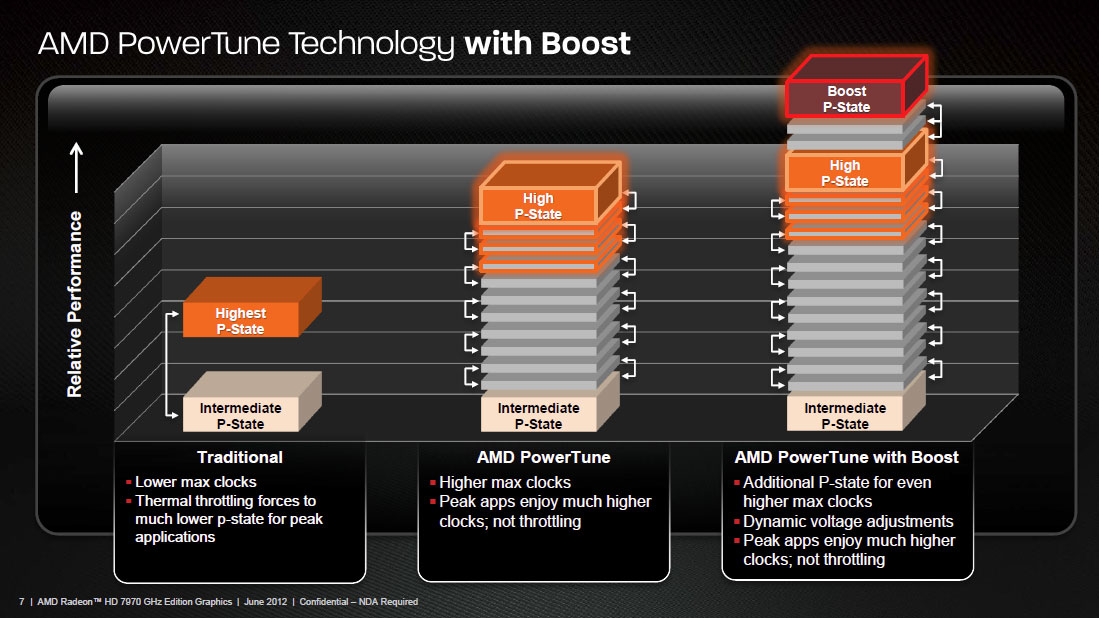
The core of the HD 7970 GHz Edition is clocked as high as 1000 MHz, with a Boost frequency of 1050 MHz; while the memory is upped to 1500 MHz (actual) or 6.00 GHz (GDDR5 effective), resulting in a staggering 288 GB/s bandwidth thanks to the 384-bit wide memory interface. The PowerTune with Boost, on the other hand, is an evolution of AMD's PowerTune technology. Whereas PowerTune provides high maximum clock speeds, PowerTune with Boost uses a new deterministic algorithm that takes into account power-draw and temperatures, to find more opportunities to boost the clock speed. The technology even tunes the voltage, if it is required to support the Boost state, as long as power-draw and temperatures are within acceptable limits.
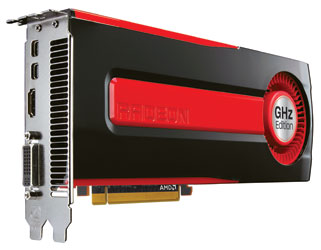
The card itself doesn't look any different from the reference design Radeon HD 7970, right down to its PCB layout, although we expect the SKU to be mostly sold as non-reference design graphics cards by AMD's contingent of add-in board partners. The move by AMD is to minimize development costs for itself, and its partners. AMD's one point agenda with the Radeon HD 7970 GHz Edition is retaking the performance crown from NVIDIA GeForce GTX 680. It is also priced on-par with it. In this review we will find out if AMD succeeds at it, and if so, at what 'cost'.
| GeForce GTX 580 | Radeon HD 7950 | GeForce GTX 670 | Radeon HD 7970 | HD 7970 GHz Edition | GeForce GTX 680 | Radeon HD 6990 | GeForce GTX 590 | GeForce GTX 690 | ||
|---|---|---|---|---|---|---|---|---|---|---|
| Shader Units | 512 | 1792 | 1344 | 2048 | 2048 | 1536 | 2x 1536 | 2x 512 | 2x 1536 | |
| ROPs | 48 | 32 | 32 | 32 | 32 | 32 | 2x 32 | 2x 48 | 2x 32 | |
| Graphics Processor | GF110 | Tahiti | GK104 | Tahiti | Tahiti | GK104 | 2x Cayman | 2x GF110 | 2x GK104 | |
| Transistors | 3000M | 4310M | 3500M | 4310M | 4310M | 3500M | 2x 2640M | 2x 3000M | 2x 3500M | |
| Memory Size | 1536 MB | 3072 MB | 2048 MB | 3072 MB | 3072 MB | 2048 MB | 2x 2048 MB | 2x 1536 MB | 2x 2048 MB | |
| Memory Bus Width | 384 bit | 384 bit | 256 bit | 384 bit | 384 bit | 256 bit | 2x 256 bit | 2x 384 bit | 2x 256 bit | |
| Core Clock | 772 MHz | 800 MHz | 915 MHz+ | 925 MHz | 1050 MHz | 1006 MHz+ | 830 MHz | 607 MHz | 915 MHz+ | |
| Memory Clock | 1002 MHz | 1250 MHz | 1502 MHz | 1375 MHz | 1500 MHz | 1502 MHz | 1250 MHz | 855 MHz | 1502 MHz | |
| Price | $380 | $380 | $400 | $450 | $500 | $500 | $700 | $750 | $999 |
Apr 28th, 2024 07:11 EDT
change timezone
Latest GPU Drivers
New Forum Posts
- Ryzen Owners Zen Garden (7259)
- DeepCool factory tour - very interesting (0)
- Which air cooler for a ryzen 9 5900x (175)
- On ACER V3-772G GDDR5 laptop no display (9)
- Which PSU to take? (11)
- Does a faster NVMe make any difference? (8)
- Does charging protection matter? (7)
- Core PL1 + GPU PL1 + Ring EDP OTHER (14)
- Would I be able to put that rx 6600 in my build? (1)
- Arctic P14 MAX fans (4)
Popular Reviews
- Ugreen NASync DXP4800 Plus Review
- HYTE THICC Q60 240 mm AIO Review
- Upcoming Hardware Launches 2023 (Updated Feb 2024)
- MOONDROP x Crinacle DUSK In-Ear Monitors Review - The Last 5%
- Thermalright Phantom Spirit 120 EVO Review
- AMD Ryzen 7 7800X3D Review - The Best Gaming CPU
- FiiO K19 Desktop DAC/Headphone Amplifier Review
- ASUS Radeon RX 7900 GRE TUF OC Review
- Alienware Pro Wireless Gaming Keyboard Review
- Intel Core i9-14900KS Review - The Last of its Kind
Controversial News Posts
- Windows 11 Now Officially Adware as Microsoft Embeds Ads in the Start Menu (139)
- Sony PlayStation 5 Pro Specifications Confirmed, Console Arrives Before Holidays (117)
- NVIDIA Points Intel Raptor Lake CPU Users to Get Help from Intel Amid System Instability Issues (106)
- AMD "Strix Halo" Zen 5 Mobile Processor Pictured: Chiplet-based, Uses 256-bit LPDDR5X (103)
- US Government Wants Nuclear Plants to Offload AI Data Center Expansion (98)
- AMD's RDNA 4 GPUs Could Stick with 18 Gbps GDDR6 Memory (95)
- Developers of Outpost Infinity Siege Recommend Underclocking i9-13900K and i9-14900K for Stability on Machines with RTX 4090 (85)
- Windows 10 Security Updates to Cost $61 After 2025, $427 by 2028 (84)