Friday, December 22nd 2023
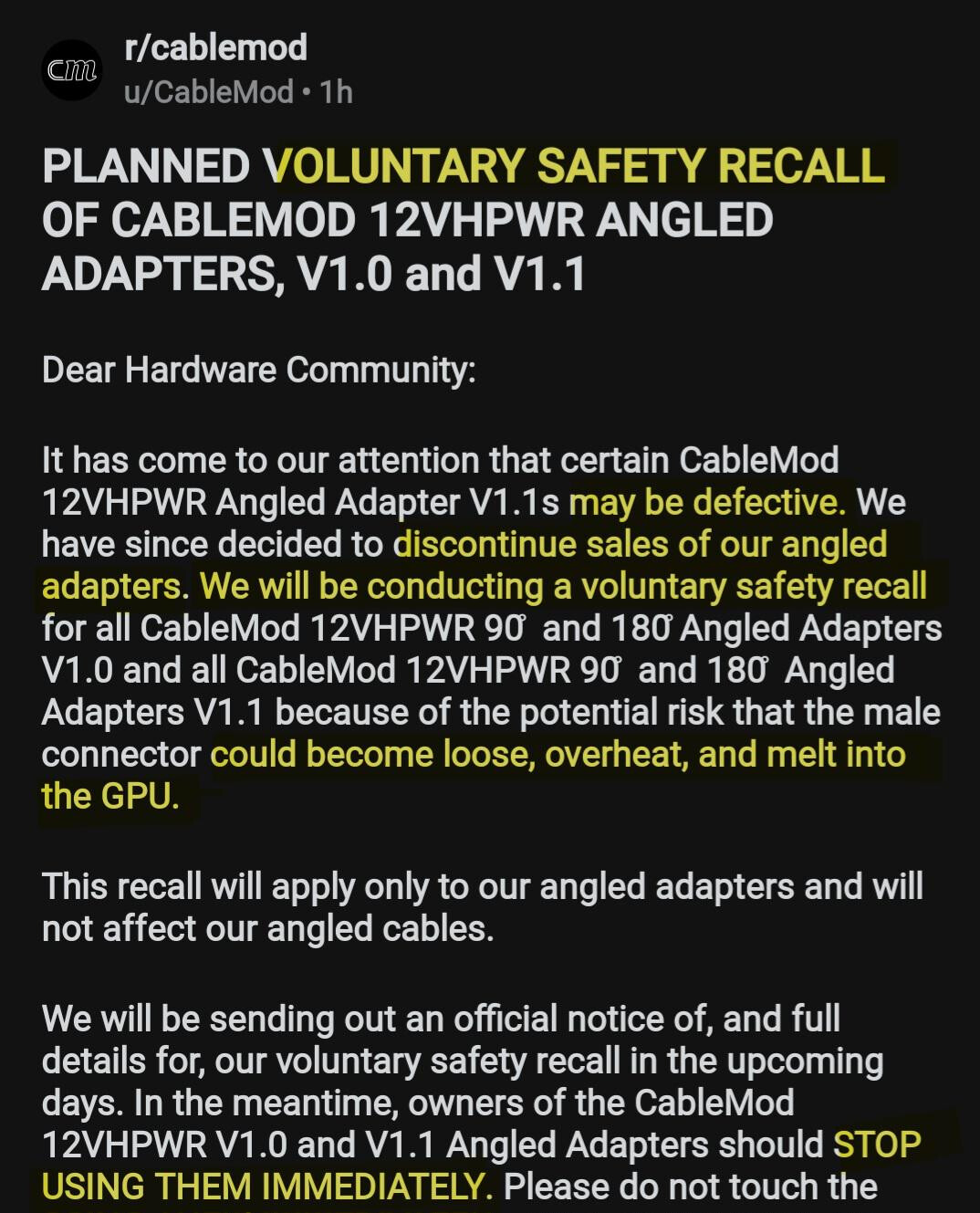
CableMod Recalls 12VHPWR v1.0 and v1.1 Angled Adapters
CableMod issued a safety recall of its 16-pin 12VHPWR angled adapters, versions 1.0 and 1.1. The company cites safety issues behind the recall. This includes both the company's 90° angled, and 180° hard connectors. The company observed that the contact points in the male connector is improper, causing it to overheat and melt into the GPU. The safety issue only affects CableMod's hard adapters, and not its angled cables. Owners of these cables are advised to stop using the adapters immediately, and contact CableMod to be part of the recall, and further service recovery options.
47 Comments on CableMod Recalls 12VHPWR v1.0 and v1.1 Angled Adapters
In addition there was and still is a lack of education in regards to the new cable. It's very likely that people who don't constantly follow tech news will go ahead and bend their 12V2X6 and 12VHPWR cable because that was completely fine with the 8-pin and 6-pin connectors. Nvidia and board partners haven't lifted a finger to inform the boarder public about that either. Even for enthusiasts, many were still shafted because there was no attempt to communicate the difficulty of fully seating the connector nor the length requirements prior to purchase. In fact I even pulled out my 4080's box and the documentation makes zero mention of properly seating the cable or the straight length requirements coming out of the cable. There was no campaign by Nvidia to make customers aware of this fact prior to their purchase. Enthusiasts only found out after people's video cards were burning up and in essence the only way someone finds out to this day is word of mouth or they are an enthusiast. Either way it's beyond negligent. You cannot pin this on customers, it was and still is an ongoing failure on multiple fronts.
Either you are implying that they were grossly incompetent and didn't perform said testing with prior gen cables (hard to imagine given that partial terminations are not new) or that they performed routine testing, the same of which they did for the 12VHPWR cable which still had issues despite that testing. By extension said routine testing doesn't vindicate this new cable because as clearly evidences, it's not a 100% guarantee there will be no issue.It remains to be seen whether or not this new connector still requires a significant length of the cable to be straight without a bend. They changed the pin design but I've seen no guidance that states the cables no longer need to heed prior bending issues. Given the lack of communication on the subject in general, most likely customers will find out through personal experience. Who knows, maybe it will push back the issues from burning up on launch to burning up in 2-3 years, perfectly out of warranty and ready to force you to upgrade.
And yes, I most certainly am implying that PCI/ATX standards team totally failed to do their job first time around on the 12VHPWR plug. They probably just took the plug manufacturer's word for it.
Found it - www.techpowerup.com/314066/the-12v-2x6-connectors-appear-to-handle-full-load-while-partially-inserted
They have not to my knowledge changed the 35mm guidance for not bending the wires as they exit the connector. They did the same tests you're referring to for the first revision and still said "ship it" lol. Lots of people tested the first connector and had no issues. That anecdotal evidence was clearly not good enough. The people who developed it didn't test it as it's actually used. It looks good in CAD, the math works on paper, and if it is manufactured perfectly and installed perfectly, no problem. The real world unfortunately doesn't work like that. The molding tolerances on these are terrible (otherwise the whole unseated issue would have never even happened), the gpu designs mostly don't accommodate the location of the connector for any non-huge case so most owners have to bend the wires immediately, the ones that recessed the connector made it so you can't see if it's seated properly, and if you pull it or put lateral strain on it, it's likely to not seat correctly.
But hey, who am I to say... Oh... Right... An electrical engineer that actually designs circuits, PCBs, power systems, and specifies connectors for my designs as a key part of my job... And thats the ~12 years of design engineering after I did safety testing on electronics (including over-current testing)... Yeah, I probably have no idea what I'm talking about. It's probably perfect. My bad.
Here are three examples of better options they could have gone with that aren't even custom without doing an exhaustive search:
1. Samtec power blades with metal latches on the sides:
They could get these in 8-10 pin versions that are right-angle to the PCB (which is how the current connectors are), which use cables that default at 16AWG. I'd personally be fine with having a separate smaller connector that does the sense lines if we need to entertain adaptors and all that jazz. These are 18A per pin. If you split that across the 12V and GND pins, you can drive 72A at 12V = 864W on one connector. You need more for a HOF or KP style card? use two connectors. The side latches keep the connector from wiggling and twisting and the board connector has solder tabs that keep it from twisting on the board.
2. Harwin 3mm pitch connectors.
These don't come in R/A connectors, but they're actually pretty small and come in 10-pin versions, 10A/pin. So if 5 12V and 5 GND gives you 50A, at 12V = 600W. They also have jack-screws so the cable connector actually screws to that one with captive screws (that don't fall out). So they could do budget cards with one connector and HOF/KP style boards with 2 connectors and still not take up much space. These are machined round pin connectors and they actually use 18AWG, so you don't even need the super cumbersome 16AWG wires.
3. ITT Cannon Trident Slimline (pages 18-21)
These are a little bigger because they're single-row instead of dual-row. Wouldn't really be ideal for situations where you wanted dual connectors, but you could actually do two straight ones right next to each other fairly easily, it would just mean making a clearance around the BEEFY cooler lol. Part numbers 192991-0538 (right-angle) or 192991-0354 (straight). Both 10-pin connectors, rated 500 cycles, 10A pins, again 600W rated. These have side latches and can be screwed to the PCB.
Do you have a link for their 12VHPWR test?Igor makes no such claim there at all. The only thing said is "The same is true for the spring contacts, even though the last recommendation of the PCI SIG in CEM 5.0 was clearly against the Astron contacts. The NTK design was clearly recommended there. When I know more, I will of course add or update this."
That is saying the spring contacts are now the correct contacts - for both plugs. Which just means that all existing dimple contacts in the 12VHPWR plugs are shit and should be withdrawn.
So, in theory, a newer 12VHPWR cable should have the plug with improved spring contacts too. But, unless a cable/power supply is making a big marketing deal about using the newer spring contacts, one can expect that all recent units on the market are going to be the shitty dimple contacts.
Feel free to go read the ATX 3.1 specs with the updated info on the 12V2x6 connector.
That's obviously out of date.
And my goodness Cablemod should be raked over the coals for this. First they release an adapter promising to prevent your extremely expensive hardware from getting damaged when it in fact does not. Then they release a revised version claiming to have fixed the issue and it STILL happens.
I hope nobody here was unlucky enough to have their card get damaged, especially by one of these adapters.
Yes, that confirms (by yet another source) that the primary change was the adjustment to the length of the pins to have a poor insertion detected earlier...which is exactly what I said above.
Quote from page 22:
You can also read the same info via the link below with ref to the history of the ATX 3.x spec etc.
edc.intel.com/content/www/us/en/design/ipla/software-development-platforms/client/platforms/alder-lake-desktop/atx-version-3-0-multi-rail-desktop-platform-power-supply-design-guide/2.1a/revision-history/
Intel are part of the PCI-SIG consortium and are the main players here within.
PCI-SIG of which Intel is part of developed the 12VHPWR connector on behalf of Nvidia and Dell as they both sponsored it (jongerow.com/12VHPWR/), changes to any of the specs for the ATX standard then gets submitted to the PCI-SIG for the consortium to test / vote on the changes, all companies forward changes to all / any of these specs and are published in the "Review Zone" before they are made final.
pcisig.com/specifications/review-zone
You can find a copy of the PDF files via the link below.
ATX 3 Specs
On another note, where are the RTX 3090 Ti cards with melted connectors ? <<-- Click the link !
All the RTX 3090 Ti cards use the same connector and pull the same wattage as the RTX 4090 does for the most part (450 - 525 watts), the only cards that's different here is the RTX 4090 FE with it's 600 watt max limit.
I was unlucky enough to be affected by this and lost the power connector on my 4090 to a 180° CableMod adapter on the male side, a 1.0 revision. It was fully seated and still melted in. Not easily removed.
It took three months of attempting to get it sorted, for it to finally be sorted and repaired under warranty by ASUS now. Probably getting it back in a few days. Credit where credit is due, CableMod stated they'd offer me a full refund if ASUS refused the RMA (so over $3000 AUD) or if I wasn't comfortable having CableMod have it repaired by sending it off to a third-party in the USA.
Took a long time to get sorted and I'm hardly happy about it but still. Customer service was decent from CableMod.