News Posts matching #232-layer

Return to Keyword Browsing

Micron Delivers the World's Most Advanced Client SSD Featuring 232-Layer NAND Technology

Micron Technology, Inc.,, today announced it is shipping the Micron 2550 NVMe SSD to global PC OEM customers for use in mainstream laptops and desktops. The 2550 is the world's first client SSD to ship using NAND over 200 layers. Delivering performance that eclipses the competition through its density and power advantages, the 2550 provides users with responsiveness and the low power consumption needed to extend battery life for work and home PCs.

"We focused on delivering a superior user experience for PC users with this SSD," said Praveen Vaidyanathan, vice president and general manager of the Client Storage Group at Micron. "The new 2550 SSD builds on our established and broadly adopted PCIe Gen4 architecture. It also incorporates Micron's industry-leading 232-layer NAND and focuses on thermal architecture and power design. These capabilities deliver impressive application performance and phenomenal power savings."


Chinese YMTC Achieves Mass-production of 232-layer 3D NAND, Beating Kioxia, Micron, Samsung, and SK Hynix

YMTC delivered on its roadmaps to achieve a mass-production 232-layer 3D NAND flash memory, beating entrenched players Kioxia, Micron Technology, Samsung Electronics, and SK Hynix, to the production 200+ layer feat. The Chinese memory and NAND flash giant announced this memory back in August 2022 as the YMTC X3-9070, along with its new Xtacking 3.0 architecture—a proprietary method by which the company can reliably stack a large number of NAND flash layers. Micron Technology is ready with a 232-layer 3D NAND flash of its own, although it hasn't hit a production ramp, yet. This is an incredible feat considering that YMTC only got into this business in 2016, compared to the other players that each have over two decades of market presence.

YMTC's ramp to 232-layer closely follows its unexpected 2020 feat of a production-grade 128-layer 3D NAND, which was groundbreaking enough to win a supply contract with Apple, before losing it in October 2022, due to political reasons (not technological reasons). The Xtacking 3.0 architecture involves back side source connect (BSSC) for the memory cell wafer, which leads to simpler process and lower cost compared to Xtacking 2.0 (up to 128-layers, which had introduced nickel silicide (NiSi) instead of tungsten silicide (WSi) for better device performance and I/O speed for CMOS wafer. The original Xtacking architecture from YMTC, which it debuted back in 2016, with layer counts going up to 64-layer, relied on cost-effective wafer-to-wafer bonding. The YMTC 232-layer 3D NAND flash should find plenty of takers in the consumer electronics industry, spanning smartphones, consumer storage devices, TVs, and other appliances. The high layer-count has a direct impact on density, which can help designers lower costs by using fewer chips, or increase capacity.

Micron and Kioxia are Cutting Back on DRAM and NAND Manufacturing Volumes

According to a TrendForce investigations, memory pricing began to decline from 4Q21 due to weakening demand for certain consumer electronics. Coupled with the impact of rising inflation, the Russian-Ukrainian war, and pandemic policies, demand in peak season was weak, resulting in inventory pressure that has extended from the buyer side to manufacturers. In response to the aforementioned situation, Micron announced last week that it would cut production of DRAM and NAND Flash, becoming the first major memory manufacturer to officially reduce its capacity utilization plan. In terms of NAND Flash, the market situation is more severe than that of DRAM. As the average contract price of mainstream capacity wafers has fallen to their cash cost and is approaching the periphery of selling at a loss for various manufacturers, Kioxia also announced that it will reduce NAND Flash capacity utilization by 30% from October on the heels of Micron's announcement.

In terms of DRAM, current contract pricing remains higher than the total production cost of various mainstream suppliers. Therefore, compared with NAND Flash, it remains to be seen whether there will be a significant reduction in production. In addition to mentioning the slight reduction in capacity utilization in this sector currently, Micron mainly emphasized its sharp downward revision of capital expenditures in 2023 and that the annual growth of DRAM production bits next year will only be around 5%. TrendForce believes, according to Micron, to actualize such conservative bit growth means that there is still room for a significant downward revision in capacity utilization and the extent to which Micron's subsequent production reductions are implemented remains to be seen.

Not All First Generation PCIe 5.0 SSDs Will Offer the Same Performance

The first batch of PCIe 5.0 SSDs are all likely to be based on Phison's PS5026-E26 controller, which offers eight NAND channels, capable of supporting NAND speeds of up to 2400 MT/s. Phison's own figures for the controller are 13 GB/s writes and 12 GB/s reads, with up to 1.5 million random read IOPS and 2 million random write IOPS. However, as we've already seen from various SSD brands, many PCIe 5.0 SSDs won't exceed 10 GB/s when it comes to the sequential read/write speeds. This is because the current NAND flash simply isn't fast enough to saturate the PCIe 5.0 bus, which is capable of 15.75 GB/s. That said, Micron's 232-layer 3D NAND should be able to boost the performance up to 12.4 GB/s based on the numbers Gigabyte announced for their Aorus Gen 10000 SSD.

Based on an article over at Tom's Hardware, we shouldn't expect too many drives that exceed 10 GB/s sequential writes at launch, due to most drives using 176-layer 3D NAND flash, that is limited to 1600 MT/s. As such, it might be wise to hold off on buying the first generation of PCIe 5.0 drives and wait for better availability of 232-layer 3D NAND, as beyond Micron, SK Hynix is expected to have a 238-layer 3D NAND flash in the market sometime in the first half of 2023. If you're not really eager to have the fastest SSD out there for pure bragging rights, it would seem that mid 2023 might be the right time to get a PCIe 5.0 SSD.

AMD Ryzen 7000 Series Processor Runs Phison PCIe 5.0 SSD with Micron 232-Layer NAND Flash

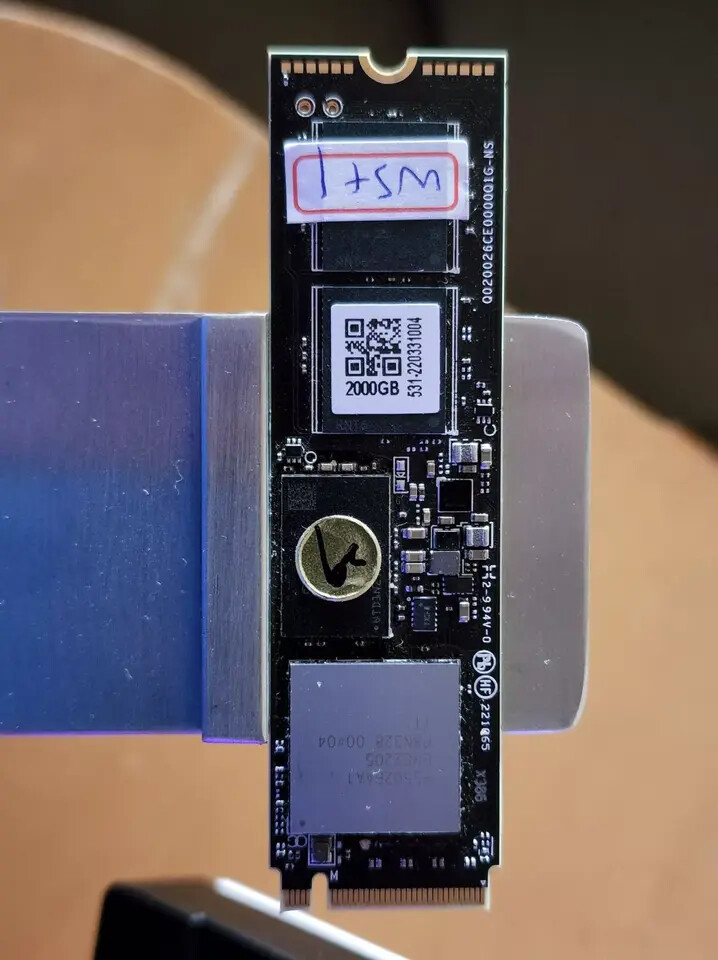
During this year's Flash Memory Summit, Phison, a company known for SSD controllers and now flash drives, demonstrated a system running AMD Ryzen 7000 series processors based on Zen 4 architecture. What is interesting about the shown specification is that the system was running an engineering sample of an upcoming Zen 4-based CPU with the latest storage technologies at impressive speeds. Using a Phison PS5026-E26 SSD controller, also called E26, the PCIe 5.0 SSD is powered by Micron's latest 232-layer TLC NAND flash. This new NAND technology will also bring greater densities to the market by promising higher endurance, higher read/write speeds, and better efficiency.

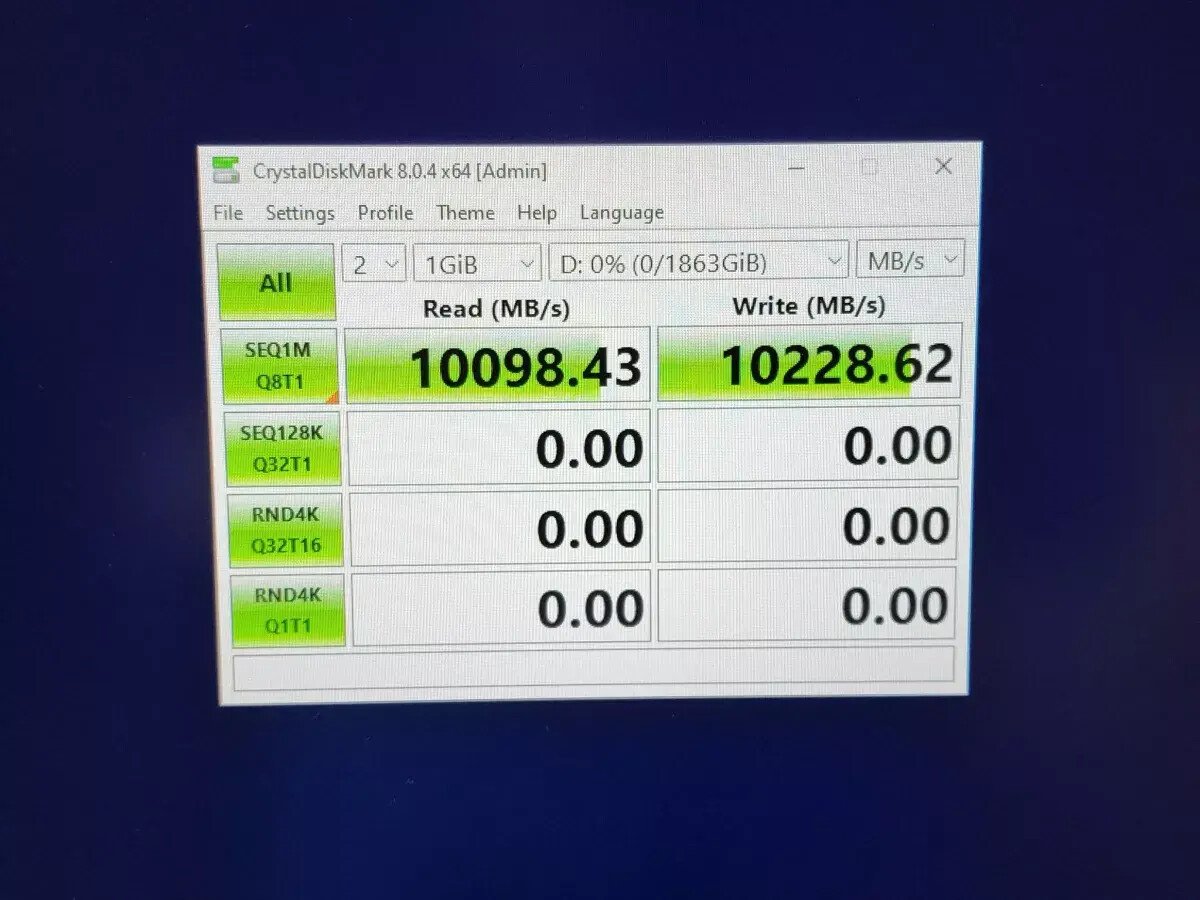
With AMD's upcoming AM5 platform, support for PCIe 5.0 SSDs is a welcome addition. And we today have some preliminary tests that show just how fast these SSDs can run. In CrystalDiskMark 8.0.4, it achieved over 10 GB/s in both read and write. We know that the E26 controller is capable of 12 GB/s speeds, so more fine-tuning is needed. Being an early sample, we expect final specifications to be better. The system is powered by an engineering sample of a six-core, twelve-threaded Zen 4 CPU running at unknown clocks, codenamed 100-000000593-20_Y. We can expect to see more of this technology once AMD's AM5 platform lands and Phison-powered SSDs hit the shelves in September.

Micron Ships World's First 232-Layer NAND, Extends Technology Leadership

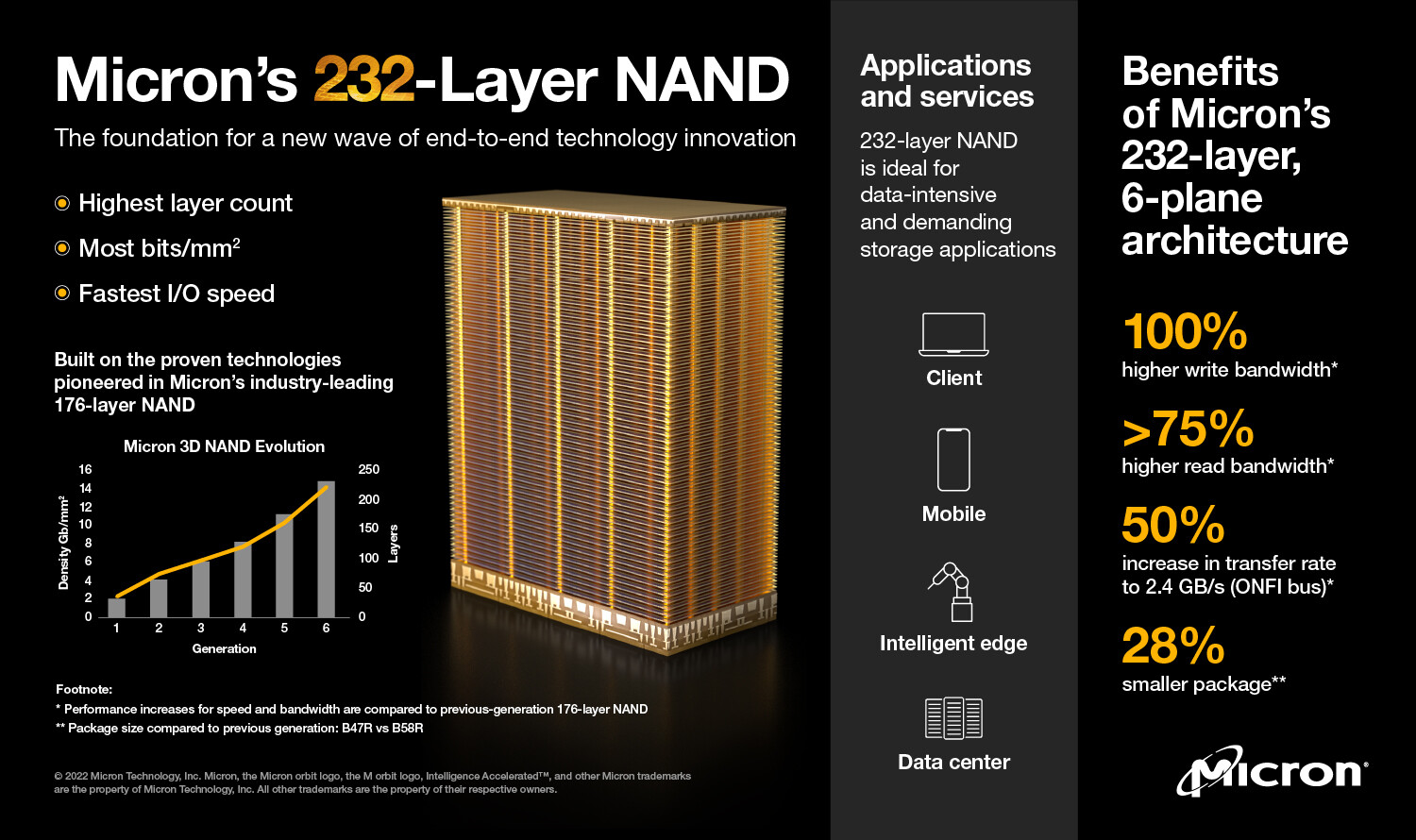
Micron Technology, Inc., today announced that it has begun volume production of the world's first 232-layer NAND, built with industry-leading innovations to drive unprecedented performance for storage solutions. It features the industry's highest areal density and delivers higher capacity and improved energy efficiency over previous generations of Micron NAND, to enable best-in-class support of the most data-intensive use cases from client to cloud.

"Micron's 232-layer NAND is a watershed moment for storage innovation as first proof of the capability to scale 3D NAND to more than 200 layers in production," said Scott DeBoer, executive vice president of technology and products at Micron. "This groundbreaking technology required extensive innovation, including advanced process capabilities to create high aspect ratio structures, novel materials advancements and leading-edge design enhancements that build on our market-leading 176-layer NAND technology."
Return to Keyword Browsing
Nov 21st, 2026 14:04 PST change timezone

New Forum Posts

Popular Reviews

TPU on YouTube

Controversial News Posts