News Posts matching #365

Return to Keyword Browsing

Microsoft 365 Cuts Family OneDrive Storage from 6 TB to 2 TB

Microsoft has updated its Microsoft 365 Family and Premium subscriptions to reduce the overall storage pool. Previously, these subscription tiers allowed one buyer to share a subscription with five additional family members, totaling six people using the service. Each person received 1 TB of OneDrive storage to use as they wished, resulting in a total of 6 TB of storage from a single subscription. However, Microsoft is now reducing this capacity to a total of 2 TB of OneDrive storage, shared among the six individuals.

Microsoft notes that the shared storage capacity now applies to the entire subscription rather than being assigned individually. This means your storage capacity isn't fixed and could affect others if you decide to store large files. It's important to note that all personal files, photos, and documents remain private by default, even with the shared storage system. However, your guaranteed capacity will depend on other members, as you all share the same storage pool. If you purchase additional storage capacity with OneDrive, it will be added to the shared pool that everyone can access. Realistically, if one person uploads large files, the others may be left with limited storage in their subscription.

Microsoft CEO Satya Nadella Calls Updated Copilot a "New OS for Work"

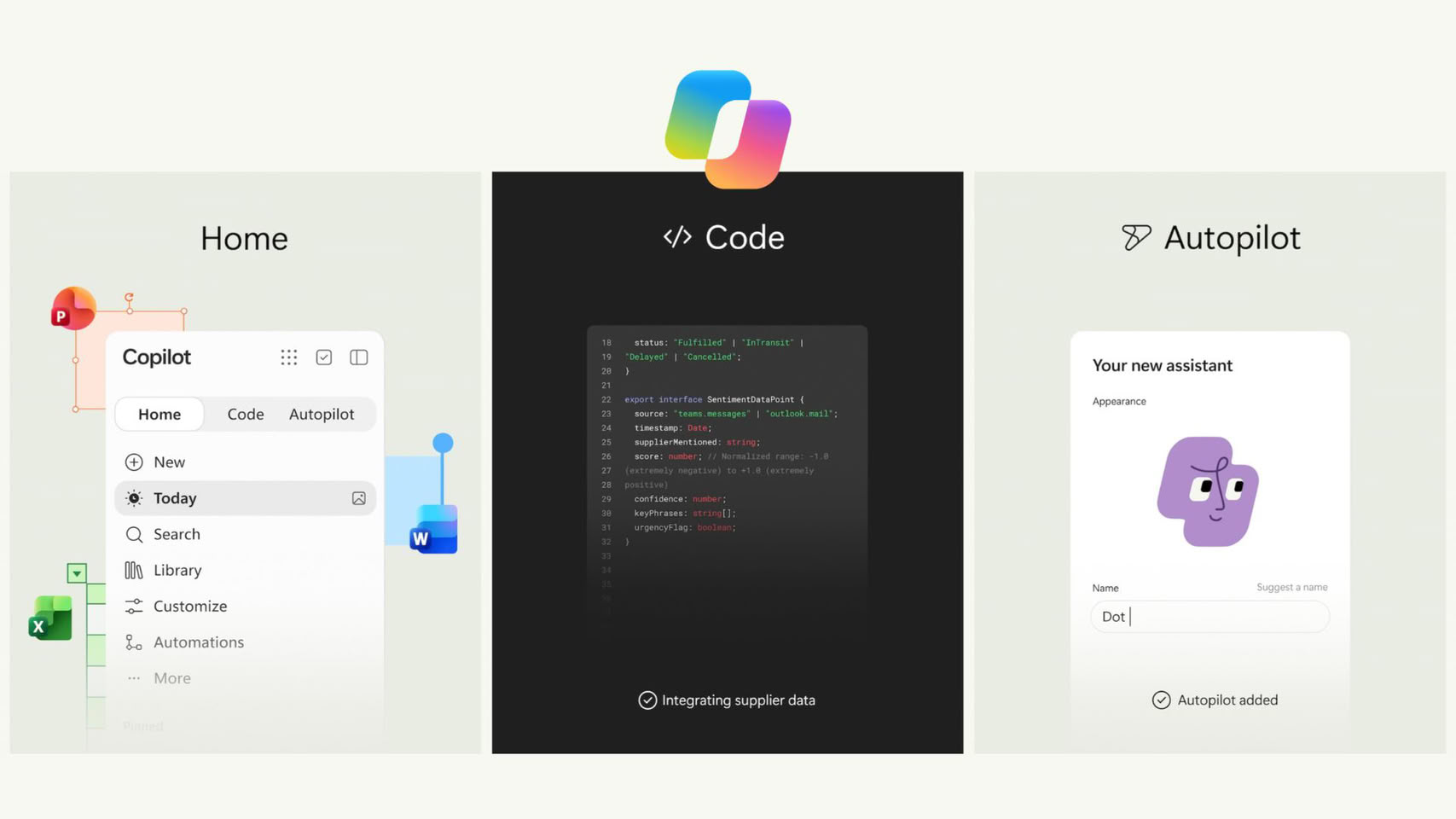
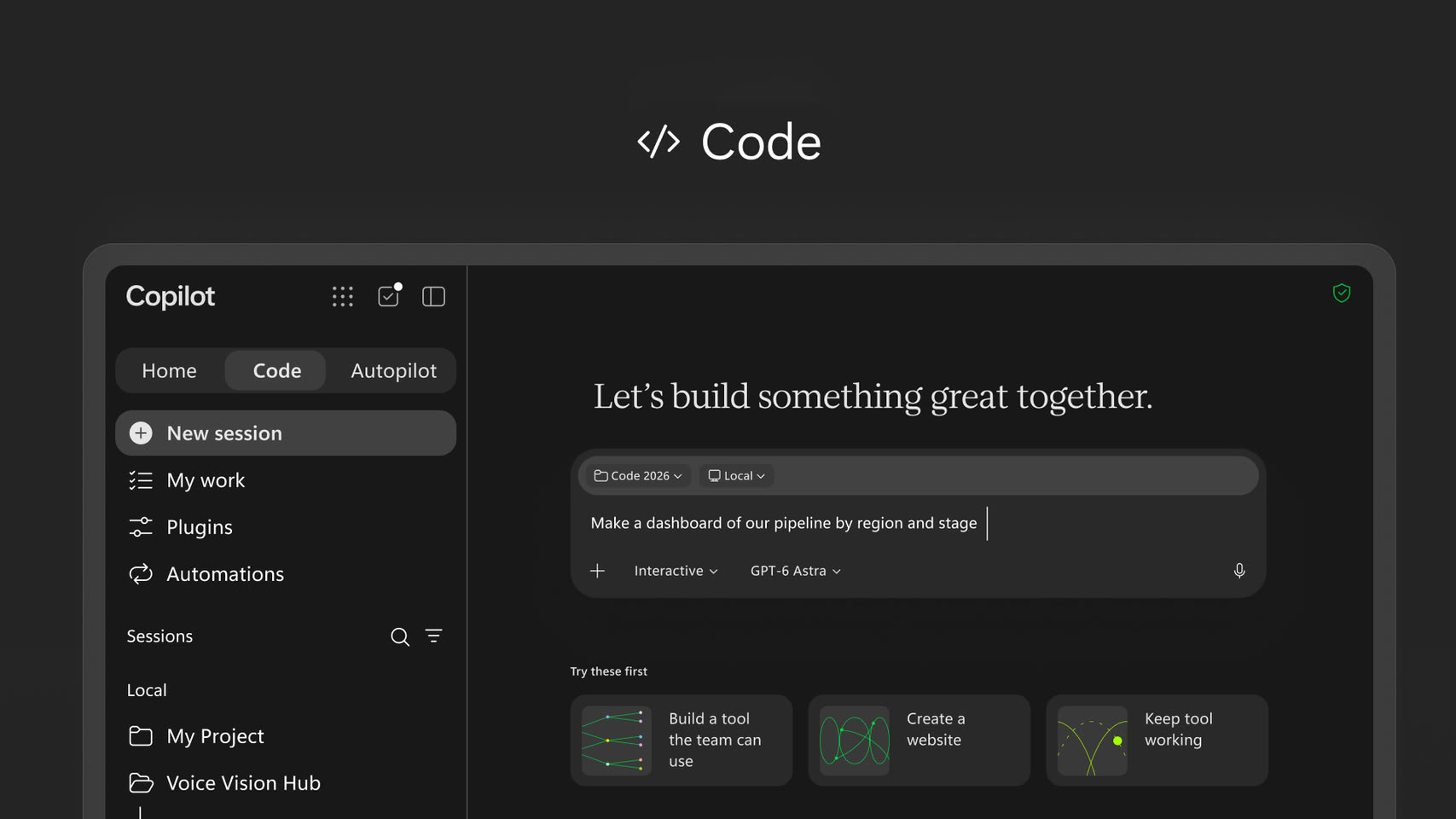
Microsoft CEO Satya Nadella has laid out his most direct pitch yet for what Copilot is supposed to become, calling it a "new OS for work that spans every model, every form factor, and every task." The comment came alongside Microsoft's biggest Copilot overhaul to date, which merges four pieces into one app: Autopilot (a long-running enterprise agent), Code (an in-app builder that hosts apps inside a company's own tenant), Home (which combines Chat and Cowork), and Office, with Word, Excel, and PowerPoint now built directly into Copilot. Nadella also mentioned Copilot support inside Teams, plus a new feature called Today that pulls relevant information from across Microsoft 365 without the user having to ask.

It looks like Microsoft wants Copilot to work more like a proactive layer sitting across a person's entire workday instead of a chat window they open on demand (or by accident). Interestingly, Microsoft avoided calling Copilot part of the Windows 11 operating system this time, a year after its "agentic OS" framing for Windows drew a fairly rough reception from users. This is not even the first time Microsoft has thought about expanding Copilot in this way. Microsoft did explore a full Copilot-centered operating system internally, under the codename Project Aion, though that reportedly dates back to 2024 and there's no word on whether it's still active.

Microsoft 365 Companion Apps Are Getting Retired

Back in early 2025, Microsoft added three new "companion" applications to its Microsoft 365 suite—Calendar, People, and Files. These were designed to provide quick access to people, files, and calendar events directly from the Windows 11 taskbar. However, it seems that Microsoft 365 customers did not find them particularly useful, and Microsoft plans to retire them on December 16, 2026. This is one of Microsoft's examples of short-lived mini applications. These mini applications pulled data from Microsoft 365 applications to generate quick insights about a person, a file, or a calendar event. Existing only as a WebView2 wrapper, they added an unnecessary layer of applications.

For Microsoft 365 users, previously known as Office suite users, the company actively tried to install these applications automatically on many PCs. After the forced installation, the company even pinned these applications to the taskbar. Although Microsoft confirmed it would automatically install these companion apps, administrators had the option to opt out. However, regular users had to manage them continuously. Interestingly, after the December 16 deadline, Microsoft confirmed that these applications would stop working, but users would need to remove them manually. Essentially, after forcing users to install these applications, Microsoft is leaving them to handle the cleanup themselves.

Piston V Touchscreen Bazzite Mini PC Launches on Kickstarter With $799 MSRP

In early August, the Piston V appeared online, shrouded in mystery, but ran the gauntlet in a video by ETA Prime. Now, the Piston V has officially launched on Kickstarter at a surprisingly early bird price. The Kickstarter campaign also fully reveals the mini PC's specs and bundled accessories. The Piston V launched on Kickstarter with a super early bird price of $559, and, at the time of writing, is available starting at $590. However, the post-Kickstarter MSRP is expected to be around $799. The creators of the mini PC and its crowdfunding campaign tout the device as a hybrid mini PC and game console "in a gadget form factor," with the Bazzite/Windows dual-boot and a 4-inch touchscreen on the front adding to the HTPC experience.

As was shown in the pre-launch hands-video, the mini PC will feature the AMD Ryzen AI 9 365 APU with its built-in AMD Radeon 880M iGPU, which should deliver reasonable performance for most non-AAA games. All models available in the Kickstarter come with 16 GB of DDR5-5600 memory and a 500 GB PCIe Gen 4×4 M.2 SSD, but the specs are upgradeable 24, 32, 48, or 64 GB of memory and up to 4 TB of SSD storage. One thing that wasn't mentioned in the original hands-on was the presence of an OCuLink port for eGPU support.

Microsoft Unifies Copilot Features Into a Super App

Microsoft is finally scaling back on creating numerous Copilot variants for every use case and is instead consolidating many Copilot buttons, icons, and functions into the main Copilot app. According to the latest support document update, Microsoft is rolling out a unified Copilot experience to create a Copilot "super application," bringing all the functionality that was previously spread across the operating system under one roof. These features include Deep Research, Group Chat, and Podcasts. The Deep Research functionality is being retired for consumers, but existing content will remain available. The same applies to Podcasts and Group Chat, which will be fully retired starting August 18.

Microsoft notes that the updated Copilot application is introducing a fresh look, with the ability to access Word, Excel, Outlook, and many other Microsoft 365 services and apps directly from the Copilot super app. Users who were using Copilot functionality across the operating system that is being retired will now find everything under one roof, with chat history and the majority of content being moved to the new home. The migration will include chats, images, and any type of content that has been created with Copilot.

Microsoft Will Again Force-Install Microsoft 365 Copilot App on Windows 11

If readers recall, earlier this year in mid-March, Microsoft stopped automatically installing its Microsoft 365 Copilot App on Windows 11 by default. Instead, the company decided to leave this option to users, which makes sense considering it is their operating system. However, Microsoft is now reversing this decision after only a few months, once again requiring the installation of the Microsoft 365 Copilot application on Windows 11 systems. For those familiar with the regular Copilot application, Microsoft 365 Copilot is the rebranded version of what was originally called Microsoft 365 / Office Hub. This app was introduced alongside the regular Copilot app on Windows 11 systems, offering AI-enhanced Microsoft 365 services.

In a recent note on the Microsoft Admin Portal, the company states that users will have to opt out if they don't want the Microsoft 365 Copilot App installed by default on their system. This means users might end up installing the app without their consent, even if they don't want it on their systems. To remove it, users must do so manually or opt out of the installation, which involves additional steps, particularly for IT admins managing an organization's infrastructure. The company now states, "This change simplifies access to Copilot and ensures users can easily discover and engage with productivity-enhancing features."

Microsoft Won't Auto-Install Microsoft 365 Copilot App on Windows 11 Anymore After Backlash

Microsoft has reportedly decided not to automatically install its Microsoft 365 Copilot App on Windows 11 by default, following significant user backlash against its AI integration into the operating system. What seemed to be a major initiative by the Redmond giant is now being reined in by a group of power users and enthusiasts who are resisting the "Copilot everywhere" strategy that Microsoft has recently promoted. According to a new update on the Admin 365 dashboard, Microsoft states, "Automatic installation of the Microsoft 365 Copilot app on Windows devices with Microsoft 365 desktop apps, planned for December 2025, is temporarily disabled. Existing installations remain unaffected. Admins can deploy the app via other methods and should await further updates."

For those who may not remember, the Microsoft 365 Copilot App is the rebranded version of what was originally called Microsoft 365 / Office Hub. This app version was introduced alongside the regular Copilot app on customers' Windows 11 systems. Back in September 2025, Microsoft planned to automatically install the Microsoft 365 Copilot App on Windows 11, along with the regular Copilot App, which meant users would receive two "AI-enhanced" applications automatically. This move sparked a significant backlash from the community, particularly from enthusiasts who saw little to no added value in Microsoft's AI integrations. Users made it clear that they wanted this enhancement to be optional, if not stopped altogether. Microsoft has recently commented that the company is focusing on what truly matters to consumers, such as fixing the bug-prone operating system and enhancing core features for a smoother user experience in Windows 11. They also mentioned stepping back from the "AI-everywhere" approach.

Windows 11 25H2 and 24H2 October Update Triggers BitLocker Recovery

Microsoft has encountered another unusual issue, this time mostly affecting Intel-based PCs. Users of Windows 11 versions 25H2 and 24H2, as well as some Windows 10 users, may unexpectedly find themselves in BitLocker recovery mode. Typically, BitLocker should not request the recovery key unless there have been changes to the system configuration. However, due to a new bug, users are being prompted to enter their recovery keys without any such changes. BitLocker encrypts the entire drive volume using AES encryption by default, ensuring the drive's security even if it is stolen, lost, or improperly decommissioned. "After installing Windows Updates released on or after October 14, 2025 (the Originating KBs listed above), some devices might encounter issues during restart or startup," notes Microsoft document for Microsoft 365 Business and Windows 11 Enterprise licensees.

From a portal not accessible to us (thanks to Windows Latest for images), it seems that Windows 11 25H2 with KB5066835 and Windows 11 version 24H2 with the same KB number are affected. Windows 10 version 22H2 is also impacted, with the originating ID KB5066791. The interesting part is the source of this issue. Since the launch of Windows 8, the Windows OS has included a Connected Standby feature. This power-saving feature allows the PC to stay connected to the network, receiving notifications and streaming music even while in standby mode. It was originally designed to extend battery life on laptops by maintaining a low-power state instead of draining the battery.

Microsoft Azure Goes Down and Takes Xbox and 365 With It

Microsoft Azure is experiencing its first major outage in a while. Around 16:00 UTC, the Azure cloud platform encountered issues that have disrupted numerous Microsoft services and some third-party companies relying on Azure. Affected Microsoft services include the entire Xbox platform, Minecraft, and the Microsoft 365 suite, which encompasses web-based Teams, Word, Excel, PowerPoint, Outlook, OneNote, Defender, OneDrive, Designer, Clipchamp, and SharePoint. These services have faced outages, causing some to become completely unavailable. As of our latest testing, Microsoft has restored the 365 services, with only third-party services using Azure Networking infrastructure still experiencing downtime.
MicrosoftStarting at approximately 16:00 UTC, we began experiencing Azure Front Door (AFD) issues resulting in a loss of availability of some services. We suspect that an inadvertent configuration change as the trigger event for this issue. We are taking several concurrent actions: Firstly, where we are blocking all changes to the AFD services, this includes customer configuration changes as well. At the same time, we are rolling back our AFD configuration to our last known good state. As we rollback we want to ensure that the problematic configuration doesn't re-initiate upon recovery... We do not have an ETA for when the rollback will be completed, but we will update this communication within 30 minutes or when we have an update. This message was last updated at 17:40 UTC on 29 October 2025

Microsoft Redesigns Microsoft 365 Icons With Brighter, Fluid Visuals

Microsoft has officially unveiled a redesigned icon pack for its core Office apps, which are found within the Microsoft 365 service. The 10 primary application marks now sport brighter colors, a more playful tone, and softer contours inspired by the company's Copilot emblem. This is the first large-scale update since 2018, and it will be available on web, desktop, and mobile platforms in the coming weeks. The 10 core apps include Teams, Word, Excel, PowerPoint, Outlook, OneNote, Defender, OneDrive, Designer, and Clipchamp. All 10 of these core applications now have redesigned icons following fluid forms and vibrant colors. On the surface, these are visual changes, yet the company frames them as a sign of context-aware tools that blend AI assistance with human intent.

Under the new look, the icons move away from blocky solidity and toward folded, curved forms that suggest motion and approachability. Designers simplified details to keep each mark clear at small sizes. For example, Word now shows three horizontal bars instead of four to improve legibility. The palettes are richer, featuring exaggerated analogous gradients designed to enhance contrast across various displays and support accessibility. Letter plates remain where brand recognition matters, but proportions, texture, and spacing were modernized, so the icons feel cohesive with Copilot and recent Microsoft products. For most people, the change will be a visual refresh, brighter, simpler tiles appearing across their devices, but Microsoft says the icons are intended to reflect a larger evolution in product making where interfaces and AI work together to help people reach their desired outcomes faster.

Microsoft to Force-Install Copilot on Most Windows PCs This October

Microsoft will force-install the Microsoft 365 Copilot app on Windows PCs that already have Microsoft 365 desktop applications, the company said, with a phased rollout beginning in October 2025 and expected to finish by mid-November. The installation will be applied globally outside the European Economic Area and the Copilot app will be added to the Start menu and enabled by default, though visibility may vary depending on an individual system's configuration. Microsoft advised IT administrators to prepare support teams and notify users ahead of the change to reduce confusion and help desk volume. Organizations can prevent automatic installation by changing the setting in the Microsoft 365 Apps admin center under Device Configuration, but most personal users who manage their own machines will lack a straightforward opt-out pathway.

Admins can disable the automatic installation setting in the Apps admin center to preserve existing deployment policies and image configurations immediately available. The forced-installation move is Microsoft's way of forcing its own AI solution across its productivity suite, following recent integrations of Copilot features into Edge and subscription tiers that expanded access to paid AI tools. Centralizing Copilot could lower the barrier to entry for users who could need prompt-driven assistance inside Word, Excel, and PowerPoint, potentially speeding up repetitive tasks. For those opposed, practical solutions include removing the app post-installation, altering startup behavior, or avoiding Microsoft 365 services, though each option has trade-offs.

Microsoft Releases FY25 Q4 Earnings Report

Microsoft Corp. today announced the following results for the quarter ended June 30, 2025, as compared to the corresponding period of last fiscal year:
  • Revenue was $76.4 billion and increased 18% (up 17% in constant currency)
  • Operating income was $34.3 billion and increased 23% (up 22% in constant currency)
  • Net income was $27.2 billion and increased 24% (up 22% in constant currency)
  • Diluted earnings per share was $3.65 and increased 24% (up 22% in constant currency)
"Cloud and AI is the driving force of business transformation across every industry and sector," said Satya Nadella, chairman and chief executive officer of Microsoft. "We're innovating across the tech stack to help customers adapt and grow in this new era, and this year, Azure surpassed $75 billion in revenue, up 34 percent, driven by growth across all workloads."

AMD Releases Ryzen AI H 300 Processor Series as Chinese Exclusive

Navigating AMD's various modern processor model naming schemes is tricky business, and another layer of complexity has been added this week; with newly revealed "Strix Point" and "Krackan Point" CPUs. Three previously unannounced SKUs have appeared on AMD's Chinese website: Ryzen AI 9 H 365, Ryzen AI 7 H 350, and Ryzen AI 5 H 340. At first glance, these models codes seem to be familiar—after a double take, we see a small difference in nomenclature. The addition of a middle-placed/detached "H" has press outlets and hardware enthusiasts scratching their collective heads. After discovering Team Red's Ryzen AI 9 H 365 APU listing, Lonely City Hardware posted a humorous observation on social media: "for the Chinese market. No one can remember the full name."

Frustratingly, Western search engines (at the time of writing) just point you to the non-H equivalents. The "H" designation denotes Chinese market exclusivity; TechPowerUp has covered previous-generation examples in the recent past. When comparing technical details and specification sheets to Western equivalents, VideoCardz noted that there were no apparent differences—platform and packaging are the same (FP8). A cross-reference—of clock speeds, thermal ratings, and core architecture (Zen 5/Zen 5C)—points to spec parity across East and West variants.

Microsoft Announces Copilot Pro AI Assistant for Office Suite, Coming as a Subscription

Today, Microsoft launched Copilot Pro, bringing its AI-powered productivity features to mainstream consumers. Available as a $20 per month add-on to Microsoft 365 Personal or Home subscriptions, Copilot Pro injects AI directly into Office apps to help users write faster and work smarter. The key features include AI-generated text suggestions and summaries in Word, automated data analysis and graph creation in Excel, and even entire PowerPoint presentation generation from a text prompt. Copilot can also suggest email replies in Outlook and assist with other productivity tasks. What sets Copilot Pro apart from the free Copilot assistant is its tight integration with Office apps and ability to summarize long Word documents and generate entire decks. The Pro version also offers priority access to the latest AI models from OpenAI, Microsoft's key partner. The regular Copilot uses GPT-4 during non-priority times, while the Copilot Pro aims to serve its users with GPT-4 and GPT-4 Turbo all the time.

While regular Copilot is available to anyone with a Microsoft account, Copilot Pro is reserved for those with active Microsoft 365 subscriptions. However, it brings previously business-only AI capabilities like PowerPoint generation to mainstream users. Microsoft's Divya Kumar, global head of marketing for search and AI at Microsoft, stated in a discussion for The Verge that Copilot Pro will continue to expand over time: "Given that pattern we've been in, that rolling thunder, you can expect we're going to do the exact same thing for Copilot Pro." So, while the initial launch focuses on core Office apps, expect Copilot Pro to pop up across Microsoft's software and services eventually. For now, it aims to boost productivity for Office power users willing to pay a little extra for AI assistance.

Microsoft Brings Python Integration to Excel, but not for Everyone

Microsoft today announced that Python integration is happening, and it is coming to the latest Excel version. Through a new partnership with Anaconda, Excel will natively support executing Python code and accessing popular Python data science libraries like Pandas, Matplotlib, and Statsmodels. This integration will empower Excel users to leverage the full capabilities of Python for data transformation, analysis, and visualization without switching between separate tools. The Python integration will be available starting today in preview form for Microsoft 365 Insider beta channel members. It is being added as part of Excel's Power Query data preparation feature.

To access it, Insiders must install the latest Excel preview build, then look under the Formulas tab for the new "Insert Python" option. This will allow them to write and execute Python scripts directly in Excel worksheets. The limited-time integration preview will revert to reduced functionality once it expires. At that point, users must purchase a license to regain full access. This reflects Microsoft's strategic move to position Python as an alternative to VBA for programming and automation in Excel. With this new level of Python integration, Excel continues to evolve as a versatile hub for data analysis tasks, reducing the need to switch between separate Python and Excel workflows. Anaconda provides documentation and training resources to help users take full advantage of the new capabilities.
Update 10:58 UTC: Just to clarify: only the "Office 365" cloud version receives Python integration—no improvements for the classic offline version.

Microsoft Releases FY23 Q4 Earnings, Xbox Hardware Revenue Down 13%

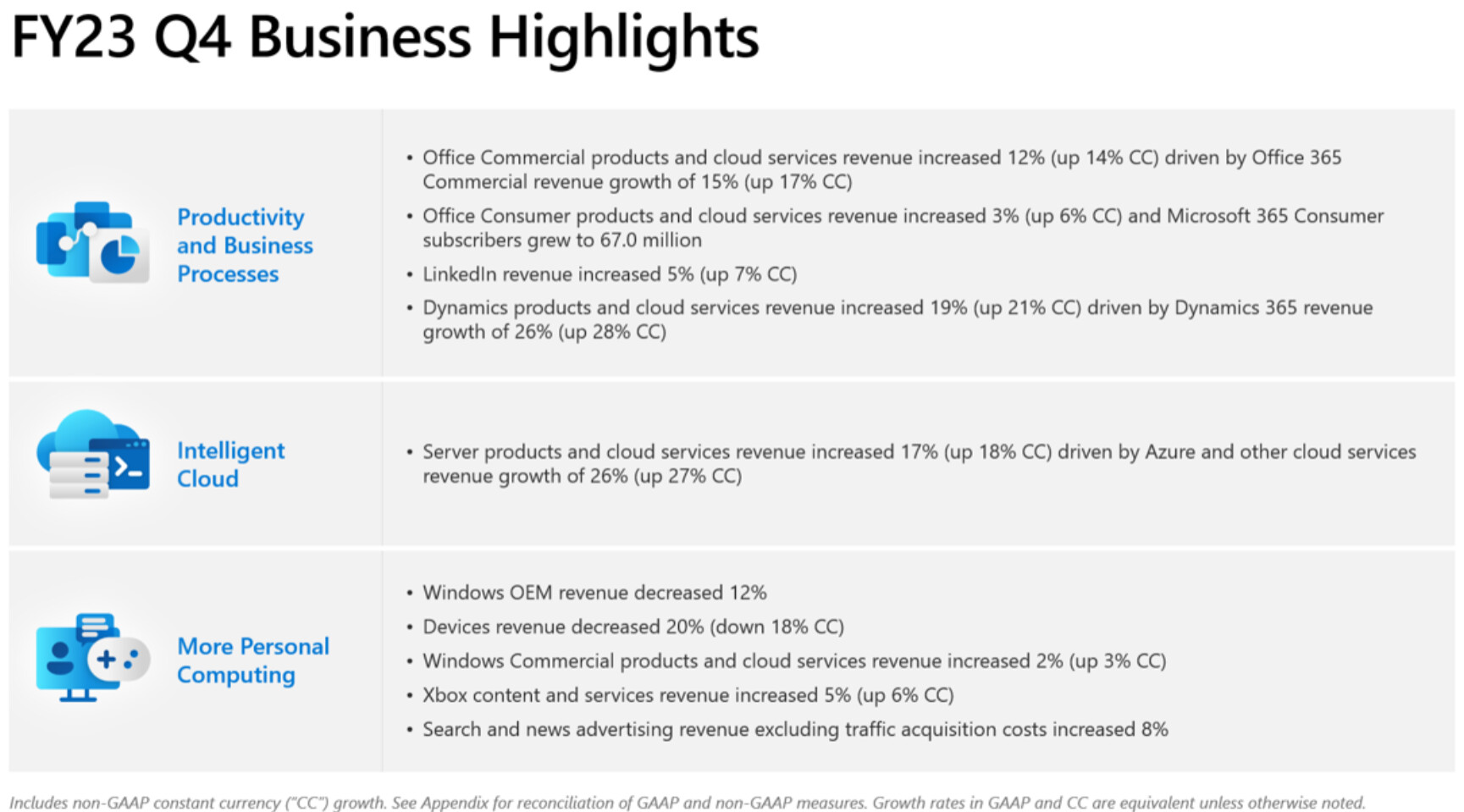
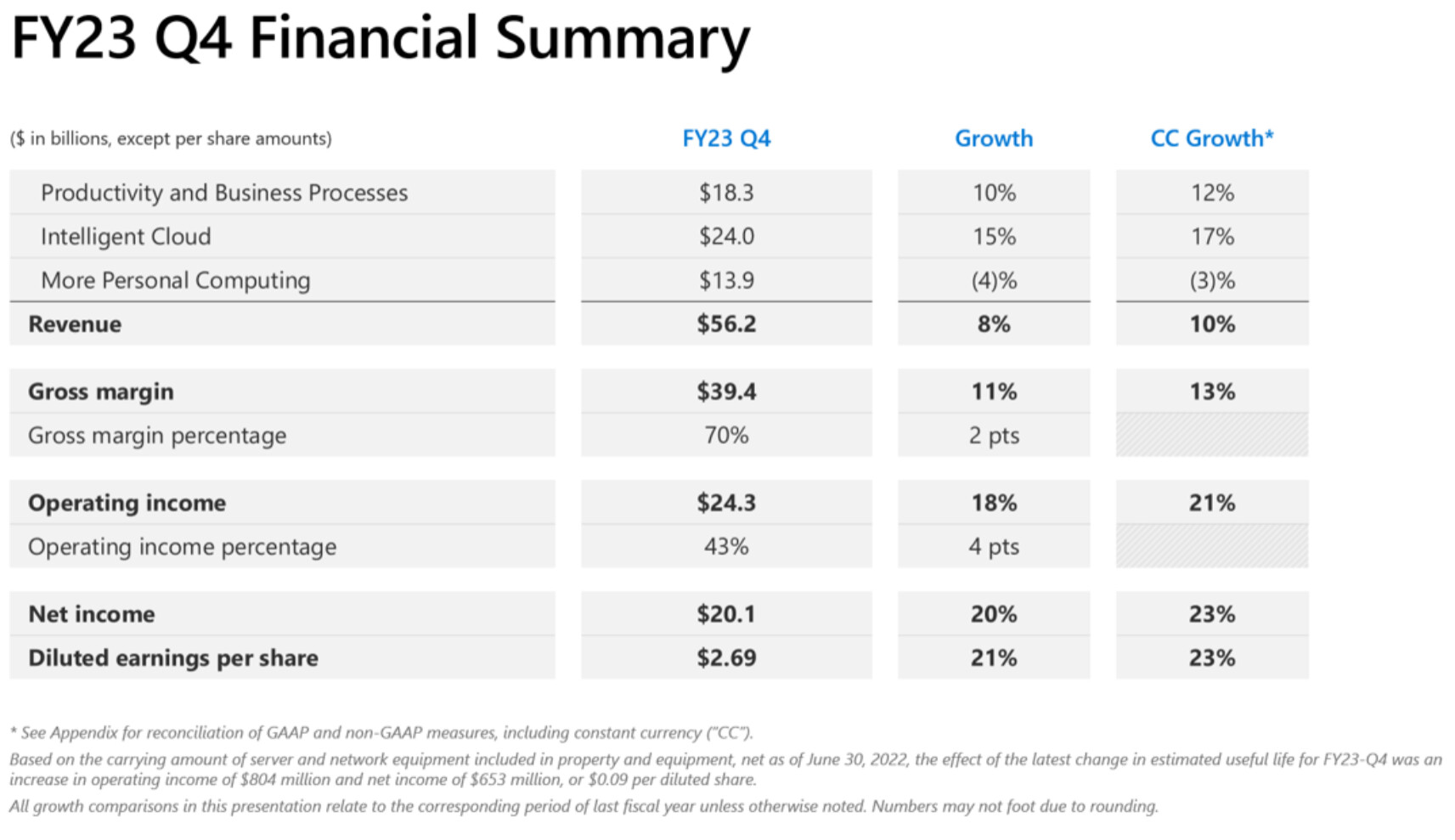
Microsoft Corp. today announced the following results for the quarter ended June 30, 2023, as compared to the corresponding period of last fiscal year:
  • Revenue was $56.2 billion and increased 8% (up 10% in constant currency)
  • Operating income was $24.3 billion and increased 18% (up 21% in constant currency)
  • Net income was $20.1 billion and increased 20% (up 23% in constant currency)
  • Diluted earnings per share was $2.69 and increased 21% (up 23% in constant currency)
"Organizations are asking not only how - but how fast - they can apply this next generation of AI to address the biggest opportunities and challenges they face - safely and responsibly," said Satya Nadella, chairman and chief executive officer of Microsoft. "We remain focused on leading the new AI platform shift, helping customers use the Microsoft Cloud to get the most value out of their digital spend, and driving operating leverage."

Microsoft is Back to its Old Ways—Links in Office Will Open in MS Edge Browser, Ignoring Browser Preference

Windows OS users have been critical of Microsoft's strategy of prioritizing its Edge browser for a while now, and more angry feedback is expected following an announcement that updates to Microsoft 365 Outlook and Teams applications will change how things work with regards to link clicking. Discerning users of Windows have adjusted preferences so that clicked links will always open in their web browser of choice (e.g Chrome, Firefox, Opera etc.). Microsoft will be adjusting behaviors in its Outlook and Teams apps, so links are set to open in Microsoft Edge by default. The changes are advertised as a positive for customers using Windows 10 & 11, as well as Office applications: "Microsoft is always striving to improve and streamline our product experiences—offering a new way to use the classic Microsoft Outlook app on Windows and the Microsoft Edge web browser."

This week's support message explains the upcoming situation shift: "If you have a Microsoft 365 Personal or Family subscription, browser links from the Outlook app will open in Microsoft Edge by default, right alongside the email they're from in the Microsoft Edge sidebar pane. This allows you to easily access, read, and respond to the message using your matching authenticated profile. No more disruptive switching—just your email and the web content you need to reference, in a single, side-by-side view. And we're always optimizing the sidebar in Microsoft Edge to give you useful content and tools while you're browsing so you don't have to toggle back and forth between windows or even other tabs—whether you're shopping online or working in a Microsoft 365 web app." Outlook will be the first application to get updated with the "handy new feature," and the Teams app will be adjusted later this year.
Return to Keyword Browsing
Nov 11th, 2026 07:09 CST change timezone

New Forum Posts

Popular Reviews

TPU on YouTube

Controversial News Posts