News Posts matching #Accuracy Super Resolution

Return to Keyword Browsing

Arm Neural Technology Delivers Smarter, Sharper, More Efficient Mobile Graphics for Developers

On-device AI is transforming workloads everywhere, from mobile gaming to productivity tools to intelligent cameras. This is driving demand for stunning visuals, high frame rates and smarter features - without draining battery or adding friction. Announced today at SIGGRAPH, Arm neural technology is an industry first, bringing dedicated neural accelerators to Arm GPUs from 2026. This takes the performance of GPUs for graphics rendering to new heights, delivering up to 50% GPU workload reduction for today's most intensive mobile content, starting with mobile gaming. And this is just the beginning - the availability of this new technology lays the foundations for the industry to deliver even more on-device AI innovation in the future.

Alongside this technology, we are launching the world's first publicly available neural graphics development kit, designed to integrate AI-powered rendering into existing workflows so that developers can start building today, a full year ahead of hardware availability. All of Arm's neural technology will be completely open - that means the model architecture, the weights and the tools that a studio would need to retrain the model. Partners that have shown support for the development kit to date include Enduring Games, Epic Games (Unreal Engine), NetEase Games, Sumo Digital, Tencent Games, and Traverse Research.


Arm Releases Open-Source ASR Upscaler Based on AMD FSR 2 Technology

Arm has officially unveiled its Accuracy Super Resolution (ASR) upscaling technology at Game Developer Conference 2025, delivering an open-source upscaling solution for mobile and low-power devices. Built upon AMD's FidelityFX Super Resolution 2 (FSR 2) framework, ASR promises up to 53% higher frame rates while reducing power consumption by 20% on devices utilizing the Immortalis-G720 GPU. This technology addresses a critical performance gap in the Android ecosystem, which has historically lagged behind Apple's MetalFX implementation. The temporal upscaling approach employed by ASR combines information from multiple frames to generate higher-quality images, offering superior visual fidelity compared to Qualcomm's Game Super Resolution (GSR), which relies on the older spatial-based FSR 1 technique. In benchmark testing with complex scenes, Arm demonstrated that ASR helps maintain stable device temperatures, preventing thermal throttling that can compromise user experience.

Collaboration with MediaTek confirmed significant power savings on Dimensity 9300 chipsets, directly addressing battery life concerns for mobile gamers. Arm plans to release pre-built plugins for Unity and Unreal Engine by year-end, streamlining integration for developers working with these widely-used game engines. During GDC demonstrations, Arm showcased the "Mori" demo running in Unreal Engine 5, where ASR delivered 30% performance improvements without visual compromises. Licensed under MIT open-source terms, ASR's accessibility extends across the entire Arm ecosystem, potentially benefiting smartphones running MediaTek Dimensity, Qualcomm Snapdragon, Samsung Exynos, and even Arm-powered laptops featuring Snapdragon X series SoCs.

Arm Unveils "Accuracy Super Resolution" Based on AMD FSR 2

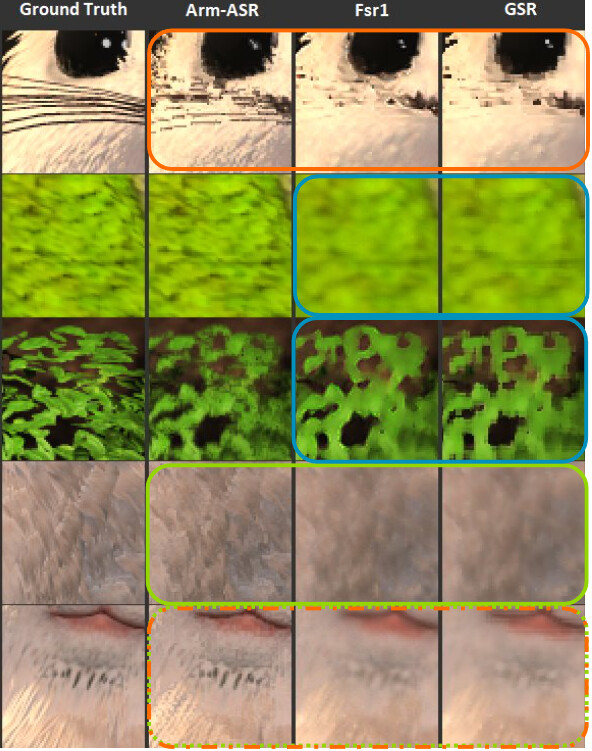
In a community blog post, Arm has announced its new Accuracy Super Resolution (ASR) upscaling technology. This open-source solution aims to transform mobile gaming by offering best-in-class upscaling capabilities for smartphones and tablets. Arm ASR addresses a critical challenge in mobile gaming: delivering high-quality graphics while managing power consumption and heat generation. By rendering games at lower resolutions and then intelligently upscaling them, Arm ASR promises to significantly boost performance without sacrificing visual quality. The technology builds upon AMD's FidelityFX Super Resolution 2 (FSR 2) and adapts it specifically for mobile devices. Arm ASR utilizes temporal upscaling, which combines information from multiple frames to produce higher-quality images from lower-resolution inputs. Even though temporal upscaling is more complicated to implement than spatial frame-by-frame upscaling, it delivers better results and gives developers more freedom.

This approach allows for more ambitious graphics while maintaining smooth gameplay. In benchmark tests using a complex scene, Arm demonstrated impressive results. Devices featuring the Arm Immortalis-G720 GPU showed substantial framerate improvements when using Arm ASR compared to native resolution rendering and Qualcomm's Game Super Resolution (GSR). Moreover, the technology helped maintain stable temperatures, preventing thermal throttling that can compromise user experience. Collaboration with MediaTek revealed significant power savings when using Arm ASR on a Dimensity 9300 handset. This translates to extended battery life for mobile gamers, addressing key concerns. Arm is releasing ASR under an MIT open-source license, encouraging widespread adoption and experimentation among developers. Below you can see the comparison of various upscalers.

Return to Keyword Browsing
Nov 14th, 2026 00:32 CST change timezone

New Forum Posts

Popular Reviews

TPU on YouTube

Controversial News Posts