News Posts matching #Asgard

Return to Keyword Browsing

Asgard's Latest DDR5 6000 MT/s Memory Kits Launched in China, 256 GB Valkyrie II Costs ~$2400

Fresh JD.com store listings have aptly reaffirmed ever-increasing memory pricing trends—over the past weekend, ITHome noticed extortionate tags applied to Asgard's newest high-capacity DDR5 kits. Given current circumstances, certain PC hardware enthusiasts will begrudgingly meet the challenge of taking on daunting costs of ownership. The Chinese brand's latest premium-tier 256 GB (4 x 64 GB) and 192 GB (4 x 48 GB) kits are not particularly cutting-edge in terms of basic specifications: 6000 MT/s memory transfer rates, on SK Hynix M-die ICs. Over a year ago, the company launched a better-binned Thor DDR5-9600 product line, albeit with a much lower capacity: 48 GB (2 x 24 GB).

The Valkyrie II RGB 256 GB limited edition kit—marked with CL32-45-45-90 timing credentials—reportedly launched at 14,599 Yuan (~$2067 USD), but an updated JD.com page tacks on an additional 2400 Yuan. This (roughly) 16.4 % increase leads to a ~$2407 USD total. The Valkyrie's "racing orange" color scheme is an acquired taste; thankfully the manufacturer's cheaper alternative offers a stealthier approach. At the time of writing, the Asgard Thor Armor 192 GB limited edition kit's launch price remains intact: at 8599 Yuan (~$1217 USD). Granting access to respectable CL28-36-36-72 timings, and understated "carbon fiber heat spreaders." Recent press coverage has compared Asgard high-capacity memory prices to current-gen NVIDIA desktop graphics products—namely the Valkyrie II 256 GB costing $400 more than a GeForce RTX 5090 Founders Edition card (at MSRP). Tom's Hardware points out that similarly specced G. Skill and Corsair kits sport greater price tags, with competing Asgard SKUs matching or exceeding performance (specs-wise).

Asgard Intros Thor DDR5-9600 48 GB CUDIMM Memory

Asgard joined the ranks of V-Color to unveil its first high-frequency DDR5 memory, the Thor DDR5-9600. V-Color recently launched its DDR5-9200 memory, and Asgard one-upped it with DDR5-9600. Both these are CUDIMMs—UDIMMs that feature a client clock driver (CKD) component. These modules feature the highest bins of DDR5-9600 chips from SK Hynix. The advertised speed of DDR5-9600 is achieved using timings of 44-56-56-136, and a scorching DRAM voltage of 1.50 V. The module includes an XMP 3.0 profile to enable these settings on an Intel platform. With a single-rank configuration and 24 GB module density, the dual-channel kit gives you 48 GB. Asgard revealed that it is working on a DDR5-10000 kit. The company didn't announce US availability.

Marvel Rivals PVP Shooter Boasts Incredible Lineup of Marvel Characters

NetEase Games and Marvel Games are excited to announce their latest collaboration: Marvel Rivals, a cooperative, Super Hero team-based PVP shooter! Players can assemble an ever-evolving all-star squad of Super Heroes and Super Villains, while battling with unique super powers across a dynamic lineup of destructible maps from across the Marvel Multiverse. Marvel Rivals is in development for PC by a NetEase team composed of global talent, who previously worked on hit franchises such as Call of Duty and Battlefield.

"We are overjoyed to bring Marvel Rivals to players around the world. We have always loved Marvel's universe and its characters, and we are so excited to be developing this game," said the Marvel Rivals Producer Stephen Wu. "This is the game we want to make, and we feel very lucky to be the team who made all of this come true."

Asgard Announces AN4 PCIe 4.0 SSD - 128 Layer 3D TLC NAND, 7,500 MB/s Read

Chinese manufacturer Asgard has announced the company's (and the Chinese market's) first PCIe 4.0 SSD. The AN4 pairs 128 Layer 3D TLC NAND manufactured by YMTC (Yangtze Memory Technologies Co., Ltd) Xtacking 2.0 technology, which uses a two-step manufacturing process wherein both NAND cells and interconnects are manufactured in two separate wafers and then optically fused. The NAND memory is then paired with Innogrit's IG5236 Rainier controller. The AN4 is rated for 7,500 MB/s and 5,500 MB/s sequential read and write speeds and features a "high" TBW endurance rating, though Asgard didn't clarify the exact random performance figures, nor the TBW rating for the SSD. Pricing is similarly up in the air - Asgard has only announced market availability for the 1 TB SSD solution come August, with additional 2 TB and 512 GB capacities being readied to market for a later timeframe.

The manufacturing technology of YMTC results in NAND that's as fast as Micron's latest 192-layer NAND tech, and beats well-established Kioxia's 96-layer technology performance-wise. One Bilibili forum user put the drive through its paces, and discovered that to unlock its full potential, one has to have a system capable of 512 bit maximum payload size (MPS), which is currently only supported by AMD motherboards - maximum Intel MPS currently stands at 256 bit, which "only" enables sequential performance of up to 7,150 MB/s. The user put the AN4 through a variety of tests, including PCMark 10's Drive Performance Consistency Test - a 10 to 20 hours workload marathon that puts more than 23 TB of drives on the SSD. It seems that Chinese manufacturers have achieved parity with the top western manufacturers, meaning there is one more option in the global, high-performance NAND market.

Chinese Manufacturer Asgard to Launch DDR5 128 GB, 5,600 MHz Sticks As Early as 2022

Chinese company Jiahe Jinwei owns a sub-brand of gaming-oriented products named after Norse mythology - Asgard. The company has now announced that the trial production for high-speed DDR5 modules using Micron's semiconductors has completed without issue, meaning that their roadmap is going through without a hitch. Of course, as with the introduction of any new DDR memory standard, operating frequencies are still in their nascent stage; Asgard currently is only offering 4,800 MHz DDR5 sticks, which the most premium DDR4 sticks can already surpass.

It's only a matter of time before DDR5 speeds accelerate however, and Asgard is already planning to launch 5600 MHz DDR5 kits as early as 2022. These should be available in 32 GB and 128 GB capacities with a CAS latency of 46 cycles. The next step in performance increase would look towards 6,400 MHz kits, but these should only be expected towards the end of 2022 and beginning of 2023, should the development continue to move along smoothly. All of the DDR5 memory speeds should still make do with a relatively puny 1.1 V.

Chinese Company Jiahe Jinwei Begins DDR5 Memory Mass Production

We have seen a number of announcements from key industry players about the introduction of DDR5 memory but today's news from Chinese company Jiahe Jinwei marks the beginning of DDR5 mass production. The company announced that DDR5 RAM from Micron had arrived at its facilities and that memory module production could begin. Jiahe Jinwei is the fourth largest memory manufacturer in China and owns memory brands such as Guangwei and Asgard which have recently announced DDR5 modules with capacities of up to 128 GB and speeds reaching 4,800 MHz. Intel is expected to launch their 12th Generation Alder Lake processors later this year with DDR5 support while AMD will introduce support with Zen 4 processors on a new AM5 socket.

Chinese Manufacturer Asgard Launches 4,800 MHz DDR5 Memory Modules

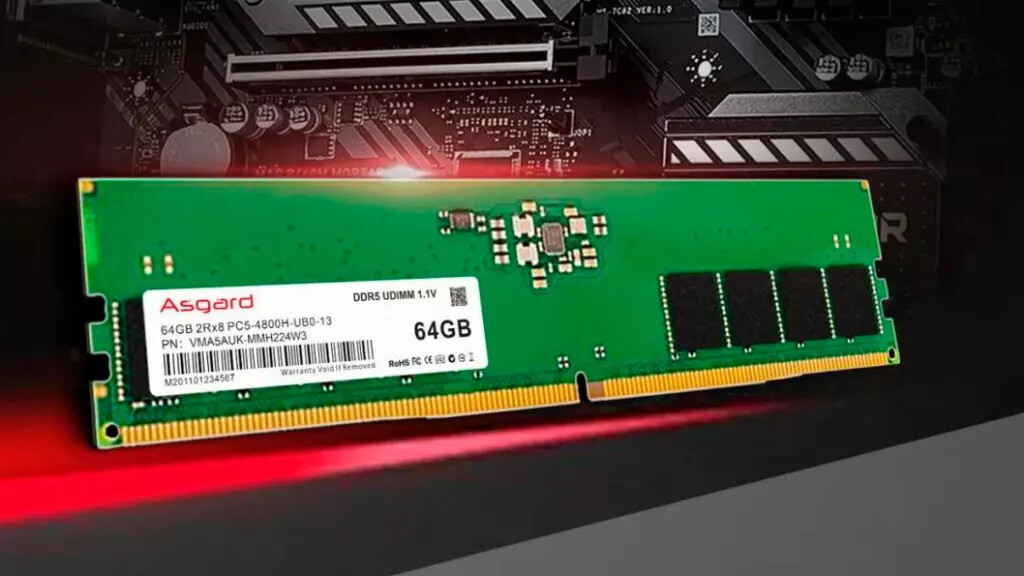
In the name of Odin, Chinese manufacturer Asgard has launched their first DDR5 memory modules to market - beating some competing western companies that are still "gearing up" for it. Owned by the much less interestingly-named Shenzhen Jiahe Jinwei Electronic Technology Co., Ltd., Asgard likewise lost some of its flair in naming these DDR5 sticks - the best they could do was VMA5AUK-MMH224W3. The modules will be available in 32 GB, 64 GB and 128 GB per-stick densities.

The initial modules don't have any flair - they're built with the same green PCB that's actually the forerunner of today's colored ones. The company hs also announced that the modules win run at a relatively mild 4,800 MHz (the DDR5 specification goes up to 8,400 MHz), and that its timings coincide with JEDEC's "B" classification, which should mean 40-40-40. The voltage likewise remains at the JEDEC-set standard of 1.1 V. The company announced that mass-production rollout will only occur after there are actual CPUs and platforms that can take advantage of the DDR5 memory spec, and said that they expect Intel's Alder-Lake, Sapphire Rapids and Tiger Lake-U from the blue team, as well as Van Gogh and Rembrandt APUs from the AMD camp. No word on consumer pricing was available at time of writing.
Return to Keyword Browsing
Nov 13th, 2026 08:26 PST change timezone

New Forum Posts

Popular Reviews

TPU on YouTube

Controversial News Posts