News Posts matching #Binary Optimization Tool

Return to Keyword Browsing

Intel Core Ultra 7 260K Arrives Without an Announcement, Limited to Two Prebuilt Desktops

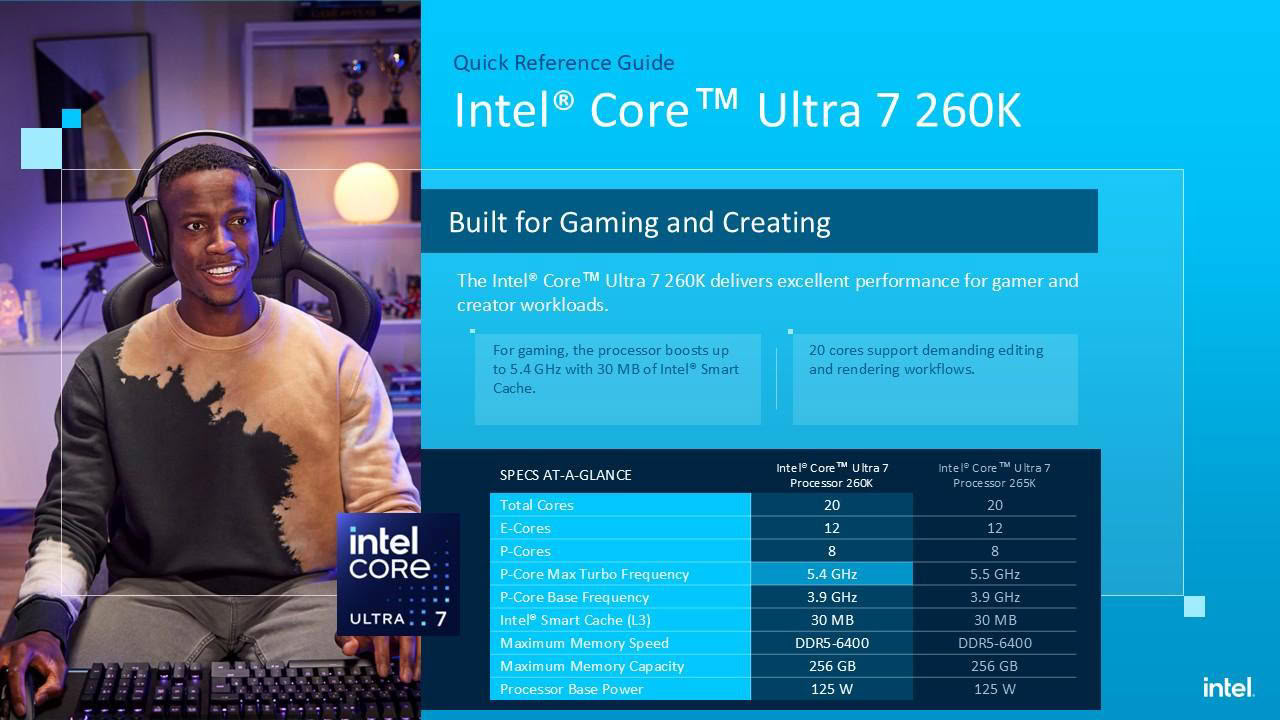
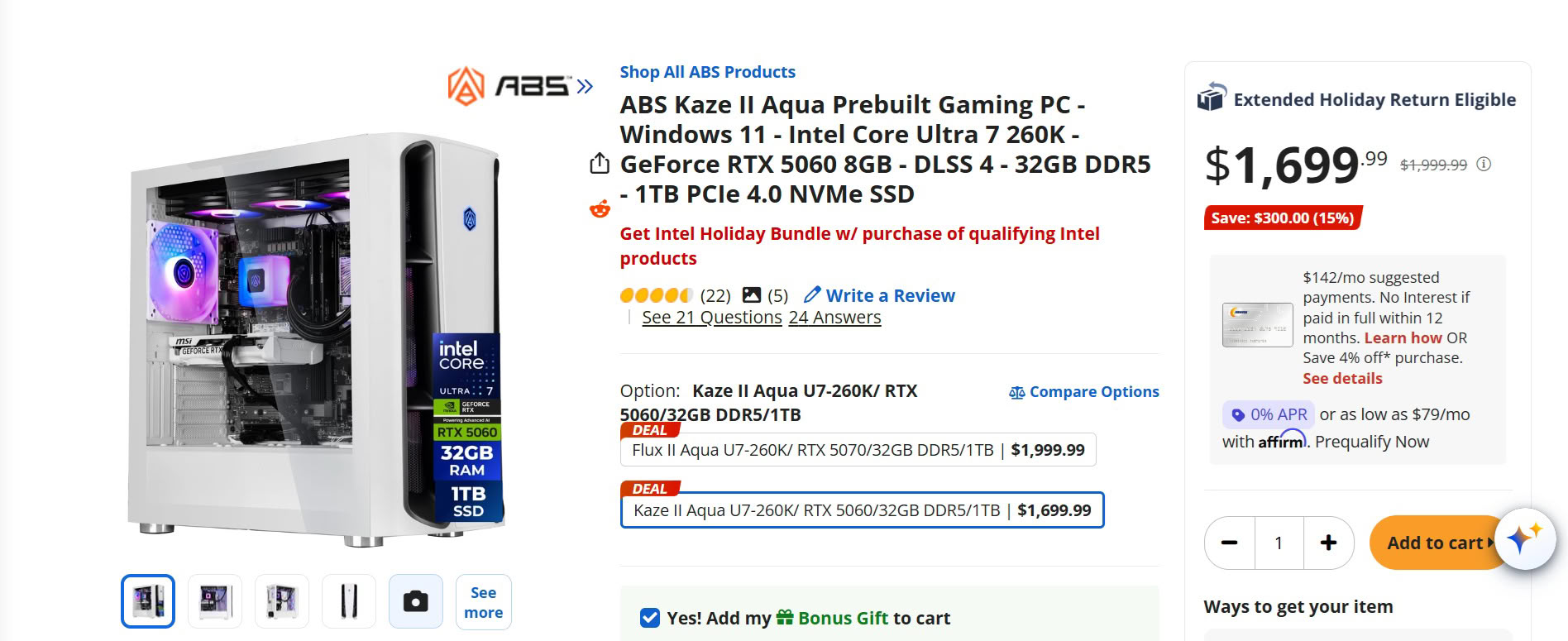
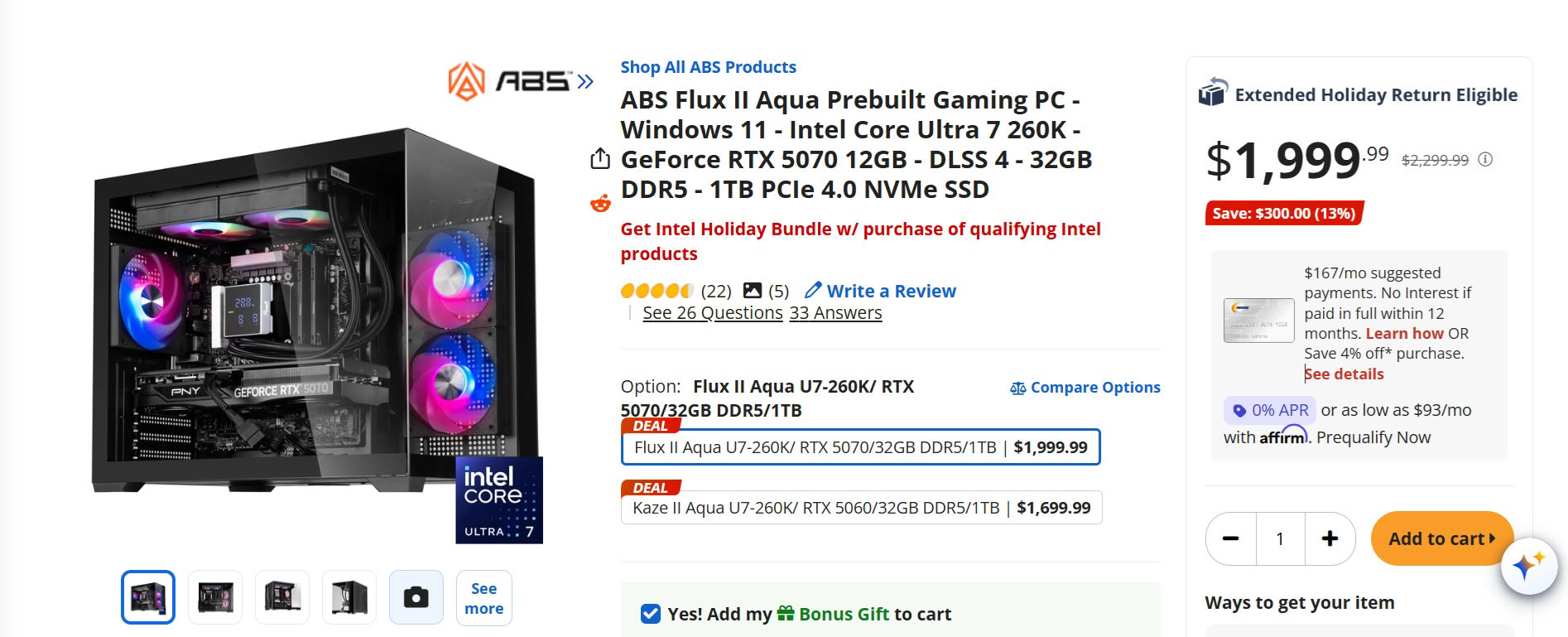
A new unannounced Intel CPU, the Core Ultra 7 260K, is now on sale, though only inside two of Newegg's in-house ABS gaming desktops. The Kaze II Aqua pairs it with an RTX 5060 for $1,699.99, while the Flux II Aqua steps up to an RTX 5070 for $1,999.99. Newegg confirmed the chip is exclusive to its ABS systems and won't be sold separately. Per Tom's Hardware, Intel has since described it as a "limited-availability" SKU with no boxed retail version, and its specifications should appear on Intel's website within a few days.

Going by Newegg's own buying guide, the 260K looks like a Core Ultra 7 265K with a slightly lower clock speed ceiling. It keeps the same 8P+12E core layout, 30 MB of L3 cache, 125 W base power, and DDR5-6400 support for up to 256 GB of memory, but the P-cores top out at 5.4 GHz instead of 5.5 GHz. That DDR5-6400 limit places it in the original Arrow Lake family rather than the Arrow Lake Refresh lineup, so it misses out on DDR5-7200 support and Intel's Binary Optimization Tool as well.



Intel Binary Optimization Tool Changes Code Execution with Heavy Vectorization

The Intel Binary Optimization Tool (BOT) has been launched alongside the "Arrow Lake Refresh" series of processors, which includes the Core Ultra 5 250K Plus and Core Ultra 7 270K Plus models. While the tool is beneficial for gamers looking to extract a few extra frames from their setups, it may be a nightmare for makers of benchmarking tools like Geekbench by Primate Labs. Recently, Primate Labs testing found that BOT changes the way .exe applications run and concluded that Geekbench runs will now flag these BOT-enhanced runs. However, in deeper testing, Primate Labs discovered that Intel's BOT may deliver significant boosts in some applications like Object Remover and HDR, increasing performance by up to 30%. This is thanks to the deep vectorization that the BOT performs behind the scenes to optimize performance.

For example, Primate Labs used Intel's own Software Development Emulator (SDE) to measure how many instructions were executed and which types of instructions the program executed. Without BOT, Geekbench 6 required a total of 1.26 trillion instructions to finish, while a BOT-enhanced run completed with 1.08 trillion instructions. This is an impressive 14% reduction. However, when examining the execution by type, we see that BOT makes heavy use of vector instructions like SSE2 and AVX2. The number of scalar instructions needed to execute a program fell from 220 billion to 84.6 billion, while the number of vector instructions increased from 1.25 billion to 18.3 billion, a 13.7x increase. This means that Intel BOT finds a way to turn inefficient scalar code into vectorized instructions that are processed much more efficiently inside Intel CPUs. These techniques indicate a very complex behind-the-scenes process than was originally believed. The Geekbench v6.7 update will include a flag for BOT, allowing future Geekbench results to be easily distinguished as BOT-enhanced or not.

Intel's Binary Optimization Tool Results Marked as Potentially Invalid by Geekbench

Alongside "Arrow Lake Refresh," Intel released a new Binary Optimization Tool, available for Core Ultra 270K Plus and 250K Plus SKUs. However, since the tool essentially changes the way .exe applications run, scores on popular benchmarking applications may be deemed invalid. According to Primate Labs, the developer behind Geekbench, the use of Intel's binary optimization tool will result in a special flag on Geekbench scores. Reportedly, as the tool modifies the instruction sequence that the CPU exhibits, benchmark scores will deviate from the standard range. In a standardized benchmarking environment, this is a massive negative consequence, as the inner workings of the Binary Optimization Tool are unknown and resemble a black box that benchmark makers like Primate Labs have to deal with. To combat the use of this tool, Geekbench will now display the message "This benchmark result may be invalid due to binary modification tools that can run on this system" as a warning.

In TechPowerUp's own testing of the Binary Optimization Tool, we found that Intel's Binary Optimization Tool boosts Geekbench v6 single-core performance by 8.2%, while the multi-core score has risen by 7.8%, resulting in about an 8% average uplift in Geekbench testing. Games like Cyberpunk 2077 experience smaller uplifts, while some select titles like Shadow of the Tomb Raider can see up to a 22% increase using the Binary Optimization Tool. In reality, Intel only supports 12 games for now, which will expand further as the company labs release more optimizations. For gamers, this is fantastic news as the performance uplift is essentially free without any drawbacks, but for benchmarks, it is a potential issue as it represents an execution mystery since no one outside Intel knows exactly how the tool runs and how the code paths get modified.
Return to Keyword Browsing
Nov 13th, 2026 18:48 PST change timezone

New Forum Posts

Popular Reviews

TPU on YouTube

Controversial News Posts