News Posts matching #Competition

Return to Keyword Browsing

Zowie Named Official Monitor of Valorant Champions Tour Americas by Riot Games

ZOWIE, a leading global esports brand and part of BenQ Corporation, has been named by Riot Games as the official monitor for the VALORANT Champions Tour Americas (VCTA). This collaboration is grounded in a shared commitment to competitive performance and player-first standards. Trusted by professional FPS players worldwide, ZOWIE monitors are engineered for precision, responsiveness, and consistency under tournament conditions, delivering a performance benchmark that meets the demands of top-tier competition.

ZOWIE's best in class XL2566X+ Gaming Monitor will be used on stage during VCT Americas competitions, giving pro players elite performance when it matters most. The XL2566X+ features a 400 Hz Fast TN Panel with native FHD and DyAc 2 technology to deliver industry-leading motion clarity, and clear, sharp visuals with enhanced color modes. Designed specifically for FPS games, ZOWIE monitors provide stable, predictable performance, empowering players to Strive for Perfection.

Global Top Five Enterprise SSD Vendors Post Over 50% QoQ Revenue Growth in 4Q25, with SK Group Leading Growth

The widespread adoption of AI inference workloads in 4Q25 significantly raised requirements for data storage systems, according to TrendForce's latest findings on the enterprise SSD market. Meanwhile, enterprises accelerated upgrades to their general-purpose servers, while shortages in HDD supply pushed some demand toward SSD solutions. These factors together drove combined revenue for the world's top five enterprise SSD vendors up 51.7% QoQ to more than US$9.9 billion.

Among leading vendors, Samsung retained its top position, reporting nearly $3.66 billion in revenue in 4Q25, up 49.7% QoQ. The company demonstrated the strength of its vertically integrated business model. As concerns grew over potential DRAM shortages, many customers turned to Samsung because it can rely on its own DRAM and NAND Flash production to ensure stable SSD supply.

Sony Faces $2.7 Billion UK Lawsuit Over PlayStation Store Monopoly Claims

A $2.7 billion (£1.97 billion) lawsuit against Sony has gone to trial in London, on behalf of around 12 million UK PlayStation users. Sony is accused of abusing its dominant market position by forcing digital game and add-on purchases exclusively through the PlayStation Store, keeping prices artificially higher than physical alternatives. The case is being heard at the Competition Appeal Tribunal and is led by Alex Neill, who has stated that "gamers have paid too much and they should get some money back." The claim was previously valued at up to $6.7 billion (£5 billion) before being revised down to its current figure. The case follows a similar pattern to other recent UK tech lawsuits. A comparable class action against Steam on behalf of 14 million users was cleared to proceed last month, and Apple was found in October to have abused its dominant position over App Store commissions, a ruling it is currently appealing.

Sony is fighting back, arguing it has invested years and billions into an integrated gaming platform that operates in a competitive market alongside Nintendo and Xbox, both of which use similar closed storefronts. Its lawyers contend that the margins earned on digital game sales aren't excessive and that the lawsuit fails to account for Sony's costs and the value of its platform. The company also frames the claimants' position as essentially demanding that third parties be allowed to sell on PlayStation while free-riding on the Sony infrastructure. If successful, the roughly 12.2 million eligible users, anyone who bought a digital PlayStation game or in-game download over the past ten years, would receive an estimated $217 (£162) each, on an opt-out basis.

Samsung's Texas Fab Reportedly Attracting Major Customer Interest as AI Boom Continues

A report put together by Deutsche Bank analysts has mentioned an ongoing supply-demand imbalance within the semiconductor market. According to Jukan's summary of the financial institute's findings, TSMC's "share of the advanced-node foundry market" could fall from an impressive 95% level, down to a mere 90% in the coming years. The industry-leading chipmaker continues to enjoy a prime position, but its international operation footprint seemingly cannot keep up with requests—mainly from fabless customers—during the ongoing AI hardware boom. Deutsche Bank believes that the Taiwanese foundry business has an order backlog extending way into 2027, with many clients requiring 3 nm wafer products. TSMC reportedly aims to get 3 nm node production lines pumping out around 190,000 wafers per month, by the end of this year. Even if this major target is met, demand is expected to outweigh supply. AI chip production-centric bottlenecks—mostly involving CoWoS packaging—have been dealt with in the recent past, but industry observers posit that VIP customers are considering alternate providers.

Allegedly, the next best options are the Samsung and Intel Foundries, despite rumors of teething problems—both companies will very likely welcome new requests. In modern times, many of Samsung's big clients have switched over to TSMC, due to (the former's) supposedly troubled development of more advanced nodes. Deutsche Bank analysts have outlined a "big six" group of key customers: AMD, Apple, Broadcom, MediaTek, NVIDIA, and Qualcomm. The fabless firms could be pursuing alternate "production capacity" avenues, with Samsung's 2 nm (SF2) and 4 nm node process lines being of particular interest. Like TSMC, the South Korea megacorp's state-of-the-art fabrication sites and staff expertise are concentrated in home territories. A surprise prediction has highlighted Samsung's main North American foundry—the Deutsche Bank report pinpointed a very specific location: "for customers seeking alternative supply, Samsung's Taylor fab is more likely to become the first destination." In addition, analysts think that the big six will select Samsung's Texas-based foundry over Intel's best native site (perhaps dealing in 18A).

Samsung's Proprietary "Heat Path Block" Tech Could be Adopted by Apple & Qualcomm

Samsung Foundry's "Heat Path Block" (HPB) technology is reportedly a key aspect featured within the upcoming Exynos 2600 application processor (AP). The South Korean's previous flagship mobile chipsets have often been beset with thermal issues, leading to the deployment of rival chipsets within certain generations of Samsung Galaxy smartphones. The South Korean seems to be pinning its hopes on the emerging Exynos 2600 across a number of fronts. Most notably as a confident "proof of concept" demonstration of the foundry business's cutting-edge 2 nm GAA process (aka SF2). According to a freshly-published ET News SK article, Samsung's innovative "semiconductor heat-suppressing technology" has already attracted interest from Apple and Qualcomm.

In the recent past, these VVIP clients have been on the order books for TSMC's best modern node processes. Samsung's SF2 line is seemingly being dangled as a carrot; designed to entice the return of former customers. Semiconductor industry trackers reckon that the Exynos 2600 SoC—enhanced with HPB tech—will serve as a strong demo of Samsung's 2 nm chip making capabilities. The foundry's in-house Heat Path Block is a copper heatsink that is packaged on top of a mobile AP. Heat dissipation is further maximized by moving DRAM to the side—previous Exynos layouts had this aspect placed atop APs. Insiders believe that a 30% improvement has been observed when comparing the Exynos 2600 to a predecessor. Samsung's System LSI division supposedly co-created the HPB design with an internal packaging development organization.
Another "Xeon 696X" Sample Gets Benched, PassMark Incorrectly Identifies 32-core Config

Late last month, an unreleased "Xeon 696X" processor was spotted in the SiSoftware Official Benchmark Ranker database. A recent uptick in "Granite Rapids-WS" leaks—including a long SKU stack—hints at an imminent launch. The latest leak, found within the PassMark CPU benchmark archive, seemingly reaffirms the Xeon 696X model's existence. Unfortunately, today's diagnostic points to a lower than anticipated core count: 32 instead 64. Based on older information, this appears to be a major mistake (on the PassMark side). Last month's SiSoftware-based info dump described a sample that leveraged 64 cores and 128 threads.

x86deadandback's initial social media post highlighted the PassMark suite's error. According to a quick benchmark score comparison (courtesy of Wccftech), the forthcoming sub-flagship workstation processor does better than the current "Sapphire Rapids-WS" range topper (Xeon W9-3595X) in multicore scenarios. A disappointing single-core tally likely comes from the next-gen candidate being disadvantaged as an early engineering sample. A rough equivalent from the Red Team—Ryzen Threadripper PRO 9985WX—enjoys a leading position on the comparative chart.

Huawei Ascend 910C Accelerator's Maturation Allegedly Spurred NVIDIA H200 Export Reversal

Earlier this week, the US government approved exports of NVIDIA H200 data center-grade accelerators to China. This reverses a previous decision, to prevent "full fat" H200 hardware reaching Chinese shores. Team Green engineers were reportedly working on a severely reduced "H20" alternative—whispers of this sanction-conforming design emerged earlier on in 2025. A competing Chinese product—Huawei's Ascend 910C accelerator—is often regarded as a main rival to newly approved past-gen Team Green AI-crunching solutions. According to Bloomberg's inside sources, White House officials were assessing the Ascend 910C's capabilities—most notably in the form of Huawei's super node CloudMatrix 384 system.

Despite lagging behind the H200, in terms of computing power and memory bandwidth, a large array of Ascend 910C accelerators (384 in total) is still a significant force. Additionally, Bloomberg's unnamed sources allege that the current US administration is worried about China rapidly improving its domestic semiconductor production capacities. Anonymous industry figures have whispered about Huawei and foundry partners working towards manufacturing 600,000 units throughout the coming year. Supposedly, the aforementioned White House staffers have considered a slightly different scenario—that Huawei: "would be capable, in 2026, of producing a few million of its Ascend 910C accelerators." According to a related Reuters news article, Chinese regulators are reportedly weighing up methods that will limit local industry's access to NVIDIA H200 systems.

NVIDIA Presents ARC Raiders-wrapped GeForce RTX 5090 FE, Another Giveaway Exclusive

NVIDIA has introduced another themed variant of its current "Blackwell" flagship gaming graphics card. The latest custom wrap features an Arc Raiders character and branding. The smash hit indie title—produced by Embark Studios—has already enjoyed some Team Green promo attention. An ARC Raiders GeForce RTX 50 Series bundle campaign was concluded early last month, necessitating purchases of expensive GB20x GPU-powered graphics cards.

In sharp contrast, NVIDIA's Christmas promotion will only affect a blessed handful of individuals: "the Season of RTX continues with an ARC Raiders GeForce RTX 5090 giveaway! For a chance to win this custom-wrapped graphics card, head to our social channels on Facebook, Instagram and X, look for the prompt, and follow the steps to enter yourself into the giveaway for this (customized) GeForce RTX 5090 Founders Edition." High-end graphics card enthusiasts have become accustomed to small batch releases of giveaway-exclusive variants. Past competitions, throughout 2025, have awarded lucky winners with Cyberpunk 2077 Edition and DOOM: The Dark Ages wrapped FE hardware.

Insider Theorizes Four Unlocked Intel "Nova Lake-S" SKUs, Bolstered with bLLC

Two days ago, Jaykihn claimed that an unannounced Intel "Nova Lake-S" SKU would carry 144 MB of bLLC (Big Last Level Cache) cache. In theory, this generous supplementary provision could elevate Team Blue's placement in the gaming desktop CPU market—where AMD has enjoyed plenty of success, courtesy of their 3D V-Cache-laden offerings. Yesterday, kopite7kimi weighed in with additional insider information. Specifically, they proposed that Intel is readying four individual "unlocked" SKUs—as part of the late 2026 "Core Ultra 400" CPU family—that will feature implementations of bLLC. Experts believe that this stash of cache will be bunged onto the "Nova Lake-S" design's compute tile.

Hours later, kopite7kimi replied to a query regarding possible differing compute die configurations. They outlined the potential existence of dual-tile options, alongside expected single-tile alternatives. Rumors of a 52-core engineering sample emerged at the start of September—leveraging a dual-tile configuration, comprised of two 8+16 layouts, plus 4 low power cores. This week, experts posit that a variant could launch with 144 MB of Big Last Level Cache implemented on each tile, thus granting a total of 288 MB bLLC within that package. kopite7kimi warned that this information was not completely concrete, and threw in another quick forecast: "(I am) not 100% sure yet. The power supply design of the new platform will be a challenge for motherboard manufacturers." The other dual-tile option could make do with a lesser core count: comprised of two 8+12 tiles.

Samsung Cuts 2 nm Node Pricing by 33% in TSMC Competition Push

Samsung has cut its 2 nm wafer prices to $20,000 offering a 33% discount compared to TSMC's expected $30,000 per wafer cost, industry reports say. The company aims to draw customers to its underused advanced manufacturing capacity. The Korean chipmaker faces big pressure to get returns on billions it put into cutting-edge fabrication plants across South Korea and the United States. With production lines running below capacity due to few orders, Samsung has started using bold pricing tactics to compete with Taiwan Semiconductor Manufacturing Company's strong market position. Just recently, the company landed a $16.5 billion deal with Tesla to make next-gen AI chips. People in the industry think this team-up might grow to include more chances maybe even making chips for Elon Musk's xAI project.

TSMC keeps its lead in advanced node manufacturing getting major clients like NVIDIA and AMD for its 2 nm process. The Taiwanese foundry plans to start mass production of 2 nm chips in Q4 2025 even with record-high wafer prices at $30,000 per unit. Samsung has always used lower prices to take on TSMC's control of the market, and it seems to remain on the same strategy with discounts up to 33% cheaper than TSMC's prices for similar 2 nm chip-making services.

Chinese Tech Firms Reportedly Unimpressed with Overheating of Huawei AI Accelerator Samples

Mid-way through last month, Tencent's President—Martin Lau—confirmed that this company had stockpiled a huge quantity of NVIDIA H20 AI GPUs, prior to new trade restrictions coming into effect. According to earlier reports, China's largest tech firms have collectively spent $16 billion on hardware acquisitions in Q1'25. Team Green engineers are likely engaged in the creation of "nerfed" enterprise-grade chip designs—potentially ready for deployment later on in 2025. Huawei leadership is likely keen to take advantage of this situation, although it will be difficult to compete with the sheer volume of accumulated H20 units. The Shenzhen, Guangdong-based giant's Ascend AI accelerator family is considered to be a valid alternative to equivalent "sanction-conformant" NVIDIA products.

The controversial 910C model and a successor seem to be worthy candidates; as demonstrated by preliminary performance data, but fresh industry murmurs suggest teething problems. The Information has picked up inside track chatter from unnamed moles at ByteDance and Alibaba. During test runs, staffers noted the overheating of Huawei Ascend 910C trial samples. Additionally, they highlighted limitations within the Huawei Compute Architecture for Neural Networks (CANN) software platform. NVIDIA's extremely mature CUDA ecosystem holds a significant advantage here. Several of China's prime AI players—including DeepSeek—are reportedly pursuing in-house AI chip development projects; therefore positioning themselves as competing with Huawei, in a future scenario.

TSMC Reportedly Surpasses 90% Production Yield Rate with 2 nm Process

At the tail end of Q1'25, industry whispers suggested that TSMC's premier facilities had completed cutting/leading-edge 2 nm (N2) trial production runs. By early April, company insiders alluded to a confident push into preparations for a futuristic 1.4 nm node at the "P2" Baoshan Plant. This is a very distant prospect; watchdogs envision a 2028 release window. According to expert predictions, cross-facility 2 nm wafer mass production phases are expected to start by the end of this year. Foundry staff seem to be actively pursuing an improvement in yields; earlier guesstimates indicated the crossing of a 70% milestone—good enough for full-blown manufacturing runs.

Fresher musings point to staffers and advanced equipment achieving and stepping just beyond an impressive 90% mark, albeit with silicon intended for "memory products." As of mid-May, Samsung's competing "SF2" product—allegedly—remains in testing phases. South Korean insider news reports posit 2 nm GAA trial yields passing 40%—a significant development for the megacorp's foundry business. Roughly a month ago, (in public) TSMC leadership spoke about an unprecedented demand for 2 nm wafers. Due to rumors of greater than anticipated charges for important TSMC clients, Samsung Semi's top brass is supposedly trying to woo the likes of NVIDIA and Qualcomm.

Samsung Reportedly Courting HBM4 Supply Interest From Big Players

The vast majority of High Bandwidth Memory (HBM) new stories—so far, in 2025—have involved or alluded to new-generation SK hynix and Micron products. As mentioned in recently published Samsung Electronics Q1 financial papers, company engineers are still working on "upcoming enhanced HBM3E products." Late last month, a neighbor/main rival publicly showcased their groundbreaking HBM4 memory solution—indicating a market leading development position. Samsung has officially roadmapped a futuristic "sixth-generation" HBM4 technology, but their immediate focus seems to be a targeted sales expansion of incoming "enhanced HBM3E 12H" products. Previously, the firm's Memory Business has lost HBM3 ground—within AI GPU/accelerator market segments—to key competitors.

Industry insiders believe that company leadership will attempt to regain lost market shares in a post-2025 world. As reported by South Korean news outlets, Kim Jae-joon (VP of Samsung's memory department) stated—during a recent earnings call, with analysts—that his team is: "already collaborating with multiple customers on custom versions based on both HBM4 and the enhanced HBM4E." The initiation of commercial shipments is anticipated at some point in 2026, hinging on mass production starting by the second half of this year. The boss notified listeners about development "running on schedule." A Hankyung article alleges that Samsung HBM4 evaluation samples have been sent out to "NVIDIA, Broadcom, and Google." Wccftech posits a positive early outlook: "Samsung will use its own 4 nm process from the foundry division and utilize the 10 nm 6th-generation 1c DRAM, which is known as one of the highest-end in the market. On paper, (their) HBM4 solution will be on par with competing models (from SK hynix), but we will have to wait and see."

Scythe's European Branch to Cease Operations, After-sales Support Rerouted Through Local Distributors & Retailers

Last Saturday, Scythe Group announced the closure of its European branch. This followed mid-April reports of unusually low stock numbers in Germany—at the time, ComputerBase.de and its community highlighted the complete absence of the manufacturer's flagship Mugen 6 CPU air cooler at regional retail outlets. The site published an investigative article on April 22; presenting an important Consumer Protection Forum filing. Apparently "economic difficulties" have warranted the initiation of "preliminary insolvency proceedings"—as a result, Scythe EU GmbH faced an uncertain future. Looking back in TechPowerUp's news archive, the last official introduction of brand-new products—Mugen 6 standard and Black Edition coolers—happened around early February. Also within the same month, TPU's crazyeyesreaper reviewed the brand's "highly-recommended" Fuma 3 model. Despite releasing consistently high-grade and top-performing products; Scythe has faced aggressive competition across Europe—Chinese brands have flooded regional markers with cheaper alternatives. In particular, Thermalright has gained plenty of attention and uptake—due to a rapid cadence and wide variety of highly-acclaimed new releases.

Scythe's April 26 official notice stated: "To All Valued Clients, we deeply regret to inform you that SCYTHE EU will be ceasing operations. Moving forward, SCYTHE-branded products and customer support will remain available through our European distributors and online e-commerce platforms. During the transition period with our distributors/e-commerce channels, there may be some unfinished matters, and we apologize for any inconvenience this may cause. SCYTHE will continue to uphold the principles of responsibility and integrity, ensuring consumer rights are protected in accordance with the law. We sincerely thank you for your support and loyalty to the SCYTHE brand over the years."

AMD Radeon RX 9060 XT Graphics Cards Could Launch Shortly After Computex 2025

Earlier in the week, AMD's unannounced Radeon RX 9060 XT graphics card design was linked to a possible public announcement at this year's edition of Computex. Naturally, Team Red has missed an opportunity to take on Team Green with a parallel launch of rival products. Leaks have pointed to the existence of two Radeon RX 9060 XT variants; one with 16 GB of GDDR6 VRAM, and another with an 8 GB pool. The cheaper end of RDNA 4—including a mysterious Radeon RX 9050 model—seems to be geared up to take on NVIDIA's GeForce RTX 5060 Ti, RTX 5060 and RTX 5050 cards. Further rumors have emerged; following initial hints of a formal introduction at an important late Spring event.

Chiphell's chief reviewer and editor reckons that Radeon RX 9060 XT cards will arrive at retail in May. This Chinese PC hardware forum is a notorious source of leaks—around early January, participants were boasting about having extremely early access to Radeon RX 9070 XT samples. In response to this morning's relevant VideoCardz report, Hoang Anh Phu weighed in with a new prediction—AMD and board partners could launch Radeon RX 9060 XT products two weeks after an official reveal at Computex 2025. Team Red is likely mapping out a new pricing strategy, due to NVIDIA's launch of "cheaper than expected" new models. So far, brand-new GeForce RTX 5060 Ti options have received a largely lukewarm welcome. Another Chiphell member has picked up on regional whispers about "starter" price points (including VAT)—reports suggest that the: "(Radeon RX) 9060 XT 8 GB version is 3100 yuan (~$422 USD, and the 16 GB variant is 3500 yuan (~$476 USD)."

Samsung's 2 nm GAA Node Process Test Yields Reportedly Pass 40% Mark

According to the latest South Korean semiconductor industry whispers, Samsung's 2 nm GAA node process (aka SF2) development team has hit another pleasing experimental production milestone. An Asia Economy SK news article has sourced insights from inside track players—one unnamed mole posited that: "the 2 nm yield currently under development at Samsung Foundry is much better than previously known...and more positive than the (reportedly abandoned) 3 nm process." A combination of relatively new leadership and a rumored welcoming of first wave High-NA EUV equipment has likely bolstered next-gen efforts, after late 2024's alleged failure of 3 nm prototypes. Leaks from earlier in 2025 indicated SF2 test yields wavering around 20-30%; far from ideal—back then, insider reports suggested that TSMC was well on the way to achieving 60% rates with a competing 2 nm product line. Asia Economy has picked up on mutterings about Samsung's current progress—latest outputs: "have exceeded 40% in the wafer testing stage at a post-processing company."

Industry watchdogs reckon that the South Korean's foundry business is making good progress; perhaps on track to commence speculated mass production by the third quarter of this year—just in time to get finalized flagship "Exynos 2600" mobile chips in the manufacturing pipeline. The Taiwanese rumor mill indicated a major milestone "completion" of TSMC's 2 nm trial phase at some point last month—insiders mentioned excellent yield rates: in the region of 70-80%. Cross-facility mass production could start later this year, but experts propose that the market leader will be implementing price hikes. These "elevated charges" could send loyal TSMC customers in the direction of an alternate source of 2 nm wafers: Samsung. Fresh semicon biz gossip has the likes of Apple, AMD and NVIDIA in the picture.

Multiple GIGABYTE Radeon RX 9060 XT 8/16 GB & GeForce RTX 5060 Ti 16 GB SKUs Registered in S. Korea

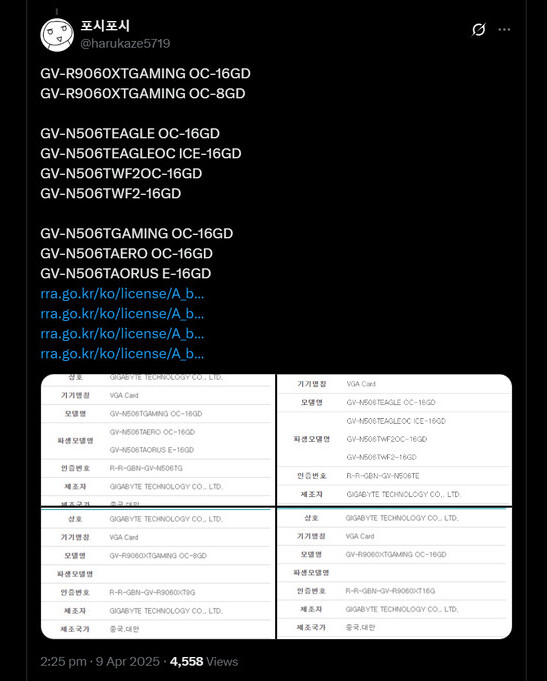
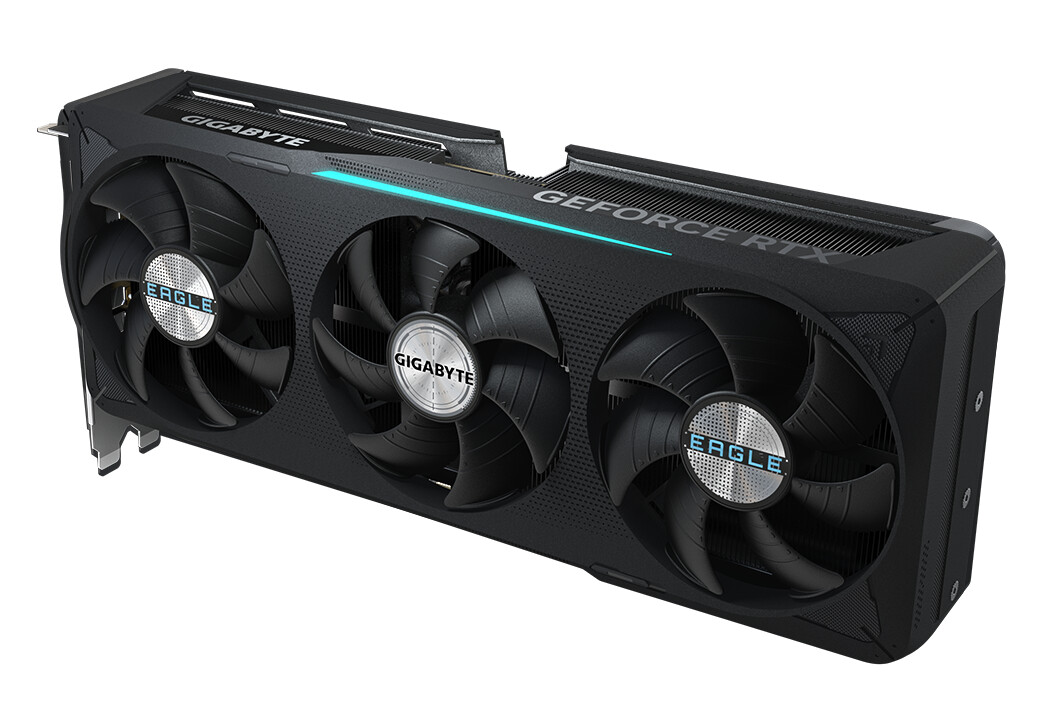
GIGABYTE has registered an (overall) impressive number of unannounced AMD Radeon RX 9060 XT and NVIDIA GeForce RTX 5060 Ti custom models in South Korea. The early April filings were spotted by harukaze5719—evidence of this "official" leak was posted to social media this afternoon. The South Korean Radio Agency (RRA) registrations indicate an imminent arrival of cheaper offerings from the opposing teams—possibly within proximity of each other, time-wise. GIGABYTE's collection of forthcoming GeForce RTX 5060 Ti 16 GB SKUs includes AERO, AORUS ELITE, EAGLE, GAMING, and WINDFORCE options.

By comparison, their Radeon RX 9060 XT portfolio is looking thoroughly threadbare—with the registration of two RDNA 4 GAMING OC cards; sporting 16 GB and 8 GB VRAM configurations. As reported late last month, ASUS seems to have three budget-friendly Radeon product lines—DUAL, PRIME and TUF—in the pipeline. It is possible that another set of cards are in line for processing at the RRA. So far, GIGABYTE's custom GeForce RTX 5060 Ti SKU filings are all 16 GB variants. 8 GB cards could be stuck in a queue. NVIDIA's board partners are expected to launch the first wave of GB206 "Blackwell" GPU-based desktop gaming solutions next week; "adjusted" speculative price points were leaked a day or two ago.

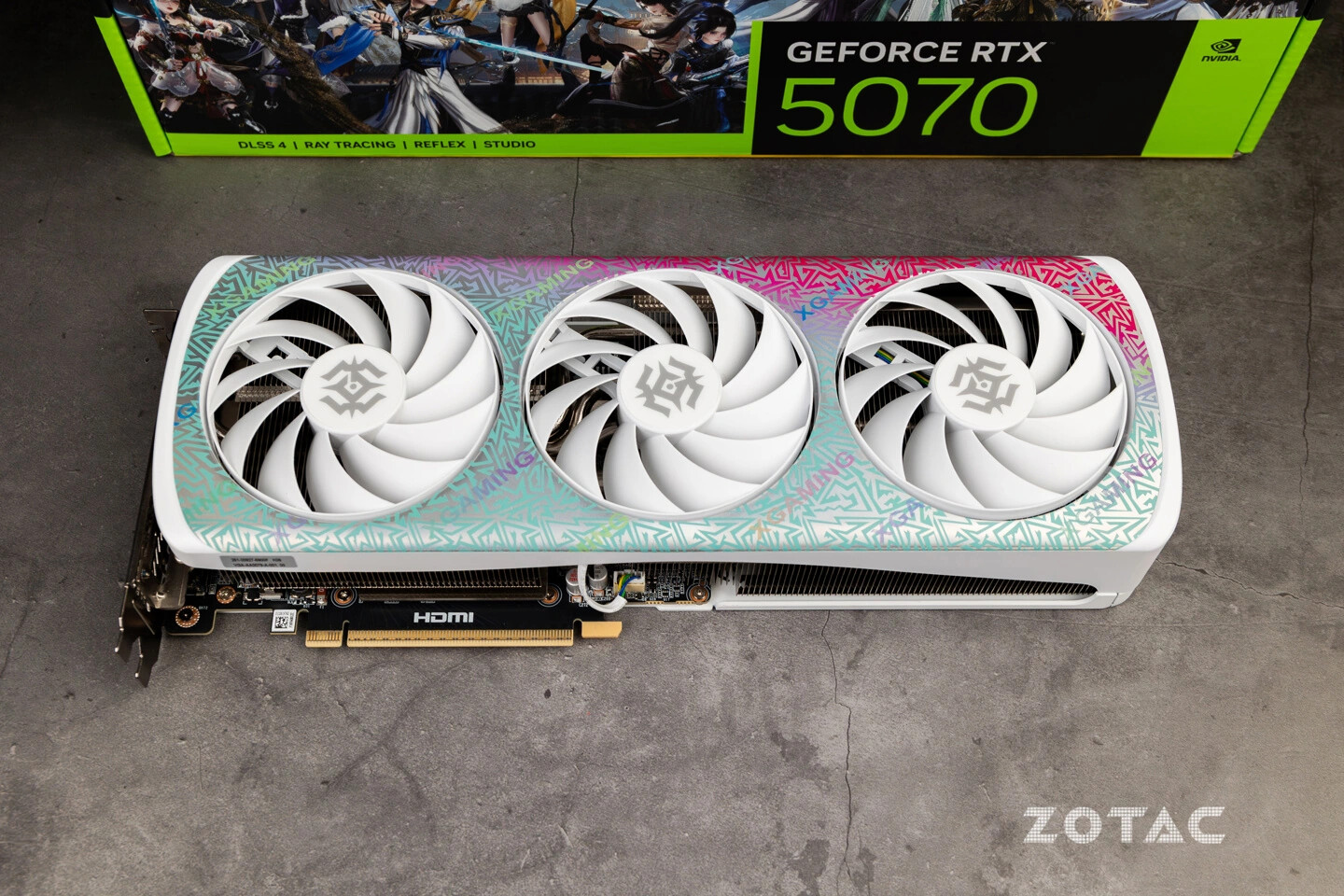
ZOTAC Reveals X-Gaming GeForce RTX 5070 Jian Wang 3 Special Edition

Earlier today, ZOTAC unveiled a special edition spin-off of its relatively new GeForce RTX 5070 X-Gaming 12 GB design. The manufacturer's Weibo channel outlined the very exclusive nature of this MMORPG-themed offering (via machine translation): "watch the finals and get a graphics card! ZOTAC and the first 'Jian Wang 3' competitive group hero joint customized graphics card, fine customization, supports NVIDIA DLSS 4 and Reflex 2 technology, excellent performance. On April 12-13, Nanjing Ledongli Jiangning International E-sports Center, watch the heroes aiming for the top!" According to an ITHome report, the Chinese brand has redecorated its overclocked GeForce RTX 5070 X-Gaming model with Jian Wang 3 characters. ZOTAC's promotional shots showcase a customized backplate, and the same illustration of Jian Wang 3's main cast adorning the card's retail box.

Late last month, Kuroutoshikou Japan introduced a less impressive Blade and Soul NEO-themed rebadge of their standard Radeon RX 7600 SKU—essentially, PowerColor's Fighter RX 7600 design. ITHome noted that ZOTAC has a short-ish history of readying very limited edition designs for past Jian Wang 3 Masters Tournaments. 2024's prize was based on the manufacturer's GeForce RTX 4070 Ti SUPER TRINITY OC White SKU. 2023 finalists were gifted with customized GeForce RTX 4070 Ti X-Gaming OC cards. Both of the previous gen tie-in designs sported Jian Wang 3 graphics or symbols on their shrouds, while the latest entry simply reuses its base SKU's "youthful graffiti" aesthetic.

Indian Retailer Holds Baffling Competition - Lucky Winners Will Buy COLORFUL GeForce RTX 5080 Cards at "MSRP"

A farcical "GIGABYTE RTX 5090 Super Bundle" was highlighted by PC hardware media outlets last week—the steep demand for flagship and high-end NVIDIA GeForce RTX 50-series "Blackwell" graphics cards has prompted the creation of many "innovative" anti-scalper selling strategies. Another ludicrous example has emerged courtesy of fresh news coverage focusing on an "EliteHubs x COLORFUL RTX 5080 Campaign." This competition is open to residents of India—EliteHubs advertises itself as a popular regional "computer accessories store and Esports tournament organizer." Unfortunately, current global market conditions have inflated prices of recently launched new generation graphics card models—the "EliteHubs x COLORFUL RTX 5080 Campaign" apparently rallies against such practices, albeit in an extremely limited fashion. The competition's author delivered crucial details: "we're thrilled to announce an exclusive opportunity where three lucky winners will each receive a brand-new COLORFUL RTX 5080 Ultra White OC graphics card—one unit per person! This powerhouse graphics card is available at the official NVIDIA MSRP of Rs. 1,10,000 (~$1265 USD)."

According to TechSpot, a quick investigation revealed that the advertised cost of ownership was accurate—they noted: "checking other online stores in India shows all the COLORFUL RTX 5080 Ultra W OC models are priced above that MSRP. This is a higher-end third-party card, admittedly, so it appears participants are getting the chance to buy it at a slightly cheaper price than usual. Still, most people expect competitions to have actual prizes, and the fact there will be only three winners is a bit comical." Prior to official launch—in late January—a Vietnamese customer managed to bag themselves the same model for a princely sum of $1400. VideoCardz did not receive a response from COLORFUL, prior to the publication of their news coverage. The Chinese AIB did not provide comment when asked about said promotional campaign.

AMD Plans Aggressive Price Competition with Radeon RX 9000 Series

According to ITHome, AMD is preparing to disrupt its competition with aggressive pricing for its upcoming RX 9000 series. The RX 9070 XT, built on the RDNA 4 architecture, is expected to launch at $599, positioning it directly against NVIDIA's RTX 5070 Ti, which carries a $749 price tag. With this competitive pricing, AMD aims to revitalize its market position following lower-than-expected sales of the RX 7000 series, causing it to lose some market share. The upcoming RX 9070 XT features the Navi 48 core running at 2.97 GHz, complemented by 16 GB of GDDR6 memory across a 256-bit bus. Architecture's enhanced AI upscaling capabilities, already demonstrated in the PlayStation 5 Pro, could offer compelling performance advantages over current-generation cards. The base RX 9070 model is anticipated to debut at $499, creating a focused attack on multiple market segments, including NVIDIA's RTX 5070, priced at $549.

AMD reportedly plans to accelerate the end-of-life timeline for its RX 7800 XT, currently priced at $479. Sources from IT Home suggest production ceased as early as January, months ahead of the planned initial third-quarter 2025 termination. This accelerated timeline suggests AMD's confidence in the RX 9000 series' ability to deliver superior price-to-performance metrics. The March 2025 launch window for the RX 9000 series arrives at a critical point in the GPU market, as NVIDIA rolls out its Blackwell-based RTX 50 series. AMD's aggressive pricing strategy and the architectural improvements in RDNA 4 positions the company to challenge NVIDIA's market dominance, at least in the $500-$600 price range. This competitive positioning could trigger NVIDIA price adjustments, potentially benefiting consumers who have faced consistently high GPU prices in recent years.

Razer Viper V3 Pro Crowned the #1 Gaming Mouse for Esport Professionals

Razer has solidified its position as the ultimate choice for esports professionals with the Razer Viper V3 Pro officially crowned the #1 most-used gaming mouse by esports pros, according to Prosettings.net (as of December 2024). This monumental achievement completes our pro peripherals trifecta of dominance, with the Razer BlackShark V2 Pro reigning as the #1 most used esports headset as of December 2024 and the Razer Huntsman V3 Pro TKL leading as the #1 most used esports keyboard as of December 2024.

What Sets the Razer Viper V3 Pro Apart
Razer's long-standing dedication to esports innovation has led to the creation of groundbreaking gear trusted by champions. The Razer Viper V3 Pro is not just another gaming mouse; its precision-engineered excellence is designed for, and by, esports pro athletes. From its ultra-lightweight form to next-gen sensor, the Razer Viper V3 Pro is meticulously engineered to meet the uncompromising demands of competitive gaming where a single millisecond makes all the difference. Extensive feedback on shape, weight, button placement and feel of switches were taken from pro players, with more than 45 of them testing the mouse across major tournaments such as the BLAST Fall Finals 2024 Copenhagen. We listened—and the result is a mouse that transcends expectations. Read more about "The Rise of the Razer Viper V3 Pro" on Prosettings.net.

Intel Won't Compete Against NVIDIA's High-End AI Dominance Soon, Starts Laying Off Over 2,200 Workers Across US

Intel's taking a different path with its Gaudi 3 accelerator chips. It's staying away from the high-demand market for training big AI models, which has made NVIDIA so successful. Instead, Intel wants to help businesses that need cheaper AI solutions to train and run smaller specific models and open-source options. At a recent event, Intel talked up Gaudi 3's "price performance advantage" over NVIDIA's H100 GPU for inference tasks. Intel says Gaudi 3 is faster and more cost-effective than the H100 when running Llama 3 and Llama 2 models of different sizes.

Intel also claims that Gaudi 3 is as power-efficient as the H100 for large language model (LLM) inference with small token outputs and does even better with larger outputs. The company even suggests Gaudi 3 beats NVIDIA's newer H200 in LLM inference throughput for large token outputs. However, Gaudi 3 doesn't match up to the H100 in overall floating-point operation throughput for 16-bit and 8-bit formats. For bfloat16 and 8-bit floating-point precision matrix math, Gaudi 3 hits 1,835 TFLOPS in each format, while the H100 reaches 1,979 TFLOPS for BF16 and 3,958 TFLOPS for FP8.

Six Mod Artists Compete to Redesign Thermaltake TOUGHRAM XG RGB D5

Thermaltake, a leading PC DIY brand for premium hardware solutions, kicked off the "2024 Thermaltake RAM MOD Invitational" an annual competition that gathers modders from all corners of the world to mod the designated Thermaltake ram into their own masterpiece. This year we invited six modders from Austria, Italy, Japan, Thailand, and the United Kingdom to modify the TOUGHRAM XG RGB D5 Memory DDR5.

Participating modders are given a specific time frame to modify the RAM heatsinks, without changing the overall appearance and layout of the RAM itself. Contestants must only use our TOUGHRAM XG RGB D5 modules and cannot add the ram to a motherboard or a PC build. However, they can create a stand or platform for the modules but the overall modules must remain intact with the original design as the main focus.

French Authorities to File Competition Charges Against NVIDIA

On July 1st, Reuters reported that the French antitrust authority plans to file charges against NVIDIA for alleged anti-competitive practices, marking France as the first country to take such action against the tech giant. This follows a raid on NVIDIA's local offices in September 2023, as we reported here, which was part of a broader investigation into the graphics card and cloud computing sectors. A recent report released by French authorities regarding competition in generative AI highlighted concerns about potential abuses of power by chip suppliers, specifically noting the industry reliance on NVIDIA. If NVIDIA is to be found guilty of charges made by French authorities it can be facing fines of up to 10% of its global annual revenue. However, NVIDIA may have the option to make concessions to avoid such penalties.

As the world's largest manufacturer of AI chips and computer graphics cards, NVIDIA is under intense scrutiny from antitrust authorities in Europe and the United States. The European Commission is gathering informal feedback to assess whether NVIDIA had breached its antitrust rules, though it has not yet launched a formal investigation. The Department of Justice and Federal Trade Commission are reportedly conducting joint investigations into NVIDIA, Microsoft, and OpenAI, reflecting growing regulatory concern in the United States over these tech giants' market influence.

G.Skill Announces OC World Record Event 2024 Alongside New Product Launches

G.SKILL International Enterprise Co., Ltd., the world's leading brand of performance overclock memory and PC components, is excited to showcase multiple new products at Computex 2024, including new DDR5 memory, peripherals, and PC cases for PC enthusiasts. G.SKILL will also host two major annual extreme overclocking events at the G.SKILL Computex booth - the 10th Annual OC World Record Stage 2024 and the 8th Annual OC World Cup 2024 - as well as the 4th Annual G.SKILL Extreme Mod Stage 2024 to showcase creative system mods. G.SKILL sincerely invites you to come visit our booth at Nangang Exhibition Center, Hall 1 (TaiNEX 1), 1F, Booth J0601a during Computex from June 4 to June 7, 2024.

G.SKILL OC World Record Stage has been a highly anticipated overclocking event in the extreme overclocking community. It's a great venue where the world's top professional overclockers gather at the G.SKILL Computex booth and try to achieve as many overclocking records as possible using liquid nitrogen (LN2) for extreme cooling. This year, this extreme overclocking event features high-end performance motherboards from ASRock, ASUS, GIGABYTE, and MSI, the latest Intel platform, and G.SKILL DDR5 memory.
Return to Keyword Browsing
Nov 11th, 2026 03:16 CST change timezone

New Forum Posts

Popular Reviews

TPU on YouTube

Controversial News Posts