Congatec Reveals Core Ultra Series 3-powered COM-HPC & COM Express Modules
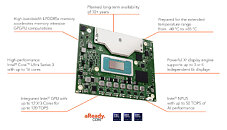
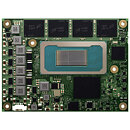
Back in January, Congatec briefly outlined a "launch of five new modules featuring the new Intel Core Ultra Series 3" processor series. Over a month later, their "Panther Lake-H"-powered range has appeared online in COM-HPC and COM Express module forms. An introductory YouTube video, with a publication date of January 5, advertises a significant new generation leap for embedded computing and accelerated edge AI workloads. The best of these modules can deliver up to 180 TOPS of AI performance, presumably enabled by Team Blue's flagship Core Ultra X9 388H APU. The credit card-sized (55 x 84 mm/COM Express Type 10) MC1000 model can be configured with a maximum of 32 GB LPDDR5X (up to) 8533 MT/s "soldered down" system memory. A soldered LPDDR5X arrangement is detailed in the HPC/mPTL's spec sheet, up to 96 GB/8533 MT/s, on a SWaP-C optimized framework (95 x 70 mm/COM-HPC mini).
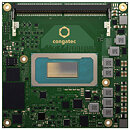
The ruggedized TC1000 and TC1000r models share the same overall dimensions (95 x 95 mm), that conforms to Congatec's COM Express compact format. The TC1000 board design sports dual SODIMM sockets, that can accept up to 64 GB DDR5/7200 MT/s memory modules, with total system capacity reaching 128 GB. The TC1000r's dram spec is described as: "96 GB LPCAMM2 memory based on LPDDR5x with up to 8533 MT/s" transfer rates. The largest "Panther Lake"-based option—HPC/cPTL (95 x 120 mm/COM-HPC Client Size A)—features an LPCAMM2 socket that accepts up to 96 GB of LPDDR5X memory, with max. transfer rates of 7466 MT/s. At the time of writing, Congatec's PR department has not issued a comprehensive PR piece. In the meantime, curious customers can peruse the manufacturer's detailed product pages, select various memory configs, and request quotes.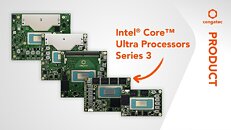
The ruggedized TC1000 and TC1000r models share the same overall dimensions (95 x 95 mm), that conforms to Congatec's COM Express compact format. The TC1000 board design sports dual SODIMM sockets, that can accept up to 64 GB DDR5/7200 MT/s memory modules, with total system capacity reaching 128 GB. The TC1000r's dram spec is described as: "96 GB LPCAMM2 memory based on LPDDR5x with up to 8533 MT/s" transfer rates. The largest "Panther Lake"-based option—HPC/cPTL (95 x 120 mm/COM-HPC Client Size A)—features an LPCAMM2 socket that accepts up to 96 GB of LPDDR5X memory, with max. transfer rates of 7466 MT/s. At the time of writing, Congatec's PR department has not issued a comprehensive PR piece. In the meantime, curious customers can peruse the manufacturer's detailed product pages, select various memory configs, and request quotes.


