News Posts matching #Cortex-X925

Return to Keyword Browsing

NVIDIA N1 Gaming SoC Surfaces on Laptop Motherboard with 128 GB LPDDR5X Memory

NVIDIA's upcoming N1 SoC, designed for gaming laptops, has officially appeared for the first time alongside its motherboard intended for a laptop. Featuring 128 GB of LPDDR5X memory running at 8,533 MT/s, the SoC is paired with SK hynix modules. NVIDIA's OEM partners for this launch, including Dell and Lenovo, have confirmed that the new NVIDIA laptop platform will be available this year, and we have seen early benchmark submissions of the N1 SoC. As NVIDIA prepares to enter the gaming laptop market, the company initially released its GB10 SoC for the DGX Spark mini workstation. This chip allowed NVIDIA to test its collaboration with MediaTek on developing new low-power SoCs that offer unusually high-performance graphics for AI applications, as well as very high RAM capacity.

In the latest images that appeared on Goofish, we see a laptop motherboard equipped with the NVIDIA N1 SoC and 128 GB of LPDDR5X memory closely packed in a specialized PCB area. This area might be designated for the cooler, which could potentially also cool the LPDDR5X memory modules. NVIDIA plans to introduce its N1/N1X SoCs with Arm-based CPU cores around Computex 2026. These will offer consumers 20 CPU cores, consisting of 10 Cortex-X925 and 10 Cortex-A725 CPU cores based on the Armv9.2 ISA, along with a "Blackwell" GPU optimized for low power settings with up to 6,144 CUDA cores in the higher-end form. You can also see the port selection on the side of the PCB, which seems to be USB-C or Thunderbolt 4/5, USB-A, and an HDMI connection. Since we don't know which laptop model this is, we have to wait a bit more before getting final details.

EA Working on Javelin Anticheat Port for Windows-on-Arm

EA posted a job listing seeking an engineer to port its Javelin Anticheat, a kernel-level anticheat solution, to the Windows-on-Arm (WoA) platform. This is a significant indicator of where the industry is headed, confirming that the biggest game developers are officially porting their game engines, games, and anticheat solutions to Arm-based PCs running the Windows 11 operating system. Interestingly, this coincides with NVIDIA's introduction of its N1/N1X SoCs with Arm-based CPU cores, which are expected to launch in the first half of this year. These will offer consumers 20 CPU cores, consisting of 10 Cortex-X925 and 10 Cortex-A725 CPU cores based on the Armv9.2 ISA, along with a "Blackwell" GPU optimized for low power settings with 6,144 CUDA cores. Adding to the growing ecosystem of WoA solutions, NVIDIA will be competing with Qualcomm's recent Snapdragon X2 Elite and X2 Plus SoCs.

If readers recall Valve's efforts to port regular Windows games to Linux, one of the biggest issues was the use of kernel-based anti-cheat solutions that simply couldn't work on the non-standard Windows 11 platform. A similar situation is now occurring even between Windows versions, as EA needs to develop a specialized solution that will work on non-x86 deployments like the standard Windows-on-Arm. It will likely be a few months before the official deployment is released, but the job listing suggests that some internal work is in progress. This means that the senior engineer EA is looking for could arrive to quickly bring these pieces together and make the new platform work without any issues.

MediaTek Unveils Dimensity 9500s and Dimensity 8500 CPUs

MediaTek has announced Dimensity 9500s and Dimensity 8500. As the latest members of the Dimensity family, both products focus on delivering outstanding performance, efficiency, AI, imaging, gaming, and wireless connectivity, driving new momentum into the flagship and premium smartphone segments.

"As leaders in smartphone global share, we are committed to increasing our investment in advanced technologies and striving to make bleeding-edge products available to more people," said JC Hsu, corporate senior vice president at MediaTek and general manager of the Wireless Communications Business Unit. "This mission is evident in this pair of Dimensity chipsets, which are intended to provide more flagship and premium smartphone experiences while upholding our vision in bringing the best possible performance and power efficiency to more people."

NVIDIA N1x is the Company's Arm Notebook Superchip

We've known since 2023 that NVIDIA is working on an Arm-based notebook SoC, and now we're seeing the first signs of the chip. A processor labelled "NVIDIA N1x" surfaced on the Geekbench 6.2.2 online database, where it scored 3096 points in the single-threaded benchmark, and 18837 points in the multithreaded benchmark. This chip is shown powering an HP-branded prototype notebook, labelled "HP 8EA3," which is running Geekbench on Ubuntu 24.04.1 LTS. The processor is identified by Geekbench as having 20 logical processors, which means it has a core-count of 20. This could be a multi-tiered big.LITTLE configuration making up those 20 cores. The clock speed being reported is 2.81 GHz. The company could implement reference Arm cores, such as the Cortex-X925 P-cores, and Cortex A725 E-cores. The HP testbed used for the Geekbench run has a whopping 128 GB of RAM.

NVIDIA has been eyeing a specific slice of the PC pie that's addressed by Qualcomm with its Snapdragon Elite line of processors for Windows-on-Arm notebooks, complete with an NPU accelerating Microsoft Copilot+ on device. The N1x could also compete with Apple's M3 or M4 chips powering its iPad Pro and MacBooks. For now, Microsoft has confined Arm-based Copilot+ to Snapdragon processors, but NVIDIA will probably work with Microsoft to open up this platform to its chips. NVIDIA has been an Arm SoC maker for decades, its first rodeo with Arm-based client-segment SoCs has been under the Tegra brand, powering Android smartphones and tablets. The company has been making Arm CPUs all this while, but for the enterprise segment (eg: Grace CPU).

NVIDIA's GB10 Arm Superchip Looks Promising in Leaked Benchmark Results

Recent benchmark leaks from Geekbench have revealed that NVIDIA's first Arm-based "superchip," the GB10 Grace Blackwell, is on the verge of its market launch as reported by Notebookcheck. This processor is expected to be showcased at Computex 2025 later this month, where NVIDIA may also roll out the N1 and N1X (MediaTek confirmed in April that their CEO—Dr. Rick Tsai—will be delivering a big keynote speech at Computex 2025 trade show) alternatives tailored for desktop and laptop use. ASUS and Dell have already put the GB10 in their upcoming products while NVIDIA has also used it in its Project DIGITS AI supercomputer. The company announced this machine at CES 2025 saying it would cost around $2,999 and be ready to buy this month.

The benchmark listings show some inconsistencies, like identifying the chipset as Armv8 instead of Armv9. However, they point out that the GB10's Cortex-X925 cores can reach speeds up to 3.9 GHz. The performance results show that the GB10 can compete with high-end Arm and x86 processors in single-core metrics. Yet, Apple's M4 Max processors still leads in this area. The GB10 marks NVIDIA's move into the workstation-grade Arm processor market and could shake up the established players in the high-performance computing field.

MediaTek Unveils New Flagship Dimensity 9400+ Mobile Platform; with Enhanced AI Performance

MediaTek today announced the Dimensity 9400+ SoC, the latest addition to MediaTek's Dimensity flagship chipset family. Providing exceptional Generative and agentic AI capabilities as well as other performance enhancements, the Dimensity 9400+ supports the latest Large Language Models (LLM) while sustaining a super power-efficient design. The Dimensity 9400+ features an All Big Core design, integrating one Arm Cortex-X925 core operating up to 3.73 GHz, combined with 3x Cortex-X4 and 4x Cortex-A720 cores. This powerful configuration accelerates single and multithreaded performance for top-tier Android UX experiences.

"The MediaTek Dimensity 9400+ will make it easier to deliver innovative, personalized AI experiences on-device, combined with enhanced overall performance to ensure your device can handle all tasks with ease," said JC Hsu, Corporate Senior Vice President at MediaTek. "We are working closely with developers and manufacturers to continue building a robust ecosystem of AI applications and other features that will bring a number of speed and privacy benefits to consumers."

Xiaomi's Proprietary Flagship Mobile SoC Reportedly Downgraded to TSMC "N4P"

According to reports from last year, Xiaomi was expected to unveil an oft-rumored proprietary mobile chipset design at some point in 2025. By October 2024, the Chinese technology giant allegedly reached the tape-out phase of its first 3 nm SoC—at the time, insiders posited that Xiaomi was seeking a manufacturing partner. Months earlier, a prototype design was linked to TSMC's 4 nm "N4P" node process—this rumor raised many smartphone watchdog eyebrows. Unlike many other Chinese firms, Xiaomi was reportedly allowed to select a fairly advanced manufacturing process at Taiwan's premier foundry service. In a past weekend news article, Wccftech outlined interesting circumstances: "(US) export controls have yet to affect Xiaomi, which is supposedly on track to launch its first in-house chipset later this year. However, while we reported last year that the company was scheduled to unveil its custom 3 nm SoC in 2025, we were disappointed to learn just the specifications of this version that will utilize TSMC's 'N4P' process. According to more details, this silicon will not sport any homegrown cores like Qualcomm has adopted for the Snapdragon 8 Elite."

Late last week, Jukanlosreve highlighted another leaker's prediction—regarding the technological foundations of Xiaomi's mystery flagship mobile processor. Fixed Focus Digital's Weibo post mentioned the "N4P" node, as well the utilization of current generation Arm Cortex-X925, Cortex-A725 and Cortex-A520 units. A speculated Imagination Technologies "IMG DXT 72-2304" integrated graphics solution is touted to outperform Qualcomm's Adreno 740 iGPU; as featured in their Snapdragon 8 Gen 2 (2022) SoC. As highlighted by Wccftech's report, one of the publication's associates has deemed Fixed Focus Digital to be an unreliable source of inside track info. In response to Jukanlosreve's tweeted question, Mochamad Farido Fanani opined: "that's right, how does Xiaomi use N4P in its new chipset? But this guy always guesses blindly." Older leaks—based on "N4P" rumors—projected performance levels roughly on par with Qualcomm's first generation Snapdragon 8 chip. This model was introduced at the tail end of 2021.

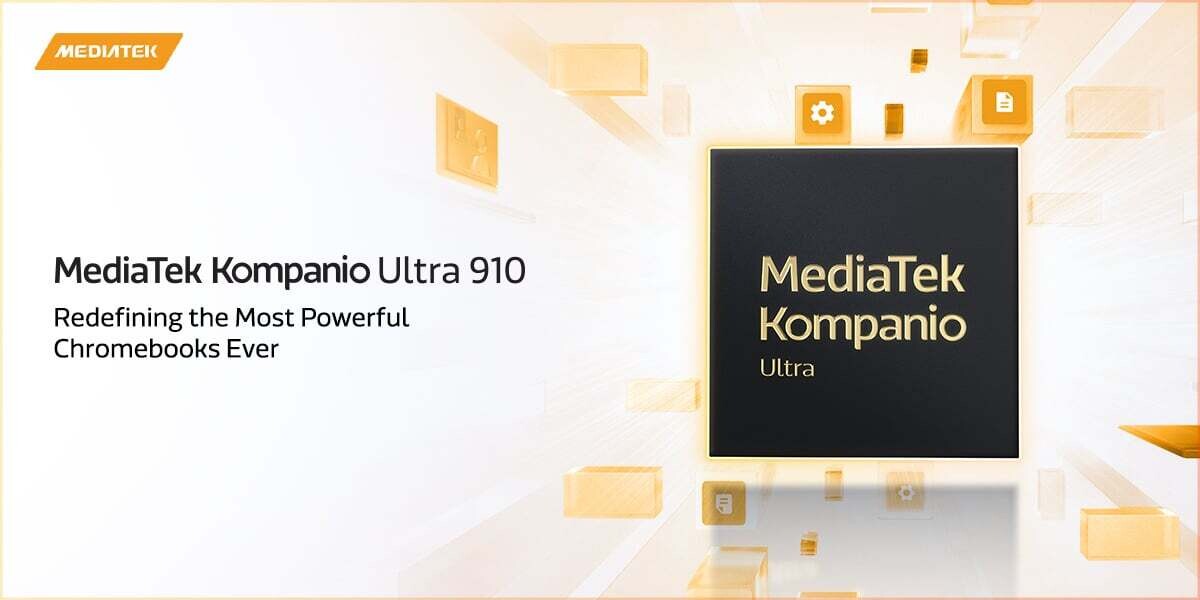
MediaTek Introduces Kompanio Ultra SoC, Touted to Redefine AI Performance for Chromebook Plus

MediaTek has introduced the Kompanio Ultra, the latest milestone in AI-powered, high-performance Chromebooks. Leveraging MediaTek's proven expertise in flagship innovation, this powerful new platform brings fantastic on-device AI capabilities, superior computing performance, and industry-leading power efficiency to the newest Chromebook Plus devices. "The Kompanio Ultra underscores our commitment to delivering groundbreaking computing performance and efficiency that MediaTek has shown as a leader in the mobile compute space for many years," said Adam King, Vice President & General Manager of Computing and Multimedia Business at MediaTek. "We worked closely with Google to ensure the newest Chromebook Plus devices enjoy next-generation on-device AI capabilities, superior performance per watt, and immersive multimedia."

The Kompanio Ultra is MediaTek's most powerful Chromebook processor to date, integrating 50 TOPS of AI processing power to enable on-device generative AI experiences. With MediaTek's 8th-generation NPU, users can expect real-time task automation, personalized computing, and seamless AI-enhanced workflows—with local processing for enhanced speed, security, efficiency, and support for AI workloads without an internet connection. Built on the cutting-edge (TSMC) 3 nm process, the Kompanio Ultra features an all-big-core CPU architecture with an Arm Cortex-X925 processor clocked at up to 3.62 GHz, delivering industry-leading single and multithreaded performance. Whether handling intensive applications like video editing, content creation, or high-resolution gaming, this processor ensures smooth, lag-free performance with unmatched multitasking capabilities.

MediaTek Announces Dimensity 9400 Flagship SoC with All Big Core Design

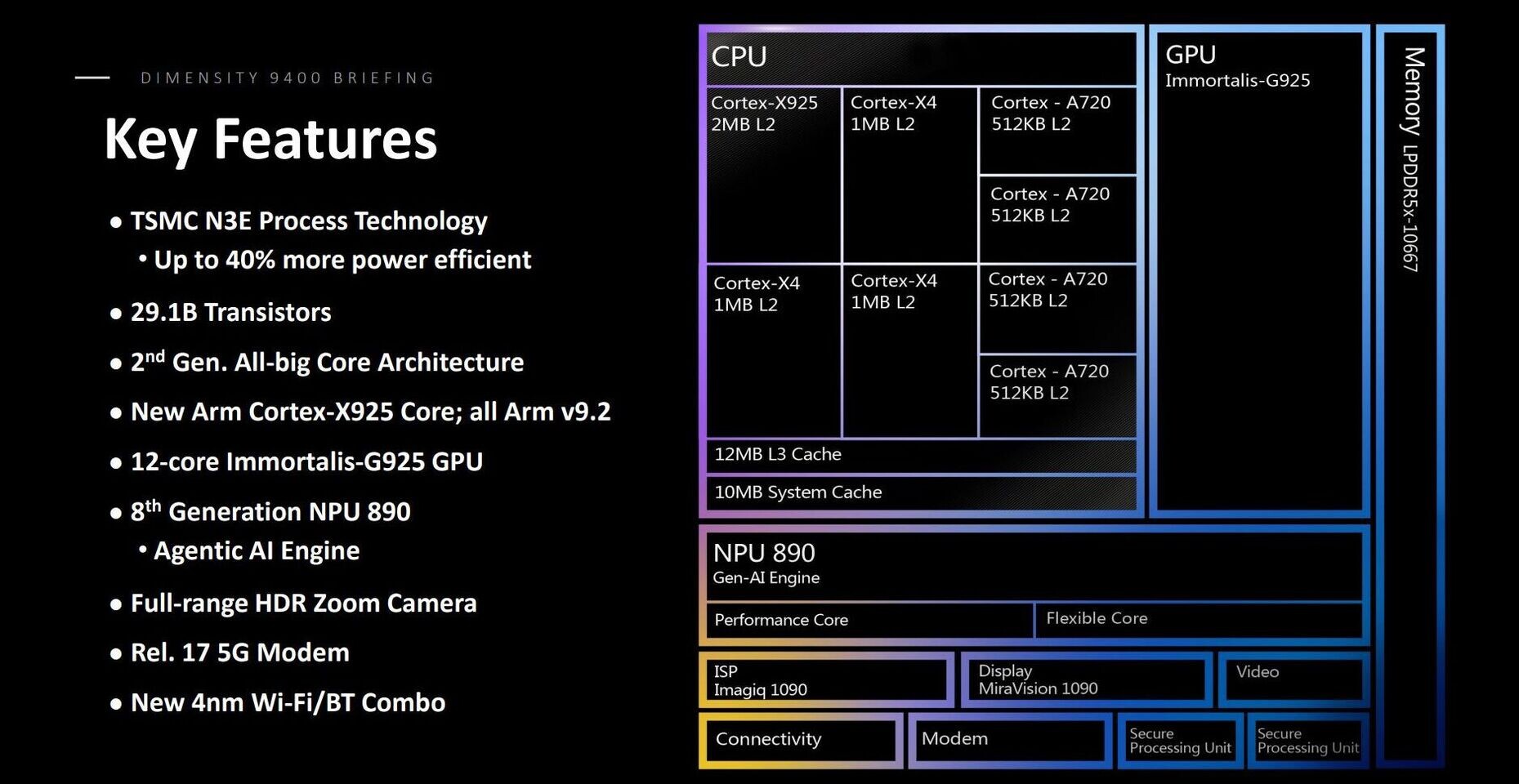
MediaTek today launched the Dimensity 9400, the company's new flagship smartphone chipset optimized for edge-AI applications, immersive gaming, incredible photography, and more. The Dimensity 9400, the fourth and latest in MediaTek's flagship mobile SoC lineup, offers a massive boost in performance with its second-generation All Big Core design built on Arm's v9.2 CPU architecture, combined with the most advanced GPU and NPU for extreme performance in a super power-efficient design.

The Dimensity 9400 adopts MediaTek's second-gen All Big Core design, integrating one Arm Cortex-X925 core operating over 3.62 GHz, combined with 3x Cortex-X4 and 4x Cortex-A720 cores. This design offers 35% faster single-core performance and 28% faster multi-core performance compared to MediaTek's previous generation flagship chipset, the Dimensity 9300. Built on TSMC's second-generation 3 nm process, the Dimensity 9400 is up to 40% more power-efficient than its predecessor, allowing users to enjoy longer battery life.

Arm Announces the Cortex-X925 and Cortex-A725 Armv9 CPU Cores

Arm has announced a pair of new Armv9 CPU cores today, alongside a refresh of a third. The new additions are the Cortex-X925—which is a huge model number jump from the previous Cortex-X4—and the Cortex-A725 which should be an upgraded Cortex-A720. Finally the Cortex-A520 has been refreshed to bring a 15 percent power efficiency improvement as well as support for 3 nm production nodes. Arm claims that the Cortex-A925 delivers its highest performance improvement ever over a previous generation with a single core uplift of up to 36 percent and an AI performance improvement of up to 46 percent compared to the Cortex-X4. The Cortex-X925 will support up to 3 MB private L2 cache and is tape-out ready for 3 nm production nodes.

The Cortex-A725 is said to offer a 35 percent performance efficiency improvement over the Cortex-A720 and it's been given performance boosts both when it comes to AI and gaming workloads. It's said to be up to 25 percent more power efficient than the Cortex-A720 and L3 cache traffic has been improved by up to 20 percent. Again, the Cortex-A720 is ready for production on a 3 nm node. Finally, Arm has also updated its DynamIQ Shared Unit to the DS-120 and here Arm has managed to reduce the typical workload power by up to 50 percent and the cache miss power by up to 60 percent. The DSU-120 scales to up to 14 Arm cores, suggesting that we might get to see some interesting new SoC implementations in the coming years from Arm's partners, although Arm's reference platform is a 2-4-2 configuration of the new cores.
Return to Keyword Browsing
Nov 18th, 2026 06:57 CST change timezone

New Forum Posts

Popular Reviews

TPU on YouTube

Controversial News Posts