News Posts matching #GPU

Return to Keyword Browsing

AMD ROCm 6.0 Adds Support for Radeon PRO W7800 & RX 7900 GRE GPUs

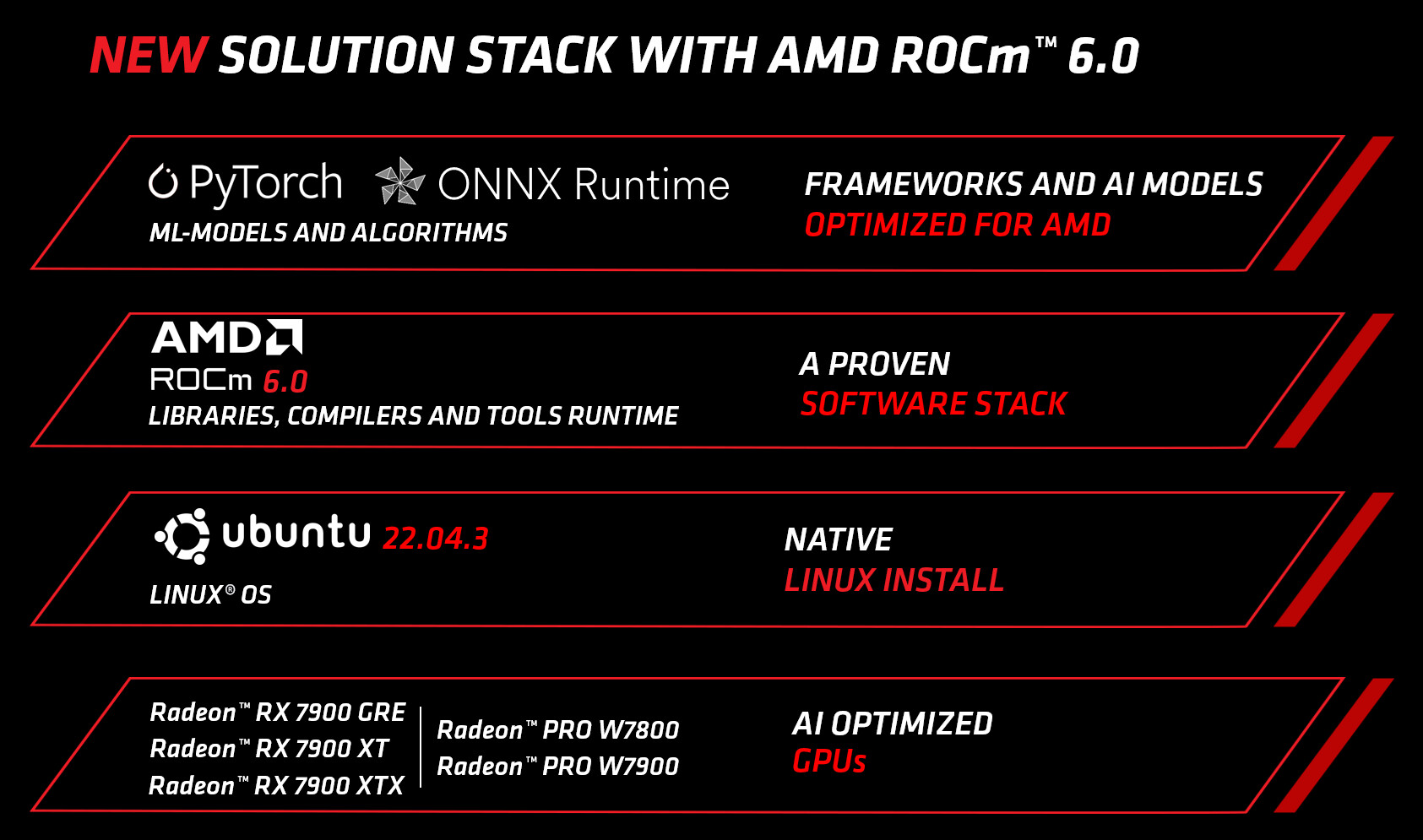
Building on our previously announced support of the AMD Radeon RX 7900 XT, XTX and Radeon PRO W7900 GPUs with AMD ROCm 5.7 and PyTorch, we are now expanding our client-based ML Development offering, both from the hardware and software side with AMD ROCm 6.0. Firstly, AI researchers and ML engineers can now also develop on Radeon PRO W7800 and on Radeon RX 7900 GRE GPUs. With support for such a broad product portfolio, AMD is helping the AI community to get access to desktop graphics cards at even more price points and at different performance levels.

Furthermore, we are complementing our solution stack with support for ONNX Runtime. ONNX, short for Open Neural Network Exchange, is an intermediary Machine Learning framework used to convert AI models between different ML frameworks. As a result, users can now perform inference on a wider range of source data on local AMD hardware. This also adds INT8 via MIGraphX—AMD's own graph inference engine—to the available data types (including FP32 and FP16). With AMD ROCm 6.0, we are continuing our support for the PyTorch framework bringing mixed precision with FP32/FP16 to Machine Learning training workflows.

NVIDIA Introduces NVIDIA RTX 2000 Ada Generation GPU

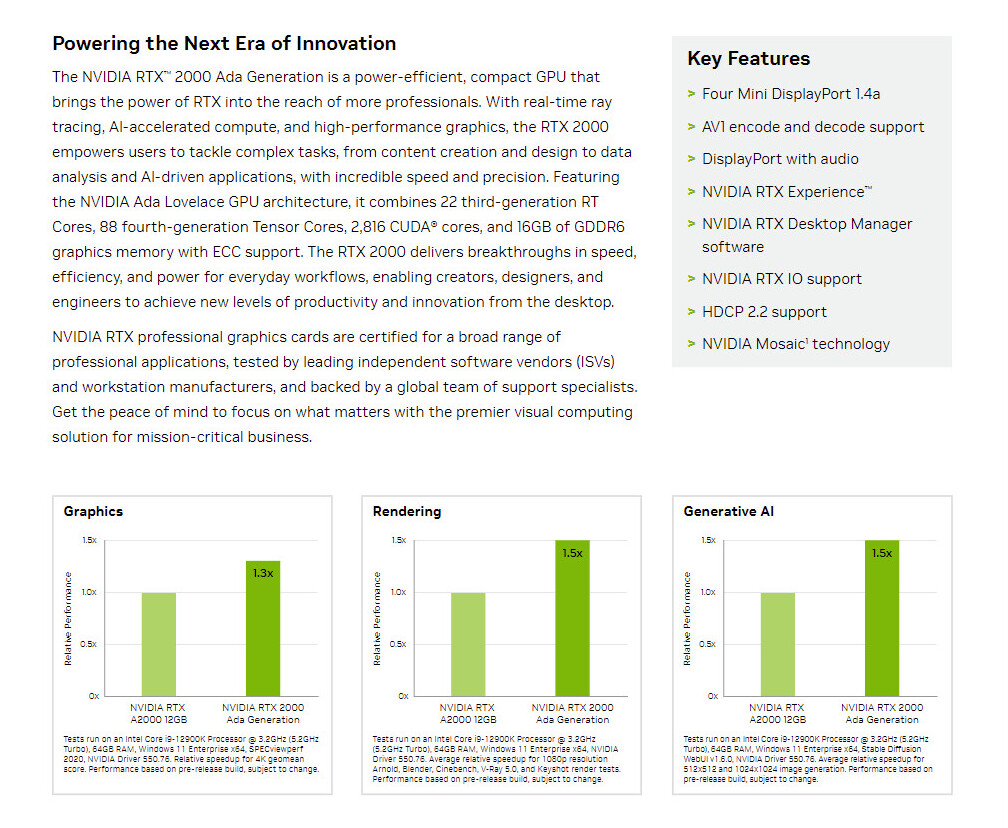
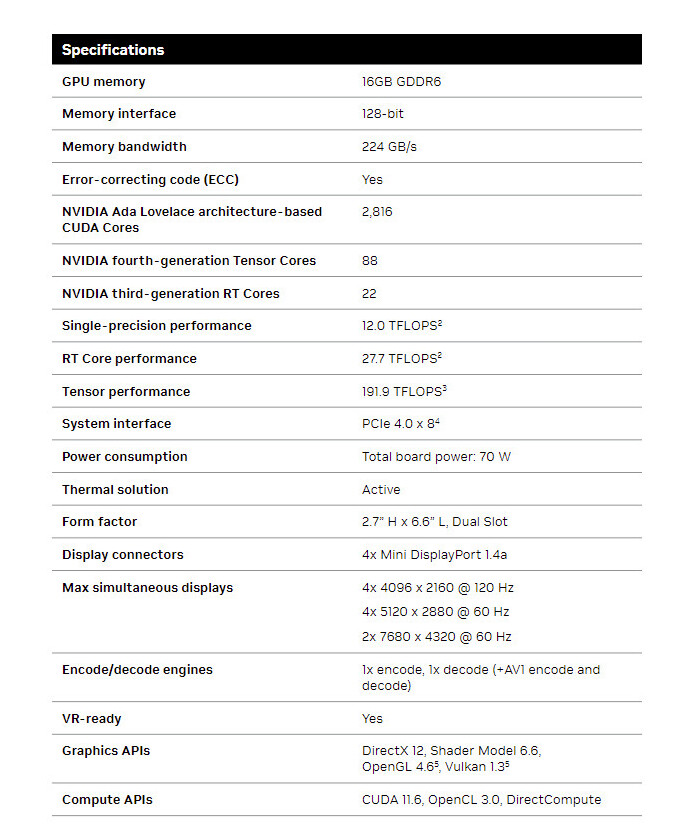
Generative AI is driving change across industries—and to take advantage of its benefits, businesses must select the right hardware to power their workflows. The new NVIDIA RTX 2000 Ada Generation GPU delivers the latest AI, graphics and compute technology to compact workstations, offering up to 1.5x the performance of the previous-generation RTX A2000 12 GB in professional workflows. From crafting stunning 3D environments to streamlining complex design reviews to refining industrial designs, the card's capabilities pave the way for an AI-accelerated future, empowering professionals to achieve more without compromising on performance or capabilities. Modern multi-application workflows, such as AI-powered tools, multi-display setups and high-resolution content, put significant demands on GPU memory. With 16 GB of memory in the RTX 2000 Ada, professionals can tap the latest technologies and tools to work faster and better with their data.
Powered by NVIDIA RTX technology, the new GPU delivers impressive realism in graphics with NVIDIA DLSS, delivering ultra-high-quality, photorealistic ray-traced images more than 3x faster than before. In addition, the RTX 2000 Ada enables an immersive experience for enterprise virtual-reality workflows, such as for product design and engineering design reviews. With its blend of performance, versatility and AI capabilities, the RTX 2000 Ada helps professionals across industries achieve efficiencies. Architects and urban planners can use it to accelerate visualization workflows and structural analysis, enhancing design precision. Product designers and engineers using industrial PCs can iterate rapidly on product designs with fast, photorealistic rendering and AI-powered generative design. Content creators can edit high-resolution videos and images seamlessly, and use AI for realistic visual effects and content creation assistance. And in vital embedded applications and edge computing, the RTX 2000 Ada can power real-time data processing for medical devices, optimize manufacturing processes with predictive maintenance and enable AI-driven intelligence in retail environments.
AMD Develops ROCm-based Solution to Run Unmodified NVIDIA's CUDA Binaries on AMD Graphics

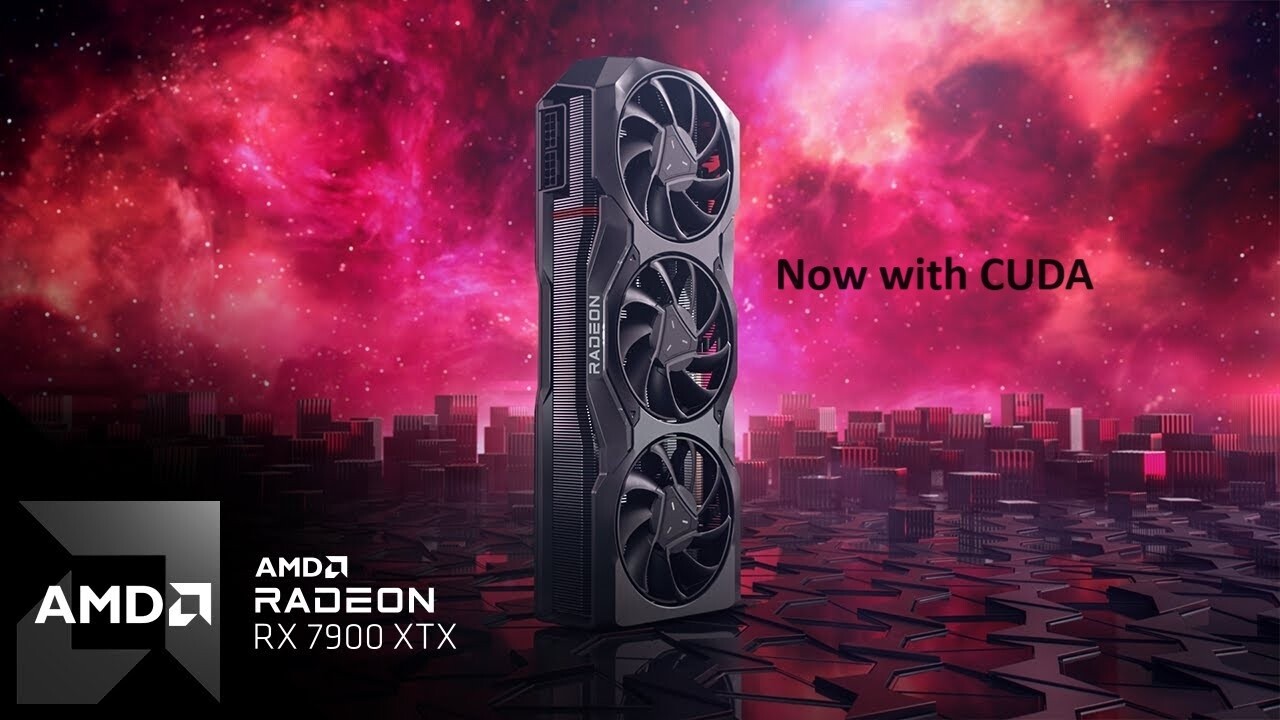
AMD has quietly funded an effort over the past two years to enable binary compatibility for NVIDIA CUDA applications on their ROCm stack. This allows CUDA software to run on AMD Radeon GPUs without adapting the source code. The project responsible is ZLUDA, which was initially developed to provide CUDA support on Intel graphics. The developer behind ZLUDA, Andrzej Janik, was contracted by AMD in 2022 to adapt his project for use on Radeon GPUs with HIP/ROCm. He spent two years bringing functional CUDA support to AMD's platform, allowing many real-world CUDA workloads to run without modification. AMD decided not to productize this effort for unknown reasons but did open-source it once funding ended per their agreement. Over at Phoronix, there were several benchmarks testing AMD's ZLUDA implementation over a wide variety of benchmarks.

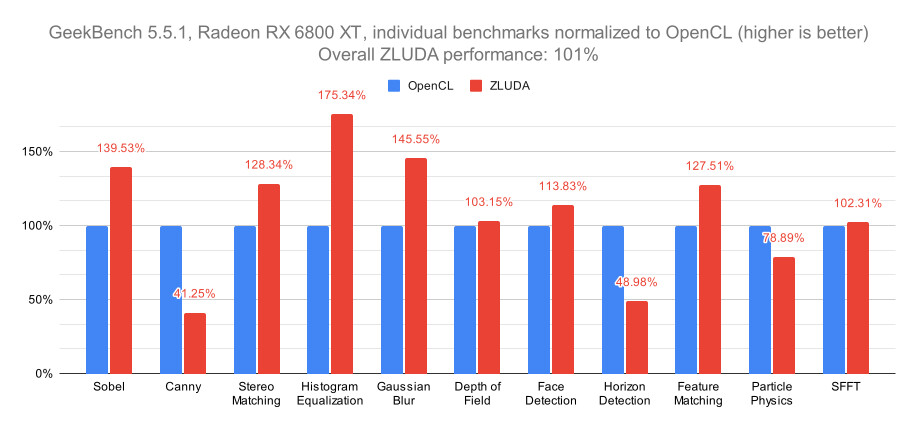
Benchmarks found that proprietary CUDA renderers and software worked on Radeon GPUs out-of-the-box with the drop-in ZLUDA library replacements. CUDA-optimized Blender 4.0 rendering now runs faster on AMD Radeon GPUs than the native ROCm/HIP port, reducing render times by around 10-20%, depending on the scene. The implementation is surprisingly robust, considering it was a single-developer project. However, there are some limitations—OptiX and PTX assembly codes still need to be fully supported. Overall, though, testing showed very promising results. Over the generic OpenCL runtimes in Geekbench, CUDA-optimized binaries produce up to 75% better results. With the ZLUDA libraries handling API translation, unmodified CUDA binaries can now run directly on top of ROCm and Radeon GPUs. Strangely, the ZLUDA port targets AMD ROCm 5.7, not the newest 6.x versions. Only time will tell if AMD continues investing in this approach to simplify porting of CUDA software. However, the open-sourced project now enables anyone to contribute and help improve compatibility. For a complete review, check out Phoronix tests.

Widespread GeForce RTX 4080 SUPER Card Shortage Reported in North America

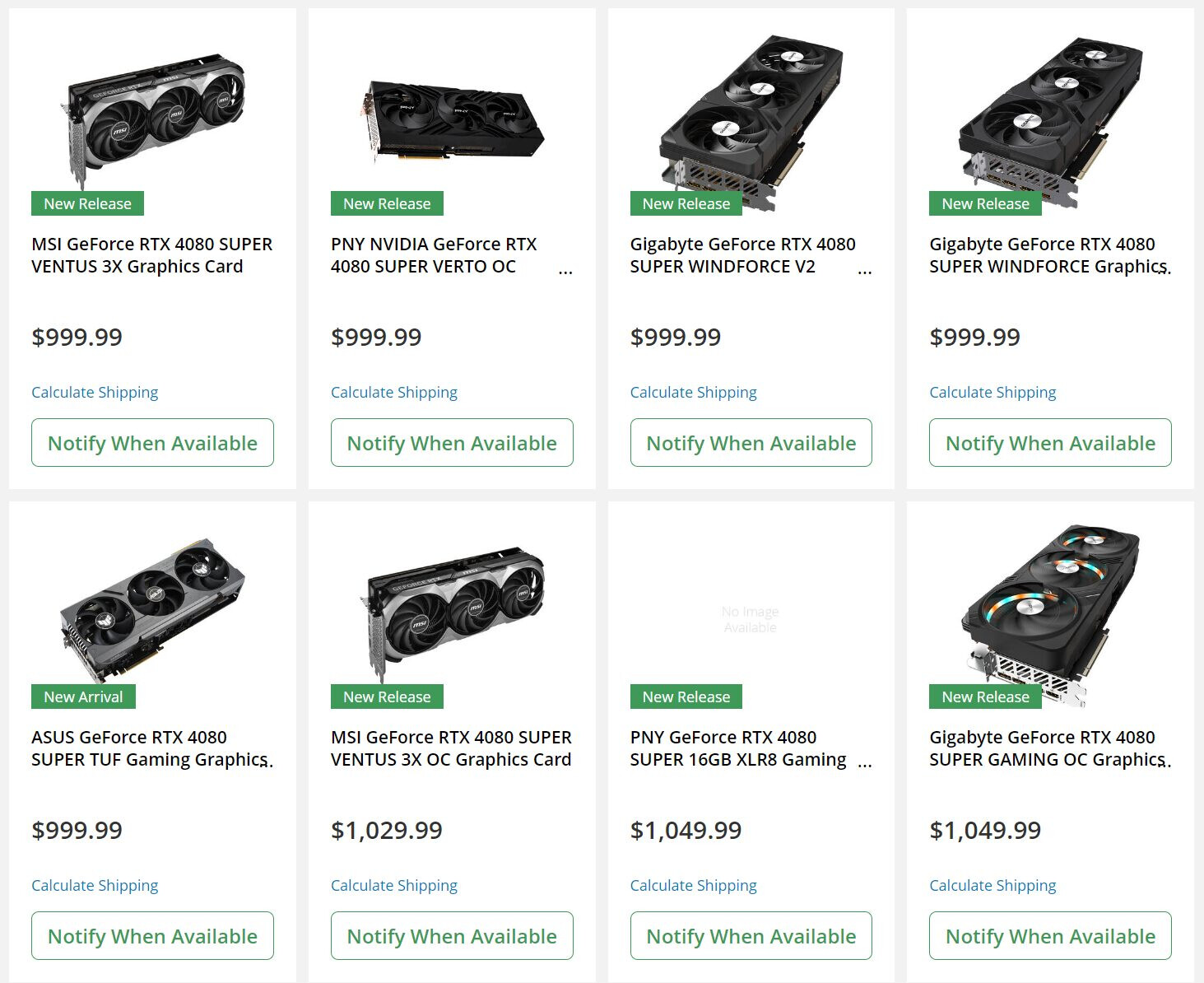
NVIDIA's decision to shave off $200 from its GeForce RTX 4080 GPU tier has caused a run on retail since the launch of SUPER variants late last month—VideoCardz has investigated an apparent North American supply shortage. The adjusted $999 base MSRP appears to be an irresistible prospect for discerning US buyers—today's report explains how: "a week after its release, that GeForce RTX 4080 SUPER cards are not available at any major US retailer for online orders." At the time of writing, no $999 models are available to purchase via e-tailers (for delivery)—BestBuy and Micro Center have a smattering of baseline MSRP cards (including the Founders Edition), but for in-store pickup only. Across the pond, AD103 SUPER's supply status is a bit different: "On the other hand, in Europe, the situation appears to be more favorable, with several retailers listing the cards at or near the MSRP of €1109."

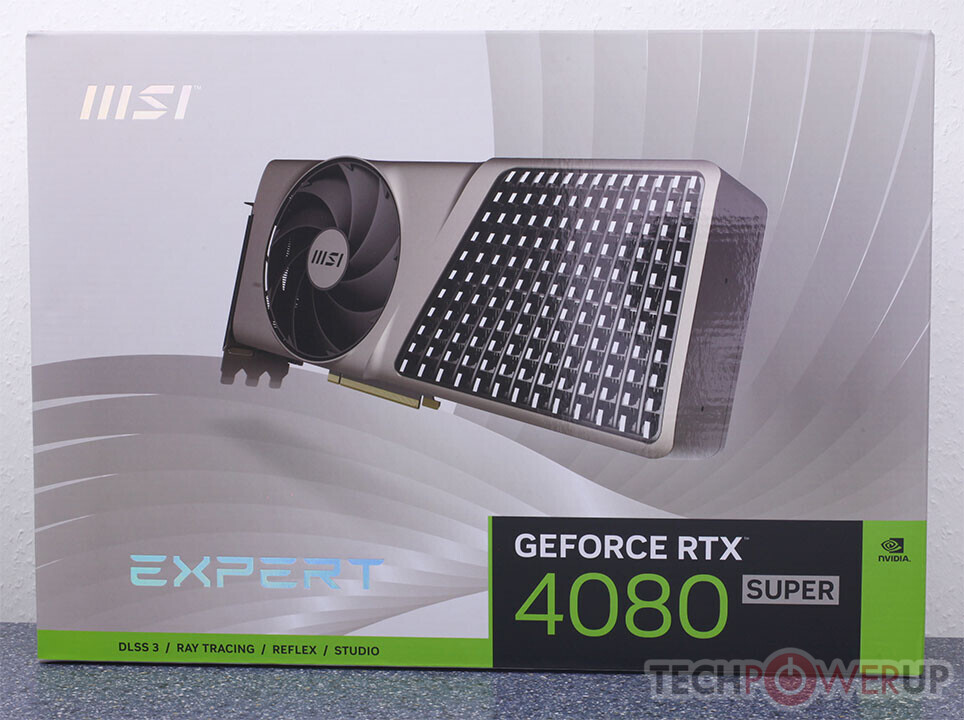
The cheapest custom GeForce RTX 4080 SUPER SKU, at $1123, seems to be listed by Amazon.com. Almost all of Newegg's product pages are displaying an "Out of Stock" notice—ZOTAC GAMING's GeForce RTX 4080 SUPER Trinity OC White Edition model is on "back order" for $1049.99, while the only "in stock" option is MSI's GeForce RTX 4080 Super Expert card (at $1149.99). VideoCardz notes that GeForce RTX 4070 SUPER and RTX 4070 TI SUPER models are in plentiful supply, which highlights a big contrast in market conditions for NVIDIA's latest Ada Lovelace families. The report also mentions an ongoing shortage of GeForce RTX 4080 (Non-SUPER) cards, going back weeks prior to the official January 31 rollout: "Similar to the RTX 4090, finding the RTX 4080 at its $1200 price point has proven challenging." Exact sales figures are not available to media outlets—it is unusual to see official metrics presented a week or two after a product's launch—so we will have to wait a little longer to find out whether demand has far outstripped supply in the USA.

IDC Forecasts Artificial Intelligence PCs to Account for Nearly 60% of All PC Shipments by 2027

A new forecast from International Data Corporation (IDC) shows shipments of artificial intelligence (AI) PCs - personal computers with specific system-on-a-chip (SoC) capabilities designed to run generative AI tasks locally - growing from nearly 50 million units in 2024 to more than 167 million in 2027. By the end of the forecast, IDC expects AI PCs will represent nearly 60% of all PC shipments worldwide.

"As we enter a new year, the hype around generative AI has reached a fever pitch, and the PC industry is running fast to capitalize on the expected benefits of bringing AI capabilities down from the cloud to the client," said Tom Mainelli, group vice president, Devices and Consumer Research. "Promises around enhanced user productivity via faster performance, plus lower inferencing costs, and the benefit of on-device privacy and security, have driven strong IT decision-maker interest in AI PCs. In 2024, we'll see AI PC shipments begin to ramp, and over the next few years, we expect the technology to move from niche to a majority."

CPSC Demands a Recall of CableMod GPU Angled Adapters, Estimates $74.5K of Damaged Property

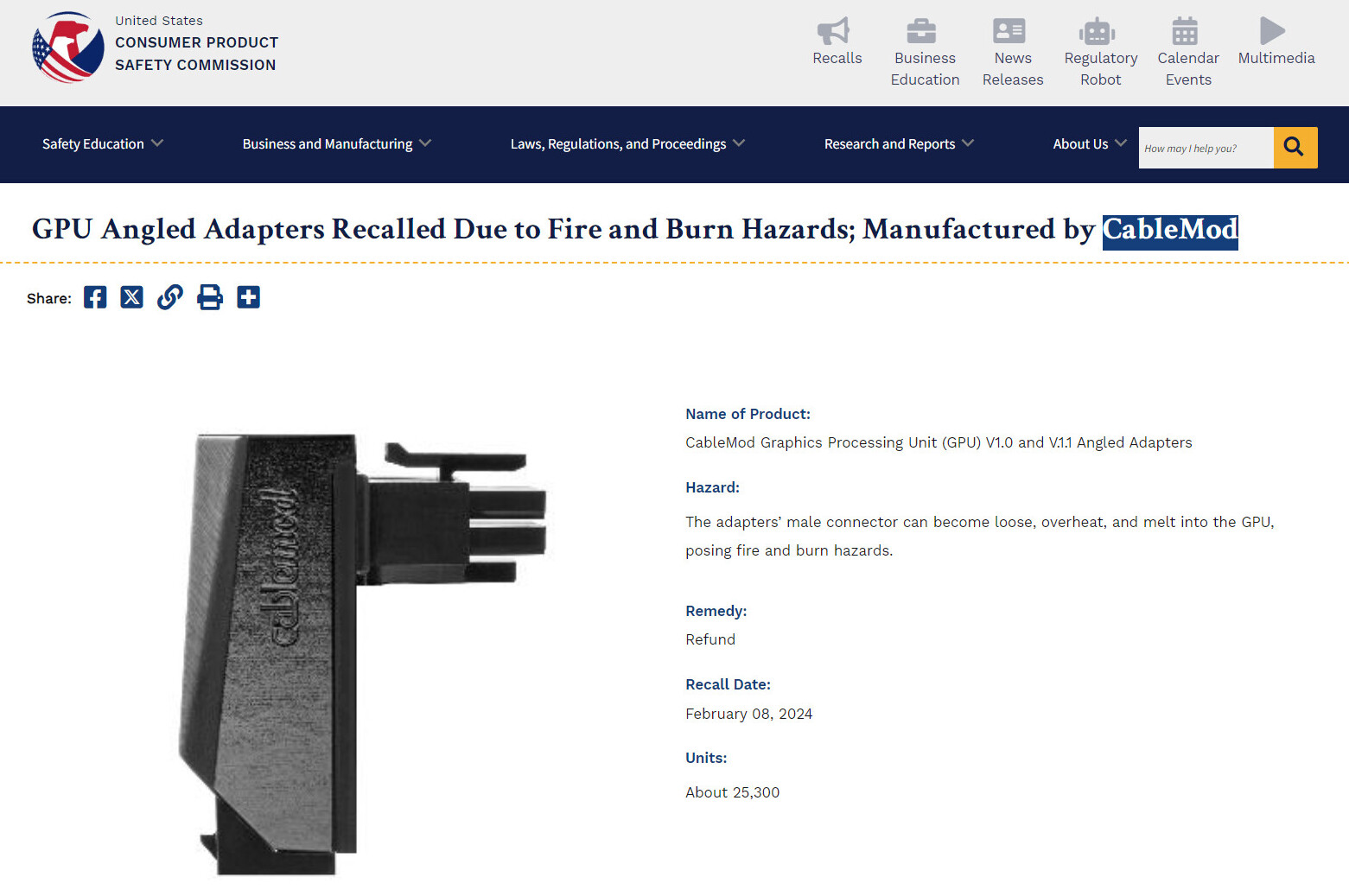
CableMod issued a statement—just before the last Christmas holiday—detailing a safety recall of 16-pin 12VHPWR angled adapters, version 1.0 and 1.1. This announcement received widespread media coverage (at least in tech circles), but some unfortunate customers have not yet received the memo about faulty adapters—CableMod's 90° angled and 180° hard connectors can overheat and in worst case scenarios, actually melt. HotHardware, amusingly named given this context, was the first hardware news outlet to notice that the Consumer Product Safety Commission (CPSC) had published a "GPU Angled Adapter" recall notice to its website earlier today, under "Recall number 24-112."

The US government body's listing outlines aforementioned hazardous conditions, along with an estimated 25,300 affected unit count. The CPSC's recommended "Remedy" advice is as follows: "Consumers should immediately stop using the recalled angled adapters and contact CableMod for instructions on how to safely remove their adapter from the GPU and for a full refund, including cost of shipping, or a $60 store credit for non-customized products, with free standard shipping. Consumers will be asked to destroy the adapter and upload a photo of the destroyed product to cablemod.com/adapterrecall/. The instructions on how to safely remove the adapter are also located on that site. Once destroyed, consumers should discard the adapter in accordance with local laws." The Safety Commission has gathered some customer feedback intelligence on this matter: "The firm (CableMod Ltd., of China) has received 272 reports of the adapters becoming loose, overheating and melting into the GPU, with at least $74,500 in property damage claims in the United States. No injuries have been reported."

Latest AMD Linux Graphics Driver Patches Linked to "RDNA 4"

Phoronix head honcho, Michael Larabel, has noticed another set of interesting updates for AMD Graphics on Linux—albeit in preparation for next generation solutions: "engineers on Monday (February 5) posted a few new patch series for enabling some updated IP (intellectual property) blocks within their open-source AMDGPU Linux kernel graphics driver. This new IP is presumably part of the ongoing hardware enablement work for their next-gen RDNA 4 graphics." Team Red GitHub patches for "GFX12" targets appeared online last November, again highlighted by Larabel's investigative work—AMD engineers appear to be quite determined with their open-source software endeavors, as seen in LLVM-Project notes regarding GFX1200's enablement.

The new "IP block" updates included patches for the enabling ATHUB 4.1, LSDMA 7.0, IH 7.0, and HDP 7.0—presumably for next generation Radeon graphics solutions. Larabel provided a quick breakdown of these components: "ATHUB 4.1 is needed for clock-gating / power management features, LSDMA 7.0 is the latest IP for Light SDMA for general purpose System DMA (SDMA) on the GPU, IH 7.0 for the Interrupt Handler on the GPU, and HDP 7.0 for the Host Data Path support for CPU accessing the GPU device memory via the PCI BAR. As far as code changes, the big chunks of the work are from the auto-generated header files." He believes that AMD's engineers have largely moved on from current generation tasks: "The big version bumps for these IP blocks all the more are likely indicative of these bits being for next-gen RDNA 4 as opposed to further iterating on RDNA3 or similar." The patches could be merged into the upcoming Linux 6.9 release, possibly coinciding with a Radeon RX 8000 series rollout.

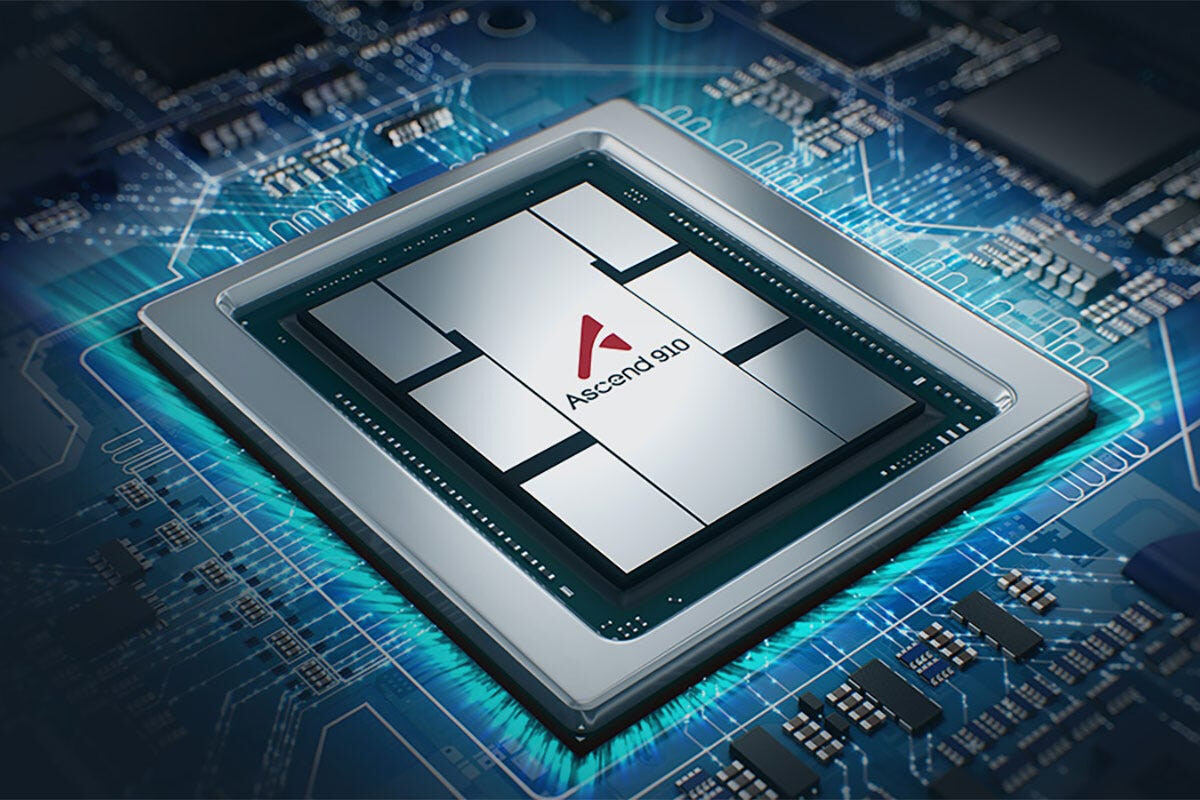
Huawei Reportedly Prioritizing Ascend AI GPU Production

Huawei's Ascend 910B AI GPU is reportedly in high demand in China—we last learned that NVIDIA's latest US sanction-busting H20 "Hopper" model is lined up as a main competitor, allegedly in terms of both pricing and performance. A recent Reuters report proposes that Huawei is reacting to native enterprise market trends by shifting its production priorities—in favor of Ascend product ranges, while demoting their Kirin smartphone chipset family. Generative AI industry experts believe that the likes of Alibaba and Tencent have rejected Team Green's latest batch of re-jigged AI chips (H20, L20 and L2)—tastes have gradually shifted to locally developed alternatives.

Huawei leadership is seemingly keen to seize these growth opportunities—their Ascend 910B is supposedly ideal for workloads "that require low-to-mind inferencing power." Reuters has spoken to three anonymous sources—all with insider knowledge of goings-on at a single facility that manufacturers Ascend AI chips and the Kirin smartphone SoCs. Two of the leakers claim that this unnamed fabrication location is facing many "production quality" challenges, namely output being "hamstrung by a low yield rate." The report claims that Huawei has pivoted by deprioritizing Kirin 9000S (7 nm) production, thus creating a knock-on effect for its premium Mate 60 smartphone range.

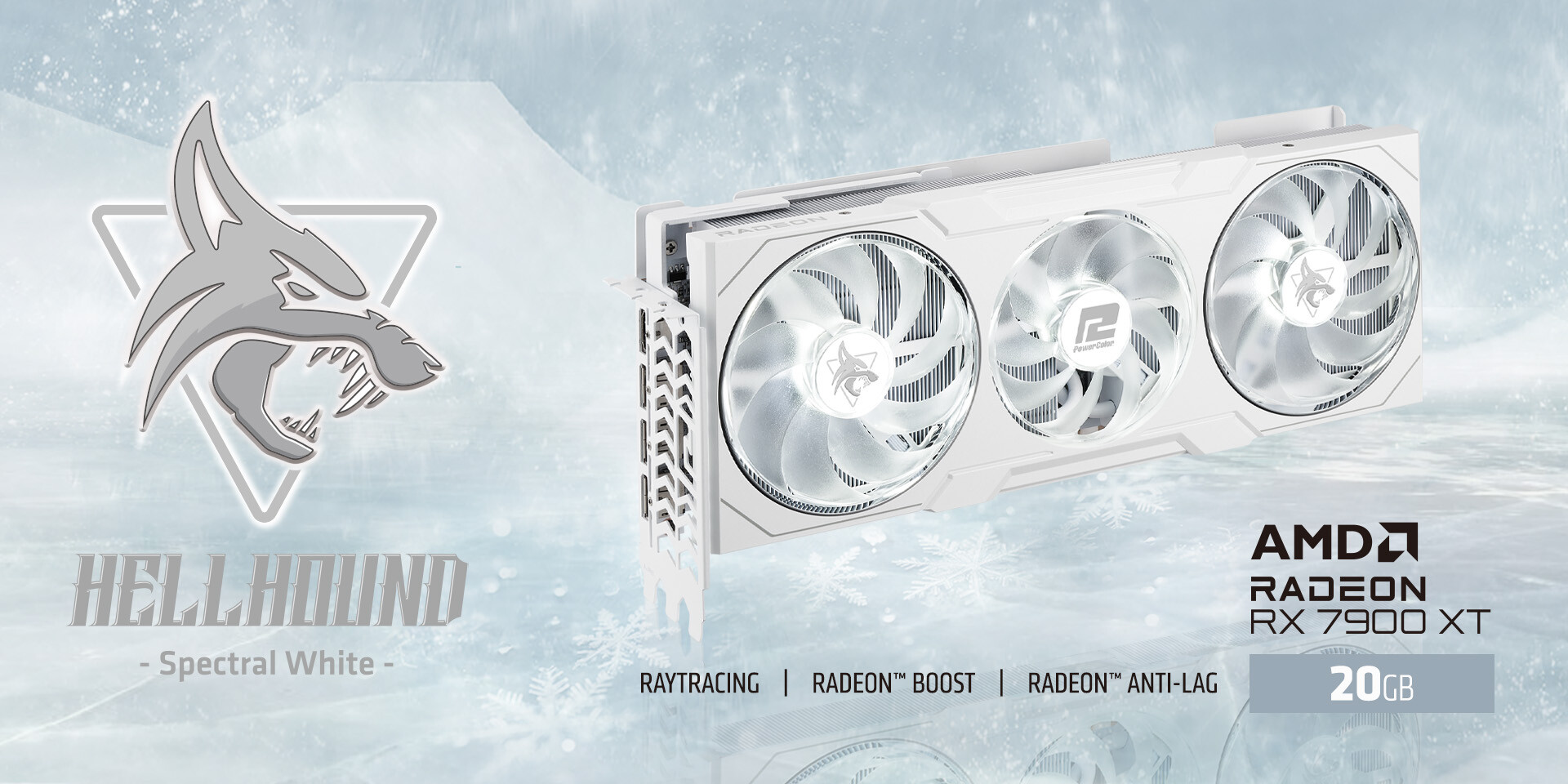
PowerColor Radeon RX 7900 XT Hellhound Spectral White Edition Revealed

PowerColor, a leader in innovative graphics card solutions, is proud to announce the launch of its latest marvel in the gaming world: the PowerColor RX 7900 XT Hellhound - Spectral White Edition. Following the overwhelming success of the 7800 XT Spectral White model, this new release brings the same unique design elements to the powerful Radeon 7900 XT series.

Spectral White Edition: A Symphony in White
The RX 7900 XT Hellhound Spectral White Edition is a testament to PowerColor's commitment to exceptional design and engineering. It features an all-white PCB, heatsink, and cooling solution, setting a new benchmark in graphics card aesthetics. This card is not just a performance powerhouse; it's a statement piece for any gaming setup, offering a pristine, unified look that white PC build enthusiasts will adore.

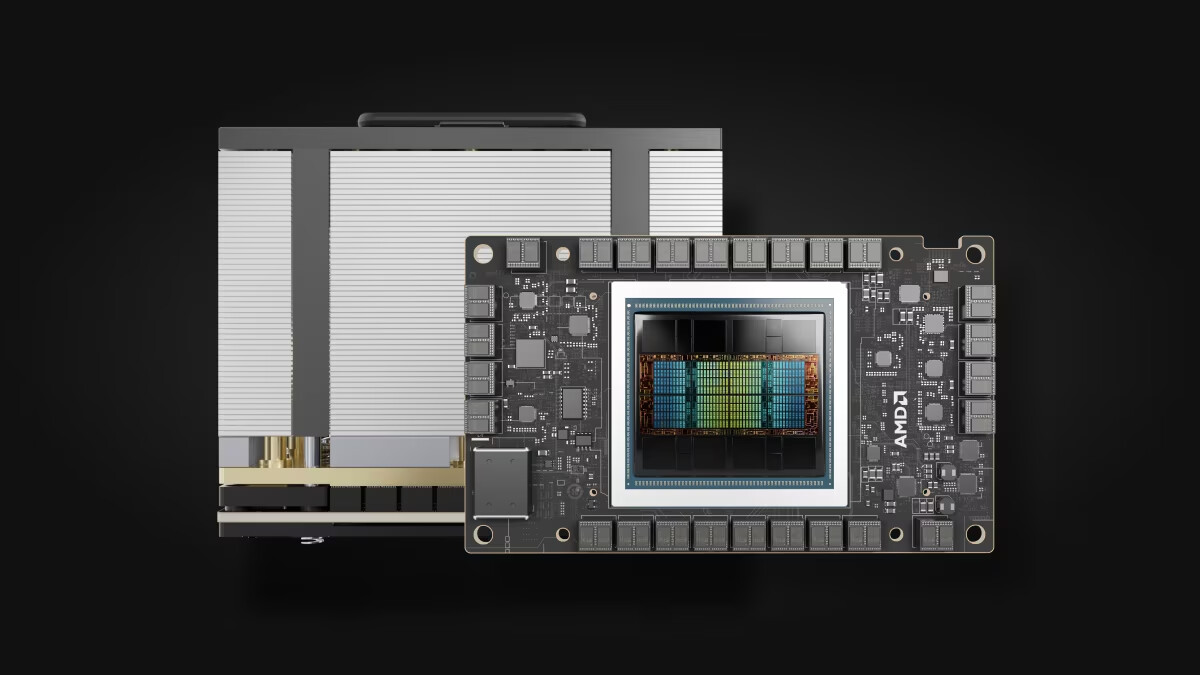
Financial Analyst Outs AMD Instinct MI300X "Projected" Pricing

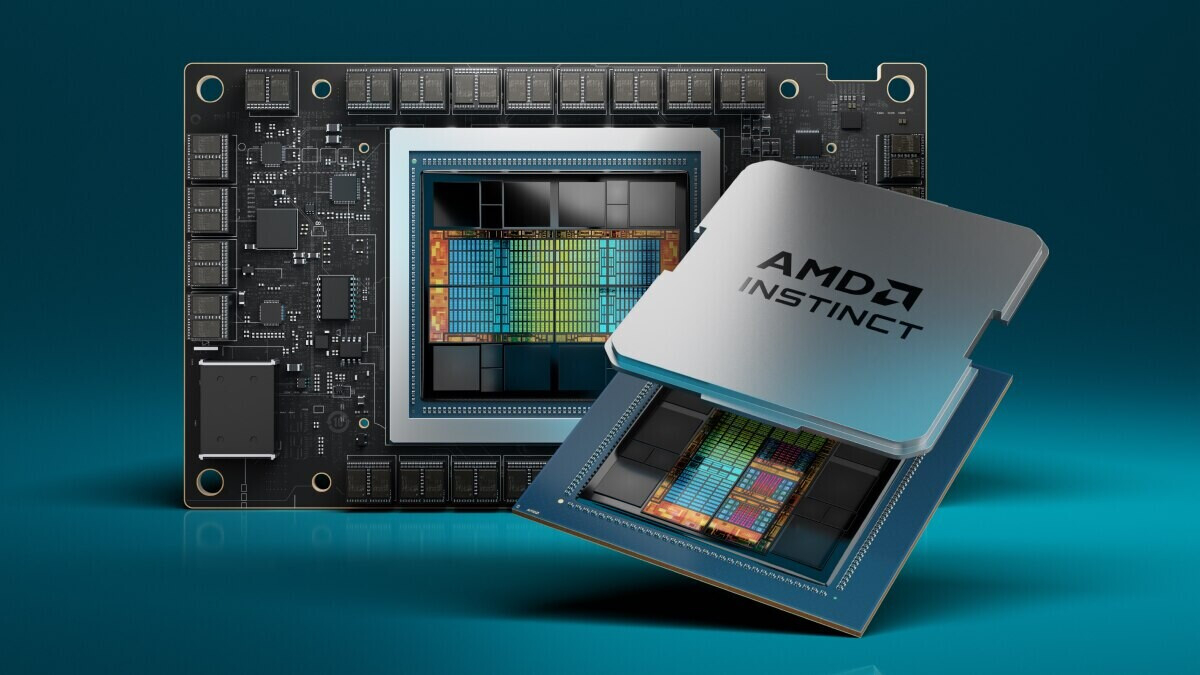
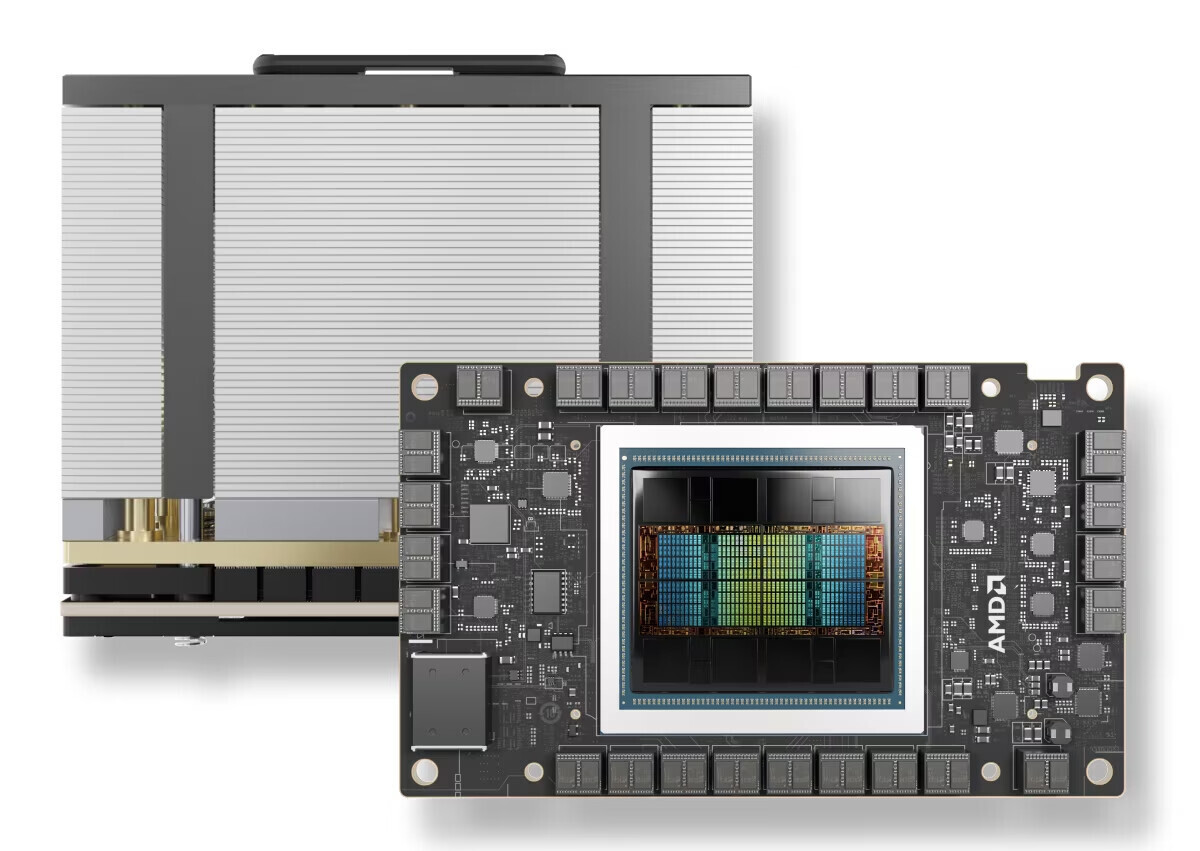
AMD's December 2023 launch of new Instinct series accelerators has generated a lot of tech news buzz and excitement within the financial world, but not many folks are privy to Team Red's MSRP for the CDNA 3.0 powered MI300X and MI300A models. A Citi report has pulled back the curtain, albeit with "projected" figures—an inside source claims that Microsoft has purchased the Instinct MI300X 192 GB model for ~$10,000 a piece. North American enterprise customers appear to have taken delivery of the latest MI300 products around mid-January time—inevitably, top secret information has leaked out to news investigators. SeekingAlpha's article (based on Citi's findings) alleges that the Microsoft data center division is AMD's top buyer of MI300X hardware—GPT-4 is reportedly up and running on these brand new accelerators.

The leakers claim that businesses further down the (AI and HPC) food chain are having to shell out $15,000 per MI300X unit, but this is a bargain when compared to NVIDIA's closest competing package—the venerable H100 SXM5 80 GB professional card. Team Green, similarly, does not reveal its enterprise pricing to the wider public—Tom's Hardware has kept tabs on H100 insider info and market leaks: "over the recent quarters, we have seen NVIDIA's H100 80 GB HBM2E add-in-card available for $30,000, $40,000, and even much more at eBay. Meanwhile, the more powerful H100 80 GB SXM with 80 GB of HBM3 memory tends to cost more than an H100 80 GB AIB." Citi's projection has Team Green charging up to four times more for its H100 product, when compared to Team Red MI300X pricing. NVIDIA's dominant AI GPU market position could be challenged by cheaper yet still very performant alternatives—additionally chip shortages have caused Jensen & Co. to step outside their comfort zone. Tom's Hardware reached out to AMD for comment on the Citi pricing claims—a company representative declined this invitation.

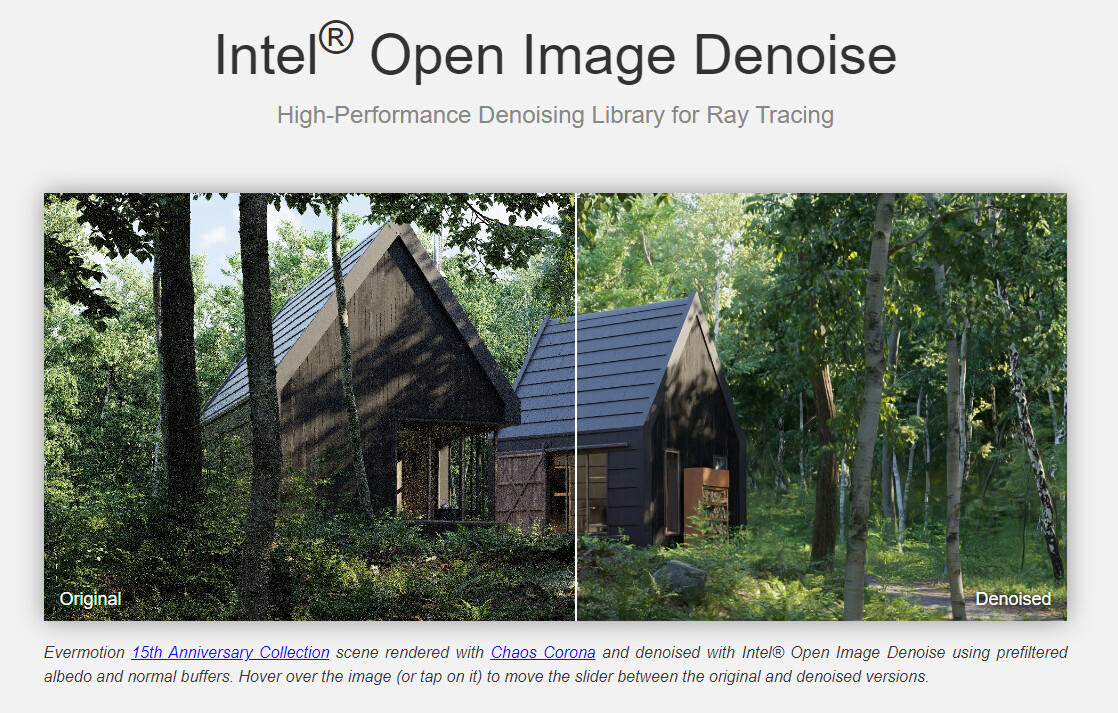
Intel Open Image Denoise v2.2 Adds Metal Support & AArch64 Improvements

An Open Image Denoise 2.2 release candidate was released earlier today—as discovered by Phoronix's founder and principal writer; Michael Larabel. Intel's dedicated website has not been updated with any new documentation or changelogs (at the time of writing), but a GitHub release page shows all of the crucial information. Team Blue's open-source oneAPI has been kept up-to-date with the latest technologies—not only limited to Intel's stable of Xe-LP, Xe-HPG and Xe-HPC components—the Phonorix article highlights updated support on competing platforms. The v2.2 preview adds support for Meteor Lake's integrated Arc graphics solution, and additional "denoising quality enhancements and other improvements."

Non-Intel platform improvements include updates for Apple's M-series chipsets, AArch64 processors, and NVIDIA CUDA. OIDn 2.2-rc: "adds Metal device support for Apple Silicon GPUs on recent versions of macOS. OIDn has already been supporting ARM64/AArch64 for Apple Silicon CPUs while now Open Image Denoise has extended that AArch64 support to work on Windows and Linux too. There is better performance in general for Open Image Denoise on CPUs with this forthcoming release." The changelog also highlights a general improvement performance across processors, and a fix that resolves a crash incident: "when releasing a buffer after releasing the device."

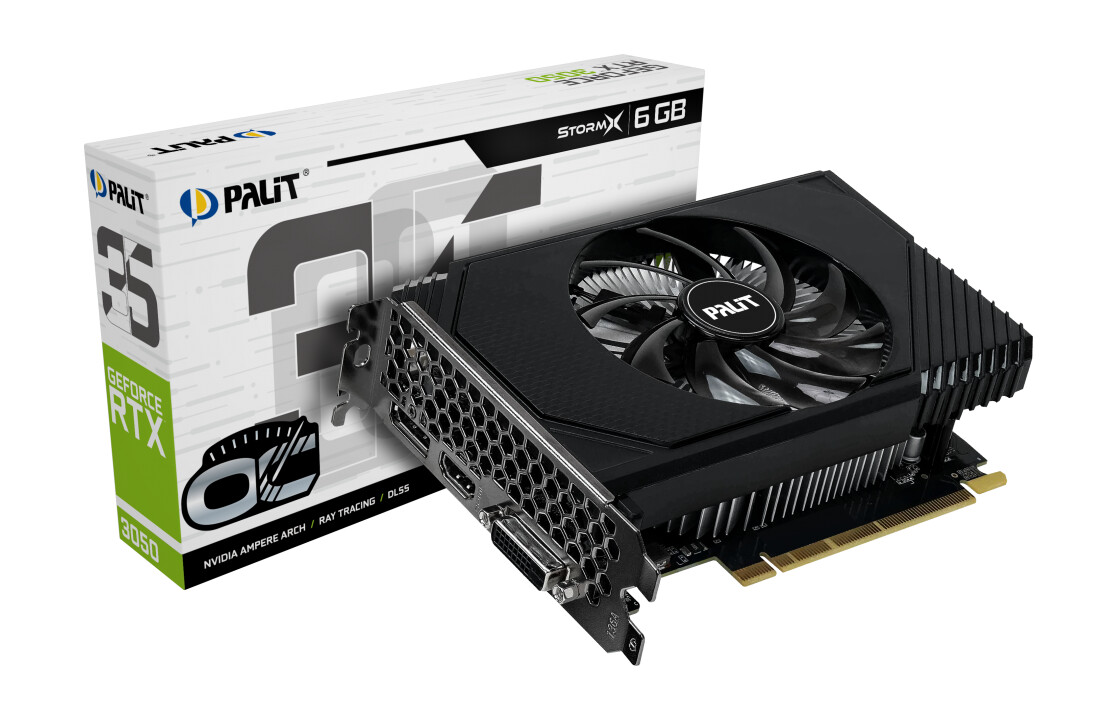
Palit Introduces GeForce RTX 3050 6 GB KalmX and StormX Models

Palit Microsystems Ltd., a leading graphics card manufacturer, proudly announces the NVIDIA GeForce RTX 3050 6 GB KalmX and StormX Series graphics cards. The GeForce RTX 3050 6 GB GPU is built with the powerful graphics performance of the NVIDIA Ampere architecture. It offers dedicated 2nd gen RT Cores and 3rd gen Tensor Cores, new streaming multiprocessors, and high-speed G6 memory to tackle the latest games.

GeForce RTX 3050 6 GB KalmX: Passive Cooling. Silent Gaming
Introducing the Palit GeForce RTX 3050 KalmX, where silence meets performance in perfect harmony. The KalmX series, renowned for its ingenious fan-less design, redefines your gaming experience. With its passive cooling system, this graphics card operates silently, making it ideal for both gaming and multimedia applications. Available on shelves today—2nd February 2024.

Aetina Introduces New MXM GPUs Powered by NVIDIA Ada Lovelace for Enhanced AI Capabilities at the Edge

Aetina, a leading global Edge AI solution provider, announces the release of its new embedded MXM GPU series utilizing the NVIDIA Ada Lovelace architecture - MX2000A-VP, MX3500A-SP, and MX5000A-WP. Designed for real-time ray tracing and AI-based neural graphics, this series significantly enhances GPU performance, delivering outstanding gaming and creative, professional graphics, AI, and compute performance. It provides the ultimate AI processing and computing capabilities for applications in smart healthcare, autonomous machines, smart manufacturing, and commercial gaming.

The global GPU (graphics processing unit) market is expected to achieve a 34.4% compound annual growth rate from 2023 to 2028, with advancements in the artificial intelligence (AI) industry being a key driver of this growth. As the trend of AI applications expands from the cloud to edge devices, many businesses are seeking to maximize AI computing performance within minimal devices due to space constraints in deployment environments. Aetina's latest embedded MXM modules - MX2000A-VP, MX3500A-SP, and MX5000A-WP, adopting the NVIDIA Ada Lovelace architecture, not only make significant breakthroughs in performance and energy efficiency but also enhance the performance of ray tracing and AI-based neural graphics. The modules, with their compact design, efficiently save space, thereby opening up more possibilities for edge AI devices.

Gigabyte Launches the GeForce RTX 40 EAGLE OC ICE Series Graphics Cards

GIGABYTE TECHNOLOGY Co. Ltd, a leading manufacturer of premium gaming hardware, today launches the GeForce RTX 40 EAGLE OC ICE series graphics cards powered by NVIDIA ADA Lovelace architecture. The latest EAGLE OC ICE series presents a white iteration of the well-received EAGLE OC graphics card series. With exceptional performance catering to the diverse requirements of gamers, creators, and AI developers, it features an extensive integration of white materials in its design. This introduces an alternative choice for gamers who appreciate white-themed setups.

GIGABYTE has introduced four models in the GeForce RTX 40 EAGLE OC ICE series, corresponding to the GeForce RTX 4070 Ti SUPER, GeForce RTX 4070 SUPER, GeForce RTX 4060 Ti, and GeForce RTX 4060 GPUs. The EAGLE OC ICE series features a brand-new white exterior design inspired by space technology and incorporates futuristic design elements. The graphics cards come with white covers and backplates, complemented by cosmic-themed graphics, symbols, and geometric shapes, providing a unique and personalized appearance for white-themed desktop setups.

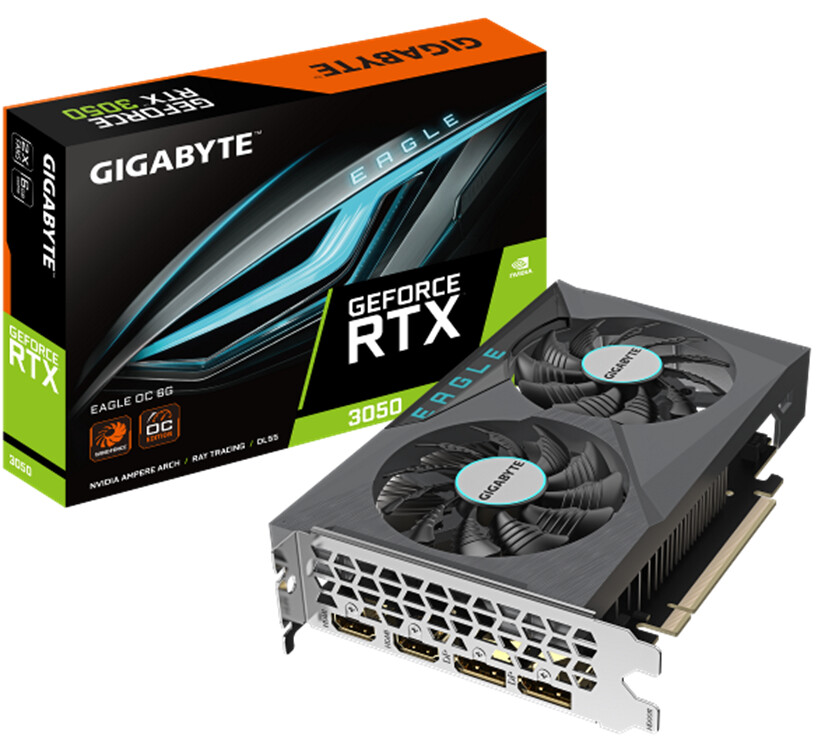
Gigabyte Launches GeForce RTX 3050 6G graphics cards

GIGABYTE TECHNOLOGY Co. Ltd, a leading manufacturer of premium gaming hardware, today announced new GeForce RTX 3050 6G graphics cards. The GeForce RTX 3050 EAGLE OC 6G and GeForce RTX 3050 OC Low Profile 6G graphics cards are powered by Ampere- NVIDIA's 2nd gen RTX architecture, featuring dedicated RT cores, AI Tensor cores, and fast GDDR6 graphics memory. They deliver the most realistic ray tracing graphics and advanced AI features with DLSS. In addition to providing gamers with a visually stunning and smooth 1080p gaming experience, creators can also indulge in the joy of creative expression.

The GIGABYTE GeForce RTX 3050 EAGLE OC 6G graphics card incorporates futuristic design elements, presenting distinctive and personalized features through cosmic-themed graphics, symbols, and geometric shapes. The GIGABYTE GeForce RTX 3050 EAGLE OC 6G is equipped with the GIGABYTE WINDFORCE cooling system. Featuring unique blade fans, alternate spinning, and fan stop functionalities, this cooling system efficiently lowers the working temperature of the graphics card, ensuring stable performance even under high-demand operations.

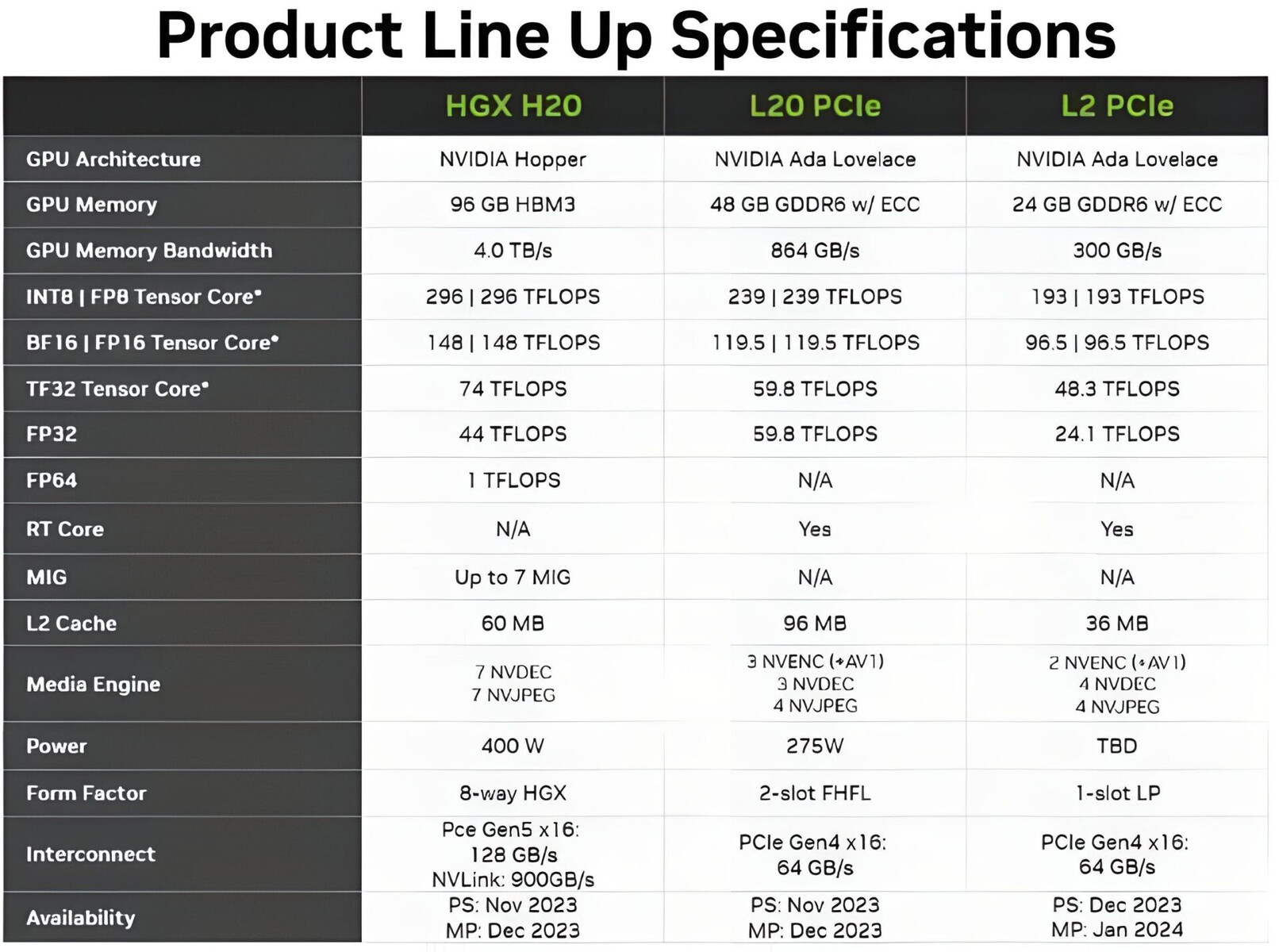
NVIDIA Readying H20 AI GPU for Chinese Market

NVIDIA's H800 AI GPU was rolled out last year to appease the Sanction Gods—but later on, the US Government deemed the cutdown "Hopper" part to be far too potent for Team Green's Chinese enterprise customers. Last October, newly amended export conditions banned sales of the H800, as well as the slightly older (plus similarly gimped) A800 "Ampere" GPU in the region. NVIDIA's engineering team returned to the drawing board, and developed a new range of compliantly weakened products. An exclusive Reuters report suggests that Team Green is taking pre-orders for a refreshed "Hopper" GPU—the latest China-specific flagship is called "HGX H20." NVIDIA web presences have not been updated with this new model, as well as Ada Lovelace-based L20 PCIe and L2 PCIe GPUs. Huawei's competing Ascend 910B is said to be slightly more performant in "some areas"—when compared to the H20—according to insiders within the distribution network.

The leakers reckon that NVIDIA's mainland distributors will be selling H20 models within a price range of $12,000 - $15,000—Huawei's locally developed Ascend 910B is priced at 120,000 RMB (~$16,900). One Reuters source stated that: "some distributors have started advertising the (NVIDIA H20) chips with a significant markup to the lower end of that range at about 110,000 yuan ($15,320). The report suggests that NVIDIA refused to comment on this situation. Another insider claimed that: "distributors are offering H20 servers, which are pre-configured with eight of the AI chips, for 1.4 million yuan. By comparison, servers that used eight of the H800 chips were sold at around 2 million yuan when they were launched a year ago." Small batches of H20 products are expected to reach important clients within the first quarter of 2024, followed by a wider release in Q2. It is believed that mass production will begin around Spring time.

Seasonic Unveils Cherry Blossom-Themed "Vertex Sakura" 1000 W Power Supply

PC power supply manufacturer Seasonic has introduced a new limited-edition variant of its Vertex 1000 W 80+ Gold certified modular power supply featuring an eye-catching design inspired by cherry blossoms. Dubbed the "Vertex Sakura," this specially-themed PSU sports a clean white color scheme with pink Sakura flower graphics and a unique textured paint finish. The Vertex Sakura caters specifically to PC enthusiasts and case modders in Japan who want to build a themed rig coordinated around the colors and aesthetic of traditional Japanese cherry blossoms. It offers the same fully modular cabling as the standard Vertex 1000 W model, allowing builders flexibility in cable management.

The PSU also meets the latest ATX 3.0 specifications, including a 12VHPWR connector to support next-generation high-wattage GPUs. Seasonic showcased the Vertex Sakura 1000 W unit at 30,000 yen (around $200 USD) in Japan, where retailers recommend interested buyers preorder as soon as possible due to limited availability. Specific regional launch details outside of Japan are still forthcoming. But the Vertex Sakura's blend of technical prowess and stunning cherry blossom visual flair will likely attract global attention from PC builders looking to add an extra touch of style to their high-end systems.

GIGABYTE Enterprise Servers & Motherboards Roll Out on European E-commerce Platform

GIGABYTE Technology, a pioneer in computer hardware, has taken a significant stride in shaping its European business model. Today, GIGABYTE has broadened its e-commerce platform, shop.gigabyte.eu, by integrating enterprise server and server motherboard solutions into its product portfolio. Being at the forefront of computer hardware manufacturing, GIGABYTE recognizes that it is imperative to expand its presence in the EMEA region to maintain its leadership across all markets. With the introduction of our enterprise-level server and motherboard solutions, we are dedicated to delivering a diverse range of high-performance products directly to our B2B clients.

GIGABYTE offers a complete product portfolio that addresses all workloads from the data center to edge including traditional and emerging workloads in HPC and AI to data analytics, 5G/edge, cloud computing, and more. Our enduring partnerships with key technology leaders ensure that our new products are at the forefront of innovation and launch with new partner platforms. Our systems embody performance, security, scalability, and sustainability. Within the e-commerce product portfolio, we offer a selection of models from our Edge, Rack, GPU, and Storage series. Additionally, the platform provides server motherboards for custom integration. The current selection comprises a mix of solutions tailored to online sales. For more complex solutions, customers can get in touch via the integrated contact form.

Intel Arc A370M Laptop GPU Transforms into ITX-Sized Desktop GPU

Taiwanese tech maker Advantech has converted Intel's Arc A370M mobile GPU into a desktop graphics card named the EAI-3100. The new card utilizes the same Arc A370M mobile GPU based on the Xe-LP architecture chip as found in laptops but adds more robust cooling to enable desktop-level performance. Specifically, the EAI-3100 implements a large aluminium heatsink spanning the entire PCB, paired with a 40 mm fan active cooling fan. This allows the card to operate at up to 60 Watt TGP (total graphics power), a noticeable increase over the A370M's 35-50 Watt mobile power range. Despite the improved cooling, Advantech has not factory overclocked the EAI-3100, leaving its graphics clock speed unchanged at 1,550 MHz. The card also retains the same PCIe 4.0 x8 interface as the mobile A370M. An 8-pin PCIe power connector has been added, giving headroom for user overclocking attempts.

In terms of gaming performance, the A370M and, by extension, the EAI-3100 deliver playable frame rates at 1080p resolution with medium image quality settings. The card is comparable to NVIDIA's mobile RTX 3050 GPU. As Intel continues optimizing Arc drivers, more gains are expected. The EAI-3100's dual-slot, 6.61-inch design allows compatibility with most desktop PC cases. Between its small size and the A370M's solid 1080p capabilities, this transformed card represents an interesting budget option for gamers seeking a discounted route to Arc's architecture. Despite the diminutive size, this custom cooling solution keeps the A370M at appropriate temperatures for sustained operation, possibly delivering more than the laptop form factor SKU. For video output, the card features two HDMI 2.0b and two DP 1.4a ports.

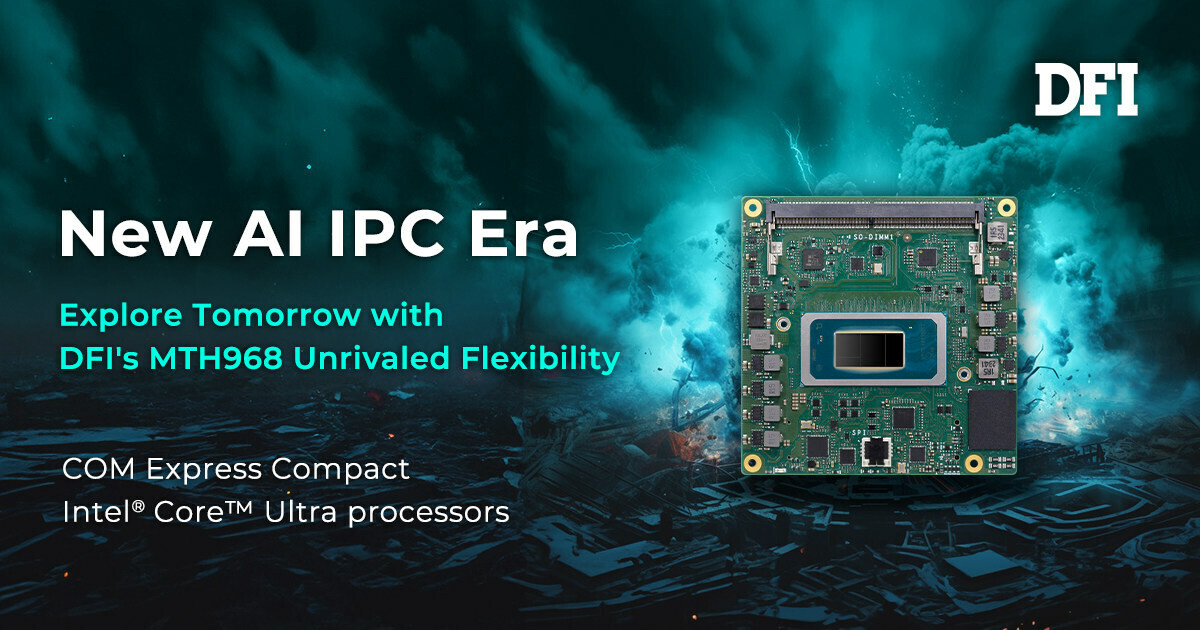
DFI Unveils Embedded System Module Equipped with Intel's Latest AI Processor

DFI, the world's leading brand in embedded motherboards and industrial computers, is targeting the AI application market by launching the embedded system module (SOM) MTH968 equipped with the latest Intel Core Ultra processor. It is the first product integrated with an NPU (Neural Processor Unit) processor, representing the official integration of AI with industrial PCs (IPCs). With the expansion into AI IPC, DFI expects to inject new momentum into the AI edge computing market.

According to the STL Partners report, the potential market value of global edge computing will increase from US$9 billion in 2020 to US$462 billion in 2030, representing a compound annual growth rate (CAGR) of 49%. Therefore, the development of products that utilize the core capabilities of chips to rapidly execute AI edge computing in devices has become a key focus for many major technology companies.

NVIDIA GeForce RTX 4080 SUPER Reviews Delayed to January 31

According to a VideoCardz report, NVIDIA is implementing a very last minute time shift with its GeForce RTX 4080 SUPER review program—embargo conditions have been delayed by a day to January 31, which coincides with the official retail launch day. We already know about non-specific sample units reaching reviewers a week (or more) in advance of Team Green's embargo date—thanks to various graphical benchmarks appearing prematurely on the Geekbench Browser database. VideoCardz states the Founders Edition GeForce RTX 4080 SUPER model was not received in a timely manner by a number of media outlets, thus dismissing rumors about driver issues being a main factor behind the sudden rescheduling. Hardware evaluators have been busy this month with trade event coverage, and spending analytical time with Team Green's previous batches of RTX 40 SUPER cards.

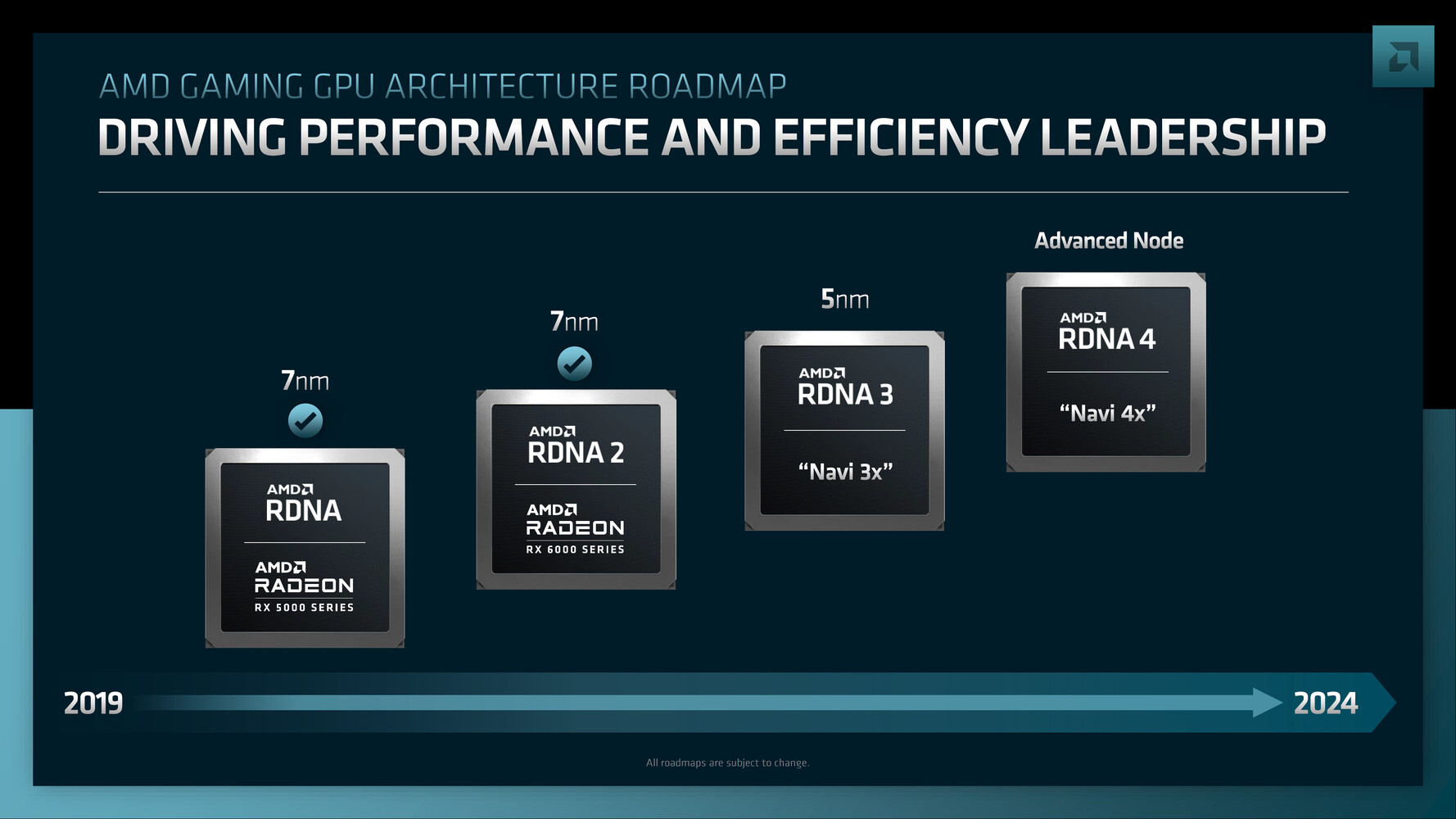
Top AMD RDNA4 Part Could Offer RX 7900 XTX Performance at Half its Price and Lower Power

We've known since way back in August 2023, that AMD is rumored to be retreating from the enthusiast graphics segment with its next-generation RDNA 4 graphics architecture, which means that we likely won't see successors to the RX 7900 series squaring off against the upper end of NVIDIA's fastest GeForce RTX "Blackwell" series. What we'll get instead is a product stack closely resembling that of the RX 5000 series RDNA, with its top part providing a highly competitive price-performance mix around the $400-mark. A more recent report by Moore's Law is Dead sheds more light on this part.

Apparently, the top Radeon RX SKU based on the next-gen RDNA4 graphics architecture will offer performance comparable to that of the current RX 7900 XTX, but at less than half its price (around the $400 mark). It is also expected to achieve this performance target using a smaller, simpler silicon, with significantly lower board cost, leading up to its price. What's more, there could be energy efficiency gains made from the switch to a newer 4 nm-class foundry node and the RDNA4 architecture itself; which could achieve its performance target using fewer numbers of compute units than the RX 7900 XTX with its 96.

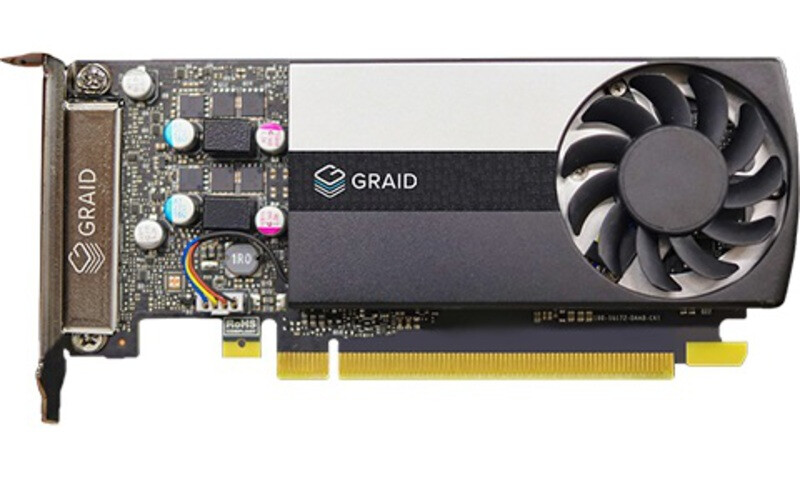
Graid Technology Launches Revolutionary GPU-Based RAID Solution, SupremeRAID SR-1001

Graid Technology, an industry trailblazer in GPU-based RAID for NVMe, proudly announces the groundbreaking release of SupremeRAID SR-1001. This innovative GPU-based RAID solution is designed to maximize NVMe SSD performance while eliminating CPU cycle consumption and avoiding throughput bottlenecks. Utilizing patented out-of-path RAID protection technology, data travels directly from the CPU to the NVMe SSDs, ensuring unmatched flexibility, unprecedented performance, and overall superior value.

NVMe SSDs, with their high-speed performance and low latency, significantly enhance tasks across CAD, video editing, IoT, and gaming. Faster loading times, improved rendering, quick file transfers, smooth playback, efficient data processing, and reduced latency contribute to overall superior performance. But traditional RAID methods introduce bottlenecks, limiting the performance of NVMe SSDs in critical applications.

MSI GeForce RTX 4080 SUPER 16G EXPERT Specs Leaked

MSI presented a massive table of GeForce RTX 40 SUPER series custom design graphics cards at CES 2024—TPU spent a lot of time photographing and documenting everything GPU-related at the tech company's booth. The kind-of mysterious GeForce RTX 4080 SUPER 16G EXPERT model seemed to get a lot of attention from online PC hardware communities. The brand new and very substantial EXPERT shroud design integrates a Zero Frozr cooling solution, but folks were quick to link its aesthetic (and vapor chamber setup) to NVIDIA's dual fan Founders Edition cooling solution. MSI has not yet published a dedicated GeForce RTX 4080 SUPER 16G EXPERT product page, while all of the other models from CES are uploaded and active.

A tipster on social media has posted a screenshot of the 16G EXPERT's specification sheet—wxnod has uncovered alleged factory settings ahead of review and launch day embargos, although pricing is still unknown at the time of writing. The leaked core figures include a boost clock of 2610 MHz in GAMING and SILENT modes (60 MHz above reference), while the MSI Center software suite can activate an Extreme Performance mode: 2625 MHz. These figures align with the SUPER SUPRIM model's core clock specs—the SUPRIM X sits above everything else as the fastest card in MSI's RTX 4080 SUPER stable. MSI's official introduction stated that the 16G EXPERT: "features a push-pull airflow design for enhanced cooling efficiency. The enclosure is constructed with aluminium Die-Casting for structural strength, while Core Pipe and a Vapor Chamber work to efficiently dissipate heat. Lastly, a patented fan design provides quiet yet reliable airflow." We hope to see the MSI GeForce RTX 4080 SUPER 16G EXPERT's addition to the TPU GPU database.

AMD Instinct MI300X Released at Opportune Moment. NVIDIA AI GPUs in Short Supply

LaminiAI appeared to be one of the first customers to receive an initial shipment of AMD's Instinct MI300X accelerators, as disclosed by their CEO posting about functioning hardware on social media late last week. A recent Taiwan Economic Daily article states that the "MI300X is rumored to have begun supply"—we are not sure about why they have adopted a semi-secretive tone in their news piece, but a couple of anonymous sources are cited. A person familiar with supply chains in Taiwan divulged that: "(they have) been receiving AMD MI300X chips one after another...due to the huge shortage of NVIDIA AI chips, the arrival of new AMD products is really a timely rainfall." Favorable industry analysis (from earlier this month) has placed Team Red in a position of strength, due to growing interest in their very performant flagship AI accelerator.

The secrecy seems to lie in Team Red's negotiation strategies in Taiwan—the news piece alleges that big manufacturers in the region have been courted. AMD has been aggressive in a push to: "cooperate and seize AI business opportunities, with GIGABYTE taking the lead and attracting the most attention. Not only was GIGABYTE the first to obtain a partnership with AMD's MI300A chip, which had previously been mass-produced, but GIGABYTE was also one of the few Taiwanese manufacturers included in AMD's first batch of MI300X partners." GIGABYTE is expected to release two new "G593" product lines of server hardware later this year, based on combinations of AMD's Instinct MI300X accelerator and EPYC 9004 series processors.
Return to Keyword Browsing
Nov 22nd, 2026 18:53 CST change timezone

New Forum Posts

Popular Reviews

TPU on YouTube

Controversial News Posts