News Posts matching #Game Developer Conference

Return to Keyword Browsing

Video Game Workers and AI: 40% Use It, but 55% Think It's Bad News

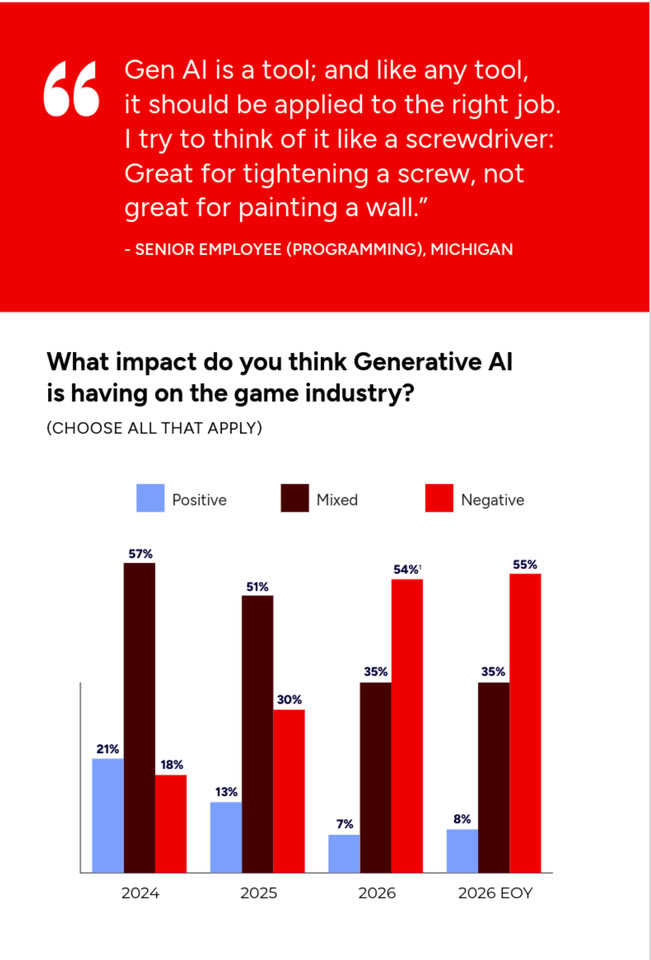
We have repeatedly seen generative AI divide the gaming industry in game industry worker surveys and in comments by game developers, and this is apparently still the case, according to the latest GDC State of the Game Industry: November 2026 survey. The organization surveyed over 2,600 game workers across different disciplines in the video game industry about a variety of topics, including the ongoing layoffs, hiring rates after being laid off, and the future of the gaming industry. When it comes to generative AI, 40% of game workers reported that they used AI in their work, with a more granular look revealing that 63% of workers in business operations or services used AI, while 51% of marketing and PR employees, and 48% of programmers used generative AI in their daily work.

Workers at "older indie studios" were less likely to use AI, with only 29% of respondents confirming AI use, while workers working on premium games also showed lower rates of AI use, at 32% of respondents. The inverse was true for free-to-play games, with 58% using AI, and mobile studios, where 70% of workers reported using AI. Company AI policies are also interesting, with as many as 23% of respondents reporting that AI was banned at their studios, while only 1% were required to use them, 12% were allowed to use them at their own discretion, 11% were discouraged from using them, and 17% were encouraged to use AI tools.

Unity Bets on AI for "Full Casual Games" With No Coding

Giants in the gaming industry seem to be increasingly excited about the future of generative AI in gaming. Unity, who has previously toyed with AI for features like facial animations, just announced in a recent earnings call that it will be leaning further into the tech with what it calls "AI-driven authoring," a new tech that it is planning on introducing at the Game Developer Conference in March. Unity says that this new AI solution will allow developers to create entire casual games native to the Unity engine without ever needing to touch code. "At the Game Developer Conference in March, we'll be unveiling a beta of the new upgraded Unity AI, which will enable developers to prompt full casual games into existence with natural language only, native to our platform—so it's simple to move from prototype to finished product," said Unity CEO, Matthew Bromberg. It's telling that the CEO specifies that the model will be able to generate casual games, which are usually less demanding than a full-scale AAA game, for example, but it remains to be seen what level of complexity the AI will be capable of and what sort of human intervention will be required.

He explained that the natural language model will be "powered by our unique understanding of the project context and our runtime," and that this combination will "provide more efficient, more effective results to game developers than general-purpose models alone." Unity uses a mixture of first- and third-party AI models during different steps of the Unity AI pipeline, all of which is detailed in the Unity AI legal guidelines document. This announcement comes shortly after a State of the Game Industry Survey revealed that, while many game industry workers at large studios are using generative AI across multiple disciplines, most of those same workers agree that the widespread use of generative AI is a detriment to the industry. Workers at EA have previously noted that increased use of gen-AI tools has also come at the cost of time and efficiency. Despite this, EA's new owner will continue leaning into an AI pivot in the name of cost savings, which is a pattern we may see become increasingly common as game engines and other development tools continue to integrate AI tools.

Arm Releases Open-Source ASR Upscaler Based on AMD FSR 2 Technology

Arm has officially unveiled its Accuracy Super Resolution (ASR) upscaling technology at Game Developer Conference 2025, delivering an open-source upscaling solution for mobile and low-power devices. Built upon AMD's FidelityFX Super Resolution 2 (FSR 2) framework, ASR promises up to 53% higher frame rates while reducing power consumption by 20% on devices utilizing the Immortalis-G720 GPU. This technology addresses a critical performance gap in the Android ecosystem, which has historically lagged behind Apple's MetalFX implementation. The temporal upscaling approach employed by ASR combines information from multiple frames to generate higher-quality images, offering superior visual fidelity compared to Qualcomm's Game Super Resolution (GSR), which relies on the older spatial-based FSR 1 technique. In benchmark testing with complex scenes, Arm demonstrated that ASR helps maintain stable device temperatures, preventing thermal throttling that can compromise user experience.

Collaboration with MediaTek confirmed significant power savings on Dimensity 9300 chipsets, directly addressing battery life concerns for mobile gamers. Arm plans to release pre-built plugins for Unity and Unreal Engine by year-end, streamlining integration for developers working with these widely-used game engines. During GDC demonstrations, Arm showcased the "Mori" demo running in Unreal Engine 5, where ASR delivered 30% performance improvements without visual compromises. Licensed under MIT open-source terms, ASR's accessibility extends across the entire Arm ecosystem, potentially benefiting smartphones running MediaTek Dimensity, Qualcomm Snapdragon, Samsung Exynos, and even Arm-powered laptops featuring Snapdragon X series SoCs.

AMD's Ryzen Chips to Launch Before March 2017's GDC

It would appear as if AMD has seemingly (and not purposely) given us some lights as to when their hotly anticipated Ryzen chips will hit the wild - and some of our wallets. While they haven't specifically given an exact date, the talk to be given by AMD at the annual Game Developer Conference (GDC) reads: "Join AMD Game Engineering team members for an introduction to the recently-launched AMD Ryzen CPU followed by advanced optimization topics". The "recently-launched tidbit is the most important, since it places Ryzen's launch necessarily before the end of GDC - which will happen between February 27th and March 3rd. AMD has, in the meantime, altered the original headline by cutting the "recently launched" tidbit altogether.
Return to Keyword Browsing
Nov 14th, 2026 00:14 CST change timezone

New Forum Posts

Popular Reviews

TPU on YouTube

Controversial News Posts