News Posts matching #Immortalis-G925

Return to Keyword Browsing

MediaTek Expands Its Genio IoT Platform at Embedded World 2026

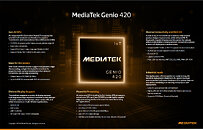
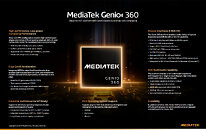
At Embedded World, MediaTek unveiled a range of new Genio platforms ideal for powering a wide variety of IoT products and applications: MediaTek Genio Pro, Genio 420 and Genio 360. The Genio Pro series is MediaTek's premium offering for high-performance IoT and embedded offerings, while Genio 420 and Genio 360 bring efficient system-level edge AI performance to smart home, retail, industrial, and commercial IoT devices.

With its impressive AI, multimedia, and display capabilities, along with rich OS support, Genio Pro enables OEMs to develop the next generation of autonomous mobile robotics, commercial drones, edge AI devices, machine vision systems, and transportation and logistics platforms.

Acer Intros Chromebook Plus Spin 514 - First Acer Chromebook with MediaTek Kompanio Ultra Processor

Acer today announced the launch of the Acer Chromebook Plus Spin 514 - its first Chromebook powered by the MediaTek Kompanio Ultra processor and featuring an integrated NPU. The premium convertible device combines efficient, AI-powered performance with long battery life, wrapped in a sleek but tough design.

"We are excited to introduce our first Chromebook with the MediaTek Kompanio Ultra processor, unlocking a new level of AI-powered capabilities that streamline multitasking, content creation, and productivity on an Acer Chromebook," said James Lin, General Manager, Notebooks, Acer Inc. "With its powerful performance, AI tools, and robust and premium build, the Acer Chromebook Plus Spin 514 will empower creators, employees, and teachers to create, work, and be productive from anywhere."

Xiaomi XRING 01 SoC Die Shot Analyzed by Chinese Tech YouTuber

Three weeks ago, Kurnal and Geekerwan dived deep into Nintendo's alleged Switch 2 chipset. The very brave Chinese leakers are notorious for their acquiring of pre-release and early silicon samples. Last week, their collective attention turned to a brand-new Xiaomi mobile chip: the XRING 01. After months of insider murmurs and official teasers, the smartphone giant recently unveiled its proprietary flagship SoC. According to industry moles, Xiaomi has invested a lot of manpower into a special chip design entity—leadership likely wants to avoid a repeat of prior first-party developed disappointments. Despite rumors of disappointing prototype performance figures, mid-May Geekbench results pointed to the emergent XRING 01 mobile chip being up there with Qualcomm's dominant Snapdragon 8 Elite platform. Die shot analysis has confirmed Xiaomi's selection of a TSMC 3 nm "N3E" node process; also utilized by the latest Apple, Qualcomm and MediaTek flagships. Overall die size is 114.48 mm² (10.8 x 10.6 mm), with 109.5 mm² of used area; comparable to Apple's A18 Pro SoC footprint (refer to Geekerwan's comparison shot, below).

Unlike nearby rivals, the XRING 01 seems to not sport an integrated 5G modem. Notebookcheck surmised: "it is rumored to use an external radio from MediaTek. It isn't located on the actual die itself, and likely a contributing factor to why its size is so small." Annotations indicate the presence of off-the-shelf/licensed Arm CPU cores (ten in total): two Cortex-X925 units, four Cortex-A725 units, two Cortex-A725 units, and two Cortex-A520 units. Additionally, an Arm Immortalis-G925 MP16 iGPU was identified. A 6-core NPU—with 16 MB of cache—was highlighted, but it is not clear whether this is a proprietary effort or something bought in. Observers have noted the absence of SLC cache. GSMArena posited: "the Geekerwan team speculates that (Xiaomi's) omission of the SLC has hurt GPU efficiency—it's pretty fast, but it uses more power than the Dimensity GPU at peak performance. The more efficient CPU combined with the fact that the GPU rarely runs at full tilt makes for pretty good overall efficiency in real-life gaming tests." The XRING department's debut product is impressive, but industry watchdogs are looking forward to refined variants or full-fledged successors.

Xiaomi Envisions Proprietary Chipset Designs Being Deployed in non-Flagship Mobile Devices

Last Thursday, Xiaomi revealed its proprietary XRING O1 3 nm mobile chipset. After months of rumors, the Chinese firm's highly anticipated first-party chip design was introduced during their special "A New Beginning" event—held in Beijing. During this multipronged product launch celebration, company leadership disclosed the underpinnings of their first-ever flagship processor. According to official descriptions, Xiaomi's pivotal XRING O1 SoC is built on: "a cutting-edge second-gen 3 nm process with 19 billion transistors, features a 10-core CPU and 16-core Immortalis-G925 GPU, delivering flagship performance with industry-leading power efficiency. It also integrates Xiaomi's fourth-gen ISP and a 6-core NPU offering 44 TOPS for advanced AI processing." Days prior to important ceremonies in China, a joint statement—issued by Qualcomm—detailed an extended Snapdragon chipset supply agreement. The XRING O1 processor line will drive forthcoming Xiaomi 15S Pro smartphones and Pad 7 Ultra tablets; reserved for initial "domestic market" launches. Qualcomm's current flagship offerings are technically superior to Xiaomi's fresh effort, but an ever-shifting political landscape could affect future shipments.

Lu Weibing—a company president and partner—has outlined a vision for XRING's eventual expansion beyond a flagship/high-end product tier. Last week's intro firmly positioned the 3 nm part as premium option that will power suitably expensive Android-based mobile devices. Weibing acknowledged that his team has jumped into the deep end: "(for) this platform capability, it is most difficult to work on smartphone flagship SoC, it has high power consumption demand and its technology is extremely complicated. If you can, then you should have the ability to work on flagship smartphone SoC. (Once you) move to work on other chips, it won't be that difficult." Industry moles posit that Xiaomi's XRING division is already a formidable force, in terms of staff headcounts and experience. The department could be absorbing some inspiration from Apple; namely their custom C1 modem chip. The firm's president painted a picture of things to come: "so we want to focus on the flagship SoC, and then we want to make a capable modem for the future. We have to work on 4G and 5G parts—together with 3G—leading to a complete matrix. So that is what we need to do at this stage." Early leaks have indicated the existence of a binned version of the XRING O1 SoC; present within early Xiaomi Pad 7 Ultra tablet samples. In theory, these compromised chips could be deployed in unannounced cheaper products.

MediaTek Unveils New Flagship Dimensity 9400+ Mobile Platform; with Enhanced AI Performance

MediaTek today announced the Dimensity 9400+ SoC, the latest addition to MediaTek's Dimensity flagship chipset family. Providing exceptional Generative and agentic AI capabilities as well as other performance enhancements, the Dimensity 9400+ supports the latest Large Language Models (LLM) while sustaining a super power-efficient design. The Dimensity 9400+ features an All Big Core design, integrating one Arm Cortex-X925 core operating up to 3.73 GHz, combined with 3x Cortex-X4 and 4x Cortex-A720 cores. This powerful configuration accelerates single and multithreaded performance for top-tier Android UX experiences.

"The MediaTek Dimensity 9400+ will make it easier to deliver innovative, personalized AI experiences on-device, combined with enhanced overall performance to ensure your device can handle all tasks with ease," said JC Hsu, Corporate Senior Vice President at MediaTek. "We are working closely with developers and manufacturers to continue building a robust ecosystem of AI applications and other features that will bring a number of speed and privacy benefits to consumers."

MediaTek Announces Dimensity 9400 Flagship SoC with All Big Core Design

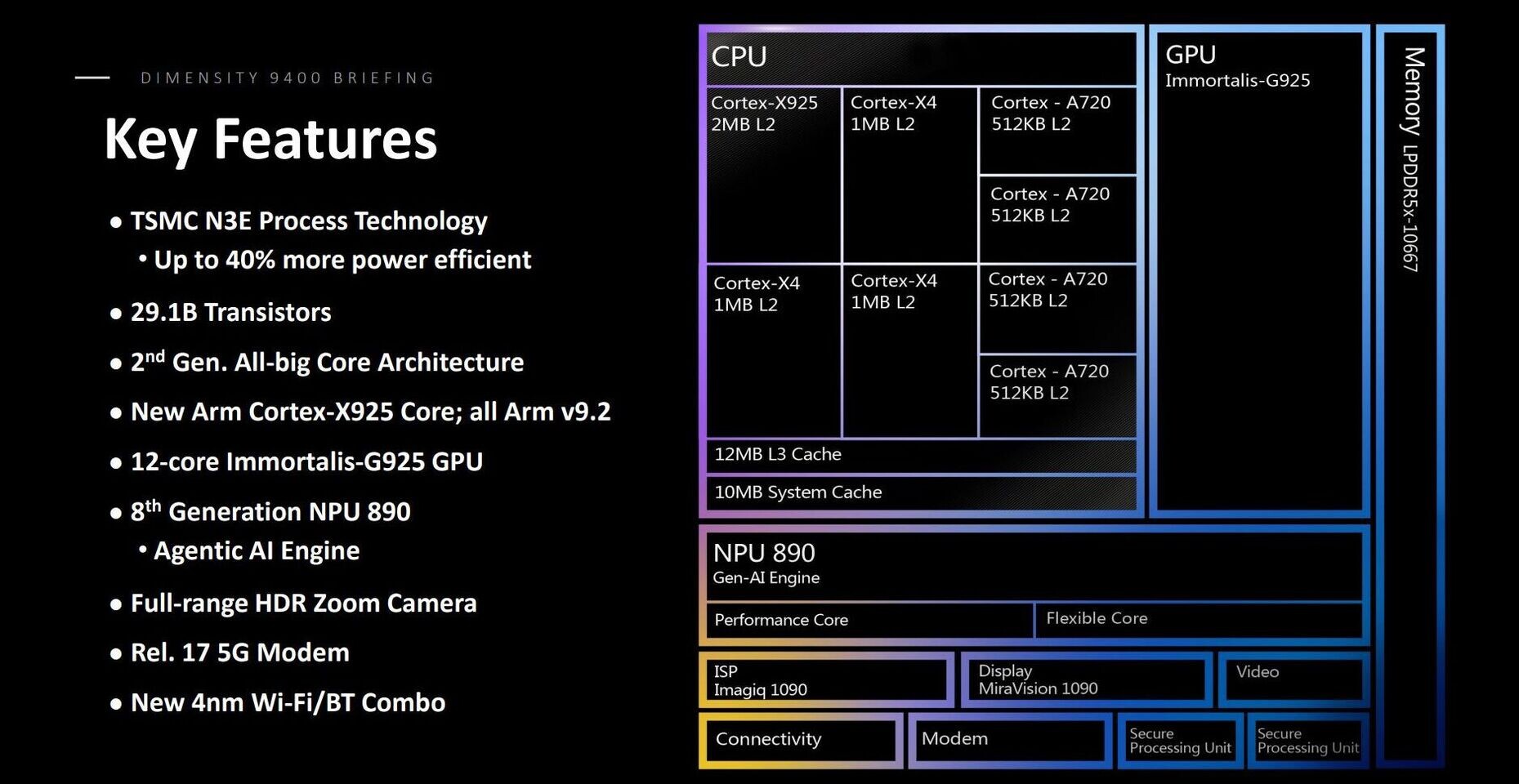
MediaTek today launched the Dimensity 9400, the company's new flagship smartphone chipset optimized for edge-AI applications, immersive gaming, incredible photography, and more. The Dimensity 9400, the fourth and latest in MediaTek's flagship mobile SoC lineup, offers a massive boost in performance with its second-generation All Big Core design built on Arm's v9.2 CPU architecture, combined with the most advanced GPU and NPU for extreme performance in a super power-efficient design.

The Dimensity 9400 adopts MediaTek's second-gen All Big Core design, integrating one Arm Cortex-X925 core operating over 3.62 GHz, combined with 3x Cortex-X4 and 4x Cortex-A720 cores. This design offers 35% faster single-core performance and 28% faster multi-core performance compared to MediaTek's previous generation flagship chipset, the Dimensity 9300. Built on TSMC's second-generation 3 nm process, the Dimensity 9400 is up to 40% more power-efficient than its predecessor, allowing users to enjoy longer battery life.

Arm Also Announces Three New GPUs for Consumer Devices

In addition to its two new CPU cores, Arm has announced three new GPU cores, namely the Immortalis-G925, Mali-G725 and Mali-G625. Starting from the top, the Immortalis-G925 is said to bring up to 37 percent better performance at 30 percent lower power usage compared to last year's Immortalis-G720 GPU core, whilst having two additional GPU cores in the test scenario. It's also said to bring up to 52 percent better ray tracing performance and up to 36 percent improved inference in AI/ML workloads. It's also been given a big overhaul when it comes to ray tracing—due to it being aimed towards gaming phones—and Arm claims that it can either offer up to 52 percent increased performance by reducing the accuracy in scenes with intricate objects, or 27 percent more performance with maintained accuracy.

The Immortalis-G925 supports 50 percent more shader cores and it supports configurations of up to 24 cores, compared to 16 cores for the Immortalis-G720. The Mali-G725 will be available with between six and nine cores, whereas the Mali-G625 will sport between one and five cores. The Mali-G625 is intended for smartwatches and entry-level mobile devices where a more complex GPU might not be suitable due to power draw. The Mali-G725 on the other hand is targeting upper mid-range devices and the Immortalis-G925 is aimed towards flagship devices or gaming phones as mentioned above. In related news, Arm said it's working with Epic Games to get its Unreal Engine 5 desktop renderer up and running on Android, which could lead to more complex games on mobile devices.
Return to Keyword Browsing
Nov 18th, 2026 06:39 CST change timezone

New Forum Posts

Popular Reviews

TPU on YouTube

Controversial News Posts