News Posts matching #M4 Max

Return to Keyword Browsing

Apple Increases Prices Amid Rising NAND Flash and DRAM Costs

Apple temporarily halted its online store today to implement a pricing update, bringing the store back online shortly after the changes were made. Even a leading consumer electronics company like Apple, known for having one of the best component supply chains in the world, couldn't ignore the impact of NAND Flash and DRAM price changes. As a result, the company has adjusted the prices of all products containing these components, reflecting an upward trend. Starting with its most affordable Mac option, the MacBook Neo, the price has increased from $599 to $699 for the base configuration. This pricing does not include the student discount, which has become more stringent. Apple now requires student verification for college students and other forms of verification for educational staff to access these discounts.

The average increase in today's price hike is $246.67. The most significant change is seen in the Mac Studio powered by the M3 Ultra SoC, which is now priced at $5,299, a $1,300 increase from its original $3,999 price. On the other end of the spectrum, the HomePod mini has experienced a $30 increase, going from $99 to $129. You can view the entire pricing update, compiled by MacRumors, below. Additionally, the 256 GB version of the Mac mini is back in stock, now priced at $799, up from its previous listing of $599. No price changes have been applied to any iPhone, Apple Watch, AirPods, Studio Display, and accessories.
All price changes follow.

Apple Silicon Approaches AMD's Laptop Market Share Only Five Years In

According to data collected by Mercury Research and analyzed by Bernstein Research, Apple Silicon has made significant progress, achieving a laptop market share comparable to that of AMD, a long-time supplier in this sector. When Apple launched its first Arm-based custom M1 SoC, it transitioned away from Intel processors in favor of customized designs aimed at enhancing battery life and optimizing performance for macOS. This shift began in November 2020. Now, five years into the Apple Silicon ecosystem, the company has established a substantial laptop market share that rivals AMD.

According to these charts below, AMD's share in the laptop sector hovers just above 20%, at roughly 21-22%, with Apple slightly below the 20% mark, around 18-19%. This difference is fascinating as Apple has just entered year six of its custom silicon for MacBook laptops and Mac desktops, with no stopping in sight. Additionally, Intel's market share in the laptop sector has been steadily declining and now grabs the remaining 60%+ share, with fluctuations. For desktop segment, Apple also made an interesting market penetration as the company holds about 10% share in the sector which has typically been dominated by Intel and AMD. Any market share deducted from Intel is going directly to AMD in the desktop sector, as the charts show, meaning that the recent trend among consumers is again loud and clear that AMD is slowly becoming a more popular choice.

Cyberpunk 2077 Lands on Apple Silicon with Full M-Series Support

CD Projekt RED is about to rewrite the Mac's reputation as a second-tier gaming rig. At 8 am Pacific on July 17, Cyberpunk 2077: Ultimate Edition, which includes the base game, Phantom Liberty, and Patch 2.3, will be available to download across the Mac App Store, Steam, GOG, and Epic. Players who already own the title on PC won't have to pay again. This isn't just a delayed port. Engineers have spent the last eighteen months rebuilding the REDengine pipeline to support Apple's Metal API, slicing each frame into parallel tasks that utilize every GPU core in M-series chips. The result is dynamic "For this Mac" presets that adjust resolution, effects, and memory usage in real-time. An M1 with 16 GB of unified RAM achieves 30 FPS at 1600×900, an M3 Pro with 18 GB maintains 60 FPS at 1080p, and the M3 Ultra or M4 Max with 36 GB sustains 60 FPS at native 1440p without thermal throttling.

Ray tracing is optional. Medium path-traced reflections run at 30 FPS on an M3 Pro and 60 FPS on an M3 Max or better, but the default settings keep neon effects rasterized for visual consistency. CDPR has also added AMD's FSR 2 frame generation and MetalFX upscaling, smoothing performance when the action ramps up. Storage requirements vary by platform: 92 GB on Steam, Epic, or GOG, and 159 GB on the Mac App Store due to pre-installed language packs. No matter where you buy it, cross-progression syncs your character across console, PC, and Mac. With Spatial Audio, dynamic HDR tuned for Pro Display XDR, and support for Metal 4 features like frame interpolation and real-time denoising, Apple aims to make AAA games feel native on Mac. If Cyberpunk 2077 runs as promised, the next studio to port a blockbuster might not wait years for a port, but plan from the beginning to tap the massive macOS market.

Apple M3 Ultra SoC: Disappointing CPU Benchmark Result Surfaces

Just recently, Apple somewhat stunned the industry with the introduction of its refreshed Mac Studio with the M4 Max and M3 Ultra SoCs. For whatever reason, the Cupertino giant decided to spec its most expensive Mac desktop with an Ultra SoC that is based on an older generation, M3, instead of the newer M4 family. However, the M3 Max, which the M3 Ultra is based on, was no slouch, indicating that the M3 Ultra will likely boast impressive performance. However, if a collection of recent benchmark runs are anything to go by, it appears that the M3 Ultra is a tad too closely matched with the M4 Max in CPU performance, which makes the $2000 premium between the two SoCs rather difficult to digest. Needless to say, a single benchmark is hardly representative of real-world performance, so accept this information with a grain of salt.

According to the recently spotted Geekbench result, the M3 Ultra managed a single-core score of 3,221, which is roughly 18% slower than the M4 Max. In multicore performance, one might expect the 32-core M3 Ultra to sweep the floor with the 16-core M4 Max, but that is not quite the case. With a score of 27,749, the M3 Ultra leads the M4 Max by an abysmal 8%. Of course, these are early runs, which may suggest that future scores will likely be higher. However, it is clear as day that the M3 Ultra and the M4 Max, at least in terms of CPU performance, will be close together in multithreaded performance, with the M4 Max continuing to be substantially faster than the far more expensive M3 Ultra variant in single-threaded performance. It does appear that the primary selling point for the M3 Ultra-equipped Mac Studio will be the massive 80-core GPU and up to 512 GB of unified memory shared by the CPU and the GPU, which should come in handy for running massive LLMs locally and other niche workloads.

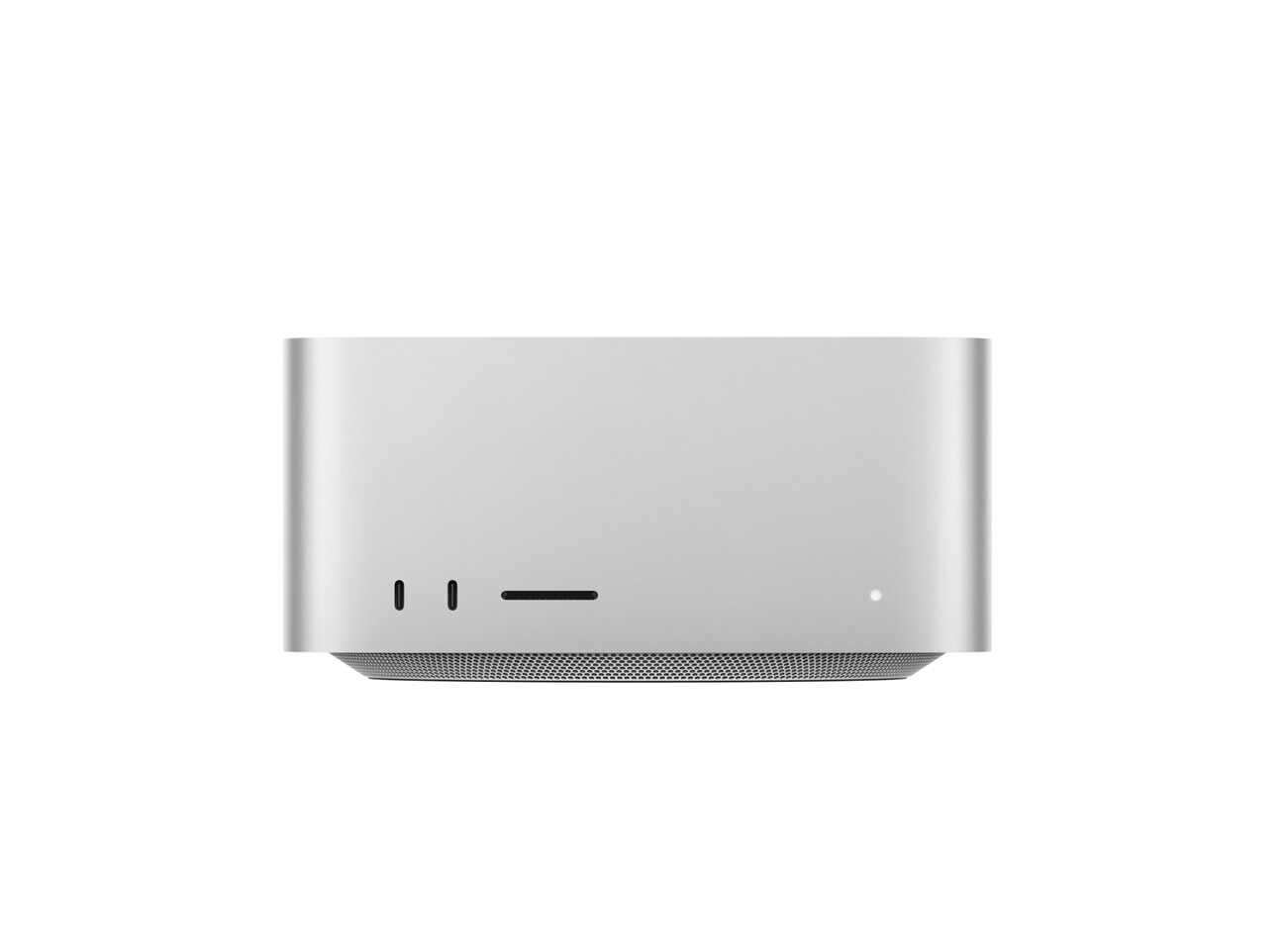
Apple Unleashes New Mac Studio With M3 Ultra and M4 Max SoCs

The refreshed Mac Studio is here, and it appears that Mark Gurman's reports were accurate once again. The system was updated with the M4 Max and the M3 Ultra SoCs - and once again, that is not a typo. For whatever reason, Apple refused to fit the Mac Studio with an M4-flavored Ultra SoC, instead settling for an undeniably confusing product lineup. The M4 Max, with up to 16 CPU cores and 40 GPU cores, will undoubtedly have the upper hand in single-core performance by as much as 30%, whereas the M3 Ultra will have superior multithreaded and GPU performance, courtesy of its 32 CPU cores and 80 GPU cores. Moreover, the price gap between the base M3 Ultra and M4 Max SKUs will remain the same, despite the former being based on an older generation.

However, the M3 Ultra will allow the system to be configured with up to a whopping 512 GB of unified memory, with memory bandwidth of 819 GB/s. While that number is not particularly mind-bending for a workstation-class system, the fact that the M3 Ultra's 80-core GPU will have access to over half a terabyte of fast-enough memory is a game changer for select few ultra-high-end workloads. Of course, this amount of VRAM is not intended for the average Joe, but the Ultra SoCs were always meant to be a halo product. The M3 Ultra variant can also be equipped with up to 16 TB of storage - at Apple's ridiculous pricing, of course. Needless to say, Apple's performance claims are as vague as always, and interested customers will have to wait for independent reviews and benchmarks to make sense of Apple's confusing SoC strategy with the new Mac Studio.

Refreshed Apple Mac Studio Likely To Launch Soon With M4 Max and M3 Ultra SoCs, For Whatever Reason

Apple's Mac Studio is in desperate need of a spec bump. The system is still powered by the M2-era SoCs, whereas the MacBook Pros are already two generations ahead. According to a fresh tidbit shared by comparatively reliable tipster Mark Gurman, Apple is set to announce a much-needed upgrade for the Mac Studio in the coming days, although the upgrade in question is sort of a confusing one. Basically, the report states that the Mac Studio will soon be available with the M4 Max, and the M3 Ultra SoCs - and that is not a typo. Apple apparently has not done the homework for an M4 Ultra chip, and will be shipping the Mac Studio with the M3 Ultra instead.

This is particularly confusing because the industry had widely believed that an M3 Ultra SoC never existed in the first place, and that Apple will be jumping straight to the M4 Ultra chip for the Mac Studio. What's even more confusing, is that Apple's 'Ultra' chips traditionally consisted of two 'Max' chips connected via the 'UltraFusion' die-to-die interconnect tech. However, the M3 Max simply does not have this feature, which means that whatever the M3 Ultra is set to be, it is likely that it won't be two M3 Max dies fused together. It will certainly be quite interesting to see how Apple manages to position the M3 Ultra, or whatever it is named, considering that the 'lower-tier' M4 Max SoC will undoubtedly have superior single-core performance. That said, the M4 Ultra is still in development, which, according to Mark Gurman, will be featured in the future Mac Pro revision, setting it apart from the Mac Studio.

Apple M4 Max CPU Faster Than Intel and AMD in 1T/nT Benchmarks

Early benchmark results have revealed Apple's newest M4 Max processor as a serious competitor to Arm-based CPUs from Qualcomm and even the best of x86 from Intel and AMD. Recent Geekbench 6 tests conducted on the latest 16-inch MacBook Pro showcase considerable improvements over both its predecessor and rival chips from major competitors. The M4 Max achieved an impressive single-core score of 4,060 points and a multicore score of 26,675 points, marking significant advancements in processing capability. These results represent approximately 30% and 27% improvements in single-core and multicore performance, respectively, compared to the previous M3 Max. This is also much higher than something like Snapdragon X Elite, which tops out at twelve cores per SoC. When measured against x86 competitors, the M4 Max also demonstrates substantial advantages.

The chip outperforms Intel's Core Ultra 9 285K by 19% in single-core and 16% in multicore tests, surpassing AMD's Ryzen 9 9950X by 18% in single-core and 25% in multicore performance. Notably, these achievements come with significantly lower power consumption than traditional x86 processors. The flagship system-on-chip features a sophisticated 16-core CPU configuration, combining twelve performance and four efficiency cores. Additionally, it integrates 40 GPU cores and supports up to 128 GB of unified memory, shared between CPU and GPU operations. The new MacBook Pro line also introduces Thunderbolt 5 compatibility, enabling data transfer speeds up to 120 Gb/s. While the M4 Max presents an impressive response to the current market, we have yet to see its capabilities in real-world benchmarks, as these types of synthetic runs are only a part of the performance story that Apple has prepared. We need to see productivity, content creation, and even gaming benchmarks to fully crown it the king of performance. Below is a table comparing Geekbench v6 scores, courtesy of Tom's Hardware, and a random Snapdragon X Elite (X1E-00-1DE) run in top configuration.

Apple's New MacBook Pro Features Powerful M4 Family of Chips and Ushers in a New Era With Apple Intelligence

Apple today unveiled the new MacBook Pro, powered by the M4 family of chips—M4, M4 Pro, and M4 Max—delivering much faster performance and enhanced capabilities. The new MacBook Pro is built for Apple Intelligence, the personal intelligence system that transforms how users work, communicate, and express themselves, while protecting their privacy. Now available in space black and silver finishes, the 14-inch MacBook Pro includes the blazing-fast performance of M4 and three Thunderbolt 4 ports, starting with 16 GB of memory, all at just $1,599. The 14- and 16-inch models with M4 Pro and M4 Max offer Thunderbolt 5 for faster transfer speeds and advanced connectivity. All models include a Liquid Retina XDR display that gets even better with an all-new nano-texture display option and up to 1000 nits of brightness for SDR content, an advanced 12MP Center Stage camera, along with up to 24 hours of battery life, the longest ever in a Mac. The new MacBook Pro is available to pre-order today, with availability beginning November 8.

Apple Introduces M4 Pro and M4 Max Processors

Apple today announced M4 Pro and M4 Max, two new chips that—along with M4—bring far more power-efficient performance and advanced capabilities to the Mac. All three chips are built using industry-leading, second-generation 3-nanometer technology, which improves performance and power efficiency. The CPUs across the M4 family feature the world's fastest CPU core, delivering the industry's best single-threaded performance, and dramatically faster multithreaded performance. The GPUs build on the breakthrough graphics architecture introduced in the previous generation, with faster cores and a 2x faster ray- racing engine. M4 Pro and M4 Max enable Thunderbolt 5 for the Mac for the first time, and unified memory bandwidth is greatly increased—up to 75 percent. Combined with a Neural Engine that's up to 2x faster than the previous generation and enhanced machine learning (ML) accelerators in the CPUs, the M4 family of chips brings incredible performance for pro and AI workloads. And they deliver blazing performance for Apple Intelligence, the personal intelligence system that transforms how users work, communicate, and express themselves, while protecting their privacy.
Return to Keyword Browsing
Nov 15th, 2026 20:21 CST change timezone

New Forum Posts

Popular Reviews

TPU on YouTube

Controversial News Posts