News Posts matching #N4C

Return to Keyword Browsing

TSMC Reiterates Node Leadership, Shows Progression from N2 to A14

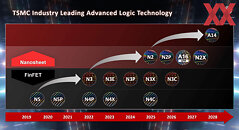
At the Open Innovation Platform Ecosystem Forum, TSMC outlined its near-term roadmap, highlighting how increasing AI workloads are intensifying the node development and balance between performance and efficiency. The company announced that N2 is now in volume production and expects N2P to ramp up in early 2026. TSMC aims to deliver initial A16 parts, which combine nanosheet transistors with a rear-side Super Power Rail (SPR), by the end of 2026. The progression of nodes moves from N3 to nanosheet-based N2, then to A16 with SPR, and eventually to the more advanced A14 node.

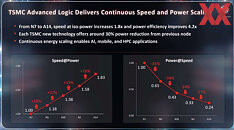
TSMC provided data showing a performance increase of about 1.8x when transitioning from N7 to A14 at constant power, along with an overall efficiency improvement of approximately 4.2x over the same period. For A16, the company predicts clock speeds 8-10% higher than N2P at the same voltage, while reducing energy consumption by 15-20% for similar throughput. For those wanting to remain on FinFET, enhanced FinFET options like N3C and N4C are still available, with N4C already in use by customers. TSMC also highlighted NanoFlex, a cell-level tuning method introduced with N2, which allows design teams to balance speed and efficiency. This approach can achieve 15% frequency gains or energy reductions of up to 30% in suitable designs.
TSMC Unveils Next-Generation A14 Process at North America Technology Symposium

TSMC today unveiled its next cutting-edge logic process technology, A14, at the Company's North America Technology Symposium. Representing a significant advancement from TSMC's industry-leading N2 process, A14 is designed to drive AI transformation forward by delivering faster computing and greater power efficiency. It is also expected to enhance smartphones by improving their on-board AI capabilities, making them even smarter. Planned to enter production in 2028, the current A14 development is progressing smoothly with yield performance ahead of schedule.

Compared with the N2 process, which is about to enter volume production later this year, A14 will offer up to 15% speed improvement at the same power, or up to 30% power reduction at the same speed, along with more than 20% increase in logic density. Leveraging the Company's experience in design-technology co-optimization for nanosheet transistor, TSMC is also evolving its TSMC NanoFlex standard cell architecture to NanoFlex Pro, enabling greater performance, power efficiency and design flexibility.

AMD to Build Zen 6 CCD on TSMC 3nm Process, Next-Gen cIOD and sIOD on 4nm

AMD is rumored to be building its next-generation CCD (core complex die) that implements the "Zen 6" microarchitecture, on the 3 nm TSMC N3E foundry node. This is part of a set of rumors from ChipHell forum, which got past rumors on AMD right. Apparently, AMD will also refresh the I/O dies for its next generation process, building them on the 4 nm foundry node, likely the TSMC N4C. The TSMC N3E node offers a 20% speed improvement, over 30% power savings, and approximately 60% logic density increase over TSMC N5, whereas the TSMC N4P node that the company uses for its current "Zen 5" chiplets only clock minor increases in logic density and power over N5. The N3E node relies on EUV double-patterning to achieve its logic density increases.

Perhaps the most interesting piece of news is the new-generation I/O dies. AMD is building these on the 4 nm node, which is a significant step up from the 6 nm node its current I/O dies are built on. On the client side of things, 4 nm will enable AMD to give the new cIOD an updated iGPU, probably based on a newer graphics architecture, such as RDNA 3.5. It will also give AMD the opportunity to integrate an NPU. The company might also update its key I/O components, such as the DDR5 memory controllers, to support higher memory speeds unlocked by CUDIMMs. We don't predict any updates on the PCIe front, since AMD is expected to carry on with Socket AM5, which determines that the cIOD puts out 28 PCIe Gen 5 lanes. At best, the USB interface put out from the processor could be updated to USB4 through an on-die host controller. Over on the server side, the new-generation sIOD will bring much needed increases to the DDR5 memory speeds enabled by clock drivers.
Return to Keyword Browsing
Nov 16th, 2026 07:49 CST change timezone

New Forum Posts

Popular Reviews

TPU on YouTube

Controversial News Posts