News Posts matching #NTT

Return to Keyword Browsing

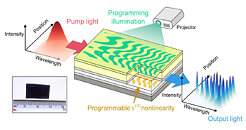
NTT Research Collaboration Breaks the "One Device, One Function" Paradigm with World's First Programmable Nonlinear Photonics Chip

NTT Research, Inc., a division of NTT, announced that its Physics and Informatics (PHI) Lab, working with Cornell University and Stanford University, has developed the world's first programmable nonlinear photonic waveguide that can switch between multiple nonlinear-optical functions on a single chip. The breakthrough fundamentally alters how nonlinear photonic devices operate, breaking the "one device, one function" paradigm, and significantly expands the applications for tunable light sources, optical and quantum computation, and communication.

Ryotatsu Yanagimoto, a scientist at NTT Research, led the research under the supervision of Peter L. McMahon, an associate professor at Cornell University. The paper, "Programmable On-Chip Nonlinear Photonics," was published by leading scientific journal Nature online on Oct. 8, 2025. It will be published in print by Nature on Nov. 13, 2025.
Japan Opens Prototype Quantum Computing System for Public, Worldwide Use

Japan's Nippon Telegraph and Telephone Company (NTT) is opening up its prototype quantum computing system for public use over the internet, giving users around the world access to one of the most elusive pieces of tech that this world has yet seem. Maybe we haven't seen it, though; observation does change the outcome, and these quantum physics really are as finicky as they come. Starting Nov. 27, Japan joins China and the U.S. in the race to develop the world's most advanced computers - and Japan has chosen the free, quantum-democratizing approach.

The NTT quantum computing solution is a state-sponsored research project, developed in conjunction with the National Institute of Informatics, Osaka university, and other partners. It has taken a different technical approach from other quantum computing developers, in that this particular computing system is exploiting the properties of light. Widely (un)known as Linear Optics Quantum Computation (LOQC), this particular approach foregoes qubits (which are extremely difficult to keep from decohering, and usually require very exotic cooling techniques to increase the qubits' stability. LOQC abandons qubits and uses photons to represent them as information carriers through linear optical elements (such as beam splitters, phase shifters, and mirrors). This allows the machine to process quantum information, using photon detectors and quantum memories to detect and store quantum information.
Return to Keyword Browsing
Nov 16th, 2026 05:18 CST change timezone

New Forum Posts

Popular Reviews

TPU on YouTube

Controversial News Posts