News Posts matching #ROG MATRIX

Return to Keyword Browsing

ASUS ROG Launches MATRIX GeForce RTX 5090 D V2 24 GB Model in China

Last November, ASUS launched its GeForce RTX 5090 ROG MATRIX Platinum 30th anniversary 32 GB graphics card model. This strictly limited edition release—at the time, only 1000 units were produced—demanded a whopping $3999 (per unit) price tag. Unique selling points (USPs) included an unusual overall design, 3 oz copper PCB layers, a dual-power input involving the 16-pin 12V-2x6 connector and BTF-supplied power delivery, as well as the integration of a tiny Bosch Sensortec BMI323 inertial measurement unit (IMU). By early December, it was not clear whether initial quality issues had caused an official(?) recall of extremely overengineered MATRIX custom flagships. Months later, a Chinese market variant has hit the pre-order stage—over the weekend, ITHome reported on the pre-release status of this sanction-conforming model.

Despite featuring downgraded specifications, the customized GeForce RTX 5090 D V2 24 GB version still demands a hefty cost of entry—a main JD.com listing advertises a price tag of 29,999 yuan (~$4341 USD). Last month, Tony Yu—the manager of ASUS China—showcased a MATRIX GeForce RTX 5090 D V2 sample achieving a 3DMark Time Spy Extreme score of 28,638 points. This impressive tally was enabled via an 800 W operation mode, ITHome noted that this figure: "even surpasses NVIDIA's RTX PRO 6000 (21,760 cores vs. 24,064 cores), which is closer to (utilizing) the 'full-blooded' GB202 (GPU die's max. count of 24,576 units)." The older GeForce RTX 5090 D "V1" 32 GB card was no slouch in gaming and AI performance departments, but global tensions led to an eventual cut-off of supplies into China. Oddly, ITHome tracked the 25,999 yuan (~$3762 USD) listing of an MSI GeForce RTX 5090 D Gaming Trio 32 GB SKU on the JD.com e-tail platform, earlier on in 2026. In any case, local hardcore PC enthusiasts and AI companies can access top-tier "Blackwell" GPU hardware, whether in V2 or V1 guises. Black market options, including "truly banned" models are also (reportedly) available.



GIGABYTE RTX 5090 AORUS Infinity, ASUS RTX 5090 ProArt, and MSI RTX 5090 Lightning Z, Hands On

At the 2026 International CES, we went hands on with a new crop of ultra-premium custom-design GeForce RTX 5090 graphics cards that launched in quick succession of each other this year, exactly 1 year following the RTX 5090's original launch. Earlier today, we also held the Inno3D iChill RTX 5090 Frostbite PRO, another such recently announced premium RTX 5090 custom-design. The GIGABYTE RTX 5090 AORUS Infinity and ASUS RTX 5090 ProArt stand out as being the first custom design implementations of NVIDIA's Dual Flow-Through cooler design that it introduced with the RTX 5090 Founders Edition graphics card, the company's de facto reference design.

This design involves placing the main PCB of the card with the GPU, memory, and VRM, as a separate, centrally located component, with heat drawn from these hot components projecting along the length of the card, and fans located at both ends, push air through the cooler and out of the backplate, through cutouts. The PCB relies on additional breakout PCBs for the PCI-Express gold fingers, and the display I/O. GIGABYTE's design sees two large 120 mm fans pump air through the heatsink, with some of it being guided through the central region of the cooler. GIGABYTE has used a similar two-tone color scheme as NVIDIA Founders Edition. We can't wait to get our hands on this card to see how the cooler fares against rival custom designs.

ASUS Denies GeForce RTX 5090 ROG MATRIX Recall

ASUS has officially denied a recall of its limited edition GeForce RTX 5090 ROG MATRIX graphics card, which was reportedly facing some quality issues. However, ASUS was quick to dispute these claims. In the past, an ASUS reportedly representative informed Swedish e-tailer "Inet" that they had identified a quality issue with the RTX 5090 32 GB ROG Matrix Platinum 30th Anniversary Edition, preventing planned deliveries while they worked on an undated replacement. However, in ComputerBase update from Christian Wefers, part of ASUS Public Relations, the situation is now clearer:
Christian Wefers, ASUS PRThere is no product recall for the ROG Matrix GeForce RTX 5090. We proactively adjusted the original timeline to allow additional time for product improvements and to ensure an optimal customer experience. The products will arrive at our partners within the next few days. Availability may vary by region.

Inet.se Pauses Shipment of ASUS RTX 5090 ROG MATRIX - Report Suggests Quality Issue

The long-windedly named ASUS ROG Matrix Platinum RTX 5090 30th Anniversary Edition graphics card has encountered a snag, on the cusp of being unleashed at retail. This quad-fan cooled monster enjoyed a late summer unveiling, followed shortly by influencer first impressions. Despite a generous dose of lead time, and much vaunted fault detection features, the $3999 product has seemingly stumbled at the starting line. PC hardware news outlets have picked up on a specific ASUS forum query, regarding the status of 1000 limited units at launch.

Upon further investigation, VideoCardz has uncovered evidence of Sweden's Inet sending updates to involved customers. The e-tailer's email message reportedly stated: "I am contacting you regarding your ASUS GeForce RTX 5090 32 GB ROG Matrix Platinum 30th Anniversary Edition order. Unfortunately, we have been informed by ASUS that they have identified a quality issue with this particular model. Due to this, we are unable to deliver the card as planned. ASUS is currently working on a replacement version without these issues, but at this time there is no estimated date for when a new copy will be available. We fully understand that this is an unfortunate situation, but unfortunately it is completely beyond our control." It is not immediately clear whether finalized stock has reached retail locations. It is possible that the mysterious problem was discovered prior to widespread disperal across international distribution networks.

ASUS GeForce RTX 5090 ROG MATRIX Priced at $3,999, Only 1,000 Units Available

ASUS has officially listed its GeForce RTX 5090 ROG MATRIX 30th anniversary limited-edition GPU for $3,999 on its U.S. store. Limited to 1,000 units, this is ASUS's most powerful and expensive card for the RTX 50-series "Blackwell" generation. The build quality justifies the price, as ASUS uses 3 oz copper PCB layers to enhance heat dissipation and minimize voltage drop across components, resulting in improved overall performance and potentially higher overclocking capabilities. The GPU features four large fans, similar to ASUS's RTX 5090 Astral GPU, with three fans in the front and one in the back, utilizing a push-pull air cooling design. The GPU shroud has a prominent ROG red design with a distinct ring on one fan, featuring an acrylic plate with the ROG MATRIX logo.

ASUS also offers an option for BTF-supplied power delivery, along with a 16-pin 12V-2x6 connector, allowing for a total power setting of up to 800 watts, which significantly exceeds the regular 575 watts of the Founders Edition GPU. ASUS claims this supplies a 10% performance boost on its own, and the boost clock frequency is confirmed at 2,730 MHz regular, and 2,760 MHz in OC BIOS mode. Embedded within the GPU is a miniature Bosch Sensortec BMI323 inertial measurement unit (IMU), which combines an accelerometer and gyroscope in a single component. ASUS integrates this sensor into the PCB to continuously monitor whether the graphics card remains level with the motherboard, triggering an immediate alert if the card shifts even slightly downward. More features are listed on ASUS website.

ASUS Level Sense Detects When GeForce RTX 5090 ROG MATRIX Sags

The ASUS GeForce RTX 5090 ROG MATRIX is approaching its retail launch, and ASUS has already detailed a new software feature called "Level Sense" designed to prevent sagging in this massive and premium-priced graphics card. Embedded within the GPU is a miniature Bosch Sensortec BMI323 inertial measurement unit (IMU), which combines an accelerometer and gyroscope in a single component for a negligible cost. ASUS integrates this sensor into the PCB to continuously monitor whether the graphics card remains level with the motherboard, triggering an immediate alert if the card shifts even slightly downward. This feature proves particularly valuable for models like the air-cooled ROG ASTRAL RTX 5090, which weighs approximately 3 kg and can place considerable strain on your motherboard's PCIe slot over extended periods.

These capabilities are integrated into ASUS GPU Tweak software, which enables real-time sag detection and provides additional tuning options for the graphics card. This functionality becomes especially significant for users who relocate their desktops infrequently and may not observe gradual changes in component positioning. As graphics cards continue to increase in size and mechanical demands, it is easy to overlook their status as a physical burden on your system, a consideration that becomes particularly relevant when moving your PC for maintenance or component upgrades.

ASUS ROG MATRIX RTX 5090 PCB Pictured, Cooler Disassembled

Here are some of the first pictures of the ASUS ROG MATRIX GeForce RTX 5090 flagship graphics card taken apart, courtesy of der8auer. The card was launched earlier today at the company's Gamescom 2025 showcase. The ROG MATRIX uses a spruced-up version of the ROG Astral RTX 5090 BTF PCB. While we haven't had a chance to take apart the BTF ROG Astral, we've tested both the ROG Astral Liquid RTX 5090 and its air-cooled sibling, which share a common PCB design. You can compare that with the ROG MATRIX RTX 5090 PCB (pictured below) and spot some obvious differences.

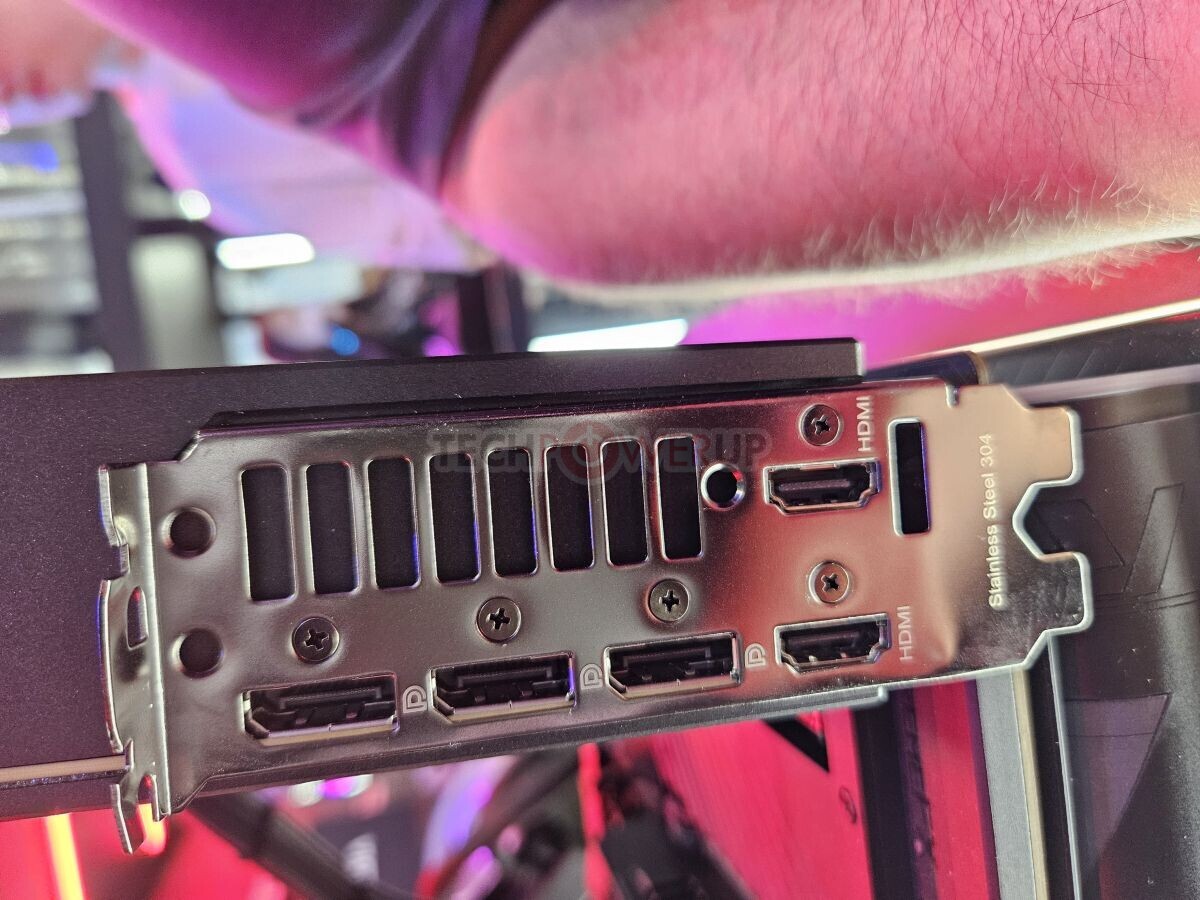
To begin with, the ROG MATRIX appears to have the same VRM configuration as the ROG Astral, with 24+7 phases. These are laid out in an identical arrangement to the ROG Astral. We can't make out the DrMOS chips, but it's possible that ASUS is using higher current DrMOS chips than the 80 A ones used in the ROG Astral. It's the only area where ASUS can one-up the Astral on the MATRIX. The other visible difference is the detachable BTF (GC-HPWR) gold-finger. It's detachable so you can use it on non-BTF motherboards by connecting the 12V-2x6 connector that's concealed by a small metal cover on the cooler shroud. It's also interesting to see the two 4-pin PWM case fan headers next to the 12V-2x6 being shrouded, but this is probably just a factory concealment. The display I/O is identical to that of the ROG Astral, which is a missed opportunity to throw in something like USB-C with DisplayPort passthrough, which ASUS implemented on its RTX 5080 ProArt. Next up, we have the cooler.

ASUS Unveils Quad-Fan GeForce RTX 5090 ROG MATRIX GPU

Last week, we received a few teasers from ASUS about its upcoming 30th anniversary special edition GPU, which will be available in the form of the GeForce RTX 5090 ROG MATRIX SKU. Today, ASUS officially showcased what we thought was an air-cooled design. Confirming that the card is air-cooled, it features four massive fans, which closely resemble ASUS's RTX 5090 Astral GPU, with three fans in the front and one in the back, performing a push-pull air cooling design. The GPU shroud features a massive ROG red design with a distinct ring on one fan, carrying an acrylic plate with the ROG MATRIX logo. ASUS also offers an option for BTF-supplied power delivery, along with a 16-pin 12V-2x6 connector, allowing for a total power setting of up to 800 Watts, which significantly exceeds the regular 575 Watts of the Founders Edition GPU. ASUS claims this supplies a 10% performance boost on its own, and the boost clock frequency is confirmed at 2,730 MHz.

For maximum performance, ASUS utilizes 3 Oz copper PCB layers to enhance heat dissipation and minimize voltage drop across componentry, resulting in improved overall performance and potentially higher overclocking capabilities. For die-to-heatsink contact, liquid metal is used to maximize heat dissipation in this beast, which is necessary given its ability to consume 800 W of power. ASUS still hasn't announced pricing and final specifications, like memory clock, but we assume it will also be overclocked out of the box. For serious tuning, the card has yet to be put through professional overclocking labs. Given that only 1,000 units will be sold, it is a question whether anyone will attempt any extreme OC record on the card.

ASUS Teases ROG MATRIX GeForce RTX 5090: Ultimate Enthusiast SKU

ASUS has prepared a surprise for its customers on its 30th birthday with the special GeForce RTX 5090 ROG MATRIX GPU, which will likely be ASUS's ultimate, no-compromise GPU. This time, we expect a special theme to follow, featuring a classic ROG red color scheme. ASUS teased what appears to be a massive single fan, likely complemented by additional fans in a push-pull configuration. There is an acrylic cutout displaying 3D-like "ASUS ROG" lettering, with additional accents all around the card.

If you recall, the previous ASUS GeForce RTX 4090 ROG MATRIX GPU featured an AIO attached to the card for ultimate overclocking performance. This new teaser suggests that the card will likely be an air-cooled variant, featuring design elements unlike any RTX 50-series card we have seen. Given that this is ASUS's top SKU, it is also likely that ASUS binned the chips used in production to maximize overclocking performance. Don't expect it to come cheap—this is definitely an enthusiast-grade SKU.

Splave's ASUS ROG MATRIX RTX 4090 Cracks 4 GHz GPU Clock Barrier

An ASUS ROG MATRIX GeForce RTX 4090 overclocked by Splave became the first graphics card to break the 4 GHz GPU clock barrier. The card was overclocked to a blistering 4005 MHz GPU clock while leaving the memory untouched at 21 Gbps. The card was GPU Pi stable, and went on to set the single GPU record of 45.402 seconds. The ROG MATRIX was cooled using a liquid nitrogen evaporator, while the Core i9-13900K powering the rig was on AIO liquid CPU cooling. The CPU was left at stock frequency, and the memory ticked at vanilla DDR5-4800. The HWBOT validation of the feat can be accessed here.

ASUS ROG MATRIX GeForce RTX 4090 PCB Pictured

Here's the first picture of the bare PCB of the upcoming ASUS ROG MATRIX GeForce RTX 4090 graphics card, courtesy of der8auer, who was given access to the card as part of a G.Skill overclocking event. We spotted a fully assembled version of this card on the Computex floor earlier. The PCB is essentially of the same design as the ROG Strix RTX 4090, but with some major changes. The card draws power from a single 16-pin 12VHPWR connector, and we're hearing that the card's power limits will be the highest ever allowed by NVIDIA for any custom RTX 4090, perhaps even getting close to the 600 W continuous design limit of the connector.

The card features a 24-phase VRM for the GPU power phases, and a 4-phase VRM for the 24 GB of GDDR6X memory across a 384-bit memory interface. We cannot make out the exact DrMOS components for this VRM, but der8auer says these are 70 A-rated MPS-sourced DrMOS (the ROG Strix uses 70 A DrMOS sourced from OnSemi). Although one can't tell just by looking, ASUS says that it has deployed a network of SMD thermal sensors across the critical areas of the card, such as individual rows of memory chips, or DrMOS. This is essentially ASUS's inspiration of the late EVGA iCX. There is a physical dual-BIOS switch, some consolidated voltage measurement points, and some fan and lighting headers, but that's about it.

ASUS Announces ROG MATRIX RTX 4090 Flagship Graphics Card

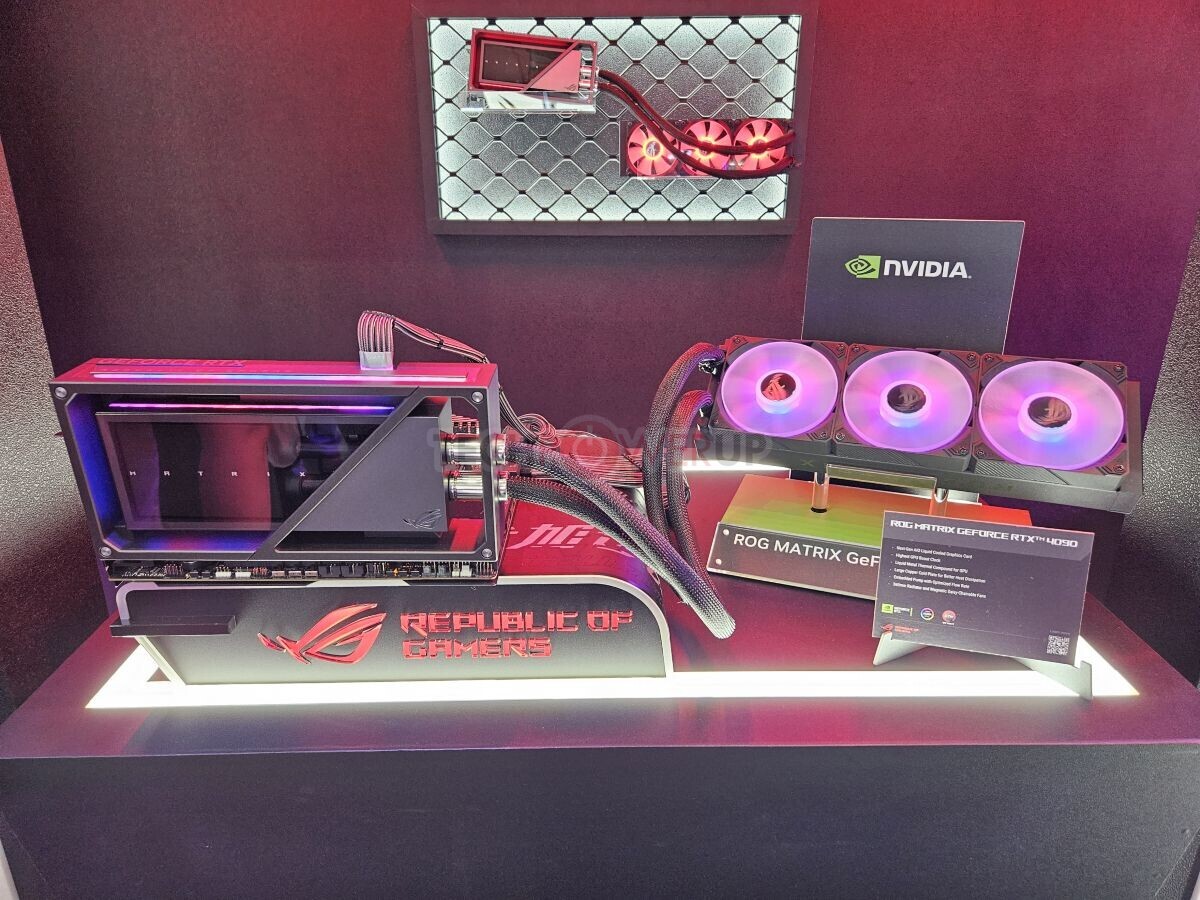
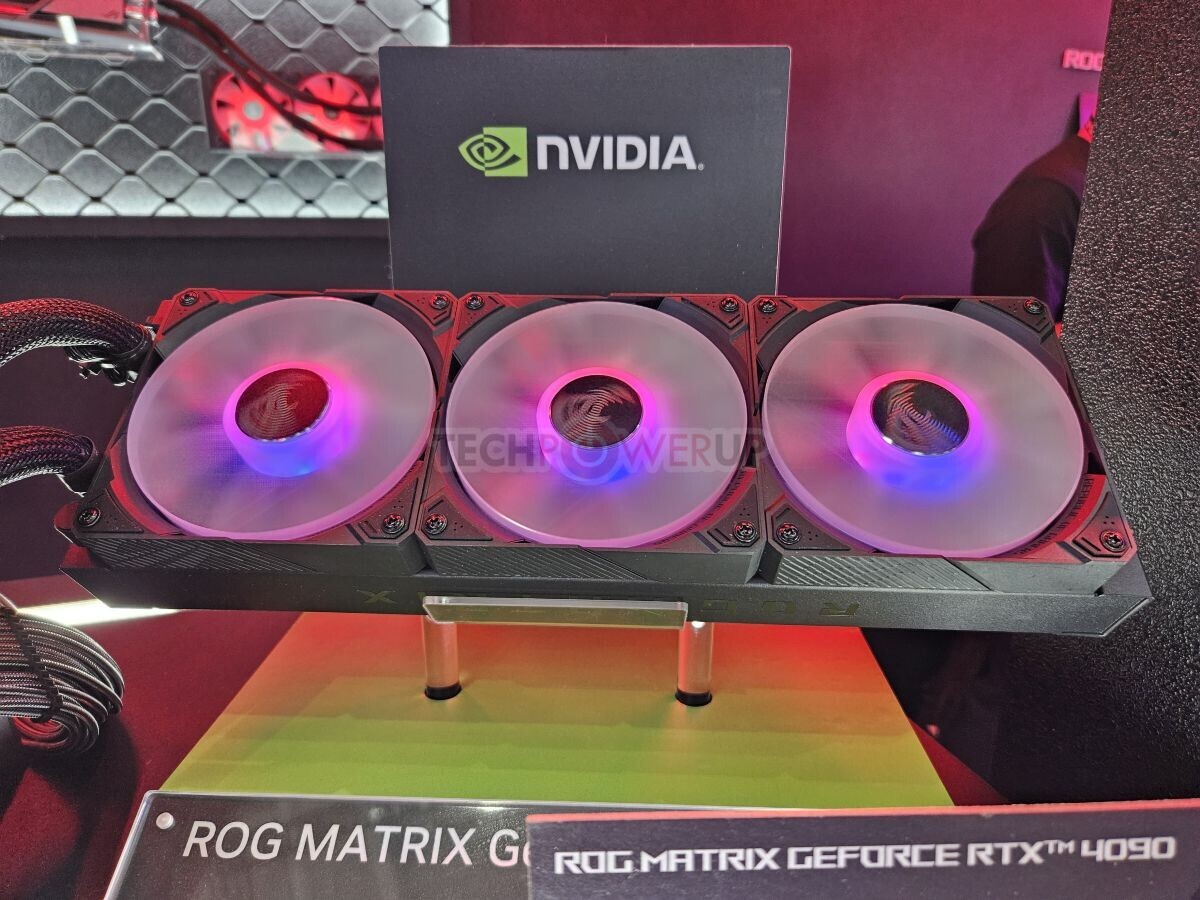
ASUS at the 2023 Computex launched the ROG MATRIX GeForce RTX 4090, its absolute top-end custom-design graphics card, designed to be the fastest money can buy. The card features the industry's highest factory-overclock for an RTX 4090, and has its power limits set squarely at 600 W, maxing out the single 16-pin 12VHPWR connector. The card also features the strongest VRM solution ever by ASUS for a graphics card, to hold this PL. The star attraction with this card is that it is marketed as the first graphics card that incorporates liquid metal technology.

What it essentially means, is that the cooling solution uses liquid-metal thermal interface material (TIM) for the GPU. The enthusiasts among you know how difficult it is to apply and maintain liquid metal, and ASUS is among the first companies to do this on an industrial scale, using a fully automated process. The company originally designed this mechanized liquid-metal TIM application technique for its high-end notebooks, but figured it could use it even for graphics cards. Liquid-metal TIMs offer the highest possible thermal conductivity as the TIM is pure metal. It's also electrically conductive, which is why application and maintenance is extremely difficult. ASUS innovated a cold-plate design specifically for this task, so the graphics card could survive international shipping from its factories. A third innovation by ASUS has been to develop a special multi-layer resin that protects the SMD components on the PCB against being shorted by the liquid-metal. ASUS is so confident in its liquid-metal technology, that the company is backing this graphics card with a comprehensive 5-year warranty.

ASUS ROG Strix RTX 2080 Ti White Edition Graphics Card Pictured

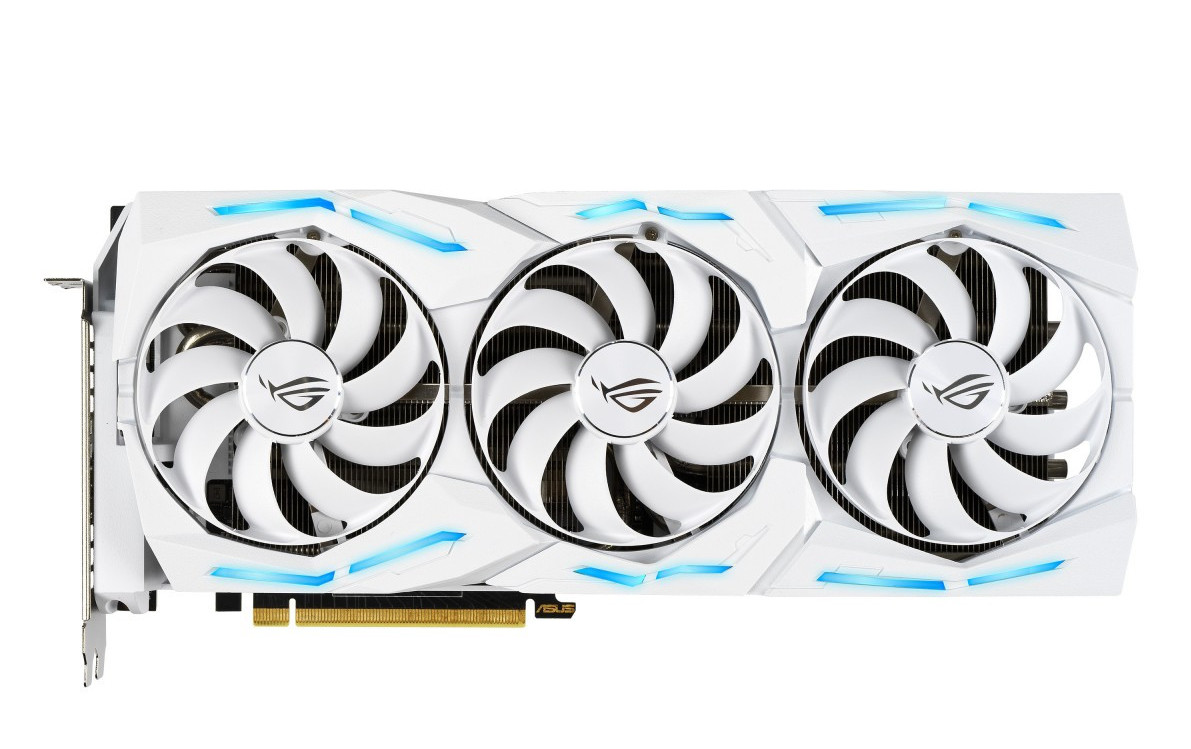
We live in strange times, with GALAX releasing HOF Black Edition graphics cards, and now ASUS dishing out an ROG Strix White Edition. Unlike GALAX, ASUS limited its whitewash to the cooler shroud, the fan impellers, the back-plate, and even the various internal cables (fans, lighting, etc.,) while leaving the PCB black. The cooler shroud has RGB LED embellishments at the same spots as the original ROG Strix RTX 2080 Ti, so you can play with color.

The card ships with 1770 MHz GPU Boost frequency, and an untouched 14 Gbps (GDDR6-effective) memory. The GPU Boost frequency in particular is significantly higher than the 1650 MHz of the ROG Strix RTX 2080 Ti O11G, and closer to the 1800 MHz that the ROG MATRIX RTX 2080 Ti ships with. The ROG Strix RTX 2080 Ti White Edition is priced at 1,600€ (including taxes).

ASUS to Introduce the ROG MATRIX GeForce RTX 2080 Ti Graphics Card With Integrated AIO "Infinity Loop"

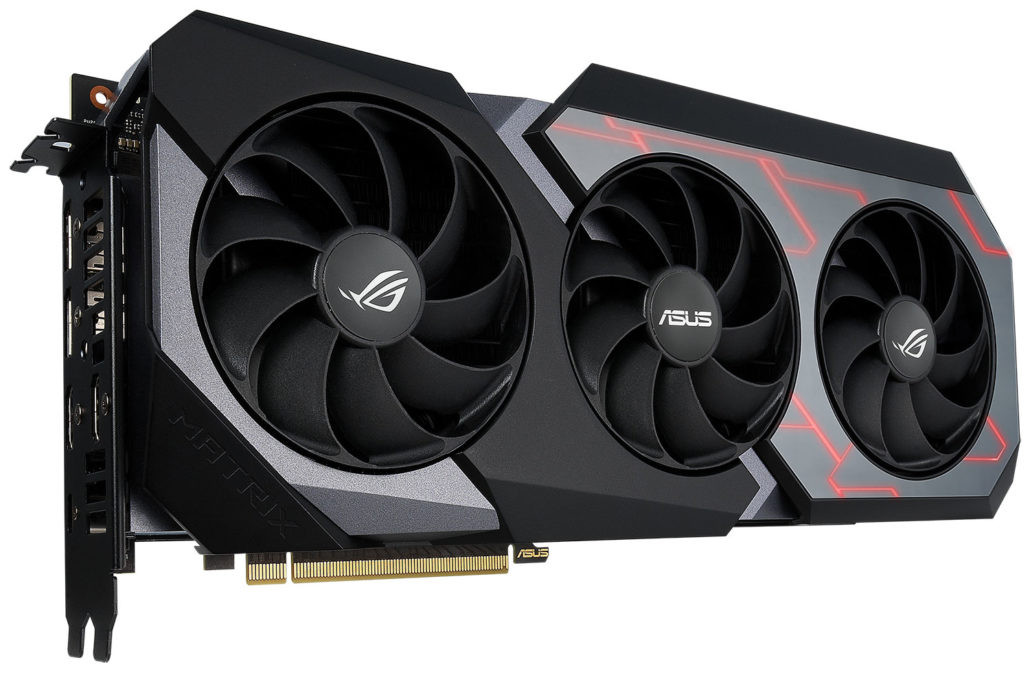
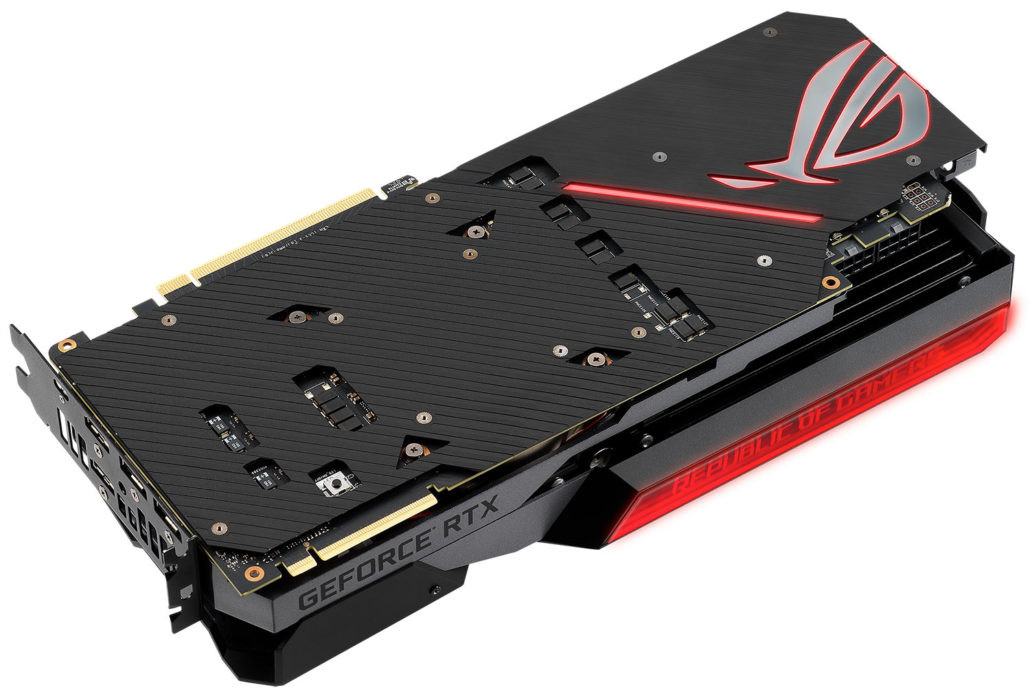
ASUS is looking to one-up the competition in the flagship graphics card market with its ROG MATRIX rendition of the RTX 2080 Ti interpretatioin of NVIDIA's silicon. The ROG MATRIX GeForce RTX 2080 Ti will incorporate an AIO watercooling solution complete with waterblock, pump, radiator and fans in a triple-slot design. ASUS claims the Infinity Loop cooler will bring about performance equivalent of that of an external 240mm AIO - a bold claim, since physics and proximity of the radiator and fans themselves to the PCB and die should dictate a higher temperature than an otherwise completely external solution.

That said, the design of the Infinity Loop is likely one of the most interesting graphics card cooling designs in some time, with a completely self-contained solution. The shroud and side of the graphics card feature laser cutouts and LED-illuminated elements (because 2019 wouldn't be much different from 2018 in that regard). Out-of-the-box clocks are set at 1815 MHz before any additional overclocking, and the card takes power from 2x 8-pin power connectors. The cost? North of $1600. Now that's design, even in the price-tag.
Return to Keyword Browsing
Nov 11th, 2026 03:13 CST change timezone

New Forum Posts

Popular Reviews

TPU on YouTube

Controversial News Posts