
News Posts matching #RTX 5090D v2

Return to Keyword Browsing

Colorful Unveils 30th Anniversary iGame GeForce RTX 5090D v2 Arcanix at Computex

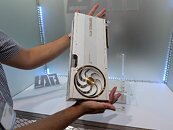
Alongside a handful of new notebooks and pre-built desktop PCs, Colorful, the Chinese electronics brand widely known for its motherboards and NVIDIA GPUs, has revealed a chunky, white and gold iGame GeForce RTX 5090D v2 Arcanix 24 GB graphics card at Computex. The new GPU bears the brand's 30th anniversary branding and a bold white and gold color scheme, with what appears to be a massive 3.5- or four-slot cooler that has four fans in total—three on the front, with an extra fan towards the rear of the backplate over a flow-through section of the heat sink.

Colorful has not shared much about the GPU's specifications, but it will be based on the 5090D V2 GPU, and the show unit TechPowerUp's news team checked out at Computex has three DisplayPort ports and an HDMI port as outputs. There is also an easily accessible toggle switch on the I/O section labelled "Normal" and "Turbo," indicating that there will be a factory overclock available. It's unclear whether this will be a global launch for Colorful or simply a China-exclusive, like many RTX 5090D V2 models are. Currently, Colorful's flagship 5090D V2 GPU


MSI GeForce RTX 5090D v2 Lightning Appears with 24 GB VRAM

The MSI GeForce RTX 5090D v2 Lightning has officially appeared on the Chinese market, according to a Bilibili user named "Hardware Patrick Star." This China-exclusive SKU is an adaptation of the new GeForce RTX 5090D v2 with MSI's overclocking enhancements, allowing the card to reach new performance heights, paired with an all-in-one liquid cooler. The new RTX 5090D v2 retains the GB202 family's compute power, with 21,760 CUDA cores, Blackwell architecture, and a 575 W TGP, but reduces the memory to 24 GB of GDDR7 on a 384-bit bus, compared to the previous 32 GB on a 512-bit bus. MSI noted that the GeForce RTX 5090D Lightning GPU is limited to 1,300 units. However, since the China-exclusive SKU is considered a completely different graphics card, it is possible that there are another 1,300 units for the Chinese market with the RTX 5090D v2 Lightning model. The Bilibili user has SKU number 909, indicating that the rest have been distributed to retail channels.

We reviewed MSI's regular GeForce RTX 5090 Lightning graphics card and found that the GPU can reach up to 1,000 W with an OC BIOS loaded. We observed an average GPU clock speed of 3,218 MHz due to the water cooling. Independent testing might show the RTX 5090D v2 Lightning achieving similar performance levels, but since it's a China-focused SKU, we could only see reviews from Chinese hardware reviewers. Earlier claims by EXPreview indicate that hands-on testing suggests mixed results for buyers. In pure gaming, the RTX 5090D and RTX 5090D v2 cards are often nearly identical, with frame rate differences usually within a percent or two, so most current 4K titles will not noticeably suffer from the missing 8 GB. For AI workloads and model inference, the gap is more significant, with single-digit to low-double-digit performance drops where extra memory is important.

NVIDIA Releases GeForce RTX 5090D v2: Similar Gaming, Lower AI Performance

NVIDIA has quietly replaced the China-bound RTX 5090D on its product pages with a new GeForce RTX 5090D v2 and set the suggested retail price at ¥16,499, the same sticker as the outgoing D model. The new RTX 5090D v2 keeps the GB202 family's compute muscle intact, with 21,760 CUDA cores, Blackwell architecture and a 575 W TGP, but trims the memory to 24 GB of GDDR7 on a 384-bit bus instead of the previous 32 GB on 512 bits. That change appears aimed at preserving a high-end gaming SKU for Chinese buyers while adapting memory and routing to regional supply and compliance realities. Retail listings and product pages from partners show the V2 already replacing prior entries, which suggests NVIDIA will, or has already, phased out the original D variant in that market.

According to EXPreview, hands-on testing suggest a split picture for buyers. In pure gaming, the RTX 5090D and RTX 5090D v2 cards are often virtually tied, with frame rate differences usually within a percent or two, so most current 4K titles will not noticeably feel the missing 8 GB. For AI workloads and model inference, the gap is more apparent, with single-digit to low-double-digit performance drops where extra memory matters. Partners are preparing custom builds with larger coolers and multi-fan designs that will likely sell above the stated price, given tight supply and demand. For gamers who want local warranty and service in China, the RTX 5090D v2 is now the top-tier choice. For teams and shops that rely on the fuller-memory D models for large-scale AI work, procurement strategies may shift, or premiums will have to be paid to secure the remaining 32 GB inventory.

NVIDIA Renames GeForce RTX 5090DD to RTX 5090D v2

NVIDIA has quietly engineered a third variant of its flagship GPU in response to new US export regulations, aiming to maintain performance while avoiding restrictions. A few weeks ago, we got leaks about the GeForce RTX 5090DD, which was supposed to be a new version based on the modified RTX 5090D. The initially released GeForce RTX 5090D was designed to comply with the Department of Commerce's updated rules while delivering virtually identical results to its unrestricted counterpart in both gaming and synthetic benchmarks. Now, the newly named RTX 5090D v2 features the same 21,760 CUDA cores and a 575 W power draw, ensuring that the core Blackwell architecture performs as users would expect, albeit with a reduced 24 GB VRAM buffer.

NVIDIA plans to introduce an updated RTX 5090D v2 model in August. According to reliable industry sources, this refresh will feature 24 GB of GDDR7 memory on a 384-bit bus, down from the original 512-bit interface, while preserving overall thermal and computational characteristics. For most gamers, the reduced VRAM capacity is unlikely to be noticeable, as only a handful of titles require more than 24 GB of VRAM. Ultimately, the success of the v2 will depend on whether it reaches the market at a price point that aligns with the expectations of its flagship. Given that the target market is China, we have to wait for sales and performance figures first. According to a well-known leaker, kopite7kimi, they noted that there is some surprise, indicating that NVIDIA has made a significant change to comply with export regulations, so it could be a firmware update preventing these cards from running AI workloads.
Return to Keyword Browsing
Nov 15th, 2026 16:10 CST change timezone

New Forum Posts

Popular Reviews

TPU on YouTube

Controversial News Posts