News Posts matching #Rhea

Return to Keyword Browsing

SiPearl Launches Athena1 Sovereign Processor Dedicated to Dual-Use

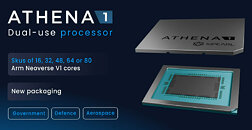
SiPearl, the European fabless designer of sovereign high-performance energy-efficient processors for HPC, AI and data centers, today announced the launch of the Athena1 processor for dual-use applications.

Based on the unique expertise in Europe developed for the design of Rhea1 (SiPearl's first generation processor, dedicated to HPC), Athena1 will offer features specifically tailored to the workloads of government, defense and aerospace applications. These include, for example, secure communications and intelligence, cryptography and encryption, intelligence processing, tactical networks, electronic detection or local data processing on vehicles.
European HPC Processor "Rhea1" Tapes Out, Launch Delayed to 2026

European Processor Initiative (EPI) is nearing completion of its first goal. SiPearl, the leading developer behind the Rhea1 processor, has finally reached the tapeout stage after a string of delays, but it will not be ready for delivery until 2026 at the earliest. When the project launched in 2020, SiPearl planned to begin production in 2023; however, the 61 billion-transistor chip only entered tapeout this summer. The design, built on TSMC's N6 process, features 80 Arm Neoverse V1 cores alongside 64 GB of HBM2E memory and a DDR5 interface. While these specifications once looked cutting-edge, the industry has already moved on, and Rhea1's raw performance may seem dated by the time samples are available. SiPearl initially explored a RISC-V architecture back in 2019 but abandoned it after early feedback and comments highlighted the instruction set's immaturity for exascale computing.

Development was further interrupted by shifting core-count debates, with teams alternately considering 72 cores, then 64, before finally settling on 80 cores by 2022. Those back-and-forth decisions, combined with evolving performance expectations, helped push the timeline back by years. Despite missing its original schedule, Rhea1 remains vital to European ambitions for high-performance computing sovereignty and serves as the intended CPU for the Jupiter supercomputer. Thanks to Jupiter's modular design, the system was not left idle; its GPU booster module, running NVIDIA Grace Hopper accelerators, is already operational and approximately 80 percent complete. With the CPU clusters slated for mid-2026 deployment, full system readiness is expected by the end of 2026. To support this effort, SiPearl has recently secured €130 million in new financing from the French government, industry partners, and Taiwan's Cathay Venture. As Rhea1 finishes its goal, work on Rhea2 is already underway, and we can expect more updates about Rhea2 in a year or two.
Rhea1

European Supercomputer Chip SiPearl Rhea Delayed, But Upgraded with More Cores

The rollout of SiPearl's much-anticipated Rhea processor for European supercomputers has been pushed back by a year to 2025, but the delay comes with a silver lining - a significant upgrade in core count and potential performance. Originally slated to arrive in 2024 with 72 cores, the homegrown high-performance chip will now pack 80 cores when it eventually launches. This decisive move by SiPearl and its partners is a strategic choice to ensure the utmost quality and capabilities for the flagship European processor. The additional 12 months will allow the engineering teams to further refine the chip's architecture, carry out extensive testing, and optimize software stacks to take full advantage of Rhea's computing power. Now called the Rhea1, the chip is a crucial component of the European Processor Initiative's mission to develop domestic high-performance computing technologies and reduce reliance on foreign processors. Supercomputer-scale simulations spanning climate science, drug discovery, energy research and more all require astonishing amounts of raw compute grunt.

By scaling up to 80 cores based on the latest Arm Neoverse V1, Rhea1 aims to go toe-to-toe with the world's most powerful processors optimized for supercomputing workloads. The SiPearl wants to utilize TSMC's N6 manufacturing process. The CPU will have 256-bit DDR5 memory connections, 104 PCIe 5.0 lanes, and four stacks of HBM2E memory. The roadmap shift also provides more time for the expansive European supercomputing ecosystem to prepare robust software stacks tailored for the upgraded Rhea silicon. Ensuring a smooth deployment with existing models and enabling future breakthroughs are top priorities. While the delay is a setback for SiPearl's launch schedule, the substantial upgrade could pay significant dividends for Europe's ambitions to join the elite ranks of worldwide supercomputer power. All eyes will be on Rhea's delivery in 2025, mainly from Europe's governments, which are funding the project.

SiPearl and AMD Join Forces to Develop European Exascale Systems

SiPearl, the company designing the highperformance, low-power microprocessor for European supercomputers, has entered into a business collaboration agreement with AMD to provide a joint offering for exascale supercomputing systems, combining SiPearl's HPC microprocessor, Rhea, with AMD Instinct accelerators.

Initially, AMD and SiPearl will jointly assess the interoperability of the AMD ROCm open software with the SiPearl Rhea microprocessor and build an optimized software solution that would strengthen the capabilities of a SiPearl microprocessor combined with an AMD Instinct accelerator. This joint work targets porting and optimization activities of the AMD HIP backend, openMP compilers and libraries, will enable scientific applications to benefit from both technologies.
Return to Keyword Browsing
Nov 23rd, 2026 01:44 CST change timezone

New Forum Posts

Popular Reviews

TPU on YouTube

Controversial News Posts