News Posts matching #SiPh

Return to Keyword Browsing

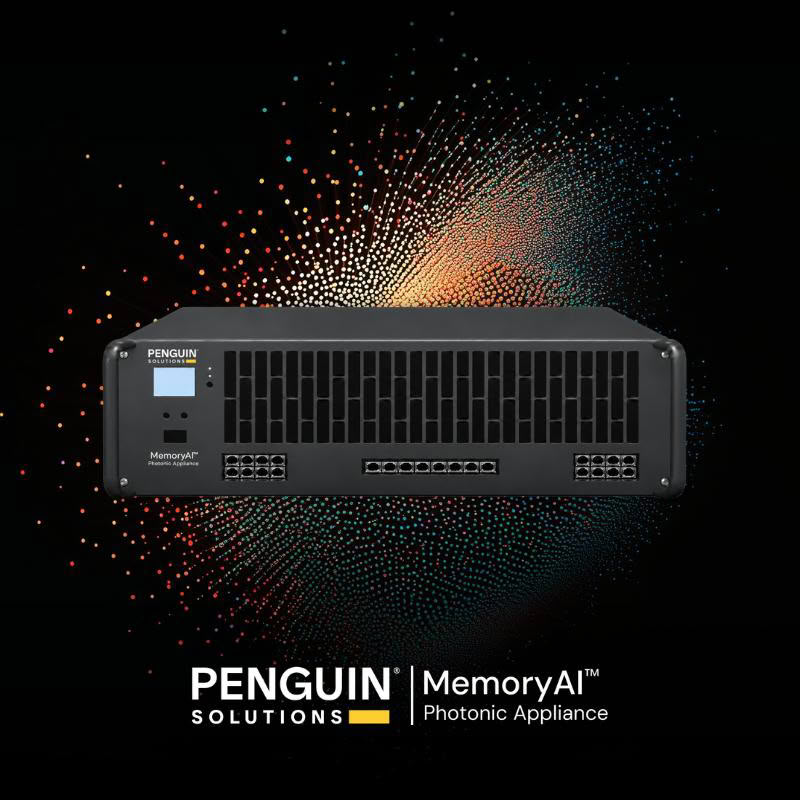
Penguin Solutions Unveils Industry's First Photonics-Based HBM-Class Memory Appliance

Penguin Solutions, Inc. (Nasdaq: PENG), the AI Factory Platform Company, today unveiled the MemoryAI Photonic Appliance, the industry's first photonics-based HBM-class memory appliance designed to overcome GPU memory capacity constraints for agentic AI workloads. Using silicon photonics, the appliance is built to enable CPUs and GPUs to transparently share memory at high bandwidth memory (HBM)-class data rates. Penguin is showcasing the appliance at SC26 in Chicago, alongside its underlying MemoryAI Photonic Memory Module, the world's first silicon photonics (SiPh) memory module designed to deliver HBM-class performance, built on the Marvell Photonic Fabric technology platform.

HBM provides the high-speed data access GPUs need for token generation that is essential to running agentic workloads. However, localized ultra-fast HBM technology must sit within millimeters of the GPU, so its capacity is limited by package size and silicon I/O constraints. These limitations can create data bottlenecks that leave GPUs underutilized, contributing to the growing AI memory wall.

AI Demand Drives 4Q25 Global Top 10 Foundries Revenue Up 2.6% QoQ; Samsung Gains Share and Tower Moves Up in Rankings

TrendForce's latest research on the semiconductor foundry industry reveals that advanced-node demand remained strong in 4Q25, driven by the tight supply of AI server GPUs and Google TPUs. Furthermore, the launch of new smartphones boosted wafer orders for mobile application processors (APs), supporting solid shipment performance.

On the mature-node side, PMIC orders related to servers and edge AI continued to keep 8-inch fabs running at high utilization rates, with some suppliers even considering price increases. Meanwhile, utilization rates at 12-inch fabs remained largely stable. Together, these factors pushed the combined revenue of the world's top ten foundries up 2.6% QoQ to nearly US$46.3 billion in 4Q25.

NVIDIA Shows Future AI Accelerator Design: Silicon Photonics and DRAM on Top of Compute

During the prestigious IEDM 2024 conference, NVIDIA presented its vision for the future AI accelerator design, which the company plans to chase after in future accelerator iterations. Currently, the limits of chip packaging and silicon innovation are being stretched. However, future AI accelerators might need some additional verticals to gain the required performance improvement. The proposed design at IEDM 24 introduces silicon photonics (SiPh) at the center stage. NVIDIA's architecture calls for 12 SiPh connections for intrachip and interchip connections, with three connections per GPU tile across four GPU tiles per tier. This marks a significant departure from traditional interconnect technologies, which in the past have been limited by the natural properties of copper.

Perhaps the most striking aspect of NVIDIA's vision is the introduction of so-called "GPU tiers"—a novel approach that appears to stack GPU components vertically. This is complemented by an advanced 3D stacked DRAM configuration featuring six memory units per tile, enabling fine-grained memory access and substantially improved bandwidth. This stacked DRAM would have a direct electrical connection to the GPU tiles, mimicking the AMD 3D V-Cache on a larger scale. However, the timeline for implementation reflects the significant technological hurdles that must be overcome. The scale-up of silicon photonics manufacturing presents a particular challenge, with NVIDIA requiring the capacity to produce over one million SiPh connections monthly to make the design commercially viable. NVIDIA has invested in Lightmatter, which builds photonic packages for scaling the compute, so some form of its technology could end up in future NVIDIA accelerators
Return to Keyword Browsing
Nov 16th, 2026 10:07 CST change timezone

New Forum Posts

Popular Reviews

TPU on YouTube

Controversial News Posts
