AMD Ryzen "Medusa Point AO" Stepping Seen in Shipping Doc, Basic Spec Includes 28 W TDP Rating
Earlier this week, another example of AMD's next-gen Ryzen "Medusa Point" mobile chip design was put in the spotlight. Olrak29 has discovered an interesting entry (dated from late last year) within NBD shipping manifests, that reaffirms information from a previous "Zen 6"-related leak. A "Medusa 1 A0" integrated microprocessor is described, along with an apparent 28 W TDP and FP10 socket type. An early December 2025 report was based on similar information, also outlining the alleged existence of a more potent 45 W TDP-rated APU design. As mentioned above, the speculated 28 W "Low TDP" variant has emerged again, albeit with a revised silicon stepping—now A0. This designation signals that Team Red was still examining samples for validation purposes, at least towards the end of last year.
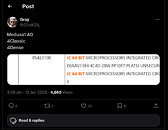
Olrak29 pointed out that "4C4D"—as seen in their screenshot—indicates a "classic 4-core and dense 4-core" layout for the 28 W TDP configured "Medusa Point" chip. An older leak proposes the presence of two additional low-power cores. This processor core configuration (4C + 4D + 2LP) could materialize in futuristic Ryzen 5 and 7 APUs. Details of the "Medusa Point 1" integrated graphics solution are not present on the aforementioned NBD listing. The usual soothsayers posit that AMD will leverage "RDNA 3.5+" iGPUs for this class, instead of pulling in truly next-gen architecture (RDNA 4, RDNA 5 or UDNA). "Zen 6"-based mobile chips are not expected to arrive until 2027. In the interim, Team Red is prepping "Gorgon Point" (Zen 5/RDNA 3.5) for an imminent launch.

Olrak29 pointed out that "4C4D"—as seen in their screenshot—indicates a "classic 4-core and dense 4-core" layout for the 28 W TDP configured "Medusa Point" chip. An older leak proposes the presence of two additional low-power cores. This processor core configuration (4C + 4D + 2LP) could materialize in futuristic Ryzen 5 and 7 APUs. Details of the "Medusa Point 1" integrated graphics solution are not present on the aforementioned NBD listing. The usual soothsayers posit that AMD will leverage "RDNA 3.5+" iGPUs for this class, instead of pulling in truly next-gen architecture (RDNA 4, RDNA 5 or UDNA). "Zen 6"-based mobile chips are not expected to arrive until 2027. In the interim, Team Red is prepping "Gorgon Point" (Zen 5/RDNA 3.5) for an imminent launch.