News Posts matching #co-processor

Return to Keyword Browsing

Q.ANT Unveils NPU Gen 2+: Photonic Fourier Transforms Power Large Language Model

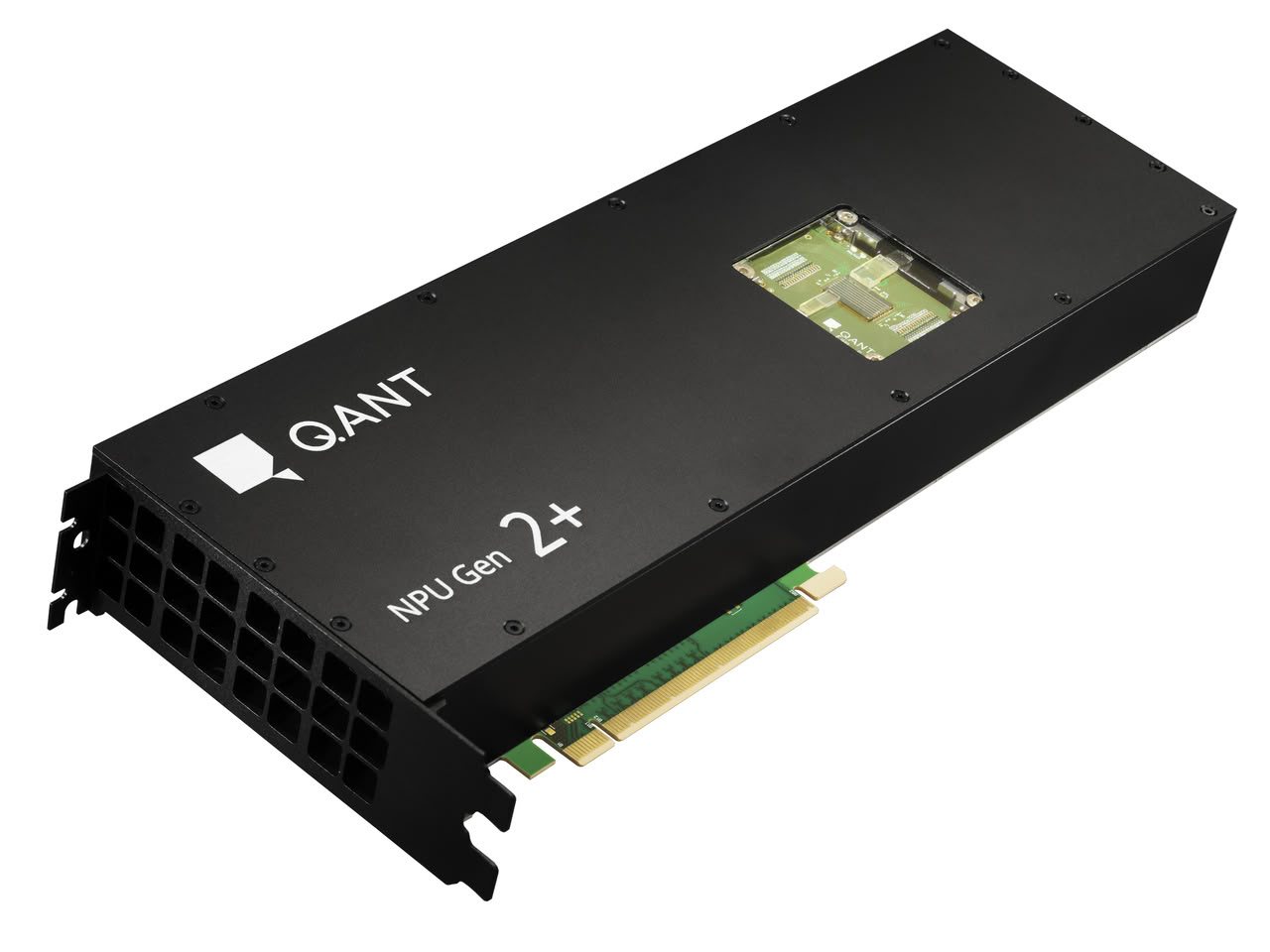
Q.ANT, the pioneer in commercial photonic computing, today unveiled the NPU Gen 2+, the latest generation of its Native Processing Unit (NPU) technology, at SC26 in Chicago. The NPU Gen 2+ adds optical Discrete Fourier Transforms (DFTs), which expands the set of mathematical functions developers can run directly in light with photonic computing. With it, developers can build faster, leaner AI models and high-performance computing (HPC) applications.

Advanced functions like the DFT let AI models work with fewer parameters and less data. On digital hardware, however, computing the transform itself with high data volumes costs time and energy. Because the NPU Gen 2+ delivers DFTs natively in light, Q.ANT demonstrates the potential algorithmic and performance advantages of photonic computing already now.
Espressif Unveils ESP32-S31 Dual-Core RISC-V SoC with Wi-Fi 6 and Bluetooth 5.4 Capabilities

Espressif Systems (688018.SH) proudly announces the upcoming release of ESP32-S31, a high-performance dual-core Wi-Fi 6 + Bluetooth 5.4 + IEEE 802.15.4 + Ethernet System-on-Chip (SoC). Building on Espressif's proven track record, this versatile SoC addresses the growing demand for advanced IoT applications including consumer and industrial appliances, smart speakers, voice-controlled devices, and automation systems requiring comprehensive wireless connectivity, edge AI capabilities, rich HMI, and robust security features.

ESP32-S31 delivers comprehensive wireless connectivity by combining Wi-Fi 6 (802.11ax) in 2.4 GHz band, Bluetooth 5.4 with both Bluetooth LE (Low Energy) and Classic (BR/EDR) support, plus an IEEE 802.15.4 radio enabling Thread and Zigbee protocols for diverse IoT applications. ESP32-S31 will provide a seamless support for Matter protocol over Wi-Fi as well as Thread radio.

SiFive's New RISC-V IP Combines Scalar, Vector and Matrix Compute to Accelerate AI from the Far Edge IoT to the Data Center

Further expanding SiFive's lead in RISC-V AI IP, the company today launched its 2nd Generation Intelligence family, featuring five new RISC-V-based products designed to accelerate AI workloads across thousands of potential applications. The lineup includes two entirely new products—the X160 Gen 2 and X180 Gen 2—alongside upgraded X280 Gen 2, X390 Gen 2 and XM Gen 2. These new products all feature enhanced scalar, vector and, specifically with XM, matrix processing capabilities designed for modern AI workloads.

The X160 Gen 2 and X180 Gen 2 target far edge compute and IoT applications, achieving high efficiency in a compact footprint and delivering advanced AI functionality to the deeply embedded edge, which is heavily constrained by power and area. Target industries include automotive, autonomous robotics, industrial automation, and smart IoT.

Cadence Accelerates Physical AI Applications with Tensilica NeuroEdge 130 AI Co-Processor

Cadence today announced the Cadence Tensilica NeuroEdge 130 AI Co-Processor (AICP), a new class of processor designed to complement any neural processing unit (NPU) and enable end-to-end execution of the latest agentic and physical AI networks on advanced automotive, consumer, industrial and mobile SoCs. Based on the proven architecture of the highly successful Tensilica Vision DSP family, the NeuroEdge 130 AICP delivers more than 30% area savings and over 20% savings in dynamic power and energy without impacting performance. It also leverages the same software, AI compilers, libraries and frameworks to deliver faster time to market. Multiple customer engagements are currently underway, and customer interest is strong.

"With the rapid proliferation of AI processing in physical AI applications such as autonomous vehicles, robotics, drones, industrial automation and healthcare, NPUs are assuming a more critical role," said Karl Freund, founder and principal analyst of Cambrian AI Research. "Today, NPUs handle the bulk of the computationally intensive AI/ML workloads, but a large number of non-MAC layers include pre- and post-processing tasks that are better offloaded to specialized processors. However, current CPU, GPU and DSP solutions involve tradeoffs, and the industry needs a low-power, high-performance solution that is optimized for co-processing and allows future proofing for rapidly evolving AI processing needs."

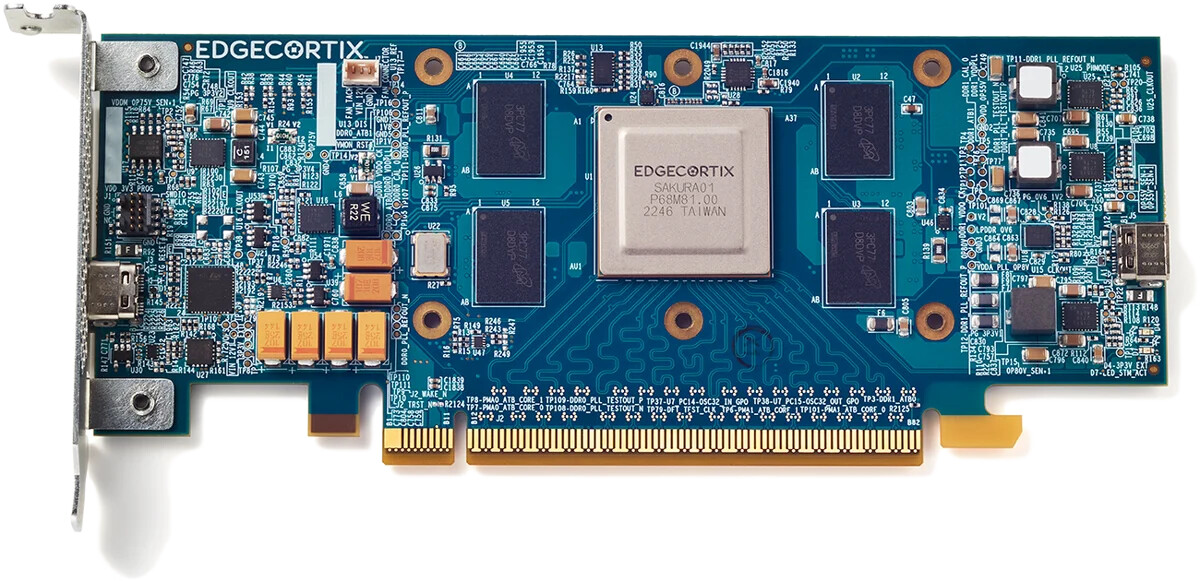
EdgeCortix to Showcase Flagship SAKURA-I Chip at Singapore Airshow 2024

EdgeCortix, the Japan-based fabless semiconductor company focused on energy-efficient AI processing, announced today that the Acquisitions, Technology and Logistics Agency (ATLA), Japan Ministry of Defense, will include the groundbreaking edge AI startup alongside an elite group of leading Japanese companies to represent Japan's air and defense innovation landscape at ATLA's booth at the Singapore Airshow to be held February 20 - 25. The Singapore Airshow is one of the largest and most influential shows of its kind in the world, and the largest in Asia, seeing as many as 50,000 attendees per biennial show. Over 1,000 companies from 50 countries are expected to participate in the 2024 show.

EdgeCortix's flagship product, the SAKURA-I chip, will be featured among a small handful of influential Japanese innovations at the booth. SAKURA-I is a dedicated co-processor that delivers high compute efficiency and low latency for artificial intelligence (AI) workloads that are carried out "at the edge", where the data is collected and mission critical decisions need to be made - far away from a datacenter. SAKURA-I delivers orders of magnitude better energy efficiency and processing speed than conventional semiconductors (ex: GPUs & CPUs), while drastically reducing operating costs for end users.

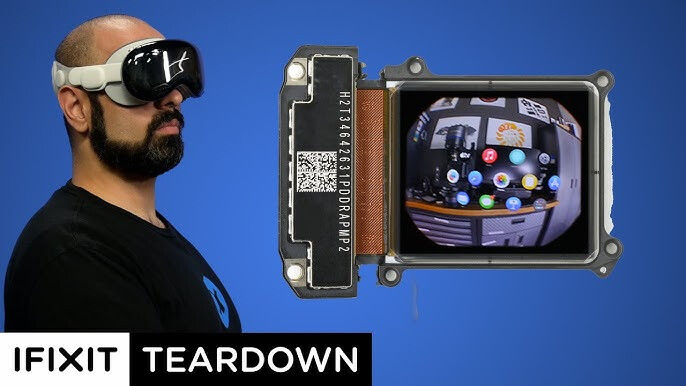
iFixit Teardown Guide Puts Spotlight on Apple Vision Pro Logic Board

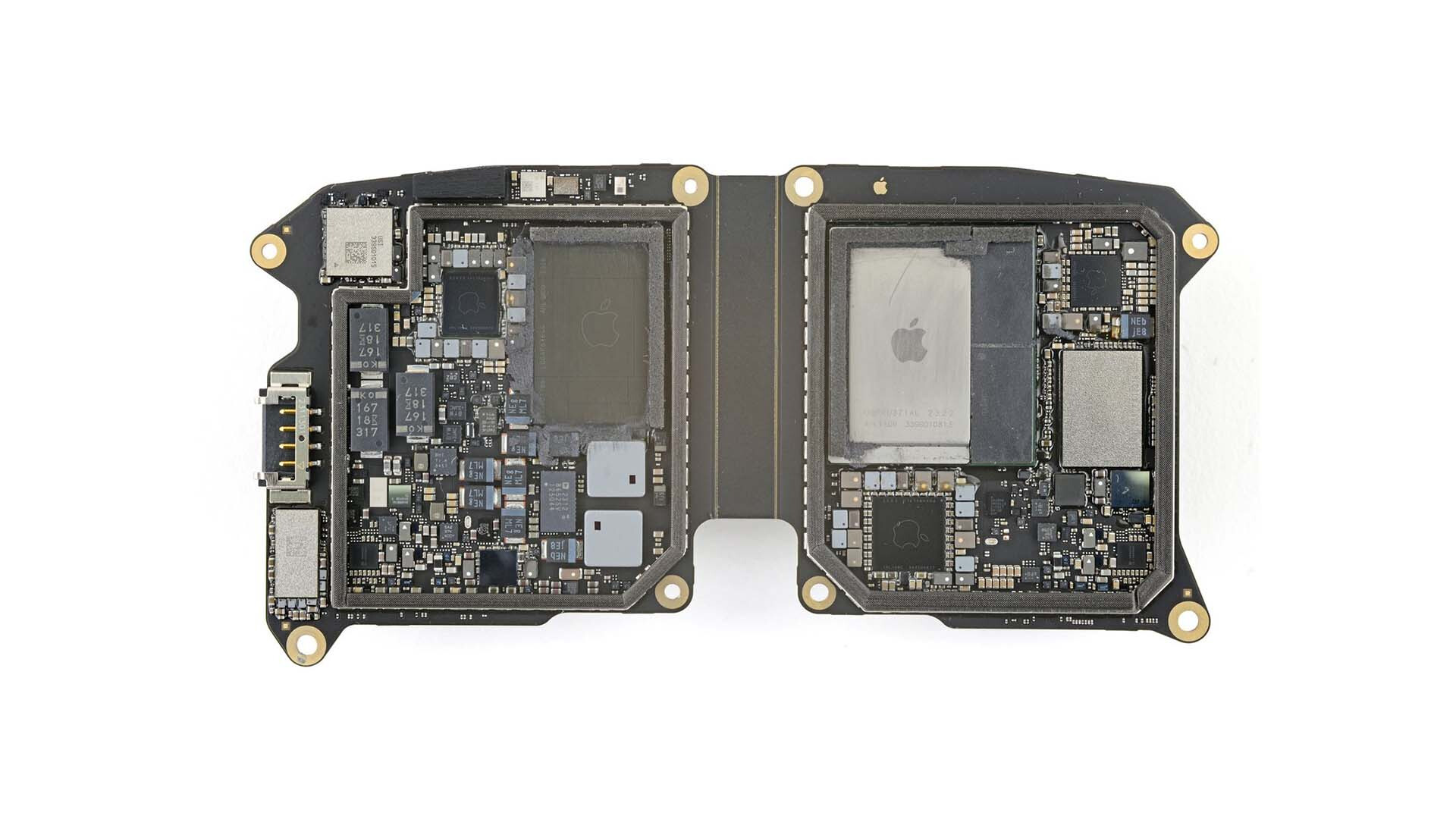
iFixit has finally posted photos of the Apple Vision Pro's inner bits, following on from the release of a video teardown (uploaded last week)—the American e-commerce and how-to website spent plenty of hours exploring the expensive mixed reality headset's "creepy" features, before breaking seals and deconstructing the device's highly complex interior. The iFixit teardown team have often complained about Apple computer products being notoriously difficult to deal with—the Vision Pro is no exception, but they eventually managed to isolate the headset's logic board. The onboard M2 octa-core chipset is identified as a APL1109/339S01081E part, while its assistant R1 sensor co-processor sports an APL1W08/339S01186 identifier. Micron has supplied 8 GB of LPDDR5 SDRAM memory (MT62F1G64D8WT-031 XT), and Kioxia has Apple covered with its K5A4RC2097 256 GB NAND flash.

Tech experts have spent time poring over iFixit's latest set of snaps, as laid out in their teardown guide—one such enthusiast, Yining Karl Li, posted an intriguing Apple Vision Pro Logic Board observation to social media: "There's this interesting shot of the main logic board (in Step 1). The R1 chip (in the red box) has interesting lines all over it dividing the surface into sub-boxes. Is the R1 chip using a chiplet design?" A small debate erupted from this quick inspection—one commenter believes that the co-processor is not all that fancy: "(it is) likely sporting low-latency fan-out memory," citing the presence of very faint horizontal and vertical lines. As pointed out by Wccftech, Li also presented a chiplet design example (for comparison purposes)—a close-up shot of Intel's Ponte Vecchio Xe-HPC GPU. The lines are a lot more pronounced on Team Blue's chip design.
Return to Keyword Browsing
Nov 17th, 2026 13:04 CST change timezone

New Forum Posts

Popular Reviews

TPU on YouTube

Controversial News Posts