News Posts matching #e-waste

Return to Keyword Browsing

EPOS Simplifies Battery Replacement to Extend Product Lifespan

Headset and speakerphone manufacturer EPOS is 'charging-up' a battery replacement program, to simplify a more sustainable future, ahead of new legislation coming into force, across parts of the world. Going forward all new product launches will provide the option to replace batteries with a simple paperclip or similar tool, rather than any complex or complicated procedures.

Søren Holm Printz, VP Corporate Strategy & Product Management, says EPOS is committed to extending the lifespan of its products by offering user-friendly battery replacement solutions.

EU Now Requires USB-C Charging for New Laptops Up to 100 W

The European Union has officially imposed a new rule for selling laptops with a power rating of 100 W or less, requiring them to use a USB-C port for charging. This rule takes effect today, April 28, Tuesday, as the European Commission has been exploring ways to reduce electronic waste and has been planning this since imposing a similar rule on smartphones in 2024. As readers may recall, modern smartphones have largely been shipping with USB-C ports since the European Commission mandated that all newly sold smartphones must have a unified connection, instead of multiple connectors that create a significant amount of e-waste across Europe. With laptops, the EU legislation now aims to address this issue in the laptop sector, as they contribute significantly to the problem.

However, there are exceptions to this rule. The traditional USB-C power delivery mechanism can deliver 240 W through a single port, but gaming laptops sometimes require more power. Gaming laptops can continue to use the typical barrel power connector on models that exceed 100 W of power, whereas any laptop model with a power rating of 100 W or less must adopt USB-C as its primary charging connector. From today, it is illegal to sell laptops that do not meet the European Commission's standards across the European Union. However, this rule does not apply to computers sold on the second-hand market; only new devices entering the EU zone must comply.

Noctua Has Shipped Half a Million CPU Cooler Mounting Upgrade Kits

Noctua has earned itself a reputation in the enthusiast space not only for its highly efficient air coolers, but also for its free mounting upgrade kit policy, which allows buyers of Noctua coolers to request a new mounting kit when a new motherboard socket from AMD or Intel launches, even years after they've purchased their original cooler. The company recently announced that it has shipped 500,000 of these free mounting upgrade kits since the project started way back in 2006 with the AMD AM2 socket. Noctua also promises that "as new sockets and architectures appear, we will continue to provide free mounting or upgrade kits where technically feasible."

Noctua explains that the ethos behind the program is to "ensure that a quality product remains useful for many years," and, in the blog post celebrating the achievement, it explains that change in approach meant rethinking the design of its coolers. New coolers designed by Noctua from 2006 onwards would need to be modular and standardized to maintain support across different platforms and generations. Noctua elaborated that part of the justification for the past and ongoing commitment to the free upgrade program is as much about the environment as it is about customer service and technical compatibility. Theoretically, 500,000 mounting kit upgrades means that up to 500,000 perfectly functional CPU coolers were kept out of the e-waste pile, conserving raw materials and cutting down on waste.

Intel Previews Sustainable Modular PC Design Concept

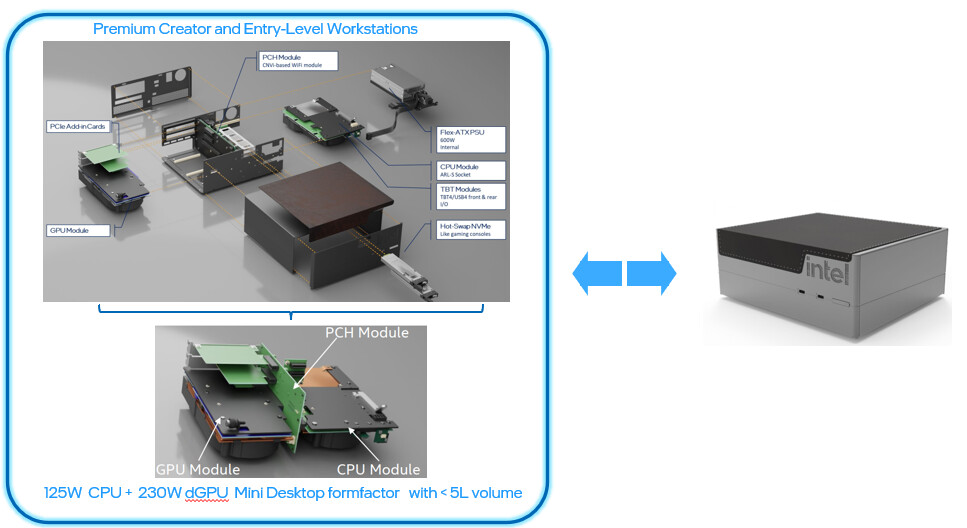
Intel's Platform Engineering and Client Segments groups are actively looking into ways of reducing computer e-waste, and (in parallel) enhance product repairability. The company's newly proposed "Modular PC Design" is set to take a "sustainable approach" across three key modularity levels: factory, field and user. Team Blue's blog post goes into great detail about revised laptop and mini-PC designs—with the "right-to-repair" movement serving as a major influence. Many "consumer activists and environmental groups" have advocated for improvements in personal computer design—Intel appears to be listening, but a firm release timeline has not been set.

Intel's proposed new standards will revolve around repairability and upgradability—as explained in their blog: "the right-to-repair emphasizes the importance of being able to fix and upgrade PCs on one's own. Improving repairability requires fundamental changes starting from the design methodology." Team Blue's Modular PC program—for laptops—breaks away from the tradition of utilizing an "all-in-one motherboard." A reference diagram shows off three internal modules: a motherboard package and two "universal" left and right I/O units. These separate boards can be: "utilized across various platforms or market segments leads to cost savings by streamlining the duration of the design cycle and minimizing the engineering investment required. The I/O boards for Premium Modular designs are engineered to be common between the fan-less Thin & Light system, which operates within a 10 W power envelope, and the premium fanned designs, which function within a 20 W (single fan) and 30 W (dual fan, Wi-Fi only SKU) power envelope." Framework recently celebrated its fifth year of operation—its modular laptop designs have seemingly "inspired" a few copycats.
Return to Keyword Browsing
Nov 17th, 2026 22:22 CST change timezone

New Forum Posts

Popular Reviews

TPU on YouTube

Controversial News Posts