News Posts matching #i226-V

Return to Keyword Browsing

Beelink Reveals Specs and Pricing for the ME Pro 2-Bay NAS

Last week, Beelink revealed a teaser for its ME Pro NAS devices and now the company has unveiled the pricing for its first two 2-bay models, which come in a total of five different SKUs. All five SKUs are based on Intel Twin Lake SoCs, with the three base SKUs being built around the Intel Processor N95 and the two remaining SKUs sporting the Intel Processor N150. The base model pairs the N95 with 12 GB of 4800 MT/s LPDDR5 and a 128 GB SSD for US$369, whereas an upgraded SKUl with a 512 GB SSD comes in at US$449 and finally the top tier SKU comes with a 1 TB SSD for US$479. The N150 SKUs include 16 GB of LPDDR5 and start at US$529 with a 512 GB SSD and tops out at US$559 with a 1 TB SSD.

The ME Pro with the Twin Lake SoCs offers three M.2 NVMe slots, one with a PCIe 3.0 x2 interface and two with a PCIe 3.0 x1 interface. There's space for a pair of 2.5- or 3.5-inch hard drives and up to 30 TB drives are supported. Around the back you'll find a 19 V DC input, a 2.5 Gbps (Intel i226-V) and a 5 Gbps (Realtek RTL8126) Ethernet jack, an HDMI 2.1 port capable of 4K60p output, two USB 2.0 ports, one USB 3.2 Gen 2 (10 Gbps) Type-C port and a 3.5 mm audio jack. Around the front is a further USB 3.2 Gen 2 (10 Gbps) Type-A port, the power switch and a reset and clear CMOS pin-hole. A neat addition is a small tool that is attached to the base of the housing. Beelink has also included Wi-Fi 6 and Bluetooth 5.4 and it seems like the ME Pro ships with Windows 11 Home. Pre-orders are up now, with shipping said to start at some point in January.
Intel Releases Windows Workaround and Patch for Ethernet Stuttering and Disconnects

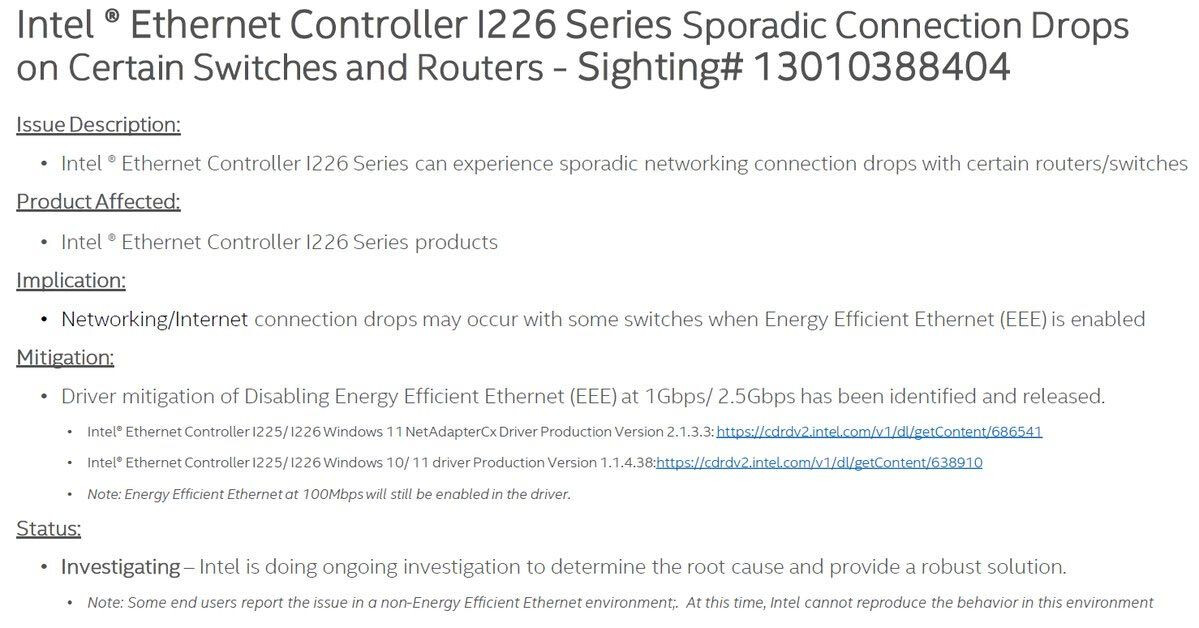
At the end of January, we reported on issues with Intel's i226-V 2.5 Gbps Ethernet controllers, which are used on a wide range of motherboards with both Intel and AMD CPUs, where users were having issues with stuttering and connections dropping. Intel has now released a workaround and a patch for the issue, not only for the i226, but also the i225 and the Killer E3100 2.5 Gbps network controller. What the workaround does, is disable the Energy-Efficient Ethernet mode, or EEE as it's also known as. EEE is only supposed to kick in when an Ethernet connection is idle and it's said to reduce power consumption by up to 50 percent.

However, in this case, it seems like EEE kicks in even when the Ethernet connection is active, which is causing the stuttering and connection dropouts. The patch disables EEE for all speeds above 100 Mbps, but it's also possible to disable EEE manually in the device settings in Windows. MSI is the first motherboard manufacturer to have released an updated driver on its site, but as this isn't a final solution to the problem, it's unlikely that this is the last we'll hear about the issue. Intel is apparently working on finding the root cause of the problem, but it's unclear if it's going to be possible to patch it in software or if a hardware revision is going to be required in the end.

Update Mar 4th: User @lovingbenji reports that on his system this new driver version does not fix the disconnect issue.

PSA: Intel I226-V 2.5GbE on Raptor Lake Motherboards Has a Connection Drop Issue: No Fix Available

The Intel Ethernet i226-V onboard 2.5 GbE controller appears to have a design flaw that causes the Ethernet connection to drop at random times for a few seconds. The I226-V is the latest version of Intel's cost-effective 2.5 Gbps Ethernet networking chips meant for PC motherboards with chipsets that have integrated MACs (i.e. Intel chipsets). It succeeds the I225-V, which was Intel's first consumer 2.5 GbE PHY. The I225-V was plagued by various issues that caused it to be unstable at 2.5 Gbps (but could be worked around by forcing 1 GbE mode). Many premium Intel 700-series chipset Socket LGA1700 motherboards integrate the new I226-V, which is the I225's successor, as their default onboard 2.5 GbE controller. Some enthusiast-segment motherboards have a second Ethernet controller that's either of a different brand (such as Realtek or Marvell), or a different kind of wired Ethernet (such as 10 GbE).

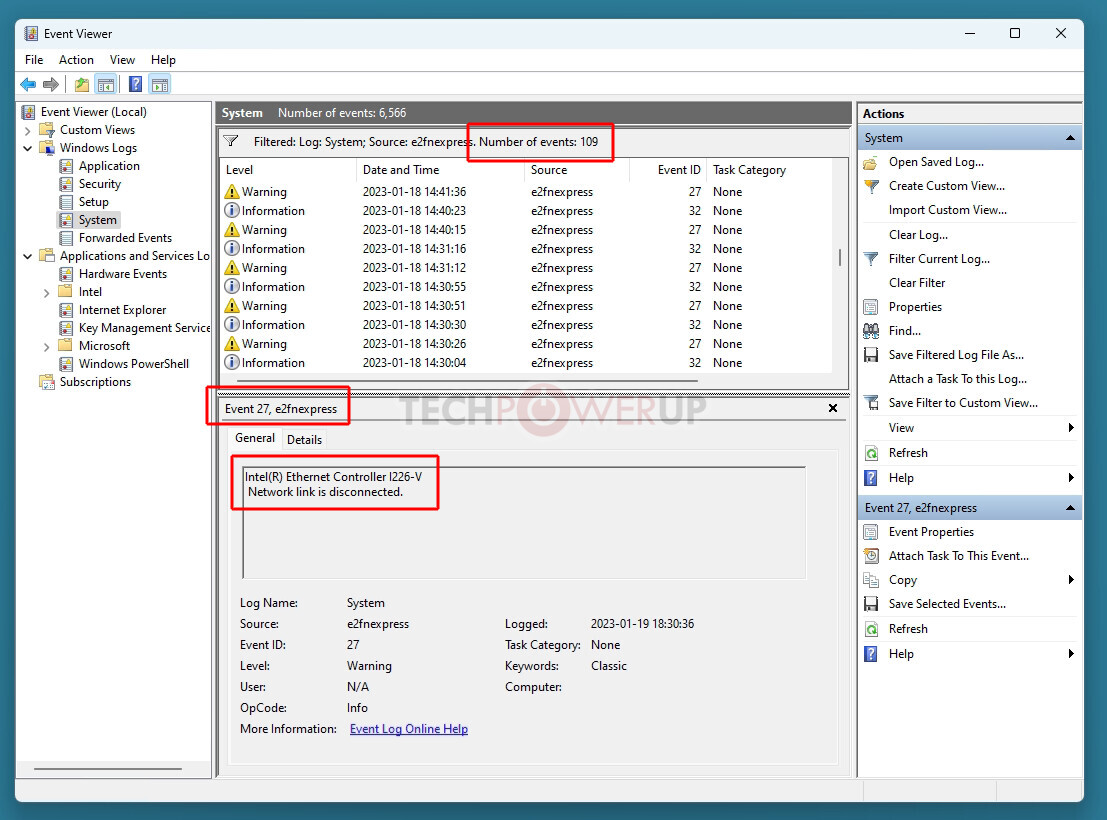
Since mid-December, users of Intel 700-series chipset motherboards (which debut the I226-V), have been reporting random connections drops to Intel's Support Community, Microsoft, ASUS and Reddit 1, 2, 3, 4, 5. These drops are momentary, last a few seconds, and you'll mostly not notice it; however for applications that need an uninterrupted connection (such as online gaming, video conferencing, VPN, Remote Desktop etc.), such a link drop will be noticeable. You can check if you are affected by opening Windows Event Viewer, navigate to "Windows Logs," "System" and search for "e2fnexpress," in particular Event 27 "Intel Ethernet Controller I226-V, Network link is disconnected." and Event 32 "Intel Ethernet Controller I226-V. Network link has been established at 1 Gbps full duplex." We've experienced the issue in our labs. We tried updating to the latest 27.8 drivers from Intel, and used the latest motherboard BIOS, at 1 Gbps speed, but the issue couldn't be fixed reliably. In the end, we just switched over to the motherboard's second network interface, which is not an Intel NIC, and the issue went away. Another option could be to buy a cheap PCI-Express network card or use the board's integrated Wi-Fi. Still, such issues aren't acceptable, especially not from a world-leading manufacturer like Intel, who once was reputed for the quality of its networking equipment. Intel and its motherboard partners need to get on top of this issue.

Update Mar 1st: Intel has issued a Windows workaround and patch for these issues. Let us know if this fixes it for you.

Update Mar 4th: User @lovingbenji reports that on his system this new driver version does not fix the disconnect issue.
Return to Keyword Browsing
Nov 23rd, 2026 03:25 CST change timezone

New Forum Posts

Popular Reviews

TPU on YouTube

Controversial News Posts