 23
ACEMAGIC Tank M1A Pro+ Review
(23 Comments) »Introduction

ACEMAGIC is typically known for affordable to mid-range Mini-PCs, but the Tank M1A Pro+ steps into an entirely different performance tier. This is not a typical office system or a light workstation substitute. It is a high-performance compact system built around AMD's Ryzen AI Max+ 395, with the Radeon 8060S, this Strix Halo hardware shifts it into a very different class from most machines in this category. This is all running at high power limits as well and wrapped in a very unconventional design.
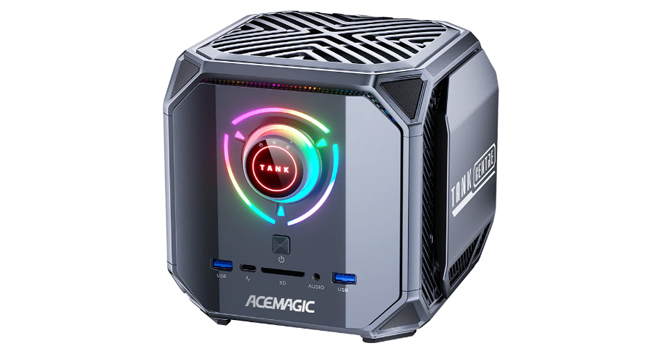
ACEMAGIC also offers a non-Plus version that's geared more toward traditional gaming and GPU-driven workloads, using Intel's Core i9-13900HK and Intel Arc A770 MXM discrete graphics with 16 GB of dedicated GDDR6 memory. That gives it a more conventional performance profile for modern gaming, rendering, and other tasks that benefit from a true dedicated GPU with its own high-bandwidth memory. By comparison, the M1A Pro+ takes a more modern hybrid approach with AMD's Radeon 8060S iGPU and XDNA 2 NPU, giving it stronger AI-focused platform capabilities. Even so, as the benchmarks will show, it performs remarkably well on integrated graphics alone with excellent gaming results, surpassing our current chart leaders and showing just how far high-end iGPU performance has come.
One of the biggest highlights of the M1A Pro+ is the Radeon 8060S, as it is currently AMD's top integrated GPU for x86 Windows systems, built on RDNA 3.5 and paired with Ryzen AI Max series processors. With 40 graphics cores and boost clocks up to 2.9 GHz, it represents a major jump over the Radeon 780M and 890M solutions found in most premium Mini-PCs, pushing integrated graphics much closer to the lower end of discrete GPU territory. It also brings support for modern graphics features such as DirectX 12, making it a much better option for current AAA games and GPU-accelerated workloads than previous AMD iGPUs.
It still works within the limits of an integrated design, relying on shared system memory and a mobile-class power envelope, so it is not a direct substitute for a proper mid-range desktop graphics card. Even so, this is one of the most powerful iGPU solutions we have tested, and it makes the GPU and gaming sections especially interesting, because integrated graphics in this review pool have mostly been advancing in smaller steps until now.
The M1A Pro+ features AMD's Ryzen AI Max+ 395, a 16-core, 32-thread Zen 5 processor with boost clocks up to 5.1 GHz and a quoted AI throughput of up to 126 TOPS. Unlike most Mini-PCs that rely on efficiency-focused power targets, ACEMAGIC allows this system to run at up to 140 W in Performance mode, giving both the CPU and GPU room to stretch in sustained workloads. Users can switch between Performance, Standard, and Eco power profiles using a front-facing dial, making it easy to adjust behavior on the fly depending on workload or noise and power preferences. In our testing, we kept the front dial set to Performance mode for the main benchmark runs, and re-ran some of them (Cinebench, y-cruncher, blender and SPECviewperf) in Balanced mode to see if it yielded any difference in results.
The memory configuration is also well beyond what most compact systems offer, shipping with 128 GB of onboard LPDDR5X-8000 in a four-channel configuration. A large portion of this can be allocated as shared video memory, making the system more viable for GPU-heavy tasks like rendering, AI workloads, and large datasets. The trade-off is that memory is not upgradeable, but that's a small caveat when you have such a massive memory pool that comes standard.
Storage support is very flexible for its size, as ACEMAGIC includes three PCIe 4.0 x4 M.2 2280 slots. That opens the door for multi-drive setups focused on speed, project space, or local data-heavy workflows, something that is often limited or entirely missing in smaller enclosures. For connectivity, the Tank M1A Pro+ includes dual 2.5 GbE Ethernet ports, Wi-Fi 7, and Bluetooth 5.4, while supporting up to four 8K displays via a combination of HDMI 2.1, DisplayPort 2.0, and USB4. Front and rear I/O are dense, with a mix of USB 3.2 Gen 2, USB 3.2 Gen 1, USB4, SD card support, and dual 3.5 mm audio jacks.
One of the more unique features of the M1A Pro+ is the large front-mounted power dial, which lets the system switch between Silent, Balanced, and Performance profiles rated at 70 W, 100 W, and 140 W respectively. To see how much of an effect it actually has, I reran several parts of the benchmark suite across all three settings, including Cinebench 2024, Blender, y-cruncher, SPECviewperf 13, and our noise stress test. It will be interesting to see how much these different power profiles affect both performance and acoustics across the review.
| Specifications | |
|---|---|
| CPU | AMD Ryzen AI Max+ 395 16 cores/32 threads Zen 5 architecture Up to 5.1 GHz boost |
| GPU | AMD Radeon 8060S RDNA 3.5 architecture 40 compute units Up to 2.9 GHz |
| Memory | 128 GB LPDDR5X-8000 Four-channel Onboard, non-upgradeable |
| Storage | 3× M.2 2280 PCIe 4.0 x4 |
| Display Outputs | 2× HDMI 2.1 (8K @ 60 Hz) 1× DisplayPort 2.0 (8K @ 60 Hz) 1× USB4 Type-C (8K @ 60 Hz) |
| Connectivity | 2× HDMI 2.1 (8K@60 Hz) |
| Networking | Wi-Fi 7 Bluetooth 5.4 2× 2.5 GbE Ethernet |
| Power Modes | Silent: 70 W Balanced: 100 W Performance: 140 W |
| Operating System | Windows 11 Pro |
| Dimensions | 166.7 × 166.9 × 160.9 mm |
| Product page | ACEMAGIC Tank M1A Pro+ |
| Price | $2,899.00 USD (on sale, as of this review) |
Packaging and Contents
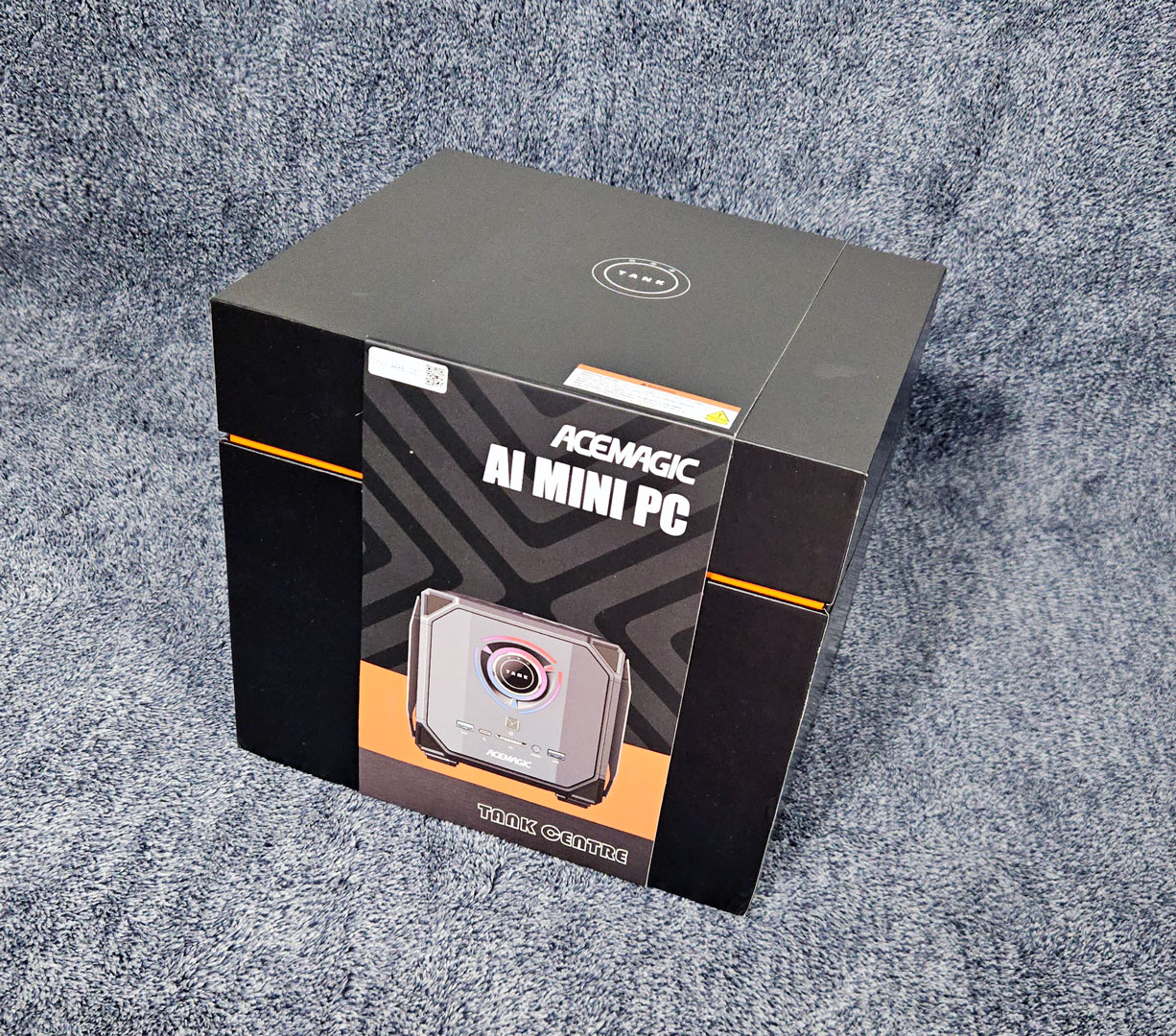
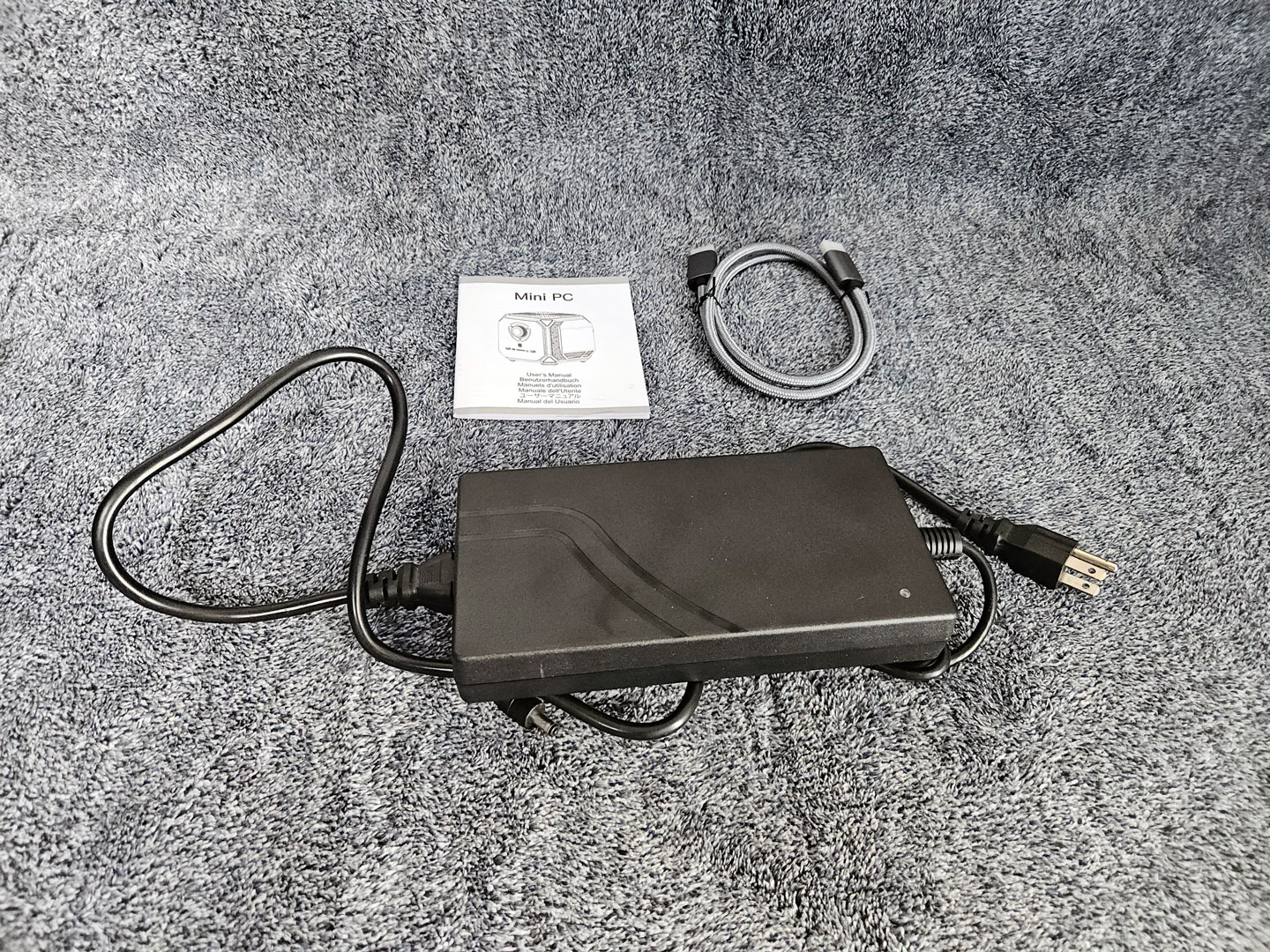
The Tank M1A+ Pro comes in a large black box with product artwork on the front, giving it a more colorful presentation than the plain packaging many Mini-PCs use. Inside, the bundle is pretty simple, consisting of the external power adapter, a braided video cable, and the user manual. The system itself is packed securely, with the accessories arranged neatly in their own compartments.
Design and Build
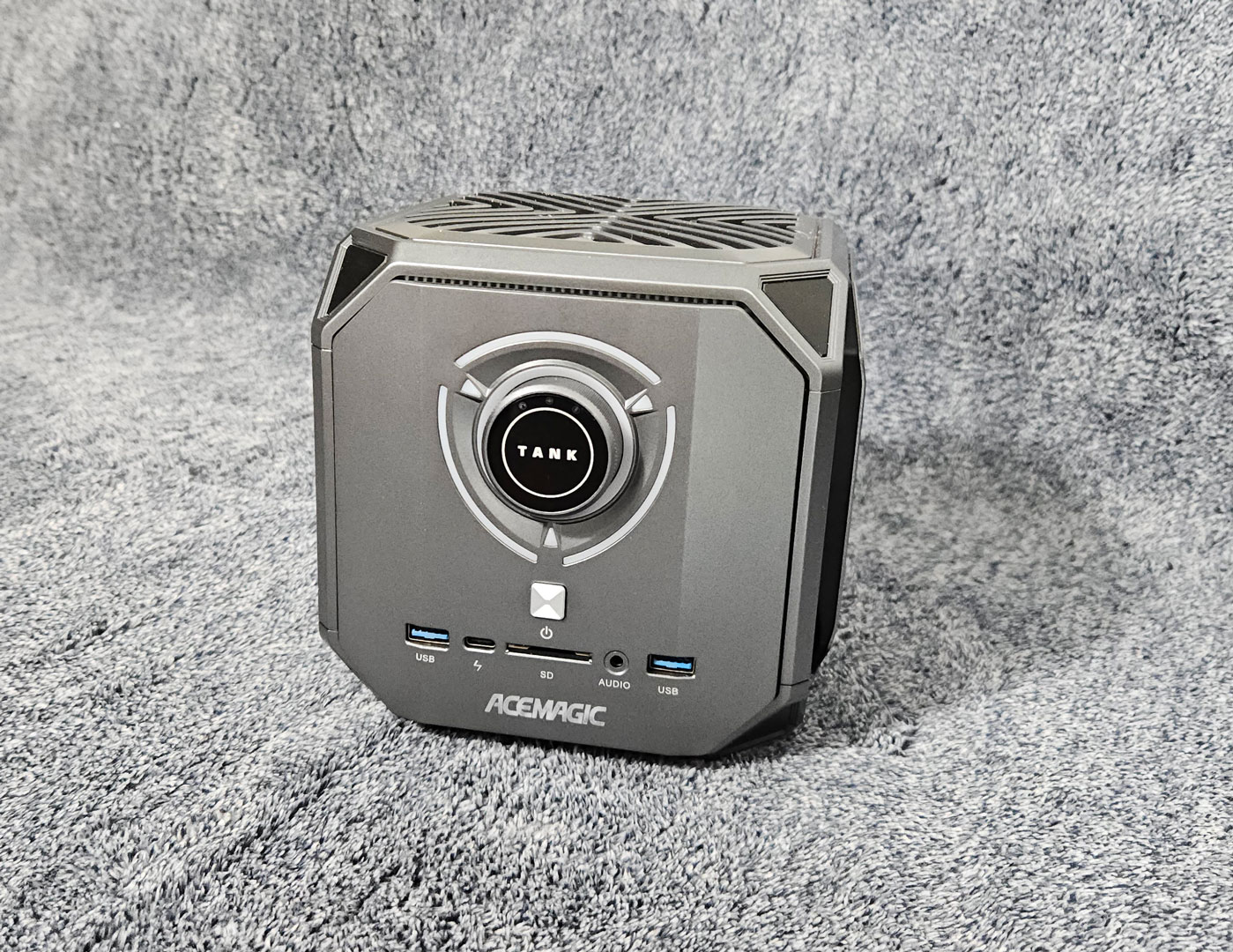
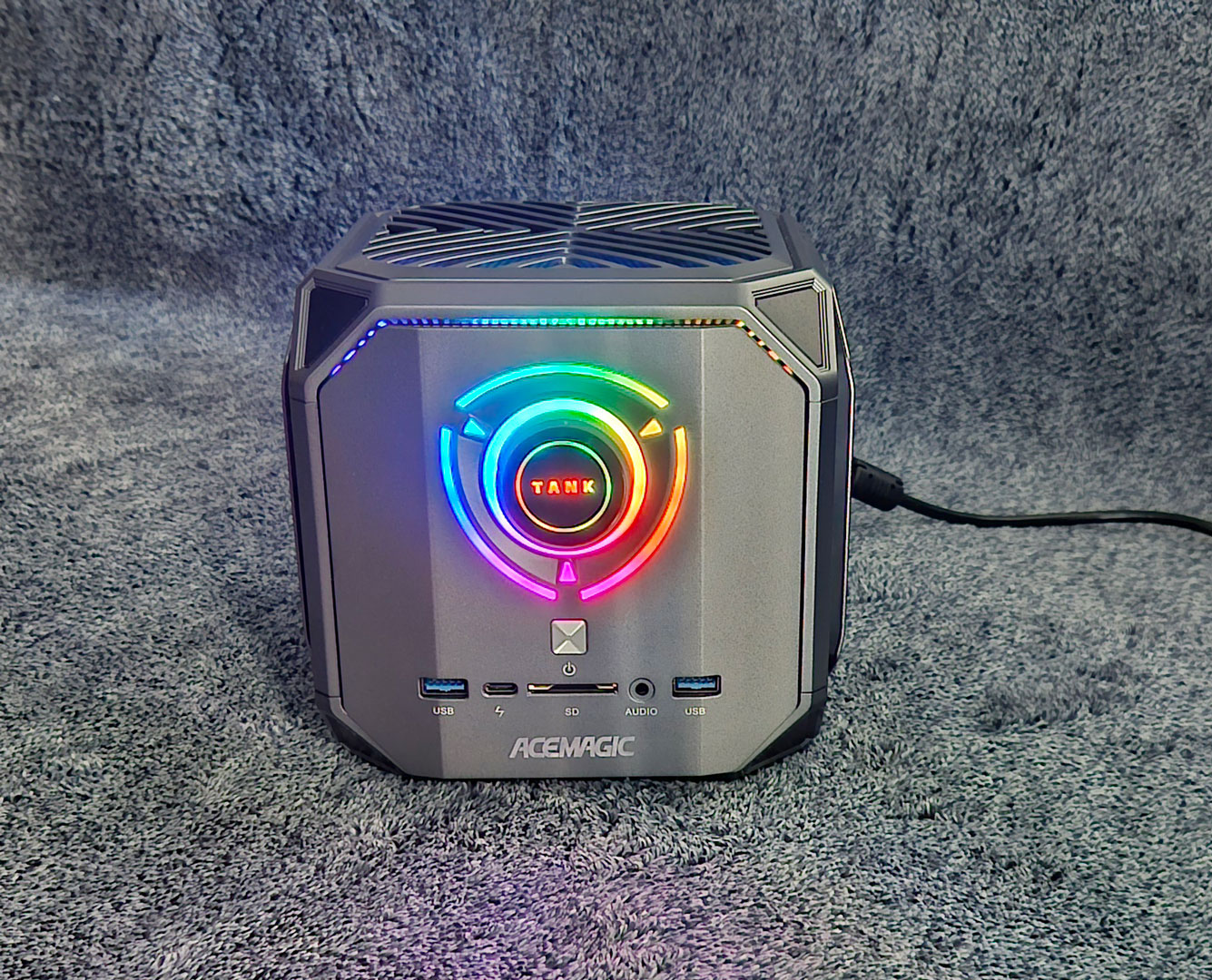
As shown in the introduction, the Tank M1A+ Pro looks very different from most Mini-PCs. Its cube-shaped enclosure, oversized front lighting, and unique styling make it look more like an ultra-compact gaming system than a small office machine. The chassis is all plastic, but it feels dense and sturdy in the hand with no rattling when moving it around.
The front panel features the circular LED-lit power dial, and alongside it, are two USB 3.2 Gen 2 Type-A ports, a full-function USB-C port for fast data and display output, a 3.5 mm audio jack, and an SD card slot. It is a practical front I/O layout, especially for temporary devices like fast external drives, headphones, or card transfers.
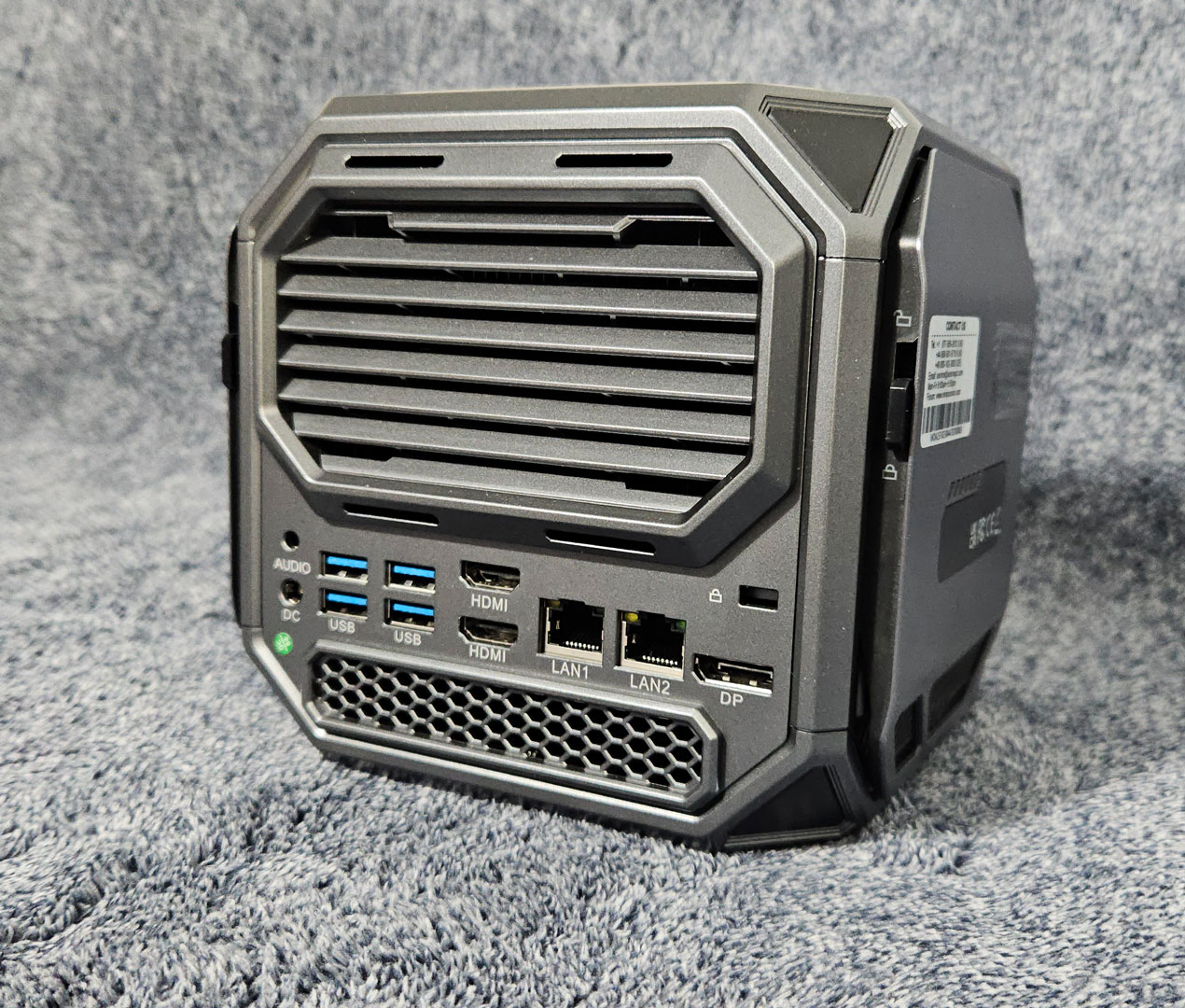
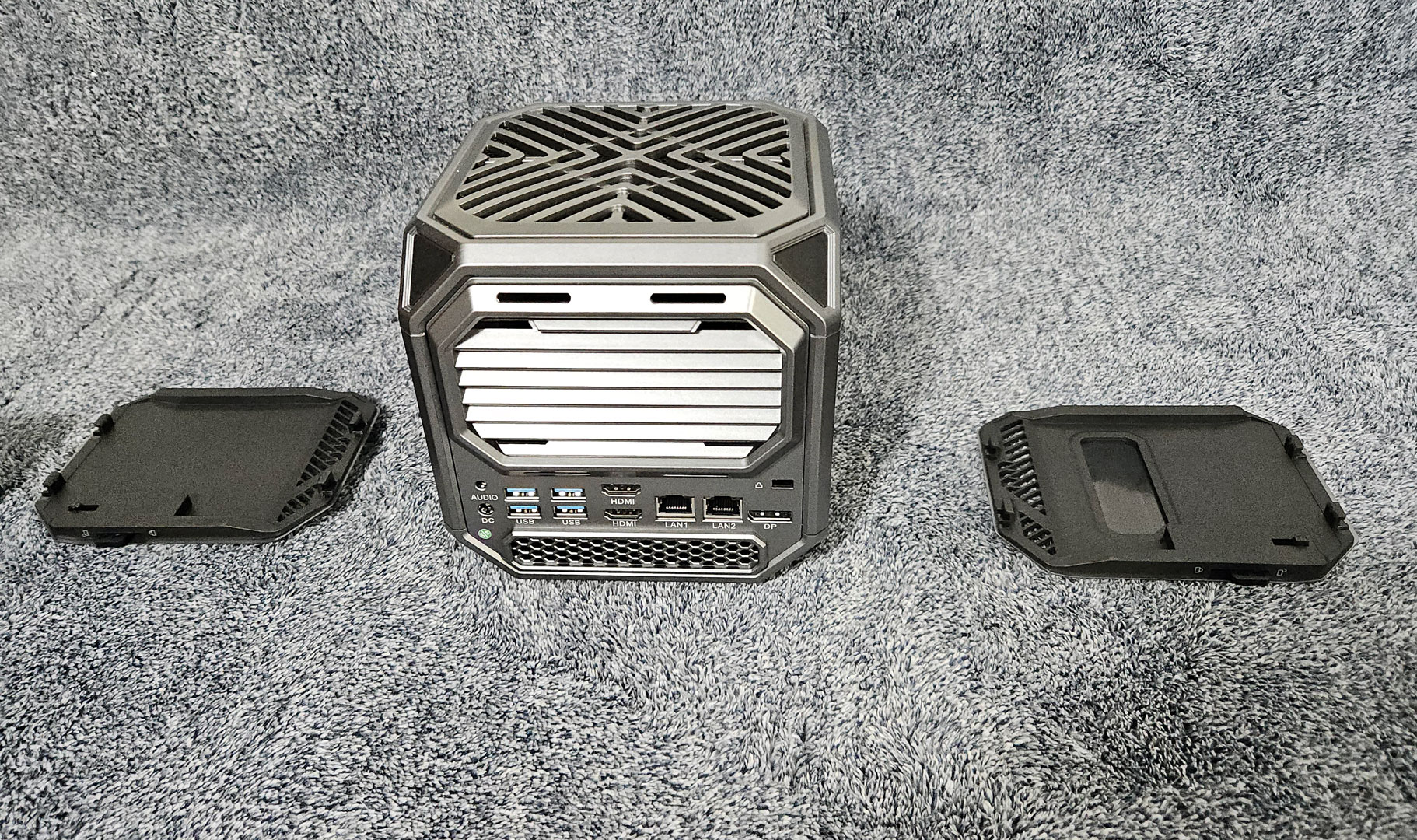
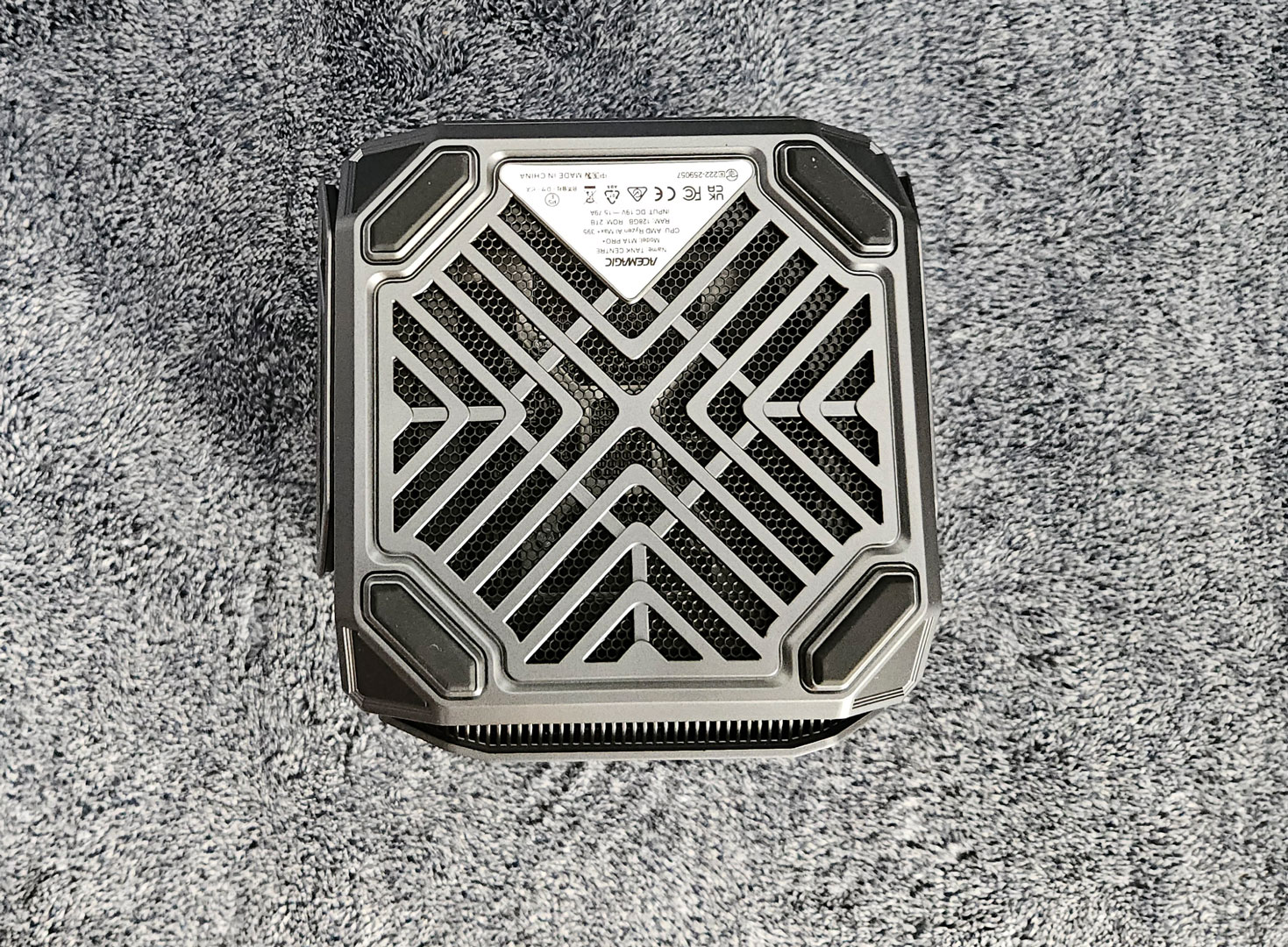
Around the back, the M1A+ Pro offers a generous port selection, including four additional USB Type-A ports split across USB 3.2 Gen 2 and Gen 1, dual 2.5 GbE Ethernet, HDMI 2.1, DisplayPort 2.0, another 3.5 mm audio jack, and the DC input. Most of the rear panel is given over to ventilation, which fits the thermal demands of the hardware inside and gives the system a more serious, performance-focused look.
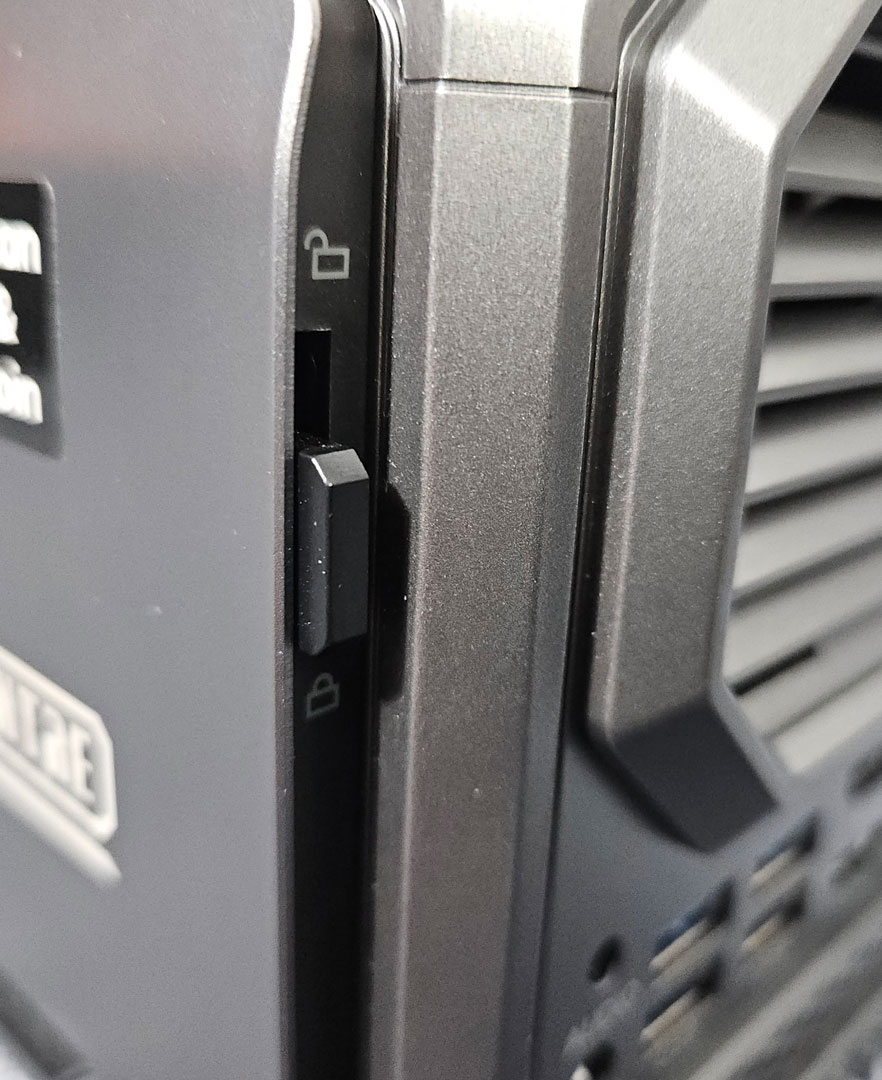
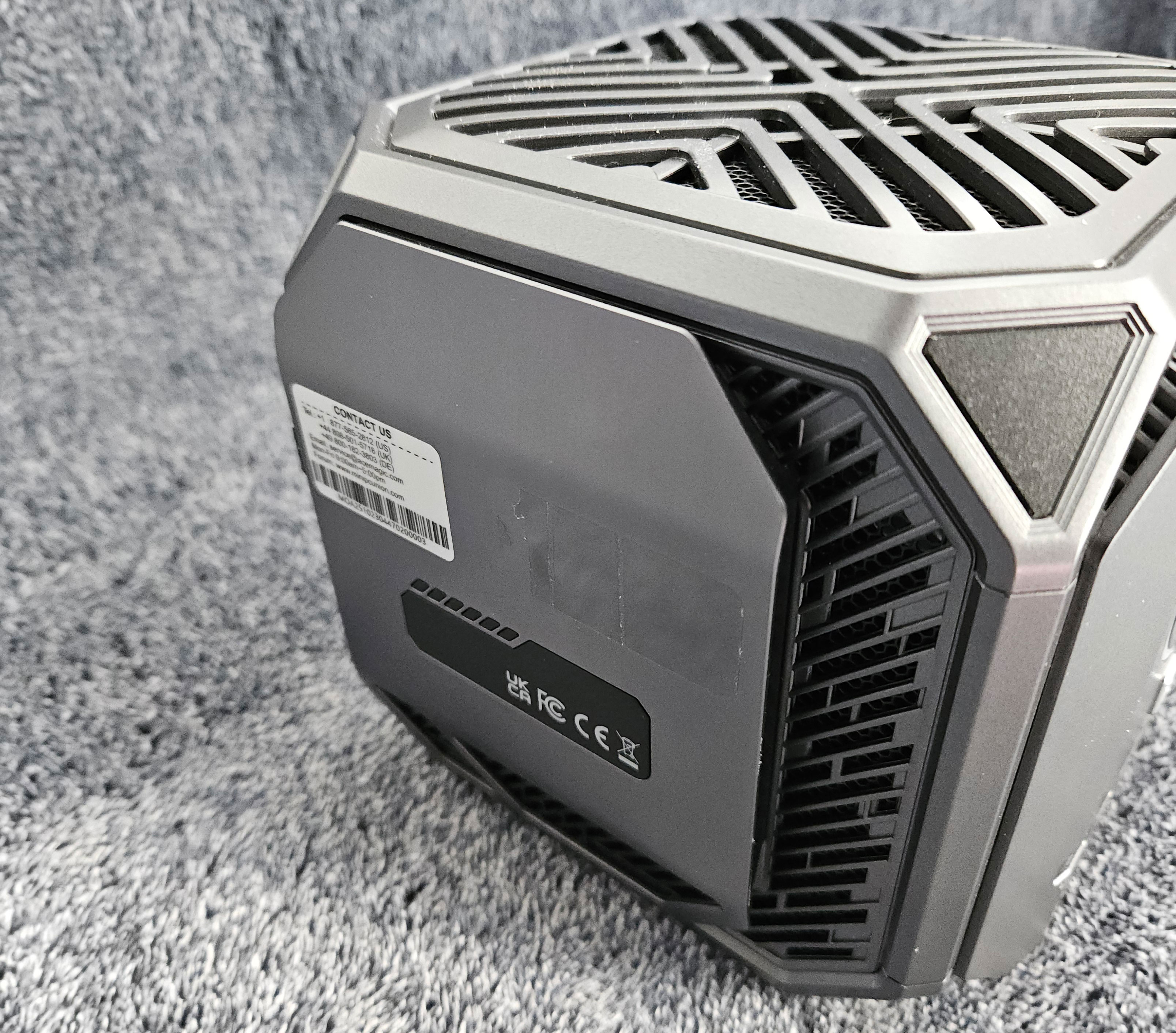
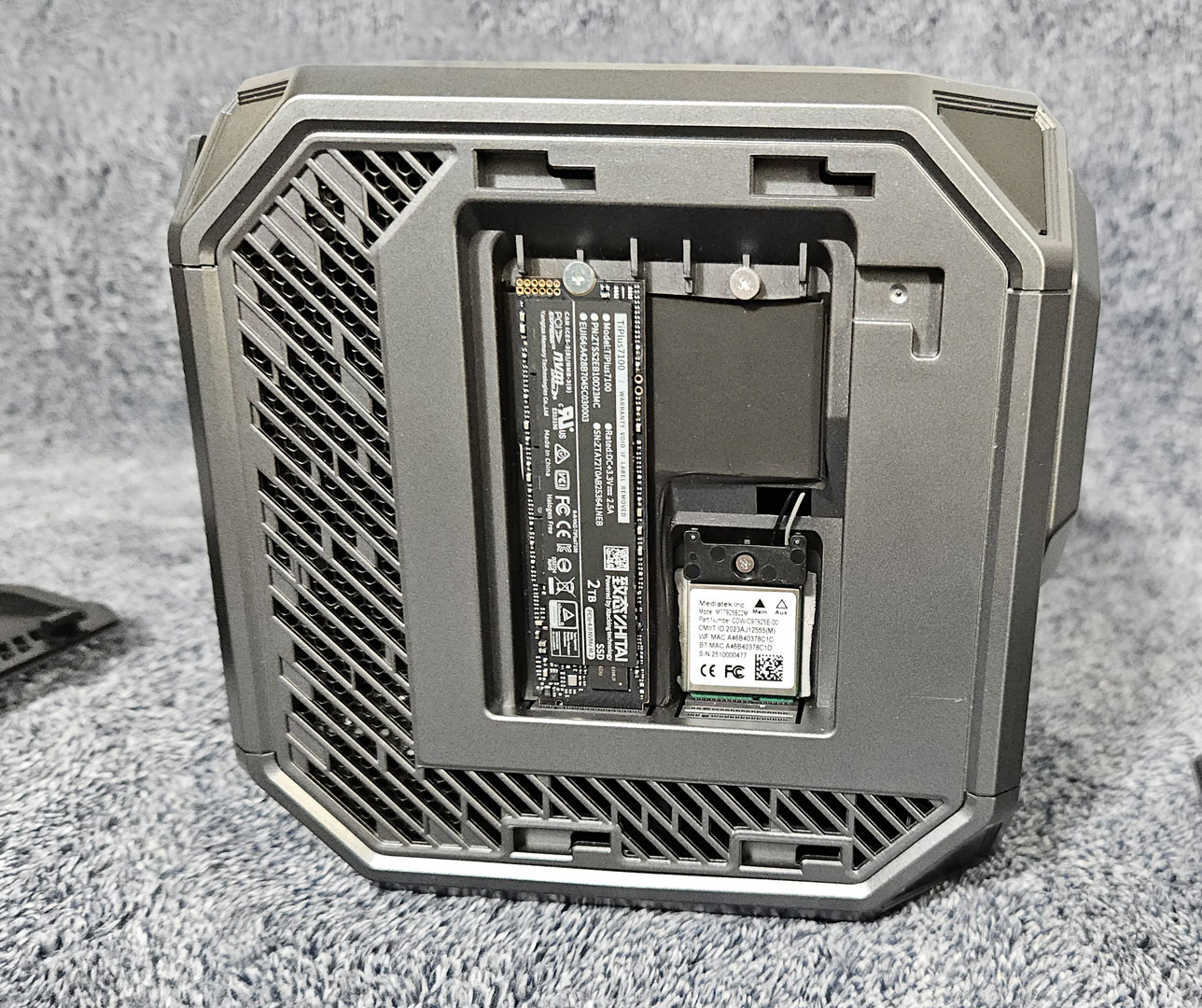
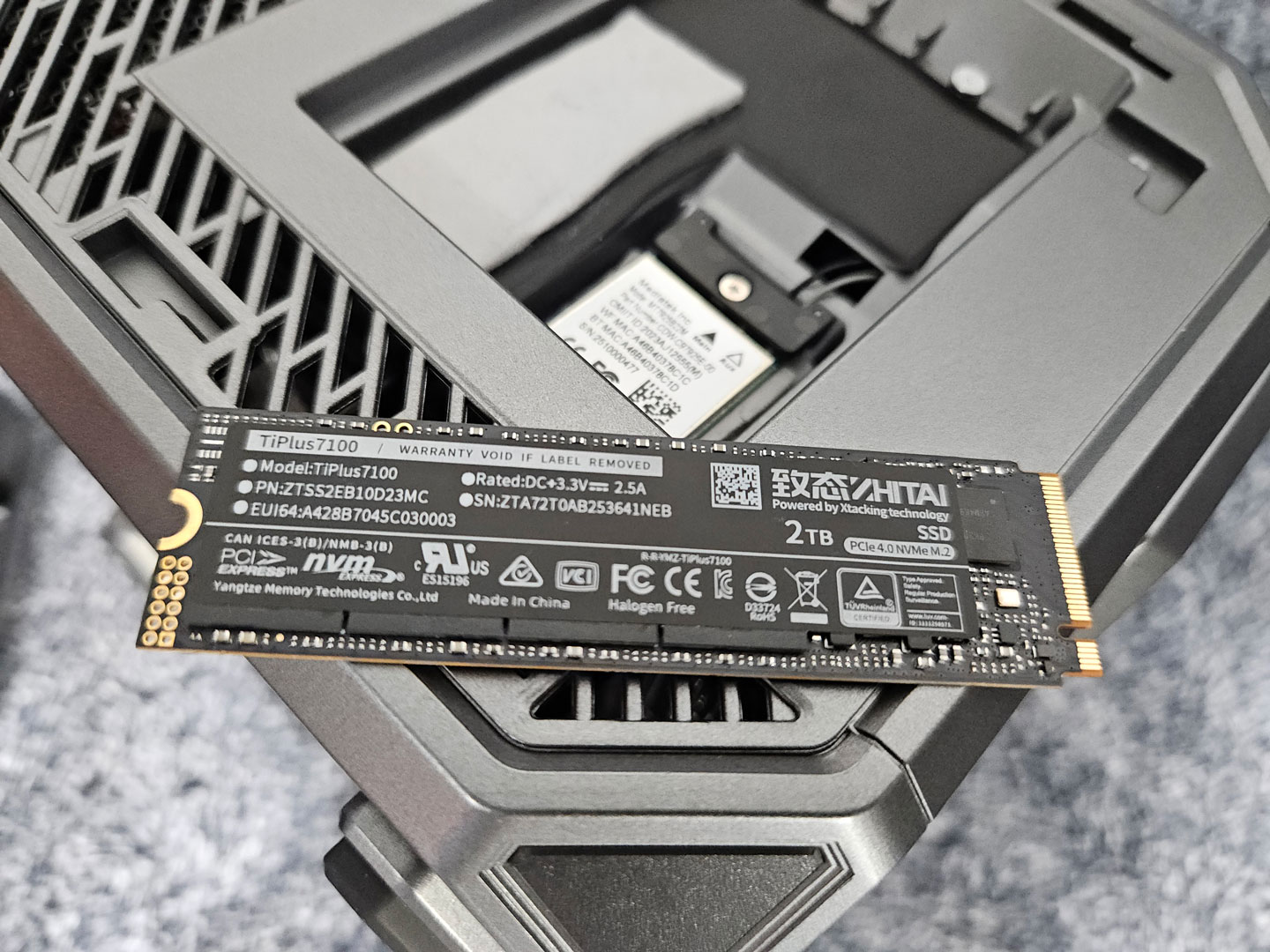
One of the nicer parts of the physical design is the quick-release side panel setup. ACEMAGIC uses a simple tool-free latch mechanism, making getting to the storage slots fast and easy. Lift the latch, pull the panel outward, and it comes right off. Putting it back is just as simple. Because I was having some hard reboot issues, ACEMAGIC recommended moving the OS SSD to the primary M.2 slot beside the fan, which solved the issue. This photo was taken before that change was made.
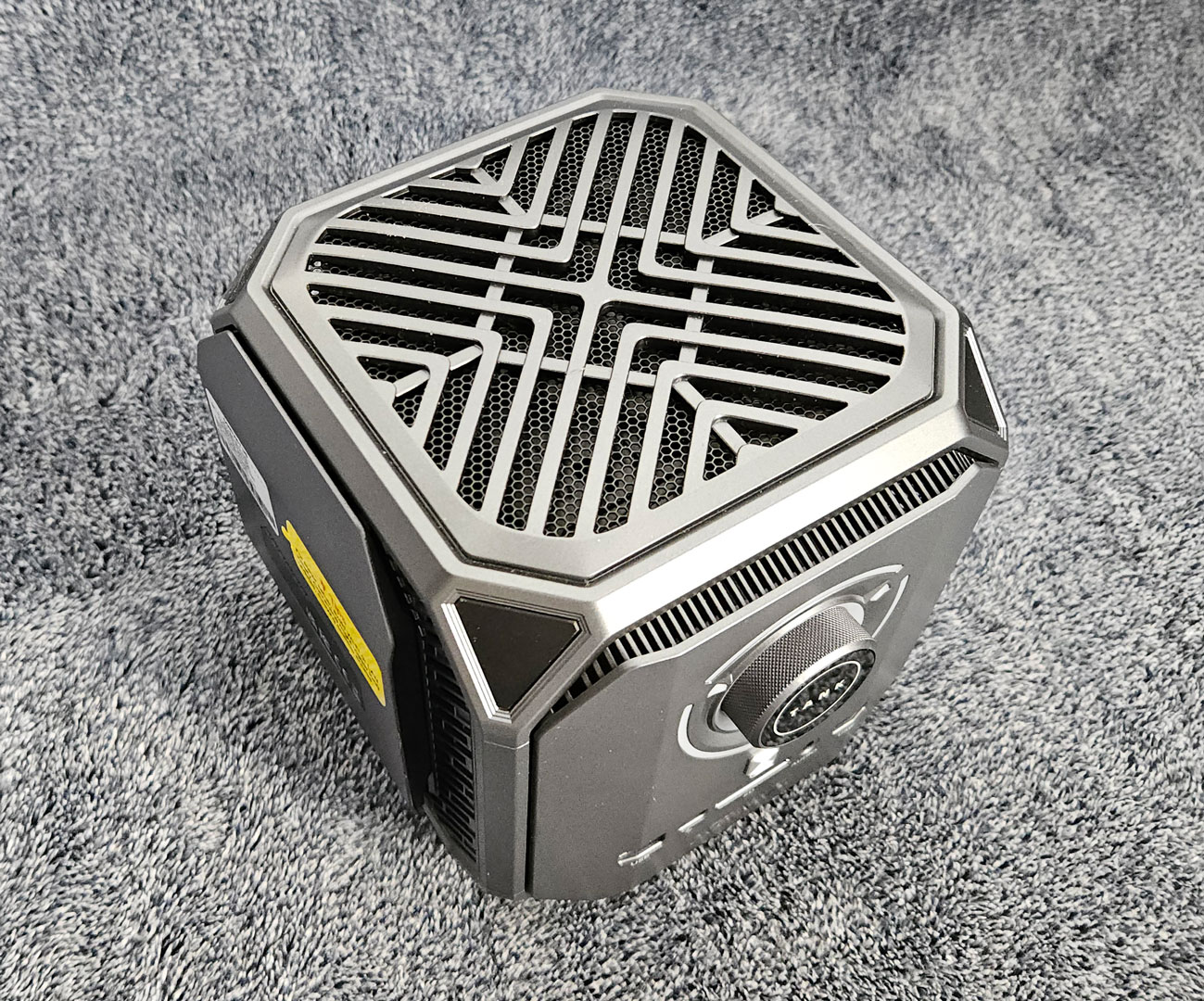
Overall, this is a very distinctive design, and whether that works for you will depend on what you want from a Mini-PC. I appreciated that it has its own personality and does not look like every other small black box on the market. However, the lighting will be a drawback for some buyers. The front LED dial cannot be turned off or dimmed in any way, which is disappointing because it is bright enough to be distracting in a darker room. When I was watching TV in my office, I found myself turning the system around, so that the light was not facing me. That limitation makes the M1A Pro+ a less appealing fit for shared spaces, media setups, bedrooms, or anywhere you may want the system to blend in.
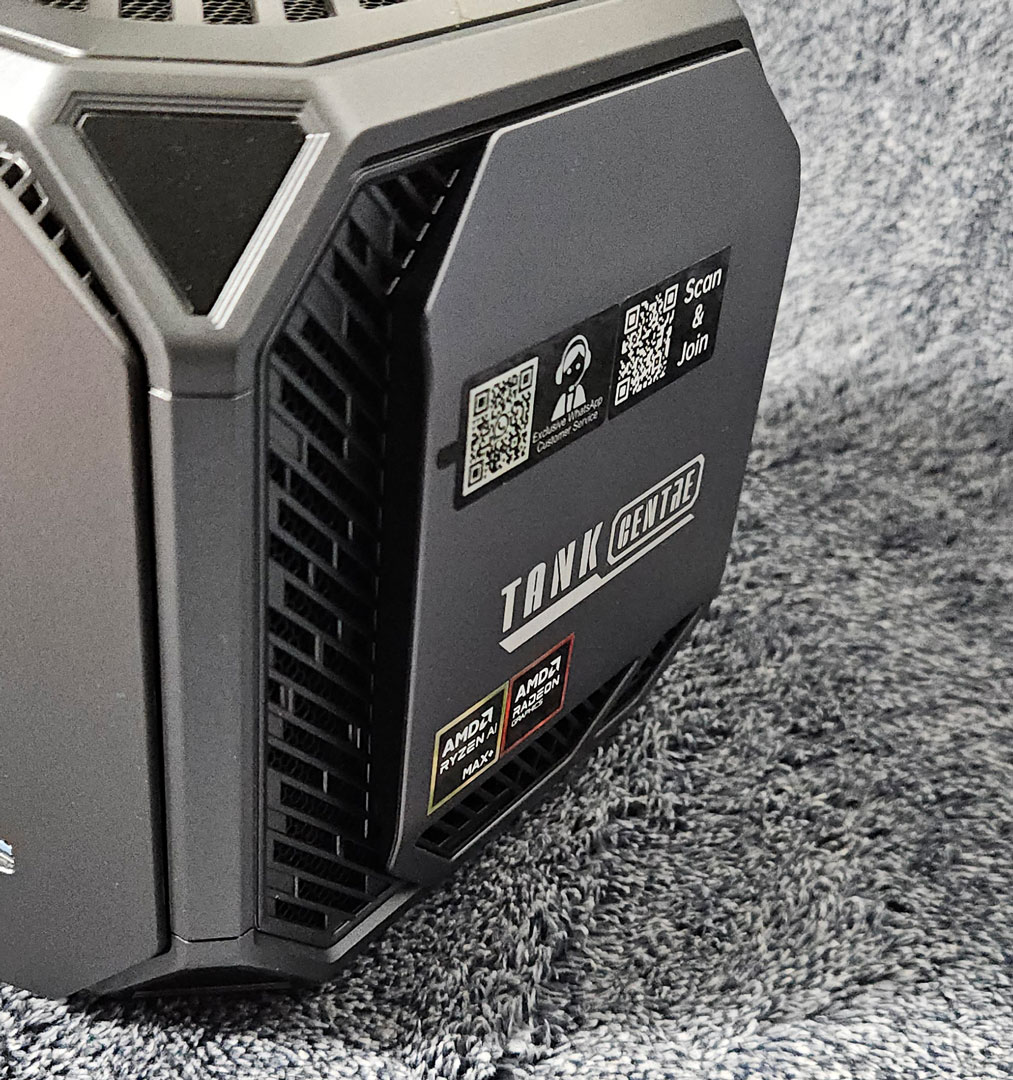
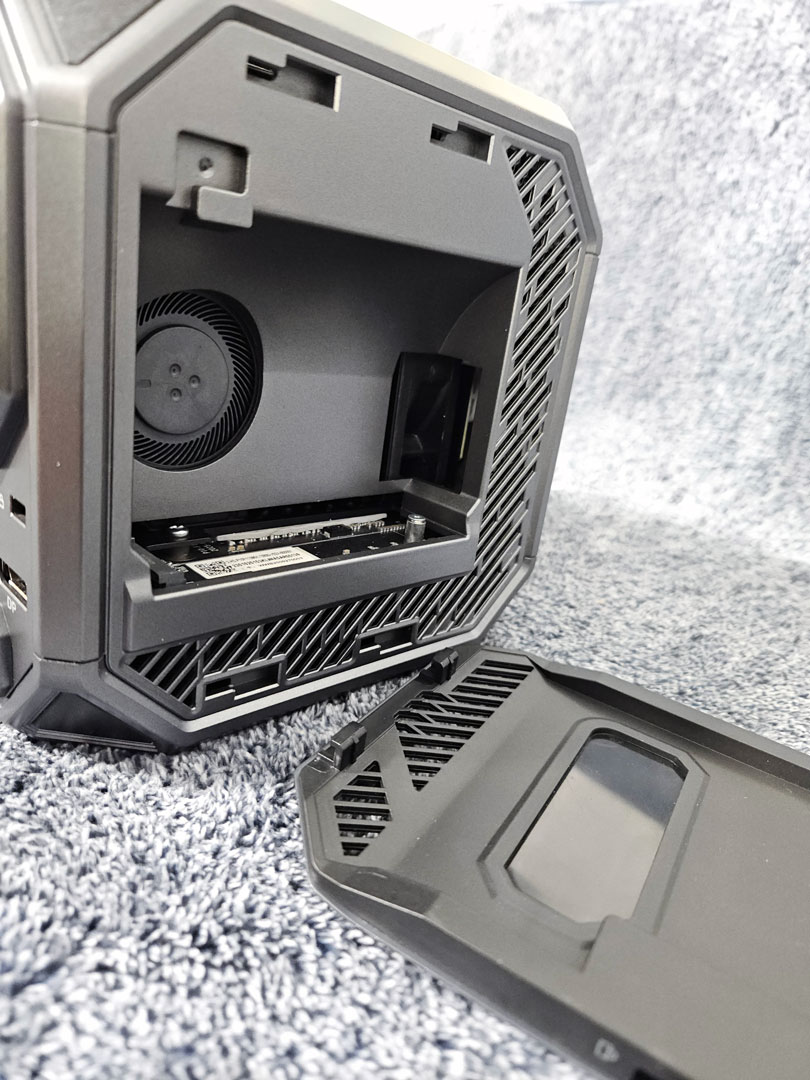
On the left side, you get access to the primary M.2 slot, where the OS drive is installed. This opening also gives a partial look at the dual-turbine cooling layout, which uses separate airflow paths for the CPU and GPU. ACEMAGIC says the CPU is cooled by two copper heat pipes, while the GPU uses five, all tied into a high-airflow exhaust arrangement designed to manage the much heavier thermal load of this platform. The right side holds the additional M.2 slots, giving the M1A Pro+ a welcome amount of storage flexibility even if the rest of the system is effectively closed off.
The side access panels are convenient, but they also highlight one of the bigger trade-offs in the design. They give you easy access to the M.2 storage slots, but that is essentially where user access ends. When I asked ACEMAGIC whether there was a practical way to get to the deeper internal components, such as the motherboard, without major disassembly, the company indicated that this is not something an end user can realistically access and would require a trained professional. In other words, this is not a system built with tinkering in mind.
That will not be a problem for everyone; for many buyers, it probably will not matter much at all. With a Ryzen AI Max+ 395, Radeon 8060S graphics, and 128 GB of memory already onboard, this is the kind of Mini-PC most people will buy as a finished package, rather than as something to upgrade piece by piece over time. Storage expansion is still available, which is the main thing many users will want, but those who enjoy opening up a system, repasting components, swapping wireless cards, or doing deeper hardware experimentation will find the design restrictive.
Our Patreon Silver Supporters can read articles in single-page format.
Nov 20th, 2026 14:03 PST
change timezone
Latest GPU Drivers
New Forum Posts
- Honestly, do you care about GTA VI? (208)
- When you could finally run Crysis maxed out? (63)
- WarpCoreBench scores! (80)
- GTA VI (20)
- Anthrophics IPO (25)
- GeekMagic Ultra Smart WiFi Weather Station (8)
- Very unusual two gaming-pc scenarios. (35)
- Can i play GTA 6 now? (Joke) (14)
- How to prevent OLED burn damage due to PC freezes or power outtages? (47)
- Zen 3 IF/IMC degradation (239)
Popular Reviews
- AMD Zen 6 Technical Deep Dive
- Ugreen NASync DXP4800 GT Review
- Microsoft Surface Laptop Ultra Review - The Next-gen Arm Laptop
- Corsair RM1200e (Second Generation) Review
- Acemagic Retro X3 Review
- Upcoming Hardware Launches 2027 (Updated Nov 2026)
- Pulsar Office Tour & First Look at P1 Dual-Sensor Mouse
- Biwin Black Opal NV7400 2 TB Review
- AMD Ryzen 7 9800X3D Memory Performance Scaling
- AMD Ryzen 7 9800X3D Review - The Best Gaming Processor
TPU on YouTube
Controversial News Posts
- NVIDIA Co-Founder and CEO Jensen Huang Officially Resigns (490)
- Report: Jensen Huang Eyes NVIDIA Comeback (255)
- Open Letter Asking NVIDIA to Reinstate Jensen Huang Passes 115,000 Signatures (184)
- OpenAI CEO Argues Home PCs Waste the World's Limited DRAM Supply (152)
- NVIDIA Launches Investigation Into Jensen Huang's Relationship With Suspected Chinese Spy (136)
- Intel "Raptor Lake Next" 16-Core and 20-Core CPUs Surface (130)
- Legendary Game Studio BioWare Shuts Down Following EA Layoffs (104)
- Dell CEO Says the Memory Shortage Will Get Worse in 2027 (95)