 14
Acer MA200 1 TB Review
Power Consumption & Efficiency »pSLC Cache / Write Intensive Usage
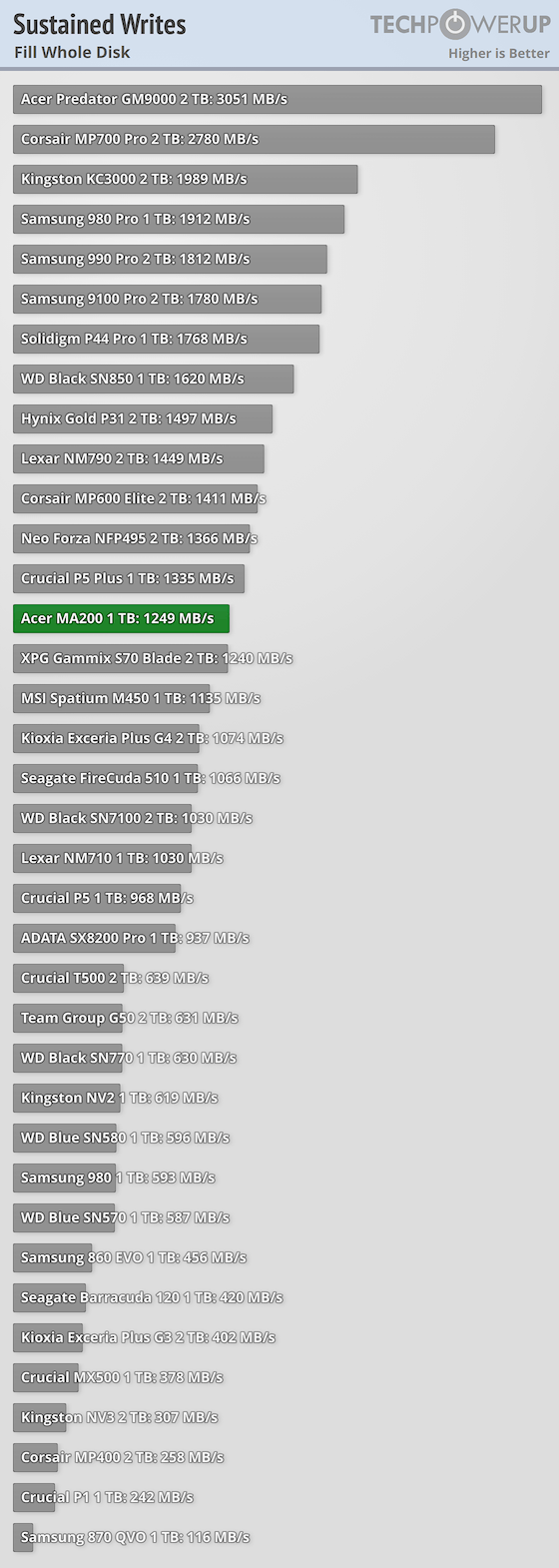
When copying games from your Steam Library, or other very large files (>10 GB), you may notice that write speeds on your SSD start at full speed, before dropping considerably. The underlying reason is that modern drives have small, fast caches, that soak up write bursts to improve performance. In the fairly uncommon scenario of writing data that's too big to fit into these caches, the drive will have to write data directly to flash, and it will probably juggle some out of its write cache at the same time, which can result in a significant loss of write speed. Newer TLC/QLC drives use part of their capacity in SLC mode for increased performance. This test can reveal the size of that pseudo-SLC cache.The testing methodology used on this page simulates such a scenario. We write a sequential stream of 1 MB blocks to the drive in a single thread, like a typical file-copy operation would do, and measure write speeds twice a second. Please note that some other publications test this at higher queue depth, which will yield bigger numbers, that are less relevant to real-world scenarios. The drive is fully erased before testing, to ensure any caches are emptied. This test generates a heavy write load with lots of data, something that most people don't do regularly—typical consumer workloads involve shorter bursts of write activity.

Write speeds start out at around 4 GB/s and are sustained until 280 GB have been written, which means the drive will fill 82% of its capacity in SLC mode first. Once the SLC cache is full, write speeds first drop to between 1.5 and 2 GB/s for another 200 GB, before dropping again to around 800 MB/s. Filling the whole capacity completes at 1249 MB/s on average, a good result that's considerably better than all the competing QLC M.2 2230 models, which reach only a fraction of the performance in this test. The only exception is the Corsair MP600 Mini, which is TLC-based, too, and reaches a tiny bit more, 1315 MB/s.
As soon as the incoming stream of data stops, even for a few seconds, write speeds will be restored to full, because the SLC cache has had some time to free up capacity in the background.

Nov 27th, 2026 04:46 CST
change timezone
Latest GPU Drivers
New Forum Posts
- Wireless Internet sharing between PC and router both-ways, is it possible? (31)
- Mouse Pad advice - Shidenkai out of production? (8)
- Using sodimm+adapter instead of full size dimm DDR5? (103)
- SABRENT AIC's (no bifurcation) Black Friday deals (0)
- What's your main Black Friday / Cyber Monday purchase? (27)
- Found Out Why My FygoOS Transfers Were Stuck at 11 MB/s (0)
- X79 and/or rampage IV OC'ing thread for those of us still left.... (2461)
- Will zen 6 mobos have anything extra vs current ones? (63)
- Dell Dimension E510 Retro Gaming PC Upgrade & Modification (3)
- Gacha Games - Discussions, Pulls, Updates, etc. (1166)
Popular Reviews
- VZMORE AX9 Max Review
- Upcoming Hardware Launches 2027 (Updated Nov 2026)
- ASRock X870E Challenger Wi-Fi White Review
- AMD Ryzen 7 9800X3D Review - The Best Gaming Processor
- Microsoft Surface Laptop Ultra Review - The Next-gen Arm Laptop
- AMD Zen 6 Technical Deep Dive
- Montech CyberFlow ARGB 360 Review
- Phantom Blade Zero Performance Benchmark Review - 35 GPUs Tested
- Corsair RM1200e (Second Generation) Review
- Pulsar Office Tour & First Look at P1 Dual-Sensor Mouse
TPU on YouTube
Controversial News Posts
- Jensen Huang Reinstated as CEO of NVIDIA (617)
- NVIDIA Co-Founder and CEO Jensen Huang Officially Resigns (492)
- Report: Jensen Huang Eyes NVIDIA Comeback (281)
- Open Letter Asking NVIDIA to Reinstate Jensen Huang Passes 115,000 Signatures (184)
- OpenAI CEO Argues Home PCs Waste the World's Limited DRAM Supply (152)
- NVIDIA Launches Investigation Into Jensen Huang's Relationship With Suspected Chinese Spy (136)
- Intel Razor Lake Gets a 12 P-Core bLLC Chip With No E-Cores, Per Leak (94)
- NVIDIA GeForce RTX 50-Series Scheduled for up to $500 Price Hike This Week (89)