 4
ADATA SE760 Portable SSD 1 TB Review
(4 Comments) »Introduction

In this review we're covering the ADATA SE760, which was announced just a few weeks ago. Portable storage is growing into an important segment for consumers, as people are moving ever increasing amounts of data. While mechanical HDDs have offered terabyte-sized capacities for years, these drives are simply too slow for an enjoyable user experience due to their slow transfer rates—copying 1 TB of data at 100 MB/s takes 3 hours!
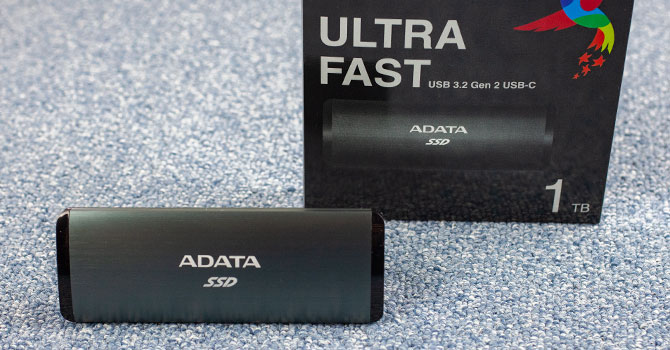
ADATA's SE760 uses the USB 3.2 Gen2 interface to support transfer rates of up to 1 GB/s, which can be a game changer if you have to copy a lot of data. Since the SE760 uses no moving parts, it is much more resilient to shock than a traditional HDD, and it also eliminates the seek-time bottleneck present on all hard drives.
Internally, ADATA is using a full-size M.2 NVMe SSD that seems to be identical to the SX6000 Pro (our review). It uses a Realtek RTS5763DL controller paired with 64-layer 3D TLC NAND chips from Micron. To shuffle the data between NVMe and USB, a JMicron JMS583 USB-to-PCIe bridge is installed.
I couldn't find any offerings in the US for the ADATA SE760. In Europe, it is available in capacities of 256 GB (€77/$70), 512 GB (€117/$107), and 1 TB (€183/$168).
Package and Contents


Inside the package you will find the SSD itself, a USB Type-C cable, and a cable with a standard USB (Type-A) port.
The Drive


ADATA has chosen a clean, stylish look for their external SSD. Due to the M.2 SSD inside, the case is relatively large, though.

A single USB-C port lets you connect to the drive. Note the small LED to the left of the connector. It lights up blue when the drive is powered on and also serves as a disk activity indicator by turning off the LED while data is accessed.
Our Patreon Silver Supporters can read articles in single-page format.
Nov 19th, 2026 20:38 CST
change timezone
Latest GPU Drivers
New Forum Posts
- Honestly, do you care about GTA VI? (173)
- RX 7600 + Ryzen 5 5600GT getting the same FPS as my old RX 6500 XT – What am I missing? (0)
- How to prevent OLED burn damage due to PC freezes or power outtages? (33)
- Dual B70 or Dual R9700 Pro on Linux (13)
- Intel Core Ultra 5 processor 250K Plus (0)
- TPU's Nostalgic Hardware Club (22171)
- What Network card after lightning strike USB or pcie? (1)
- Ryzen Owners Zen Garden (8559)
- Anthrophics IPO (7)
- GTA VI (8)
Popular Reviews
- AMD Zen 6 Technical Deep Dive
- Ugreen NASync DXP4800 GT Review
- Acemagic Retro X3 Review
- Upcoming Hardware Launches 2027 (Updated Nov 2026)
- Pulsar Office Tour & First Look at P1 Dual-Sensor Mouse
- Corsair RM1200e (Second Generation) Review
- Biwin Black Opal NV7400 2 TB Review
- Chieftec Iceberg PRO 360 DARK Review
- AMD Ryzen 7 9800X3D Memory Performance Scaling
- AMD Ryzen 7 9800X3D Review - The Best Gaming Processor
TPU on YouTube
Controversial News Posts
- NVIDIA Co-Founder and CEO Jensen Huang Officially Resigns (490)
- Report: Jensen Huang Eyes NVIDIA Comeback (224)
- Open Letter Asking NVIDIA to Reinstate Jensen Huang Passes 115,000 Signatures (184)
- OpenAI CEO Argues Home PCs Waste the World's Limited DRAM Supply (152)
- NVIDIA Launches Investigation Into Jensen Huang's Relationship With Suspected Chinese Spy (136)
- Intel "Raptor Lake Next" 16-Core and 20-Core CPUs Surface (130)
- Legendary Game Studio BioWare Shuts Down Following EA Layoffs (104)
- Dell CEO Says the Memory Shortage Will Get Worse in 2027 (95)