 8
ALLIWAVA H90Pro Review
AAA Gaming »Storage Performance
CrystalDiskMark
CrystalDiskMark (CDM) gives tells us how fast a drive can move both large sequential files and smaller random workloads.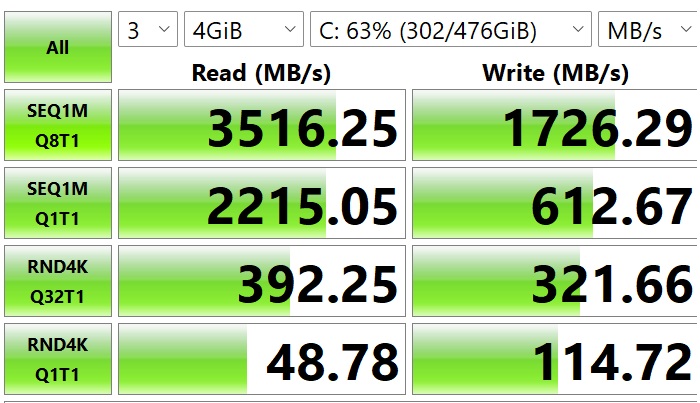
For large file transfers, the H90Pro reaches 3,515 MB/s read and 1,726 MB/s write in the sequential Q8T1 test. These speeds are in line with what you'd expect from a PCIe 3.0 SSD. For everyday users, this means copying large media libraries, backup tasks, or installing games will be slower than some competitors, though still far better than SATA SSDs or first-gen NVMe drives.
3D Mark Storage
The 3DMark Storage test is designed to simulate real-world workloads like launching games, loading levels, streaming assets, and handling frequent updates. It's a more real-world measure than raw sequential speeds because it shows how an SSD will actually behave once you start piling on modern software and larger game libraries.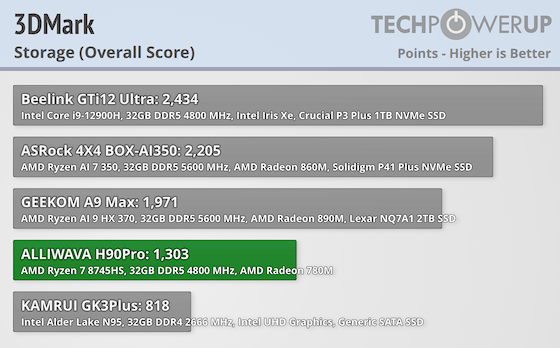
Here, the H90Pro scored 1,303, which is well behind other Mini-PCs like the Beelink GTi12 Ultra (2,434) and ASRock 4X4 BOX-AI350 (2,205). This directly reflects its use of a PCIe 3.0 SSD instead of the PCIe 4.0 or even 5.0 drive that other systems have. In practice, that means longer load times for big games and slower asset streaming, which doesn't hurt basic desktop use but does leave some performance on the table for heavier workflows. Upgrading to a Gen 4 SSD would quickly close that gap and better match what the CPU and GPU can deliver.
Nov 24th, 2026 06:58 CST
change timezone
Latest GPU Drivers
New Forum Posts
- Games at first startup always worse why? (0)
- GTA VI (30)
- Increasing Power Limit? (27)
- HP ZBook 17 G3 i7 – black screen and fans running at max speed after switching SSD to GPT (0)
- Strange PC issues with Z690 setup (2)
- How to prevent OLED burn damage due to PC freezes or power outtages? (58)
- Which ryzen am5 cpu ? (201)
- Your PC ATM (36486)
- AI generated images... (234)
- Without Jensen, PC gaming will be (58)
Popular Reviews
- Microsoft Surface Laptop Ultra Review - The Next-gen Arm Laptop
- ASRock X870E Challenger Wi-Fi White Review
- Upcoming Hardware Launches 2027 (Updated Nov 2026)
- Corsair RM1200e (Second Generation) Review
- AMD Ryzen 7 9800X3D Review - The Best Gaming Processor
- AMD Zen 6 Technical Deep Dive
- AMD Ryzen 7 7700X3D Review
- Pulsar Office Tour & First Look at P1 Dual-Sensor Mouse
- Phantom Blade Zero Performance Benchmark Review - 35 GPUs Tested
- Ugreen NASync DXP4800 GT Review
TPU on YouTube
Controversial News Posts
- NVIDIA Co-Founder and CEO Jensen Huang Officially Resigns (492)
- Jensen Huang Reinstated as CEO of NVIDIA (434)
- Report: Jensen Huang Eyes NVIDIA Comeback (281)
- Open Letter Asking NVIDIA to Reinstate Jensen Huang Passes 115,000 Signatures (184)
- OpenAI CEO Argues Home PCs Waste the World's Limited DRAM Supply (152)
- NVIDIA Launches Investigation Into Jensen Huang's Relationship With Suspected Chinese Spy (136)
- Intel "Raptor Lake Next" 16-Core and 20-Core CPUs Surface (130)
- NVIDIA GeForce RTX 50-Series Scheduled for up to $500 Price Hike This Week (89)