 8
ALLIWAVA H90Pro Review
Web & Office Productivity »General Performance
AIDA64 Cache & Memory
The AIDA64 memory benchmark measures how quickly data moves through system memory and CPU caches, showing bandwidth (read/write/copy speeds) and latency.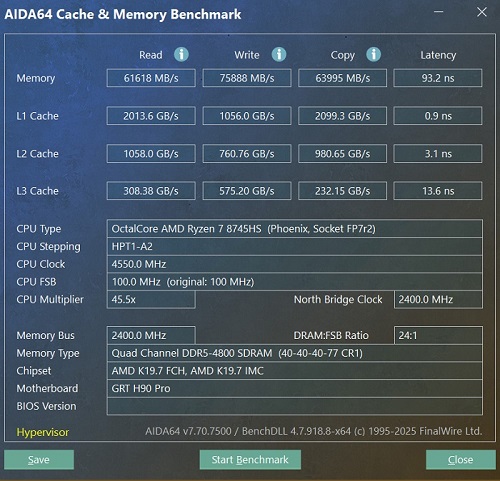
Here, the H90Pro shows dual-channel DDR5-4800 that delivers just over 61 GB/s read, 75 GB/s write, and 64 GB/s copy bandwidth, with latency measuring around 93 ns. These numbers are typical for DDR5-4800 but fall short of what you'd see with DDR5-5600, which would typically push bandwidth into the 80–90 GB/s range, besides operating at lower latency. As I mentioned earlier, since the Radeon 780M iGPU relies heavily on memory speed for performance, this slower RAM limits graphics potential compared to faster configurations. Still, for general productivity, multitasking, and even light creative work, the memory subsystem is sufficient.
Cinebench
This is a synthetic benchmark that measures CPU performance using real-world rendering workloads from Maxon's Cinema 4D engine. It stresses both single-core and multicore performance, giving a clear sense of how a processor handles light everyday tasks versus heavy, fully threaded workloads.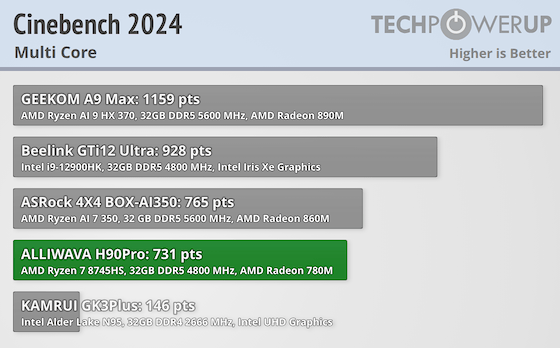
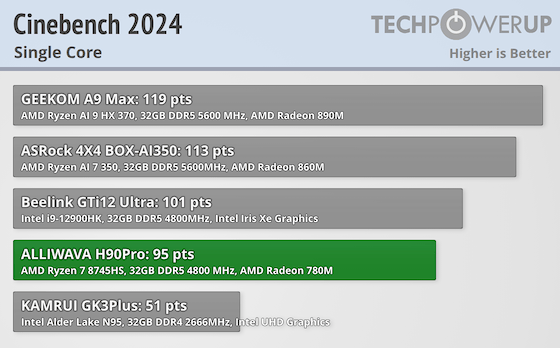
In Cinebench 2024, the H90Pro scores 731 points in multicore and 95 in singlecore. This places it behind newer Ryzen AI-based systems like the A9 Max, but the results are consistent with its Ryzen 7 8745HS CPU. Multithreaded performance is strong enough for typical office and productivity tasks, while single-threaded results show that day-to-day responsiveness remains smooth, even if heavier rendering workloads take longer compared to higher-tier chips.
7-Zip
This benchmark measures how efficiently the processor handles compression and decompression, reporting results in millions of instructions per second (MIPS).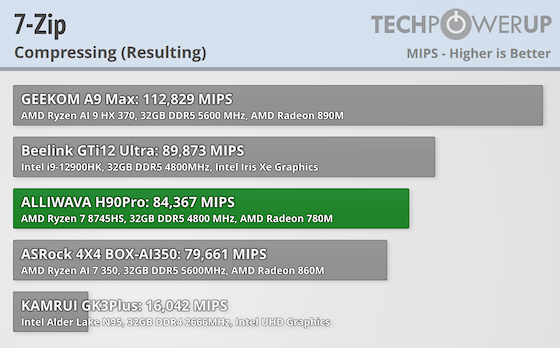
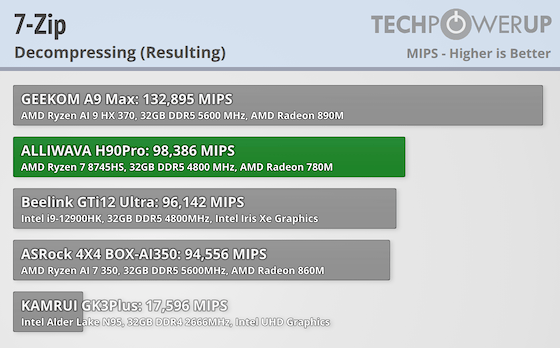
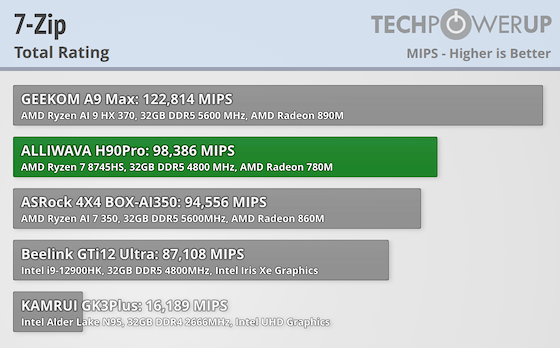
In 7-Zip's file compression test, the ALLIWAVA H90Pro lands a strong overall score of 98,386 MIPS, making it the second-fastest system in this group behind only the GEEKOM A9 Max. Its compression performance is solid at 84,367, putting it ahead of several rivals but a step back from the Beelink GTi12 Ultra and A9 Max. Where it stands out is in decompression, scoring 98,386, which edges out both Beelink and ASRock systems and shows that it can handle unpacking large archives quickly. For everyday use, this means the H90Pro is well suited for tasks like unzipping big project files or managing compressed backups, offering speed that's close to the top without needing expensive, current-gen flagship hardware.
PCMark 10
PCMark 10 is one of the better tests for showing how a system will actually feel day to day, as it breaks things down into real-world scenarios.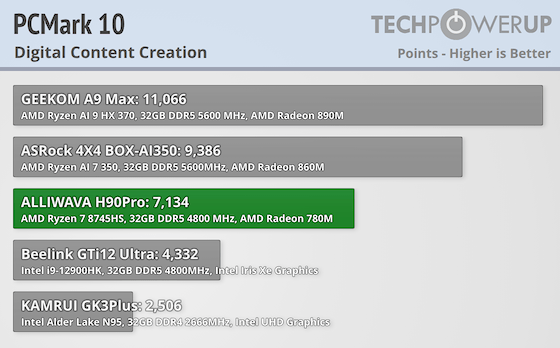
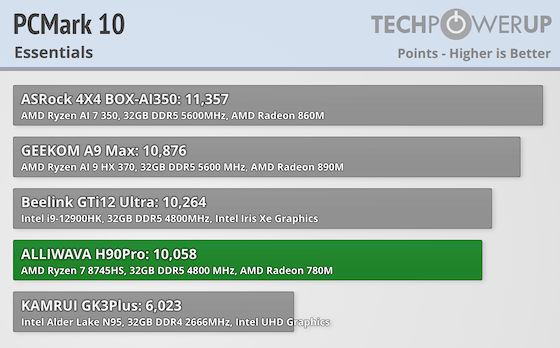
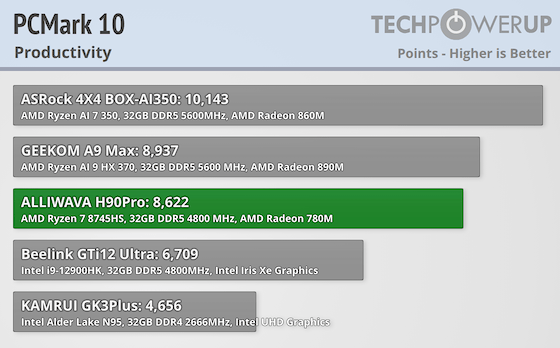
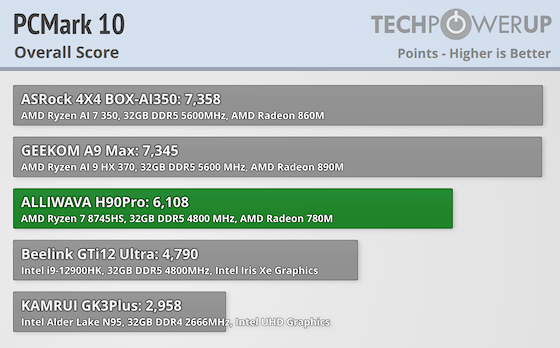
Essentials (10,058) and Productivity (8,622) score demonstrate that the system can handle browsing, video calls, and office tasks very well. Digital Content Creation (7,134) is weaker, showing the GPU limitations compared to newer RDNA 3.5 models. The overall score of 6,108 puts the H90Pro above Intel's Beelink system, though behind GEEKOM and ASRock's newer Ryzen AI models.
Y-Cruncher
Y-Cruncher is a benchmark that pushes both the CPU and memory hard by calculating digits of Pi to ridiculous precision, which makes it a great way to spot the real differences in raw compute power between systems.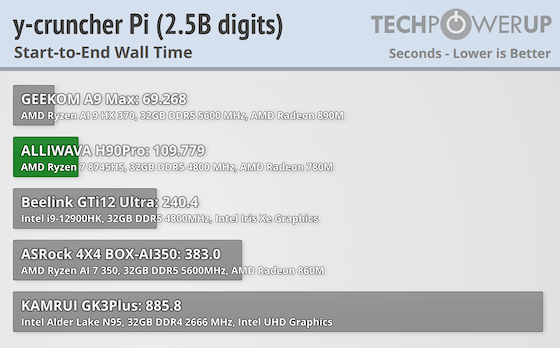
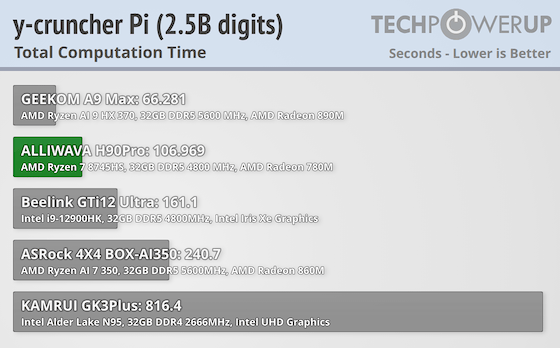
In the 2.5B digit Pi calculation, the ALLIWAVA H90Pro finished in about 107 seconds, making it the second-fastest system tested. Only the GEEKOM A9 Max pulled ahead, while the H90Pro left the rest of the field well behind, with times ranging from 149 seconds on the GH9 to over 240 seconds on the Beelink and ASRock models. While it doesn't quite have top results, the H90Pro has the processing strength to handle intensive number-crunching workloads well enough.
Geekbench
Geekbench is a widely used synthetic benchmark that measures how well a system's CPU and GPU handle a variety of consumer workloads, from web browsing and office tasks to photo editing and rendering.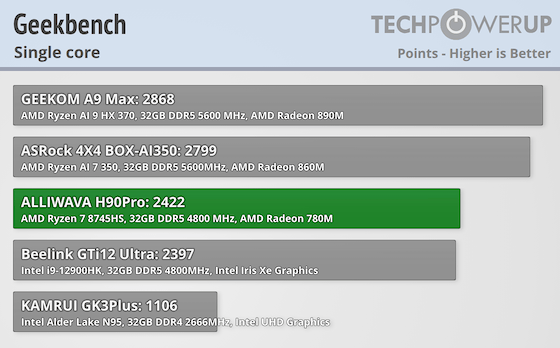
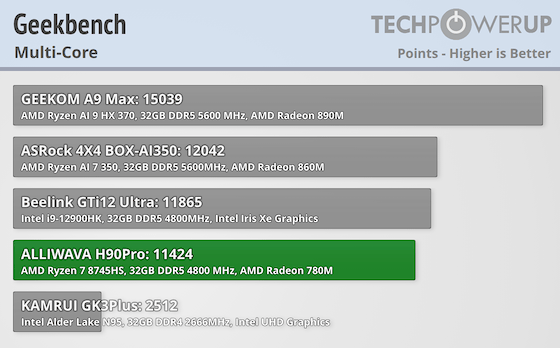
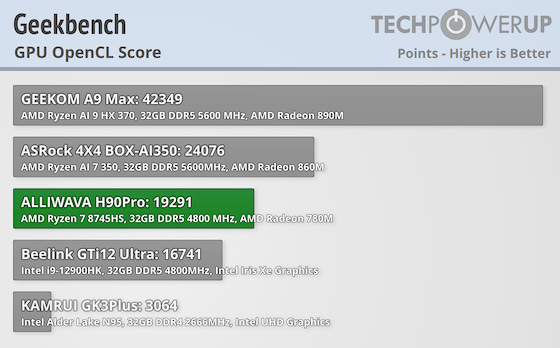
In Geekbench, the H90Pro posts 2,422 singlecore and 11,424 multicore, keeping pace with Intel's Core i9-12900H in the Beelink system on multicore workloads. GPU scores are more modest, with the Radeon 780M earning 19,291 in OpenCL. While behind the newer Radeon 860M and 890M iGPUs, it's a noticeable improvement over Intel's older integrated graphics, giving the H90Pro enough GPU power for light creative work and modern media acceleration.
Nov 24th, 2026 07:52 CST
change timezone
Latest GPU Drivers
New Forum Posts
- Increasing Power Limit? (29)
- GTA VI (33)
- I forced a 16 Year Old 64GB SSD to write 1 PETABYTE (And it didn't die) (194)
- Games at first startup always worse why? (0)
- HP ZBook 17 G3 i7 – black screen and fans running at max speed after switching SSD to GPT (0)
- Strange PC issues with Z690 setup (2)
- How to prevent OLED burn damage due to PC freezes or power outtages? (58)
- Which ryzen am5 cpu ? (201)
- Your PC ATM (36486)
- AI generated images... (234)
Popular Reviews
- Microsoft Surface Laptop Ultra Review - The Next-gen Arm Laptop
- ASRock X870E Challenger Wi-Fi White Review
- Upcoming Hardware Launches 2027 (Updated Nov 2026)
- Corsair RM1200e (Second Generation) Review
- AMD Ryzen 7 9800X3D Review - The Best Gaming Processor
- AMD Zen 6 Technical Deep Dive
- AMD Ryzen 7 7700X3D Review
- Pulsar Office Tour & First Look at P1 Dual-Sensor Mouse
- Phantom Blade Zero Performance Benchmark Review - 35 GPUs Tested
- Ugreen NASync DXP4800 GT Review
TPU on YouTube
Controversial News Posts
- NVIDIA Co-Founder and CEO Jensen Huang Officially Resigns (492)
- Jensen Huang Reinstated as CEO of NVIDIA (439)
- Report: Jensen Huang Eyes NVIDIA Comeback (281)
- Open Letter Asking NVIDIA to Reinstate Jensen Huang Passes 115,000 Signatures (184)
- OpenAI CEO Argues Home PCs Waste the World's Limited DRAM Supply (152)
- NVIDIA Launches Investigation Into Jensen Huang's Relationship With Suspected Chinese Spy (136)
- Intel "Raptor Lake Next" 16-Core and 20-Core CPUs Surface (130)
- NVIDIA GeForce RTX 50-Series Scheduled for up to $500 Price Hike This Week (89)