 56
AMD Athlon II X2 240 2.80 GHz Review
(56 Comments) »Introduction


Although the whole IT industry is slowly but surely moving to parallel computing and multithreading, dual core processors still hold a huge advantage over Triple or Quad Core models in terms of market share. There are few reasons for this situation. Nowadays Dual Cores are cheap, energy efficient and most of the times, pack enough power for an enjoyable experience in every day computing, gaming, work, etc. AMD and Intel wage their marketing war in the upper segment models with Phenom II and Core i5/i7 processors, only to win the war in the lower end segments. It's like in Formula 1 - there is no better commercial for a manufacturer than a Formula 1 title, which can be used later to stick it in the brands of every day family cars. If you have one product that is the best of the best out there, it's easier to convince people that every other product from your product line performs at the same price/performance ratios.
The new Athlon II brand is very important to AMD, and Quad Core versions under it have done remarkably well so far. Triple Cores are on the way to the stores, and by the looks of it, it's going to be an another win for AMD in this segment. This time though we're having a look at the dual core Athlon II X2 240 processor. It's an entry-level model for X2 series (not including the "e" models), and the most attractive one for small companies, and budget-oriented users.
I would like to thank Links for providing the processor sample for this review.
Packaging and Contents
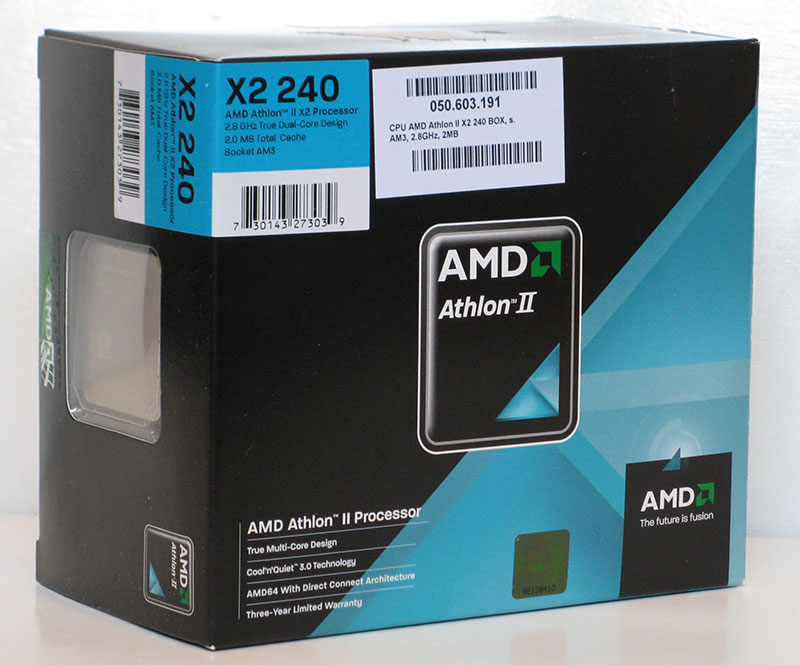
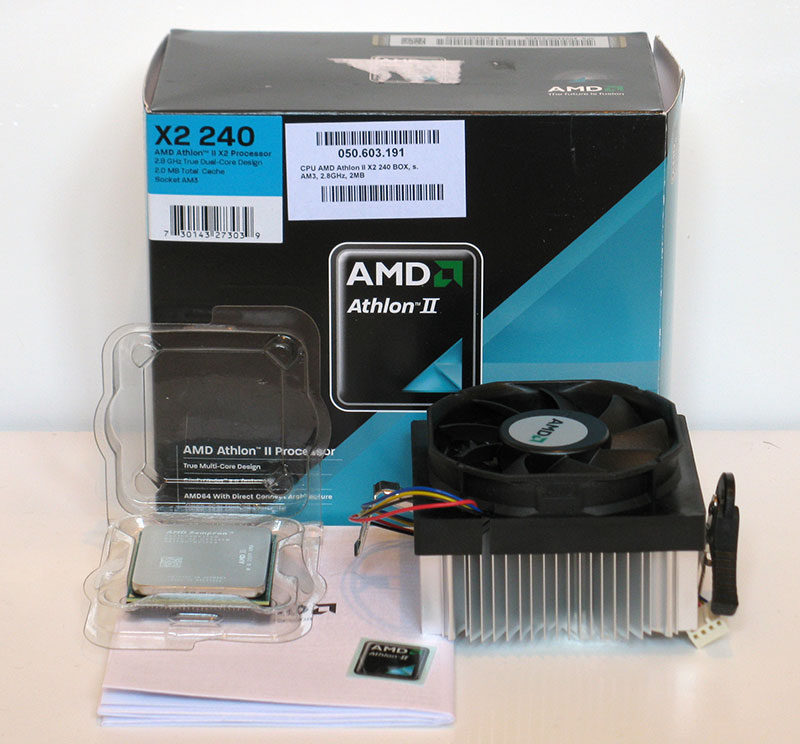
The Athlon II X2 240 comes in retail packaging that includes a short installation manual, AMD Athlon II case-badge, AMD-certified aluminum heatsink, and of course the processor itself. AMD offers a 3-year warranty for all retail processors, including this one.
Athlon II X2 240
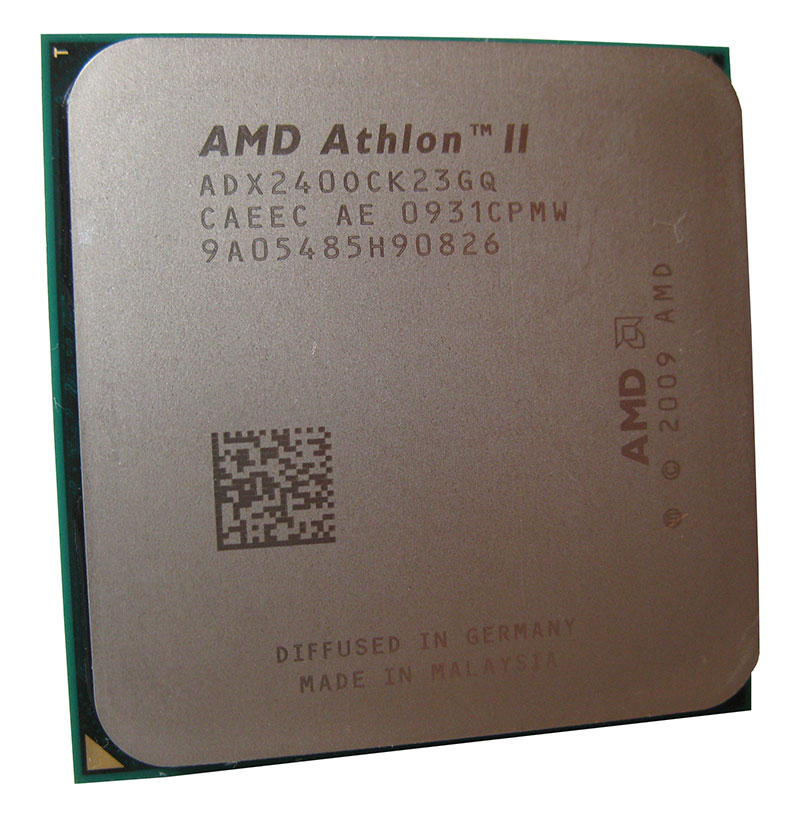
New Athlon II X2 processor models are based on one of three native core designs manufactured by AMD. First there is is Deneb, a Quad Core, that is implemented in all Phenom II models, with some variations to core number and L3 cache size. The second core is Propus, also with four logic cores, but no L3 cache. We reviewed an Athlon II X4 620 model a while back, and we have reviews of Athlon II X3 models planed in the near future, which are based on the same core design with one core disabled.
That brings us to the third and final core design. Cheapest, smallest and basic, the Regor with its two logic cores is implemented in all Athlon II X2 models and market entry Sempron models. All three cores are based on same K10.5 architecture, and the only real differences between them are the size of L2 and L3 cache memory. Deneb has 512 KB L2 cache per core and a large 6 MB L3 cache buffer that is shared between all cores. To make cheaper and slower models, Deneb, with some of its cores or some of its L3 cache memory disabled, were then renamed to Callisto/Heka and sent to market as Phenom II X2, X3 or X4 800 models. This is a great way to run a cost efficient production and offer a large selection of products to the customer.
It's the same story with the Propus core which is the base for Athlon II X4 processors. It also has 512 KB of L2 cache but lacks any L3 cache. This enables AMD to make small, power-efficient and cheap Quad Core processors, and if any of its logic cores is faulty - no problem, disable it and sell it as even cheaper Athlon II X3 (Rana) processor.
Finally there is the Regor core. It follows the same philosophy, but it has two logic cores, a total of 1 MB L2 cache memory per core, and no L3 cache memory.
To make the Regor core, AMD physically removed two cores from Propus (Quad Core). The resulting die area was so small that AMD had the opportunity to make some improvements while keeping the core die at a very cost efficient size. They increased the L2 cache from 512 KB to 1 MB per core. This means they nullified some of the performance impact of not having any L3 cache memory on board. Compared to L3 cache, L2 cache works at higher frequency, takes less cycles to process the instructions needed and has more bandwidth, so it should make some difference and we're going to check that out later in testing. In total, Regor's core die size measures 117 mm², not as small as Intel's Core 2 Duos but close enough.

Image courtesy of mAJORD from XtremeSystems.
Our Athlon II X2 240 works at 2.8 GHz frequency, 1.425 V stock voltage and has a 65 W TDP rating. For anyone who is familiar with AMD's current architecture this means three things: competitive price/performance ratio against Intel's Pentium processors, low heat output and great stock overclocking potential.
AMD is asking $60 for its Athlon II X2 240, and that's a fair deal right there. If you look at Intel's offering at that price point, Celeron E1600 and Pentiums E5x00 might just not be enough. When you put in play Athlon's flexibility with AM2+/AM3 and DDR2/DDR3 support plus all of the features it's packing including MMX, SSE2, SSE3, SSE4A instructions, Enhanced 3DNow!, NX bit, AMD64, Cool'n'Quiet, and AMD-V technology... it's clear that Intel needs something fresh in the lower market segments. Probably the most important feature is the AMD's virtualization technology, which Intel supports only with higher end Core 2 Duos and Core 2 Quad processors. Again, small business will love this feature at a $60 price point.
When talking about memory support, it's worth to note that the memory controller in Athlon II X2 models has beed downgraded to DDR2 1066 MHz and DDR3 1066 MHz, unlike other Athlon X3 and X4 models that support DDR3 up to 1333 MHz. But that's not a problem as you can manually get the memory to work up to 1600 MHz without a hitch. You may use the processor on either the AM3 or the older AM2+ platform, giving the opportunity for users to do a cheap update if they want to continue using their AM2/AM2+ motherboard and memory.
Overclocking is only possible by raising the HT Link frequency, as the multiplier is locked to 14x and can only be lowered.

It is clear that AMD is targeting non demanding users, or budget users if you like, with the new Athlon II X2 Series. It offers everything that the average user would ever want from a processor: low power consumption, low heat output, good performance and technology support and most important, cheap price. HTPC builders will rather choose the energy efficient "e" models of the Athlon II X2 or X3 lineup which were recently introduced. The normal version comes at higher voltage, resulting in higher power consumption, heat and cooler noise needed to disperse generated the heat. Gaming wise, it will be interesting to see how close the Athlon II X2 can get to AMD's Phenom II X2, which is a popular choice of some budget oriented gamers.
Like in our last review, we will be checking some non-standard features of AMD's Athlon II X2 240, including overclocking, reducing operational voltage and comparative performance to Phenom II Dual Core processor at the same clock speed.
Specifications
In the table below you can review detailed specifications of Athlon II X2 240 and other models that will show up later in the performance graphs. We will be using a clocked down 2.80 GHz Phenom II X2 to show the performance differences between Regor and Callisto cores at same frequencies. Intel is represented by two models in the similar price segment, Celeron E1600 and Pentium E5200. Core 2 Duo E8200 is included to compare Athlon II X2 240 performance to some higher end Intel Dual Core processors.| Processor | AMD Athlon II X2 240 | AMD Phenom II X2 550 BE | AMD Phenom II X3 710 | Intel Celeron E1600 | Intel Pentium E5200 | Intel Core 2 Duo E8200 |
|---|---|---|---|---|---|---|
| Number of cores | Dual | Dual | Triple | Dual | Dual | Dual |
| Core codename | Regor | Callisto | Heka | Allendale | Wolfdale 3M | Wolfdale |
| Socket | AM2+/AM3 | AM2+/AM3 | AM2+/AM3 | LGA775 | LGA775 | LGA775 |
| Core speed | 2800 MHz | 3100 MHz | 2600 MHz | 2400 MHz | 2500 MHz | 2660 MHz |
| L2 Cache | 1 MB/core | 512 KB/core | 512 KB/core | 512 KB | 2 MB | 6 MB |
| L3 Cache | - | 6 MB | 6 MB | - | - | - |
| Process Node | 45 nm | 45 nm | 45 nm | 65 nm | 45 nm | 45 nm |
| Core die size | 117 mm² | 258 mm² | 258 mm² | 77 mm² | 82 mm² | 107 mm² |
| TDP | 65 W | 80 W | 95 W | 65 W | 65 W | 65 W |
| Price | $ 60 | $ 102 | $ 100 | $ 62 | $ 67 | $ 115 |
Our Patreon Silver Supporters can read articles in single-page format.
Nov 12th, 2026 21:33 PST
change timezone
Latest GPU Drivers
New Forum Posts
- Microsoft Exchange/365 outages? (18)
- Any other old-timers here planning to play WoW Forever? (149)
- Your PC ATM (36413)
- I won't download games that are larger than 30–40 GB. (99)
- Lenovo Legion R27fc-30 vs AOC c27g4h2 which one wins ? (0)
- AI generated images... (223)
- Classic Blizzard games (WarCraft 1-2, Diablo 1-2, StarCraft 1) (7)
- WarpCoreBench scores! (26)
- Ryzen 7 8700G OC (5)
- When you could finally run Crysis maxed out? (61)
Popular Reviews
- AMD Zen 6 Technical Deep Dive
- NZXT C1200 Platinum Review
- Upcoming Hardware Launches 2027 (Updated Nov 2026)
- Corsair HX1000i Shift Crystal Review
- NZXT H7 RGB+ Review
- Montech King 95 3D PRO Review
- NZXT H5 Review
- Phantom Blade Zero Performance Benchmark Review - 35 GPUs Tested
- XPG NIMBUS PLUS Review - Mid-range Chair With Strong Competitors
- Gigabyte Z890I Aorus Ultra Review
TPU on YouTube
Controversial News Posts
- NVIDIA Co-Founder and CEO Jensen Huang Officially Resigns (293)
- OpenAI CEO Argues Home PCs Waste the World's Limited DRAM Supply (152)
- NVIDIA Launches Investigation Into Jensen Huang's Relationship With Suspected Chinese Spy (136)
- Intel "Raptor Lake Next" 16-Core and 20-Core CPUs Surface (130)
- Legendary Game Studio BioWare Shuts Down Following EA Layoffs (104)
- Dell CEO Says the Memory Shortage Will Get Worse in 2027 (95)
- NVIDIA GeForce RTX 50-Series Scheduled for up to $500 Price Hike This Week (89)
- Modder Fits RTX 5090 With Four 8-Pin Connectors, Halving Current per Wire (80)