 125
AMD FidelityFX FSR 3.1 Review - Frame Generation for Everyone
(125 Comments) »Introduction
Last Friday, AMD announced that the first five games have been released with official support for AMD's FidelityFX Super Resolution 3.1 (FSR 3.1) upscaling and Frame Generation. This is the first quality-improving update for FSR for quite some time, the last one was version 2.2.1, which released a year ago. In this article we're taking a look at the company's new upscaling technology in Horizon Forbidden West. Other titles with FSR 3.1 support are Ratchet and Clank, Spider-Man Remastered, Spider-Man Miles Morales, Ghost of Tsushima and God of War Ragnarök (out soon). These are all Sony PS5 exclusives brought to the PC by Nixxes, who are famous for their top-notch ports. I guess this means that AMD sat down with Nixxes and gave them some extra love, to help them implement FSR 3.1 in their games.
While the community often uses "DLSS 3" and "FSR 3" to specifically mean "frame generation," please do note that "FSR 3.1" does include updates for both upscaling and frame generation.
Technology

According to AMD, FSR 3.1 upscaling has "improved image quality, focusing on improved temporal stability, reduced flickering and shimmering, enhanced ghosting reduction and better detail preservation." This is possible thanks to internal tweaks of how the algorithm is treating high/low frequency signals during the upscale process.
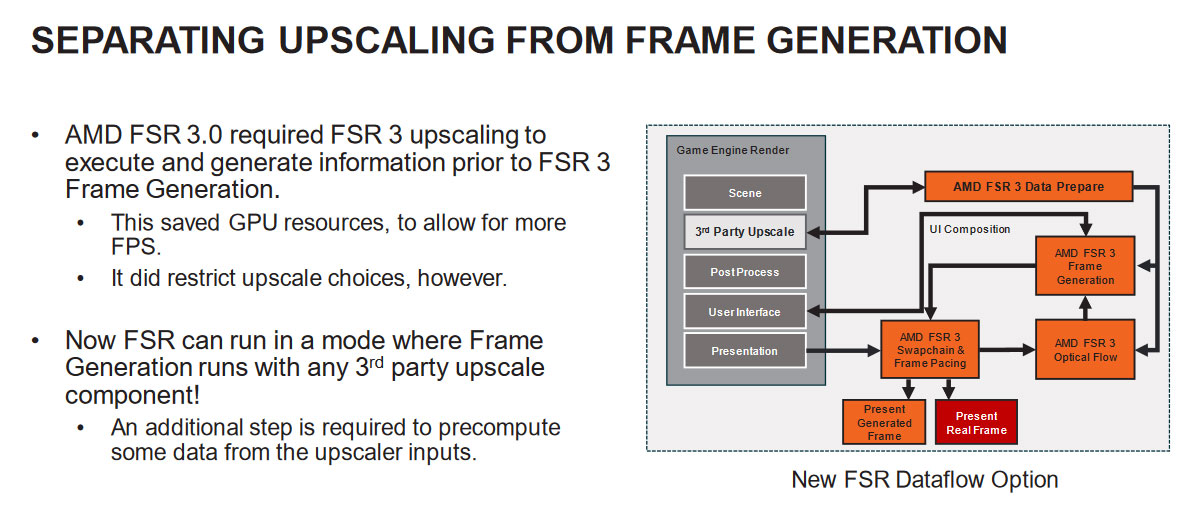
Arguably the most important and long-awaited feature of the FSR 3.1 update is upscaling and Frame Generation being decoupled. Basically, this allows using XeSS, DLSS or DLAA in conjunction with FSR Frame Generation. Previously, AMD used some intermediate data from the upscaler step as input for the frame generation code to improve performance (so that the information doesn't have to be generated twice). With FSR 3.1, AMD has added an optional API for game developers to use, to generate this data separately, so that FSR Frame Generation can be used with other upscalers (this costs a small amount of GPU time though).

Before you ask, yes, you can run FSR Frame Generation without any upscaling method (or combine it with FSR/DLSS/DLAA/XeSS).

FSR 3.1 also supports the new FidelityFX API, making AMD's upscaler even easier to add to games, and it enables independent upgrading of the FSR DLL, without having to recompile the game's code. This doesn't mean that FSR 3.1 support can be added to existing FSR 2 games by just dropping the FSR 3 DLL into the game folder. In order to upgrade to the new version, developers will have to make some code changes first. Future updates should be more seamless though, probably identical to how you can update the DLSS DLL in other games.
Image Quality
Below, you will find comparison screenshots of Horizon Forbidden West at 4K, 1440p, 1080p, and in different XeSS, FSR and DLSS quality modes; the TAA, DLAA, native FSR 3.1/XeSS and DLSS/FSR 3.1 Frame Generation screenshots are also available in the dropdown menu. If you want to see how these technologies perform in motion, watch our side-by-side comparison video, which can help uncover issues that are not visible in the still image screenshots, such as shimmering or temporal instability.Our main testing was conducted using a GeForce RTX 4080 GPU at "Very High" graphics settings. We also used a GeForce RTX 3060 and Radeon RX 7900 XT for additional testing. Motion blur, depth of field, film grain and chromatic aberration were disabled for better image viewing. DLSS Super Resolution and DLSS Frame Generation in this game shipped with version 3.5.10.
Our Patreon Silver Supporters can read articles in single-page format.
Nov 17th, 2026 23:44 CST
change timezone
Latest GPU Drivers
New Forum Posts
- nvidia 4000 ada lovelace on windows 7 ? (8)
- Hi, just to say thanks and who I am (4)
- WarpCoreBench scores! (57)
- Without Jensen, PC gaming will be (38)
- [Poll] 12V-2x6 Connector Protection: What Are You Using? (WireView / Ampinel / Equalizer / Other / Nothing) (28)
- Help with fixing Overclock (9)
- Slow SSD read speeds - help! (16)
- Will zen 6 mobos have anything extra vs current ones? (52)
- 9070 GRE 3.9ghz validation reached. (19)
- [testers wanted] Qsurfer My own QNAP Nas explorer/Search tool (8)
Popular Reviews
- Acemagic Retro X3 Review
- Upcoming Hardware Launches 2027 (Updated Nov 2026)
- AMD Zen 6 Technical Deep Dive
- ASUS ROG Strix B850-I Gaming Wi-Fi7 W Review
- Corsair HX1000i Shift Crystal Review
- Chieftec Iceberg PRO 360 DARK Review
- AMD Ryzen 7 9800X3D Review - The Best Gaming Processor
- Phantom Blade Zero Performance Benchmark Review - 35 GPUs Tested
- Biwin Black Opal NV7400 2 TB Review
- Montech King 95 3D PRO Review
TPU on YouTube
Controversial News Posts
- NVIDIA Co-Founder and CEO Jensen Huang Officially Resigns (464)
- Open Letter Asking NVIDIA to Reinstate Jensen Huang Passes 115,000 Signatures (184)
- OpenAI CEO Argues Home PCs Waste the World's Limited DRAM Supply (152)
- Report: Jensen Huang Eyes NVIDIA Comeback (137)
- NVIDIA Launches Investigation Into Jensen Huang's Relationship With Suspected Chinese Spy (136)
- Intel "Raptor Lake Next" 16-Core and 20-Core CPUs Surface (130)
- Legendary Game Studio BioWare Shuts Down Following EA Layoffs (104)
- Dell CEO Says the Memory Shortage Will Get Worse in 2027 (95)