 201
AMD FSR 4 Redstone Review
Frame Generation Screenshots & Performance »ML-Based Frame Generation

When rival NVIDIA introduced DLSS 3 Frame Generation, in which the GPU attempted to draw every alternate frame entirely using AI to double frame-rates, AMD responded with FSR 3 Frame Generation, which used more primitive frame interpolation techniques. AMD has finally caught up with image quality with its new FSR Redstone ML-powered Frame Generation.

The new AMD FSR Redstone ML-powered Framegen uses a combination of optical flow processing and motion vector re-projection to generate alternate frames. The model works by taking inputs of the previous and current frames, and their derivative depth and motion vectors to help it guess what the next frame could look like.
There are two machine learning models in use, one drives the optical flow reprojection, and the other predicts color at the blend stage when it is combining inputs from the optical flow and motion vectors.
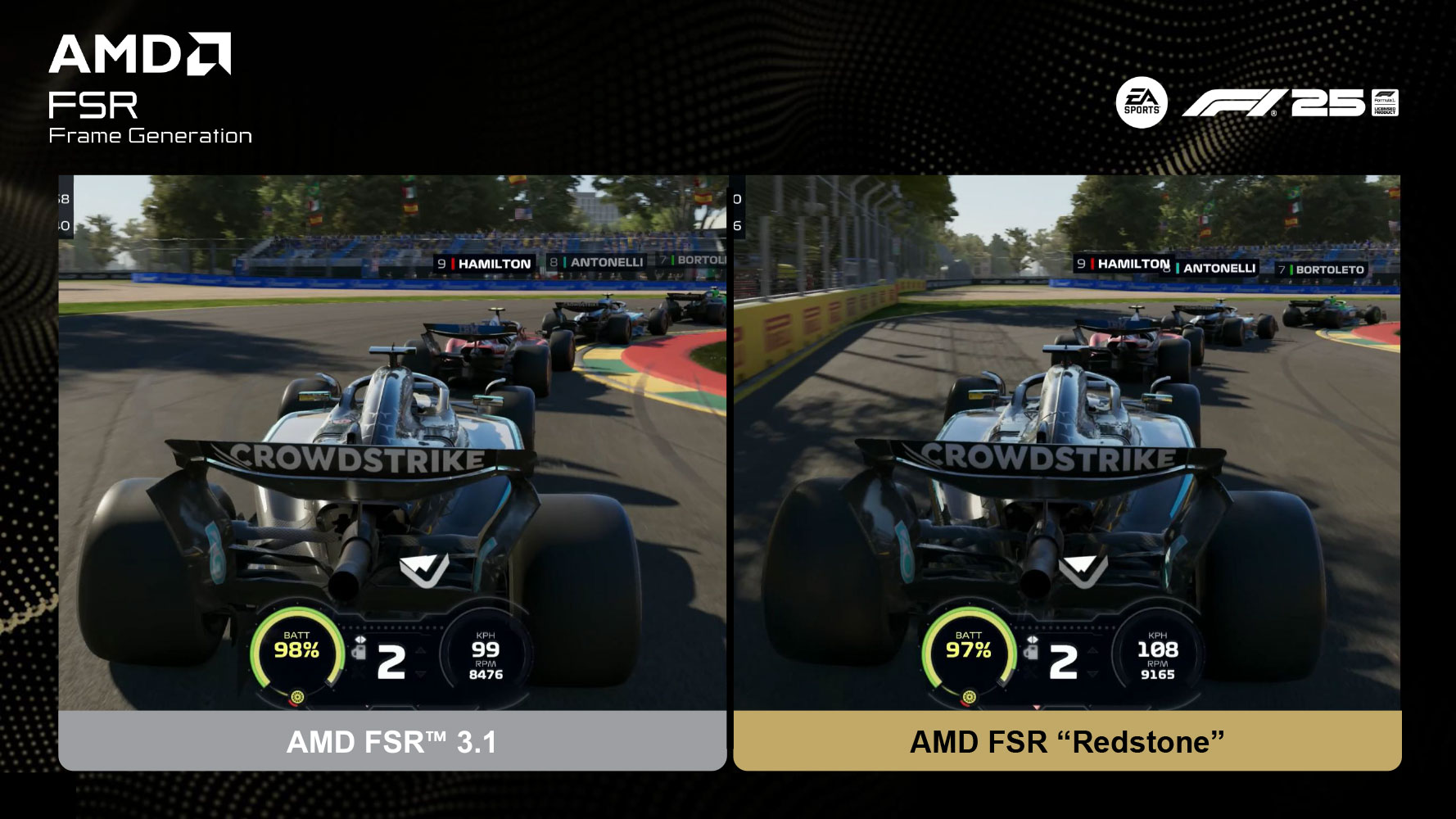
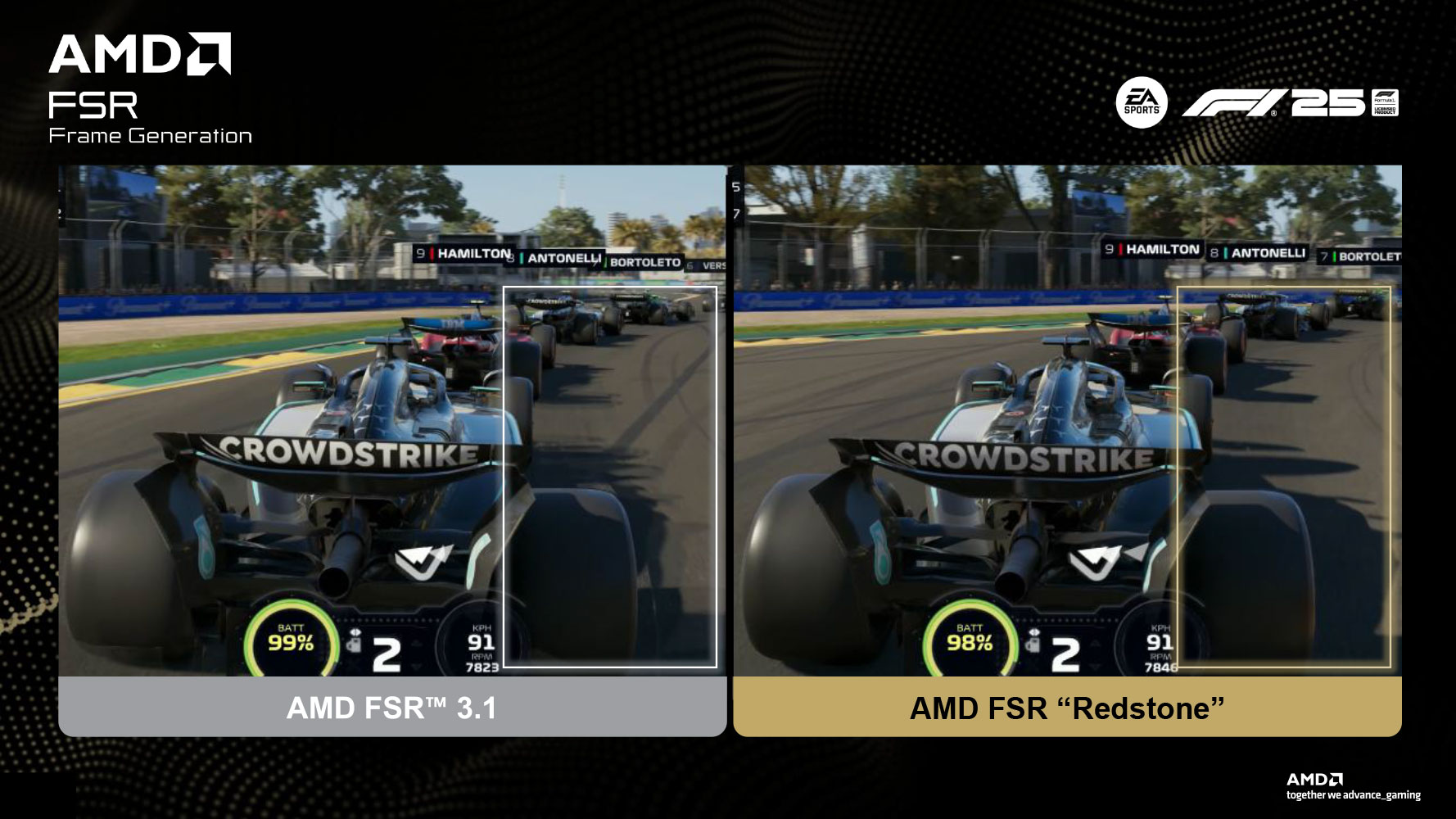
The frames generated by FSR Redstone tend to have significantly higher image quality than the interpolated frames generated in FSR 3 Frame Generation. Perhaps the best evidence of this is in the F1 25 screenshot where the shadows of the cars come out more accurately.
As we stated earlier, ML-based frame generation can either be integrated with the game and appear in the game settings, or it can be enabled through a driver-level override.
Supported Games
At this time, the following games support ML Frame Generation via driver-level override on RDNA 4 cards:- ARC Raiders
- Black Myth: Wukong
- Call of Duty: Black Ops 7
- Cash Cleaner Simulator
- Cronos: The New Dawn
- Cyberpunk 2077
- Deathground
- EXFIL
- F1 25
- Farming Simulator 25
- God of War Ragnarok
- Grand Theft Auto V Enhanced
- Hell is Us
- Hogwarts Legacy
- INDUSTRIA 2 (demo)
- Keeper
- Mafia: The Old Country
- Marvel Rivals
- No More Room in Hell 2
- Project Motor Racing
- Qanga
- Rem Survival
- Ships At Sea
- Squad
- THE FINALS
- The Last Caretaker
- The Talos Principle: Reawakened
- Titan Quest II
- Winter Survival
- Wreckfest 2
- Wuthering Waves
Nov 17th, 2026 14:35 CST
change timezone
Latest GPU Drivers
New Forum Posts
- Help with fixing Overclock (0)
- [Poll] 12V-2x6 Connector Protection: What Are You Using? (WireView / Ampinel / Equalizer / Other / Nothing) (22)
- Latest method for DTS/DDL for Logitech Z906 (0)
- What are you playing? (26232)
- Security Apps (1)
- Honestly, do you care about GTA VI? (128)
- Without Jensen, PC gaming will be (29)
- Meeting point of those who broke their GPUs. Please share what GPUs you've burned, shattered, ionized or melted accidentally. (43)
- Voltage glitch hack to unlock fuse off part of GPU core ? (2)
- 9070 GRE 3.9ghz validation reached. (14)
Popular Reviews
- Acemagic Retro X3 Review
- Corsair HX1000i Shift Crystal Review
- AMD Zen 6 Technical Deep Dive
- Upcoming Hardware Launches 2027 (Updated Nov 2026)
- ASUS ROG Strix B850-I Gaming Wi-Fi7 W Review
- Phantom Blade Zero Performance Benchmark Review - 35 GPUs Tested
- AMD Ryzen 7 9800X3D Review - The Best Gaming Processor
- Chieftec Iceberg PRO 360 DARK Review
- Montech King 95 3D PRO Review
- NZXT C1200 Platinum Review
TPU on YouTube
Controversial News Posts
- NVIDIA Co-Founder and CEO Jensen Huang Officially Resigns (455)
- Open Letter Asking NVIDIA to Reinstate Jensen Huang Passes 115,000 Signatures (184)
- OpenAI CEO Argues Home PCs Waste the World's Limited DRAM Supply (152)
- NVIDIA Launches Investigation Into Jensen Huang's Relationship With Suspected Chinese Spy (136)
- Report: Jensen Huang Eyes NVIDIA Comeback (132)
- Intel "Raptor Lake Next" 16-Core and 20-Core CPUs Surface (130)
- Legendary Game Studio BioWare Shuts Down Following EA Layoffs (104)
- Dell CEO Says the Memory Shortage Will Get Worse in 2027 (95)