 35
AMD Radeon HD 6670 1 GB Review
(35 Comments) »Introduction

Here you are, the AMD Radeon HD 6670. The new mainstream chip from AMD called "Turks" is looking to be a trusty "Jack of all trades" at a valuable market price-point. Microsoft's DirectX 11 API has once again elevated the standards of PC game graphics, but is still a new development, as DirectX 9 based self-proclaimed "Blockbuster" titles such as Crysis 2 are being released even today. In this backdrop, all of a sudden it makes sense to buy graphics cards that are under US $100, and have been moving along with market dynamics and the GPU's natural compute power growth rate.

Perhaps targeting that segment while maintaining some feature-set cushion with "100% DirectX 11 compliance," AMD is releasing its new Radeon HD 6670 graphics card. The HD 6670 is geared to be a little bit of everything, a rockstar when it comes to HD media acceleration and productive multi-display setups, but something that can smoothly run DirectX 9/10 titles at close to 1080p, and DirectX 11 at 720p. Based on the 40 nm Turks silicon, the HD 6670 features 480 stream processors, and a 128-bit wide GDDR5 memory interface, holding 1 GB of memory typically. It supports 3-display Eyefinity output, and is backed by HydraVision display head manipulation software. Let's put HD 6670 through its paces.
| Radeon HD 6450 | GeForce GT 430 | Radeon HD 5550 | Radeon HD 5570 | Radeon HD 5670 | GeForce GTS 250 | Radeon HD 6670 | GeForce GTS 450 | Radeon HD 5750 | Radeon HD 5770 | |
| Shader units | 160 | 96 | 320 | 400 | 400 | 128 | 480 | 192 | 720 | 800 |
| ROPs | 4 | 4 | 8 | 8 | 8 | 16 | 8 | 16 | 16 | 16 |
| GPU | Caicos | GF108 | Redwood | Redwood | Redwood | G92 | Turks | GF106 | Juniper | Juniper |
| Transistors | 370M | 585M | 627M | 627M | 627M | 754M | 716M | 1170M | 1040M | 1040M |
| Memory Size | 1024 MB | 1024 MB | 1024 MB | 1024 MB | 1024 MB | 1024 MB | 1024 MB | 1024 MB | 1024 MB | 1024 MB |
| Memory Bus Width | 64 bit | 128 bit | 128 bit | 128 bit | 128 bit | 256 bit | 128 bit | 128 bit | 128 bit | 128 bit |
| Core Clock | 750 MHz | 700 MHz | 550 MHz | 650 MHz | 775 MHz | 783 MHz | 800 MHz | 783 MHz | 700 MHz | 850 MHz |
| Memory Clock | 900 MHz | 900 MHz | 1000 MHz | 900 MHz | 1000 MHz | 1100 MHz | 1000 MHz | 900 MHz | 1150 MHz | 1200 MHz |
| Price | $55 | $60 | $60 | $65 | $75 | $80 | $100 | $130 | $110 | $120 |
The Card


AMD has decided to build a dual-slot low-profile design instead of the single slot full-height card that was shown in the press pictures. This has the advantage of making the card appealing to users of compact media PC systems that often do not have space for a full-height graphics card. On the other hand, really tiny media PC cases might not even have the space for a dual-slot card.

The card has one analog VGA port, one full-size HDMI port and one DVI port. AMD's display output logic is clearly superior to what NVIDIA has to offer at this time. Vendors are free to combine six TMDS links into any output configuration they want (dual-link DVI consuming two links) - and use them all at the same time. It would have been nice if AMD had used the extra space provided by the 2nd slot for some additional outputs, for example two mini DisplayPort connectors.
An HDMI sound device is also included in the GPU. The HDMI interface is HDMI 1.4a compatible which includes Dolby TrueHD, DTS-HD, AC-3, DTS and up to 7.1 channel audio with 192 kHz / 24-bit output. The new revision also brings support for Blu-ray 3D movies which will become important later this year when we will see first Blu-ray 3D titles shipping.
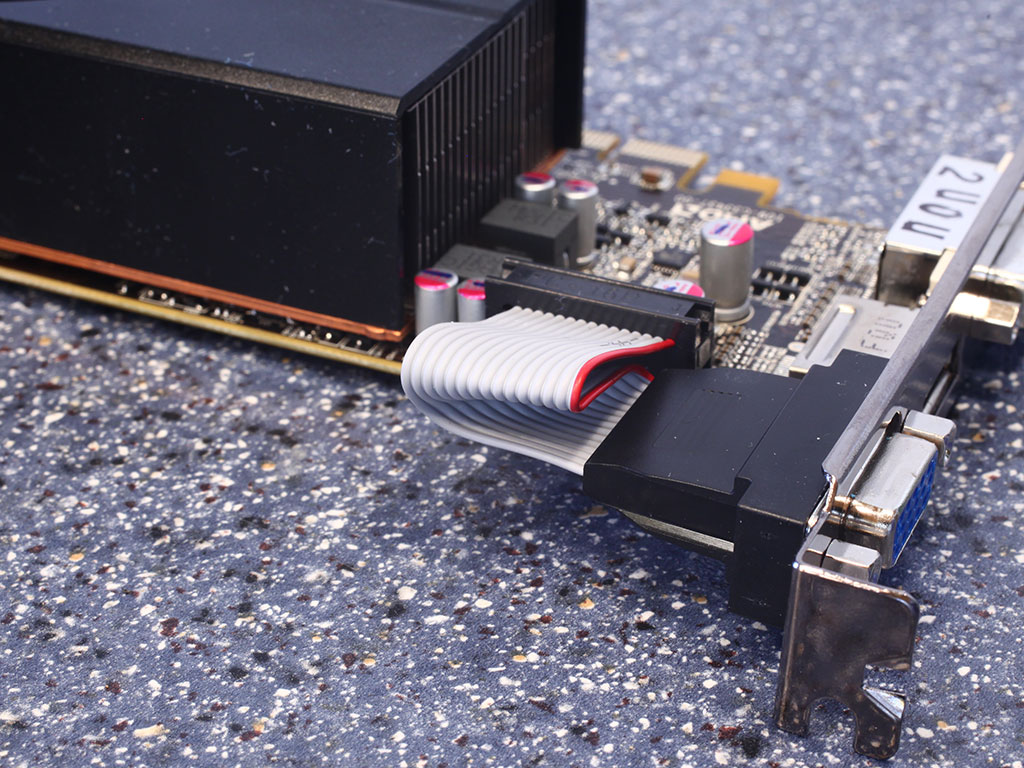
Even though a CrossFire connector is not present, you can combine two of these cards in CrossFire, which exchanges data via the PCI-Express bus.


Here are the front and the back of the card, high-res versions are also available (front, back). If you choose to use these images for voltmods etc, please include a link back to this site or let us post your article.
A Closer Look


AMD's cooler looks like a vertically stretched version of AMD's single slot cooler that we have seen on the HD 6450 for example.

Due to the low power design of the card, there is no requirement for an additional PCI-E power connector.

The GDDR5 memory chips are made by Hynix, and carry the model number H5GQ2H24MFR-T2C. They are specified to run at 1250 MHz (5000 MHz GDDR5 effective).

APW7165 is a cost effective voltage regulator that doesn't support I2C voltage control or advanced monitoring features.

AMD's Turks graphics processor is made on a 40 nm process at TSMC Taiwan. It uses approximately 716 million transistors on a die area of 118 mm².
Our Patreon Silver Supporters can read articles in single-page format.
Nov 16th, 2026 10:29 CST
change timezone
Latest GPU Drivers
New Forum Posts
- Advice for my PC upgrade (7)
- Can you guess Which game it is? (328)
- Meeting point of those who broke their GPUs. Please share what GPUs you've burned, shattered, ionized or melted accidentally. (39)
- Without Jensen, PC gaming will be (6)
- I don’t know been building “by hand” for years and we at the point where “Server Quality” is mentioned, is this the future of it or will it continue? (39)
- Honestly, do you care about GTA VI? (63)
- Warning for Windows 10 and 11 users running newer AMD GPU drivers (61)
- What storage medium you lost the most data thus far from failure? HDD/SSD Flash, etc (54)
- How much does an RTX 5090 cost in your area? (64)
- need an ide to sata adapter that lets me burn cds on an ide cdrw drive (that doesn't power down while burning or copying) (55)
Popular Reviews
- ASUS ROG Strix B850-I Gaming Wi-Fi7 W Review
- Corsair HX1000i Shift Crystal Review
- AMD Zen 6 Technical Deep Dive
- Upcoming Hardware Launches 2027 (Updated Nov 2026)
- Acemagic Retro X3 Review
- Montech King 95 3D PRO Review
- NZXT C1200 Platinum Review
- Phantom Blade Zero Performance Benchmark Review - 35 GPUs Tested
- AMD Ryzen 7 9800X3D Review - The Best Gaming Processor
- NZXT H7 RGB+ Review
TPU on YouTube
Controversial News Posts
- NVIDIA Co-Founder and CEO Jensen Huang Officially Resigns (431)
- Open Letter Asking NVIDIA to Reinstate Jensen Huang Passes 115,000 Signatures (184)
- OpenAI CEO Argues Home PCs Waste the World's Limited DRAM Supply (152)
- NVIDIA Launches Investigation Into Jensen Huang's Relationship With Suspected Chinese Spy (136)
- Intel "Raptor Lake Next" 16-Core and 20-Core CPUs Surface (130)
- Legendary Game Studio BioWare Shuts Down Following EA Layoffs (104)
- Dell CEO Says the Memory Shortage Will Get Worse in 2027 (95)
- Report: Jensen Huang Eyes NVIDIA Comeback (89)