 50
AMD Radeon HD 7950 3 GB Review
(50 Comments) »Introduction

The cash-cow of AMD's 28 nanometer "Tahiti" silicon is finally here, as the company launched its new Radeon HD 7950 graphics card. The HD 7950 is an important model for AMD, as it allows more people access to the new Graphics CoreNext architecture as a result of its lower price. The new SKU was originally slated for a January 09, 2012 launch, but was faced with unforeseen delays. Regardless, today is its hard-launch date, meaning you should be able to find a Radeon HD 7950 at a store.
The Radeon HD 7950 qualifies as being a high-end graphics card due to its pricing, which is comparative to NVIDIA's GeForce GTX 580 with its current market pricing. AMD is aiming at higher energy efficiency compared to its market rival product, and a scope for aggressive cost-cutting, if competition from future NVIDIA product so dictate. In essence, AMD Radeon HD 7950 will serve as a fulcrum for both today's high-end price-point, and tomorrow's gamer sweet-spot, again, depending on its competitive environment. This is what makes it an important model for AMD.

The Radeon HD 7950 is carved out of the 28 nm "Tahiti" silicon, on which the HD 7970 is based. This is done so by lowering the number of Graphics CoreNext Compute Units (CUs) from 32 on the HD 7970 to 28, resulting in a stream processor count of 1,792 compared to 2,048 on the Radeon HD 7970, and a TMU count lowered from 128 to 112. Every other component is left unchanged, including the memory interface and memory amount. Historically, with NVIDIA GPUs that have 384-bit wide memory interfaces, we have seen the second-best SKU having a narrower memory bus (such as 320-bit wide, for example). This is not the case with HD 7950, which has the full 384-bit wide memory interface with 3 GB of GDDR5 memory.
We also have the following reviews for you today:
- PowerColor Radeon HD 7950 PCS+ Review (custom cooler & overclocked)
- AMD Radeon HD 7950 CrossFire Review (two cards in CrossFire)

The HD 7950, hence, features 1,792 GCN stream processors, 112 TMUs, 32 ROPs, and a 384-bit wide GDDR5 memory interface, holding 3 GB of memory. The clock speeds are slightly lowered compared to the HD 7970, the core is clocked at 800 MHz, and memory at 1,250 MHz (5.00 GHz GDDR5 effective), churning out 240 GB/s of memory bandwidth. In this review, we're testing AMD's reference design HD 7950 graphics card, which is similar in design to the HD 7970, except it has a lighter VRM, and draws power from two 6-pin PCIe power connectors instead of the 6+8 pin layout on the HD 7970.
| GeForce GTX 570 | Radeon HD 6970 | GeForce GTX 580 | Radeon HD 7950 | Radeon HD 7970 | Radeon HD 6990 | GeForce GTX 590 | |
|---|---|---|---|---|---|---|---|
| Shader Units | 480 | 1536 | 512 | 1792 | 2048 | 2x 1536 | 2x 512 |
| ROPs | 40 | 32 | 48 | 32 | 32 | 2x 32 | 2x 48 |
| Graphics Processor | GF110 | Cayman | GF110 | Tahiti | Tahiti | 2x Cayman | 2x GF110 |
| Transistors | 3000M | 2640M | 3000M | 4310M | 4310M | 2x 2640M | 2x 3000M |
| Memory Size | 1280 MB | 2048 MB | 1536 MB | 3072 MB | 3072 MB | 2x 2048 MB | 2x 1536 MB |
| Memory Bus Width | 320 bit | 256 bit | 384 bit | 384 bit | 384 bit | 2x 256 bit | 2x 384 bit |
| Core Clock | 732 MHz | 880 MHz | 772 MHz | 800 MHz | 925 MHz | 830 MHz | 607 MHz |
| Memory Clock | 950 MHz | 1375 MHz | 1002 MHz | 1250 MHz | 1375 MHz | 1250 MHz | 855 MHz |
| Price | $330 | $340 | $500 | $449 | $549 | $700 | $750 |
Packaging & Contents
We received a card only from AMD, without packaging but rest assured, the retail units will come with standard accessories like adapters and power cables.With the Radeon HD 7950 AMD requires all partners to bundle an HDMI to (single link) DVI adapter, so that you can use the card with two DVI monitors.
The Card


AMD's HD 7950 looks exactly the same as its big brother, the HD 7970. The length of the card is 27.5 cm, which is the same as the HD 6970, for example.

The card requires two slots in your system.

Display connectivity options include one DVI port, one full size HDMI port and two mini-DisplayPorts. You may use all the outputs at the same time, thanks to AMD's superior display output architecture.
Please note that all the connectors are on the "first" slot now, which opens up the second one for a cooler grill through which hot air is blown out of the case. This also makes it possible to use the HD 7950 in a single slot configuration with a waterblock to cool the components.
An HDMI sound device is included in the GPU, too. It is HDMI 1.4a compatible which includes HD audio and support for Blu-ray 3D movies. The DisplayPort outputs are version 1.2 which enables the use of hubs and Multi-Stream transport.

You may combine up to four HD 7950 and HD 7970 cards from any vendor in a multi-GPU CrossFire configuration for higher framerates or better image quality settings.


Pictured above are photos of the front and back, showing the disassembled board. High-res versions are also available (front, back). If you choose to use these images for voltmods etc, please include a link back to this site or let us post your article.
A Closer Look


AMD's fansink uses a large area vapor chamber cooler to keep the GPU cool. You can also see the thermal pads for twelve memory chips and the VRM circuitry.

The card requires two 6-pin PCI-Express power cables for operation. This power configuration is good for up to 225 W of power draw.
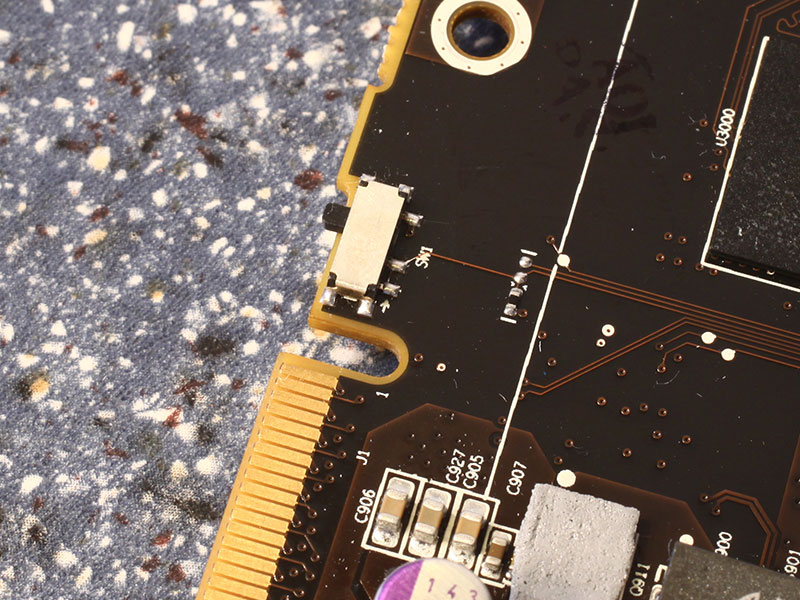
The HD 7950 comes with AMD's dual BIOS feature that was introduced with the HD 6900 Series. It provides a safety net in case a BIOS flash goes wrong; simply switch to the second BIOS and flash back to the original BIOS.
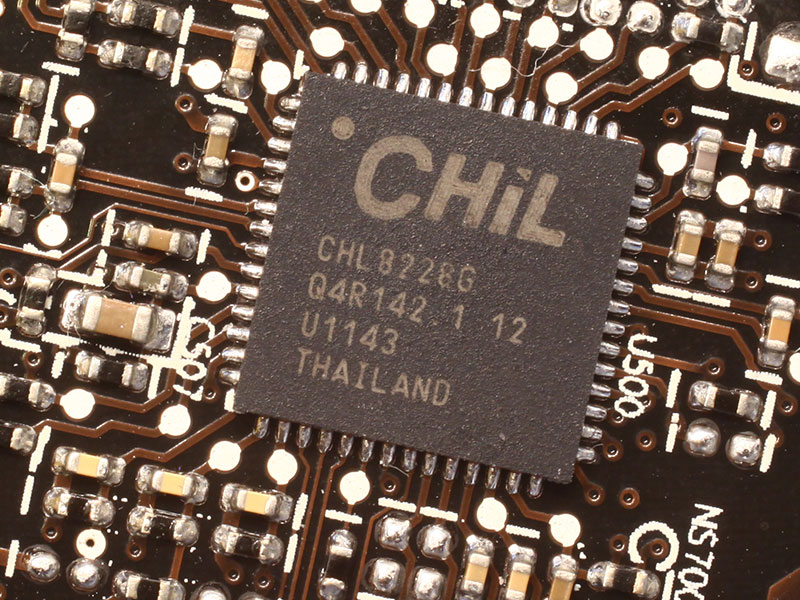
For voltage control the card uses the CHiL CHL8228 chip, it is already well supported by overclocking software, as it is the same component as on the HD 7970.

The GDDR5 memory chips are made by Hynix, and carry the model number H5GQ2H24MFR-T2C. They are specified to run at 1250 MHz (5000 MHz GDDR5 effective).

AMD's new Tahiti graphics processor introduces a new shader architecture, it is also the first GPU to be produced on a 28 nm process at TSMC. The transistor count is 4.31 billion.
Please note the shiny metal shim around the GPU core, which is part of the GPU and prevents the crushing or chipping of the die during assembly. The GPU's model number is printed on the bottom right of the shim instead of on the die itself.
Our Patreon Silver Supporters can read articles in single-page format.
Nov 13th, 2026 06:54 PST
change timezone
Latest GPU Drivers
New Forum Posts
- Microsoft Exchange/365 outages? (34)
- I won't download games that are larger than 30–40 GB. (106)
- Any other old-timers here planning to play WoW Forever? (150)
- Requesting original VBIOS for Gigabyte RX 5700 XT GAMING OC 8G Rev 2.0 (Micron) (0)
- To AiO CPU Cooler users? (0)
- Home page search by category (6)
- Windows 11 General Discussion (7727)
- Slow SSD read speeds - help! (1)
- Warning for Windows 10 and 11 users running newer AMD GPU drivers (58)
- TPU's Nostalgic Hardware Club (22150)
Popular Reviews
- AMD Zen 6 Technical Deep Dive
- Corsair HX1000i Shift Crystal Review
- NZXT C1200 Platinum Review
- Upcoming Hardware Launches 2027 (Updated Nov 2026)
- Montech King 95 3D PRO Review
- NZXT H7 RGB+ Review
- NZXT H5 Review
- Phantom Blade Zero Performance Benchmark Review - 35 GPUs Tested
- XPG NIMBUS PLUS Review - Mid-range Chair With Strong Competitors
- Gigabyte Z890I Aorus Ultra Review
TPU on YouTube
Controversial News Posts
- NVIDIA Co-Founder and CEO Jensen Huang Officially Resigns (350)
- OpenAI CEO Argues Home PCs Waste the World's Limited DRAM Supply (152)
- NVIDIA Launches Investigation Into Jensen Huang's Relationship With Suspected Chinese Spy (136)
- Intel "Raptor Lake Next" 16-Core and 20-Core CPUs Surface (130)
- Legendary Game Studio BioWare Shuts Down Following EA Layoffs (104)
- Dell CEO Says the Memory Shortage Will Get Worse in 2027 (95)
- NVIDIA GeForce RTX 50-Series Scheduled for up to $500 Price Hike This Week (89)
- Modder Fits RTX 5090 With Four 8-Pin Connectors, Halving Current per Wire (80)