 121
AMD "Navi 31" Radeon RX 7900 XTX and XT Unboxing
(121 Comments) »Introduction

Team Red knocked on our doors with the new AMD Radeon RX 7900 XTX and Radeon RX 7900 XT graphics cards, upon which ride the company's hopes to maintain competitiveness with NVIDIA in the high-end PC graphics segment. AMD claims that these have what it take to firmly offer a great alternative, and the new cards will be able to power 4K Ultra HD maxed-out gaming, much like NVIDIA's GeForce RTX 4080 and RTX 4090 do, but AMD will offer this capability at a much lower price. We can't wait to tell you how fast these are, but you'll have to wait for our full performance review, in which we'll give you a technical breakdown of the new RDNA 3 graphics architecture, and the two cards. Today we're allowed to show you the boxes these cards came in, and what these cards look like in the flesh. You will be able to purchase these cards on December 13th.

AMD has a more traditional approach to reference-design graphics cards than NVIDIA. Team Green technically does not sell its reference-design graphics cards anymore, and those are handed out to OEMs as engineering samples that they can use as templates. The Founders Edition cards are not reference-design, but rather a first-party custom-design by NVIDIA engineers, which the company sells exclusively under the NVIDIA brand (partners aren't allowed to sell them with their branding). AMD, on the other hand, never changed its reference-design marketing model. The cards you see in this article are reference-design by the classical definition of the term, and what the company likes to call "made by AMD" (MBA).
AMD sells these cards both directly under its own brand on the AMD website, and through its AIB (add-in board) partners. These AIBs basically take MBA cards out of a tray and place them in retail packaging of their own design, with their own branding, and with inclusions specific to the brand. Also, the tech-support and product warranty service of AIB-branded MBA cards are handled by the AIBs themselves (which for example means that a GIGABYTE-branded MBA card can give you an extended warranty with online-registration that the company is known for). The boxes you see in this article are from the MBA cards that AMD will directly retail on its website.
The RDNA 2-based Radeon RX 6000-series marked AMD's return to the high-end segment after a very long time (about seven years, when many lost all hope of an AMD comeback to this segment ever again). The higher-end RX 6000 series had scope for improvements with the SKU naming. The card that maxed out the "Navi 21" silicon was branded RX 6900 XT, while a slightly cut-down version of it was called the RX 6800 XT, and a third, further cut-down SKU was sold as the RX 6800, with thinner margins. This time, the company makes it easier to identify its two fastest SKUs, by branding the one that maxes out the "Navi 31" GPU as the RX 7900 XTX, and its slightly cut-down sibling as the RX 7900 XT, marking the return of the "XTX" brand-extension after about 16 years.
You'll get a detailed technical breakdown of RDNA 3 in our main reviews, but put briefly, this generation heralds the chiplet architecture for consumer GPUs in the same way as AMD did for CPUs, with the Ryzen 3000 "Zen 2." The key number-crunching components of the GPU are built on the advanced 5 nm EUV silicon fabrication process, while the components that don't benefit greatly from the node switch, are built on the older 6 nm node, as chiplets. AMD has generationally increased the shader counts and their IPC, making them much more capable, improved the ray tracing machinery, added AI accelerators not unlike NVIDIA's Tensor cores, and most importantly, widened the memory bus to 384-bit, enabling memory sizes of up to 24 GB. It all comes together in two slick reference designs which we'll talk a little more about in this article.
Radeon RX 7900 XTX Reference Design Unboxing


The AMD Radeon RX 7900 XTX RDNA 3 retail box looks awesome and is practical, made of hard cardboard, with a clamshell opening mechanism. As you open it, you're greeted by a message on the top half that reads "Welcome to the Red Team," and the card itself in the lower half, and that's basically it, in the box—no cables or adapters. To be clear, this package will be available in the retail channel, through the AMD website, as a directly-branded product, and the package isn't some fancy media kit that's exclusive to the press.


The Radeon RX 7900 series reference designs are an evolution on the RX 6900 series. The two-tone silver+black makes way for a mostly-black scheme with some gunmetal accents. The cooler shroud and backplate are made entirely of a die-cast aluminium alloy, and have a solid premium feel. While the looks and aesthetics may be subjective, the build-quality of these cards are right in the league of NVIDIA's Founders Edition cards.


The 3-quarter angle shots show you the design changes of the RX 7900 XTX over the RX 6900 XT—a curvy design that maximizes the volume of the heatsink inside the cooling solution, replacing the boxy, inward-sloping design of the RX 6900 XT. The heatsink appears bulging out, and is definitely larger in surface area than the its predecessor's. Besides gunmetal, there are subtle red bits across the card. Three of the fins of the fin-stack heatsink are painted red to denote this card being the 3rd generation of the RDNA graphics architecture (RDNA 3).


The embossed Radeon logo on the rear I/O shield makes way for a spot for regulatory markings, which we feel is nicely done. You're not going to crane your neck behind your case all that often, and you'd rather not have ugly regulatory stickers on the visible parts of your card. The tail-end has mounting holes for workstation chassis retention braces.
AMD cannot stop talk about beating NVIDIA to DisplayPort 2.1, an advanced new connector that enables much higher resolutions and refresh rates through a single cable than DisplayPort 1.4, which the competing GeForce RTX 40-series GPUs use. The reference design RX 7900 XTX provides two standard-size DisplayPort 2.1 connectors, one HDMI 2.1a, and a USB type-C port with DisplayPort 2.1 passthrough.
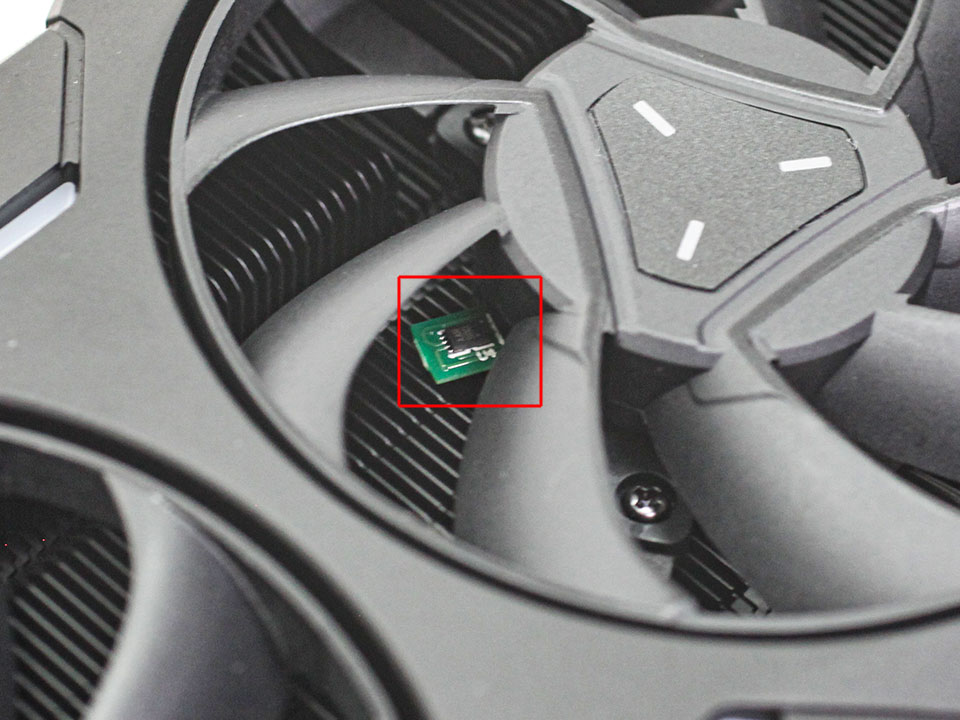
An interesting new feature being introduced with this card is air intake temperature measurement. This lets the card report the temperature of the air as it is being drawn into the card from the fans, before it comes in contact with the heatsink, to the software. At the hardware level, this is just a thermal diode that sticks out from behind the fan hub of one of the three fans (the one at the tail-end). This little stub is barely visible unless you look closely. Only the XTX has this feature, the XT does not have the intake temperature sensor.


Perhaps the most striking aspect of the Radeon RX 7900 series is the lower typical board power compared to their NVIDIA rivals. While the RTX 4080 uses a 450 W-rated 16-pin 12VHPWR connector, the RTX 4090 uses a 600 W-rated version of this connector, and both the Founders Edition and custom-design cards include an adapter that converts 8-pin PCIe power connectors into a 16-pin 12VHPWR (3x 8-pin for the RTX 4080 and 4x 8-pin for the RTX 4090). There has been some controversy over the reliability of these power adapters, and AMD seems to be cashing in on some of it. Both the Radeon RX 7900 XTX and RX 7900 XT reference designs come with just two 8-pin PCIe power connectors, with standard connectors right on the card—no adapters. This power configuration is rated for 375 W (connectors + slot-power). The RX 7900 XTX has a board power rating of 350 W, which should fit within these specs. Much like NVIDIA "Ada," AMD RDNA 3 sticks to PCI-Express 4.0 x16 as the host interface, despite both Intel and AMD having desktop platforms with PCIe Gen 5 now.
Radeon RX 7900 XT Unboxing


The AMD Radeon RX 7900 XT retail package is similar in design to the RX 7900 XTX. You get the same sober-looking, dark hard cardboard box with the same greeting inside.


The RX 7900 XT looks very similar to the RX 7900 XTX, but is physically smaller. The design language is the same, but due to the reduced length and height, some bits have been compacted.


The cooler shroud and backplate are made of the same premium die-cast aluminium material as the RX 7900 XTX, but the heatsink is lighter and doesn't appear bulging outward from the shroud. It still has that nice touch with the three red fins (denoting RDNA 3).


The display output configuration is identical to that of the RX 7900 XTX—two standard size DisplayPort 2.1, one HDMI 2.1b, and a USB-C with DisplayPort 2.1 passthrough.

The power input configuration of the RX 7900 XT is the same as the RX 7900 XTX reference, with two 8-pin PCIe power connectors, which is good for 375 W (including slot power). The typical board power of the RX 7900 XT is rated at 315 W, so these are plenty.
Our Patreon Silver Supporters can read articles in single-page format.
Nov 12th, 2026 06:12 PST
change timezone
New Forum Posts
- budget home NAS – X79, X99 or another platform? (137)
- Hey all my intro & love for retro computers (102)
- TPU's Nostalgic Hardware Club (22147)
- What are you playing? (26207)
- So I fixed the r36s “k36” variant and clone with an Onn 128gb sd card and the Onn sd card reader and it BOOTED..so real neat! Take a look. (2)
- When you could finally run Crysis maxed out? (49)
- Gacha Games - Discussions, Pulls, Updates, etc. (1152)
- Unallocated space in ssd , is it normal? (12)
- Home page search by category (4)
- Browser Bechmark scores (131)
Popular Reviews
- AMD Zen 6 Technical Deep Dive
- Upcoming Hardware Launches 2027 (Updated Nov 2026)
- NZXT C1200 Platinum Review
- XPG NIMBUS PLUS Review - Mid-range Chair With Strong Competitors
- NZXT H7 RGB+ Review
- Montech King 95 3D PRO Review
- NZXT H5 Review
- Phantom Blade Zero Performance Benchmark Review - 35 GPUs Tested
- Gigabyte Z890I Aorus Ultra Review
- INNOCN 45C1R Review - Two QHD Screens, Zero Bezels
TPU on YouTube
Controversial News Posts
- OpenAI CEO Argues Home PCs Waste the World's Limited DRAM Supply (152)
- NVIDIA Launches Investigation Into Jensen Huang's Relationship With Suspected Chinese Spy (136)
- Intel "Raptor Lake Next" 16-Core and 20-Core CPUs Surface (130)
- Legendary Game Studio BioWare Shuts Down Following EA Layoffs (104)
- Dell CEO Says the Memory Shortage Will Get Worse in 2027 (95)
- NVIDIA GeForce RTX 50-Series Scheduled for up to $500 Price Hike This Week (89)
- AMD Radeon Owners Can Now Run Nearly Every DLSS Feature Through Fan-Made Mod (80)
- Modder Fits RTX 5090 With Four 8-Pin Connectors, Halving Current per Wire (80)