 59
AMD Radeon R9 290X CrossFire Review
(59 Comments) »Introduction

A part of what makes the Radeon R9 290X an exciting option at its price is that two of them only cost 10% more than a single GeForce GTX TITAN. If you don't already know what kind of performance is on offer at $549, check out our comprehensive review of the Radeon R9 290X.
AMD is already talking a lot about how the R9 290X is ready to deal with the new generation of 4K Ultra HD monitors, which beam out 3840x2160 pixels (about 8.2 million pixels). We've been testing 5760x1080 (about 6.2 million pixels) for a while now and are fairly confident that the current generation of high-end graphics cards shouldn't make games seem like slide-shows at Ultra HD. Two of them in multi-GPU configurations stand an even better chance.
In this review, we put CrossFireX configurations with two Radeon R9 290X graphics cards to the test. Since the R9 290X comes with two BIOS modes, "Uber" (high-performance) and "Quiet," we treated CrossFireX configurations with cards running the two as distinct data points. You'll find the "R9 290X CrossFire Uber", with both cards running the "Uber" BIOS, and "R9 290X CrossFire Quiet", with both cards running the "Quiet" BIOS, pitted against a single R9 290X and other high-end graphics solutions. A hybrid configuration of "Uber" and "Quiet" R9 290X is possible, although we found it to perform too inconsistently to include in the review.
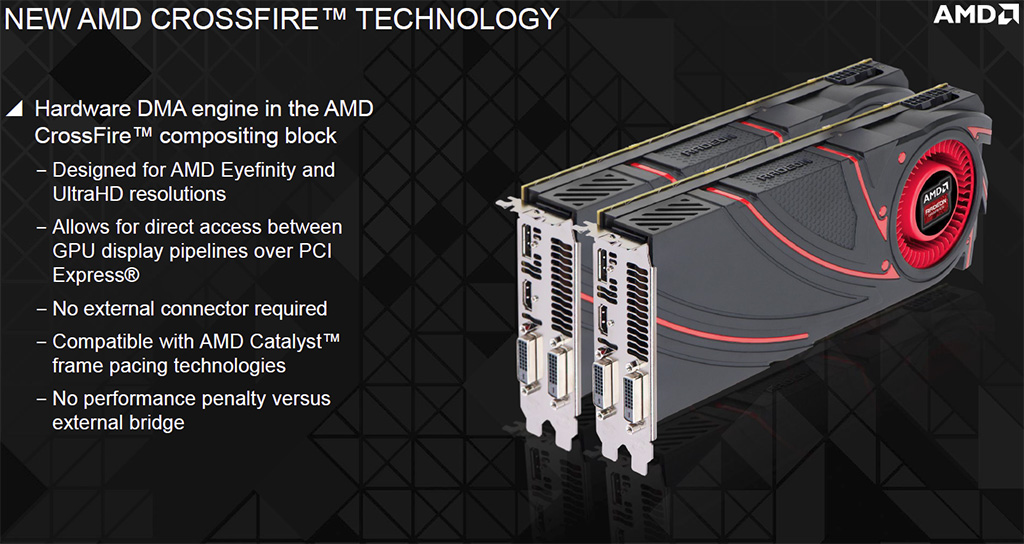
The Radeon R9 290X is the first high-end graphics card from AMD since the introduction of CrossFire that lacks a physical interconnect between cards participating in a multi-GPU setup. Even the very first Radeon X1900 XT cards relied on a cable to pass CrossFire data between cards. The R9 290X relies on the PCI-Express bus to relay CrossFire data between other cards in the CrossFire setup—no CrossFire fingers or CFBI ribbon cables run between the cards themselves. AMD assured us that such a setup doesn't affect performance or frame-latency, stating that it is in fact better suited to high-resolution display heads, such as 4K Ultra HD. We began the test by slipping into more summery clothes.
Test System
| Test System - VGA Rev. 30 | |
|---|---|
| Processor: | Intel Core i7-4770K @ 4.2 GHz (Haswell, 8192 KB Cache) |
| Motherboard: | ASUS Maximus VI Hero Intel Z87 |
| Memory: | 2x 4096 MB Corsair Vengeance PC3-12800 DDR3 @ 1600 MHz 9-9-9-24 |
| Harddisk: | WD Caviar Blue WD5000AAKS 500 GB |
| Power Supply: | Antec HCP-1200 1200W |
| Software: | Windows 7 64-bit Service Pack 1 |
| Drivers: | NVIDIA: 327.23 WHQL AMD: Catalyst 13.9 WHQL AMD R7/R9 Series: Catalyst 13.11 Beta |
| Display: | LG Flatron W3000H 30" 2560x1600 3x Hanns.G HL225DBB 21.5" 1920x1080 |
- All video card results were obtained on this exact system with exactly the same configuration.
- All games were set to their highest quality setting unless indicated otherwise.
- AA and AF are applied via in-game settings, not via the driver's control panel.
- 1600 x 900, 4x Anti-aliasing. Common resolution for most smaller flatscreens and laptops today (17" - 19").
- 1920 x 1080, 4x Anti-aliasing. Most common widescreen resolution for larger displays (22" - 26").
- 2560 x 1600, 4x Anti-aliasing. Highest possible resolution for commonly available displays (30").
- 5760 x 1080, 4x Anti-aliasing. Typical EyeFinity/Surround multi-monitor gaming setup using affordable 1080p displays.
"Uber" refers to the Uber BIOS setting of the R9 290X (BIOS switch in right position).
Assassin's Creed 3

Assassin's Creed III, published in 2012, sees series protagonist Desmond Miles relive the memories of his 18th century ancestor Ratonhnhaké:ton (aka. Connor), giving you an experience many fans craved: that of an assassin in colonial America during the American Revolution.
Based on a rehashed AnvilNext game engine using DirectX 11 and Havok CPU physics, Assassin's Creed III is the most graphics-intensive member of the franchise, depicting North American landscapes in great detail.


Our Patreon Silver Supporters can read articles in single-page format.
Nov 13th, 2026 22:44 CST
change timezone
Latest GPU Drivers
New Forum Posts
- no "PhysX" workable (9)
- What are you playing? (26215)
- Tell me about your favourite graphics card (32)
- AI generated images... (224)
- Crimson Desert (31)
- RenoDX HDR - how to view the differnce Before&After in game? (0)
- Displayport DP80 3M (10ft) cable that can achieve 80gbps stable? (5)
- I'll flash a ASUS ROG Strix RX480 O8G in Cause of Code 43, as a Newbie (1)
- Opinion on Monitor Replacement (6)
- TMOG - post your benchmark results here (16)
Popular Reviews
- AMD Zen 6 Technical Deep Dive
- Corsair HX1000i Shift Crystal Review
- NZXT C1200 Platinum Review
- Upcoming Hardware Launches 2027 (Updated Nov 2026)
- ASUS ROG Strix B850-I Gaming Wi-Fi7 W Review
- Montech King 95 3D PRO Review
- NZXT H7 RGB+ Review
- NZXT H5 Review
- Phantom Blade Zero Performance Benchmark Review - 35 GPUs Tested
- XPG NIMBUS PLUS Review - Mid-range Chair With Strong Competitors
TPU on YouTube
Controversial News Posts
- NVIDIA Co-Founder and CEO Jensen Huang Officially Resigns (379)
- OpenAI CEO Argues Home PCs Waste the World's Limited DRAM Supply (152)
- NVIDIA Launches Investigation Into Jensen Huang's Relationship With Suspected Chinese Spy (136)
- Intel "Raptor Lake Next" 16-Core and 20-Core CPUs Surface (130)
- Legendary Game Studio BioWare Shuts Down Following EA Layoffs (104)
- Dell CEO Says the Memory Shortage Will Get Worse in 2027 (95)
- NVIDIA GeForce RTX 50-Series Scheduled for up to $500 Price Hike This Week (89)
- Modder Fits RTX 5090 With Four 8-Pin Connectors, Halving Current per Wire (80)