 76
AMD Radeon RX 6800 and RX 6800 XT Unboxing
(76 Comments) »Introduction

In the run up to our comprehensive Radeon RX 6800 XT and RX 6800 "Big Navi" RDNA 2 reviews, we have a picture unboxing article for you. It is becoming a bit of a tradition for NVIDIA and AMD to allow the press to do unboxing articles in the days leading up to the main review. Not that we don't welcome it; however, unlike NVIDIA, which directly sells its Founders Edition cards on the GeForce website, AMD's reference design cards (pictured in this article) are sold through its add-in-board partners, alongside their custom-design graphics cards. The reference design (made by AMD) package you see in this review will be extremely rare in the retail channel, though the exact same card will be sold under various labels. Since this is going to be a double launch from AMD, with the Radeon RX 6800 XT and Radeon RX 6800 coming out on the same day, we have unboxings of both cards in this article.

Both the Radeon RX 6800 XT and RX 6800 come in premium-looking paperboard boxes that have a matte finish. The logos are finished off in chrome, and you'll see a large glamour shot of the respective card on the front. Chrome is a recurring theme with not just the box but also the card underneath, as it denotes accurate reflections from the real-time raytracing technology the card ships with. Unlike the NVIDIA Founders Edition boxes, which ship in a fancy clam-shell design, the RX 6800 XT and RX 6800 ship in two different box designs, as the cards are of different dimensions. The RX 6800 box is conventional thin paperboard and opens sideways, while the RX 6800 XT features a blow-out box made of thicker cardboard, essentially similar to the boxes some motherboards ship in.

Over the following pages, we will unbox both cards and give you our first visual impressions of these. At this point, we cannot show you pictures of the internals, nor can we share any performance numbers. You'll have to wait for our comprehensive reviews which go live in the coming days.
Unboxing the Radeon RX 6800 XT


As we mentioned earlier, the Radeon RX 6800 XT ships in a more upscale box made out of thicker paperboard with a matte finish and embossing for the images and logos. To begin opening it, turn the box around and cut out the factory seal tape holding the top lid in place.


Once you cut through the tape, the top lid comes off. The inner side of the lid holds a greeting, welcoming you to the red team. With RDNA 2 purported by AMD to restore competitiveness with NVIDIA's high-end, the RX 6800 series could be the first AMD Radeon card for many from this generation. Besides this message, you're greeted with another inner lid that's essentially identical to the face of the box, but it lists the four key features of this generation. Interestingly, AMD chose not to scream "raytracing" here.


This inner lid flips around to reveal the "accessory package," which doubles up as a top cushion for the card. On the other side is what you're paying $649 for—the Radeon RX 6800 XT graphics card seated snug in Styrofoam cushioning.


Besides the card, you only get a fold-out quick start guide. There are absolutely no hard accessories—no dongles, power adapters, driver disks, nothing. We peeled the lid a little to reveal a bit of hidden print that reads "ARES High." While this could be their internal codename of the RX 6800 XT for the company manufacturing the MBA (made by AMD) reference design cards, it could also just be a name for this packaging design variant.


The Radeon RX 6800 XT and RX 6800 are physically different cards—not just in design, like the RX 5700 XT and RX 5700 reference, but also in size. The RX 6800 XT is the thicker card of the two and easily distinguished from the RX 6800, although both cards are based on essentially the same design scheme. The RX 6800 XT is a significant step up in industrial design and build quality from past generations of reference design AMD Radeon cards. Other than the fans and power inputs, there's not a single plastic surface to touch. The cooler shroud seamlessly fuses with the backplate in one continuous silver-metallic shape with red accents. The top of the shroud has contrasting matte black metal bits with a few chrome accents between the fan intakes.
For both the RX 6800 XT and RX 6800 reference design cards, AMD has ditched the lateral blower design of the previous generation in favor of a triple-fan axial airflow design which sees three large 80 mm fans blow air onto a dense aluminium fin-stack heatsink. The fins are arranged such that all hot exhaust is put out through the top and bottom of the cards, nothing goes out laterally. This isn't AMD's first lateral blower reference design—the first AMD Radeon to ship with such a cooler was the Radeon VII.


Since AMD has used a purely lateral airflow heatsink, none of the air leaves through the rear I/O bracket, which is sealed much like the Radeon R9 Fury X. Display connectors include two standard DisplayPorts, one HDMI, and a USB type-C port. Given the rest of the bracket is made out of metal, we feel like this is a missed opportunity to add another row of ports, at least another DisplayPort. The RX 6800 has the same set of display connectors.

The card draws power from two 8-pin PCIe power connectors situated towards the tail end of the card—right where you'd want them.


As it's about 2.5 slots thick, the RX 6800 XT is visually bulkier than the RX 6800. The heatsink underneath is thicker to cope with the higher typical board power of this SKU.


Here's a refresher of the product specifications for the Radeon RX 6800 XT AMD put out. The RX 6800 XT almost maxes out the 7 nm "Big Navi" silicon by enabling 72 out of 80 RDNA 2 compute units, backing it with up to 2.20 GHz boost clock speeds. The card offers 16 GB of GDDR6 memory that is cushioned by AMD's on-die Infinity Cache. These come with the 300 W typical board power metric, which warrants the thicker cooler for this card in comparison to the RX 6800. AMD in its announcement presentation also claimed that the RX 6800 XT performs competitively with the GeForce RTX 3080, marking AMD's return to the high-end considering NVIDIA markets the RTX 3080 as its "flagship" product.
Radeon RX 6800 Unboxing
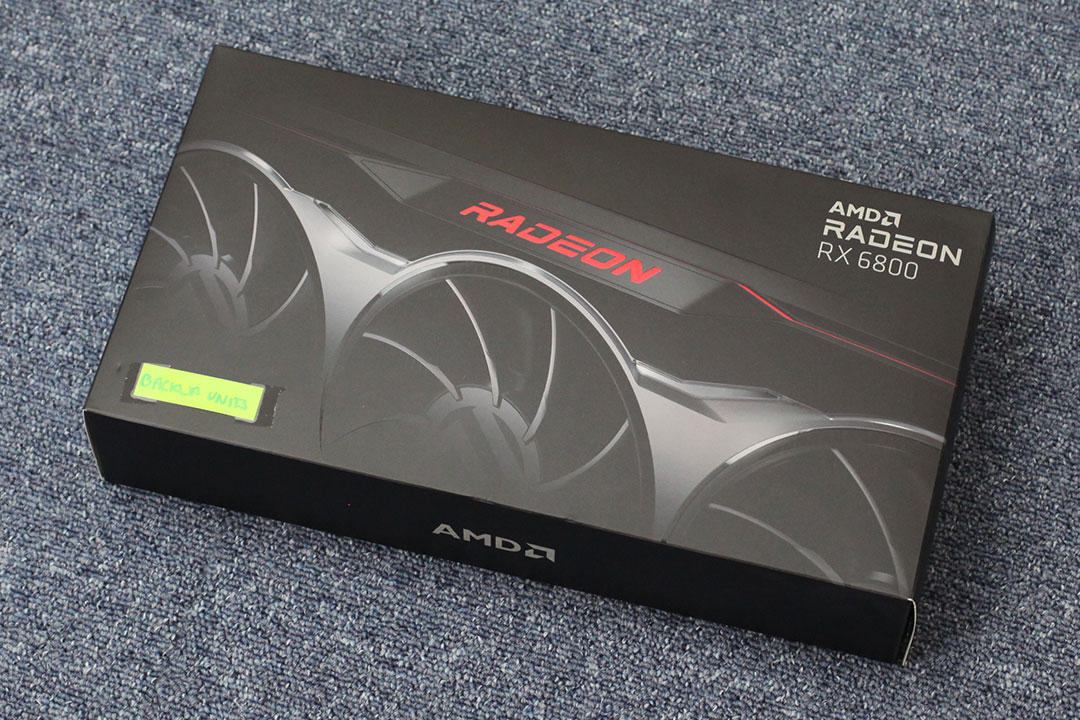


As mentioned earlier, the Radeon RX 6800 ships in a simpler paperboard box that opens along its sides. This is a visibly thinner box than on the RX 6800 XT. The outer box has a matte finish, although there's no embossing or chrome like on the RX 6800 XT box. To open, peel the factory seal from either side and open the box.


With the outer box out of the way, you come across a firmer paperboard "box," which is more like a tray with a lid. Underneath the lid is the fold-out quick-start guide. Under the lid is the RX 6800 card, secured in a Styrofoam cushion insert. For the most part, the RX 6800 looks identical to the RX 6800 XT, except that it's strictly two slots thick.

Much like the RX 6800 XT, the RX 6800 draws power from two 8-pin PCIe power connectors. The Radeon logo lights up red when powered on, just like on the RX 6800 XT.


As we pointed out earlier, what sets the RX 6800 apart from the RX 6800 XT is its strictly two-slot thickness, which should make it a better fit inside certain SFF cases with just two slots.


Here's a quick refresher of the specifications of the Radeon RX 6800 AMD revealed in its launch event. Based on the 7 nm "Big Navi" silicon, the RX 6800 is equipped with 60 RDNA 2 compute units, which works out to 3,840 stream processors, and a boost frequency of up to 2.10 GHz. It comes with 16 GB of GDDR6 memory that's cushioned by what AMD calls an on-die Infinite Cache. AMD claims that the RX 6800 offers performance competitive to the RTX 2080 Ti, which means it's gunning for the RTX 3070.
Our Patreon Silver Supporters can read articles in single-page format.
Nov 15th, 2026 16:37 CST
change timezone
Latest GPU Drivers
New Forum Posts
- What are you playing? (26222)
- WarpCoreBench scores! (51)
- Asus Rog Maximus Z890 Extreme. (Various questions). (25)
- Power supply noise stops when I move the mouse (9)
- TPU's Nostalgic Hardware Club (22165)
- HP Office Jet 7740 Pro - Supply system problem with replacement cartridge (3)
- Recommendations Wanted - Affordable Enterprise SSD for Boot (9)
- Folding Pie and Milestones!! (10204)
- What can the FX 8320 do today? Here is the answer. (59)
- How do you get games for PC? (59)
Popular Reviews
- AMD Zen 6 Technical Deep Dive
- ASUS ROG Strix B850-I Gaming Wi-Fi7 W Review
- Corsair HX1000i Shift Crystal Review
- Upcoming Hardware Launches 2027 (Updated Nov 2026)
- Montech King 95 3D PRO Review
- NZXT C1200 Platinum Review
- NZXT H7 RGB+ Review
- NZXT H5 Review
- Phantom Blade Zero Performance Benchmark Review - 35 GPUs Tested
- AMD Ryzen 7 9800X3D Review - The Best Gaming Processor
TPU on YouTube
Controversial News Posts
- NVIDIA Co-Founder and CEO Jensen Huang Officially Resigns (421)
- Open Letter Asking NVIDIA to Reinstate Jensen Huang Passes 115,000 Signatures (184)
- OpenAI CEO Argues Home PCs Waste the World's Limited DRAM Supply (152)
- NVIDIA Launches Investigation Into Jensen Huang's Relationship With Suspected Chinese Spy (136)
- Intel "Raptor Lake Next" 16-Core and 20-Core CPUs Surface (130)
- Legendary Game Studio BioWare Shuts Down Following EA Layoffs (104)
- Dell CEO Says the Memory Shortage Will Get Worse in 2027 (95)
- NVIDIA GeForce RTX 50-Series Scheduled for up to $500 Price Hike This Week (89)