 271
AMD Radeon RX 9070 Series Technical Deep Dive
(271 Comments) »Introduction

The next generation of AMD Radeon is here! The company today formally announced its Radeon RX 9070 series of performance-segment graphics cards, powered by the new RDNA 4 graphics architecture. These new cards aim to provide gamers with premium performance to max out any of today's games at resolutions of up to 4K UHD; the company also claims to have made massive strides in AI acceleration, ray tracing, and energy efficiency. The series marks AMD reorienting itself as a high performance/cost gaming GPU vendor, targeting price points PC gamers are more familiar with and want their graphics cards at; rather than runaway increase in GPU prices each generation. In many ways, AMD's strategy appears closer to that of Intel's than NVIDIA's. The RX 9070 XT comes at a starting price of $600, with the RX 9070 at $550.

AMD famously gave its Radeon 9000 series and RDNA 4 a skip at its 2025 International CES keynote address despite the two being part of pre-briefs to the press. Speculation was rife that the new series could fall woefully behind NVIDIA Blackwell, forcing AMD to fight for crumbs at the entry level with Intel. Then, something interesting happened—NVIDIA chose to build Blackwell on the same foundry node as the previous generation, going back to 2022, and the RTX 50-series SKUs launched so far don't post the kind of generational performance gains we've come to expect from NVIDIA, which the RTX 40-series Ada did. For instance, the RTX 5080 does not beat the RTX 4090, whereas even the RTX 4070 Ti beat the RTX 3090.
With RDNA 4, AMD has made a tactical retreat from the enthusiast segment. There is not going to be a "big Navi" GPU based on RDNA 4, and the Navi 48 chip powering the RX 9070 series will be the biggest chip this generation. With this, AMD will look to throw everything it has to bringing the most amount of performance and value out of its RX 9070 series, and look to target price points undercutting NVIDIA's performance-segment SKUs such as the recently announced RTX 5070 Ti, and the upcoming RTX 5070. It is unencumbered from the burden of beating the RTX 5090 or even the RTX 5080, which are both impossible to find at three-figure prices. Given that the real world pricing of the RTX 5070 Ti, particularly the custom OC cards are nearing $1,000, AMD has a great opportunity to disrupt the performance segment of the RTX 50-series the way the RX 5700 XT did for the RTX 20-series.
In this article, we will walk you through the new graphics cards AMD is launching soon, the RDNA 4 graphics architecture powering it, and what's new on the software and gamer experience side of things, particularly with FSR 4 and AMD Software.
The Cards


Today AMD is announcing only the top Radeon RX 9070 series from this generation. The two aim to provide an enthusiast-class gaming experience in the performance segment at prices that could disrupt NVIDIA's performance-segment offerings from the RTX 5070 series. Historically, the xx70 series have sold in large volumes, and AMD itself has had a track record of unsettling NVIDIA in this segment with the original RDNA RX 5700 series versus the RTX 20-series, so the company could be on to something.
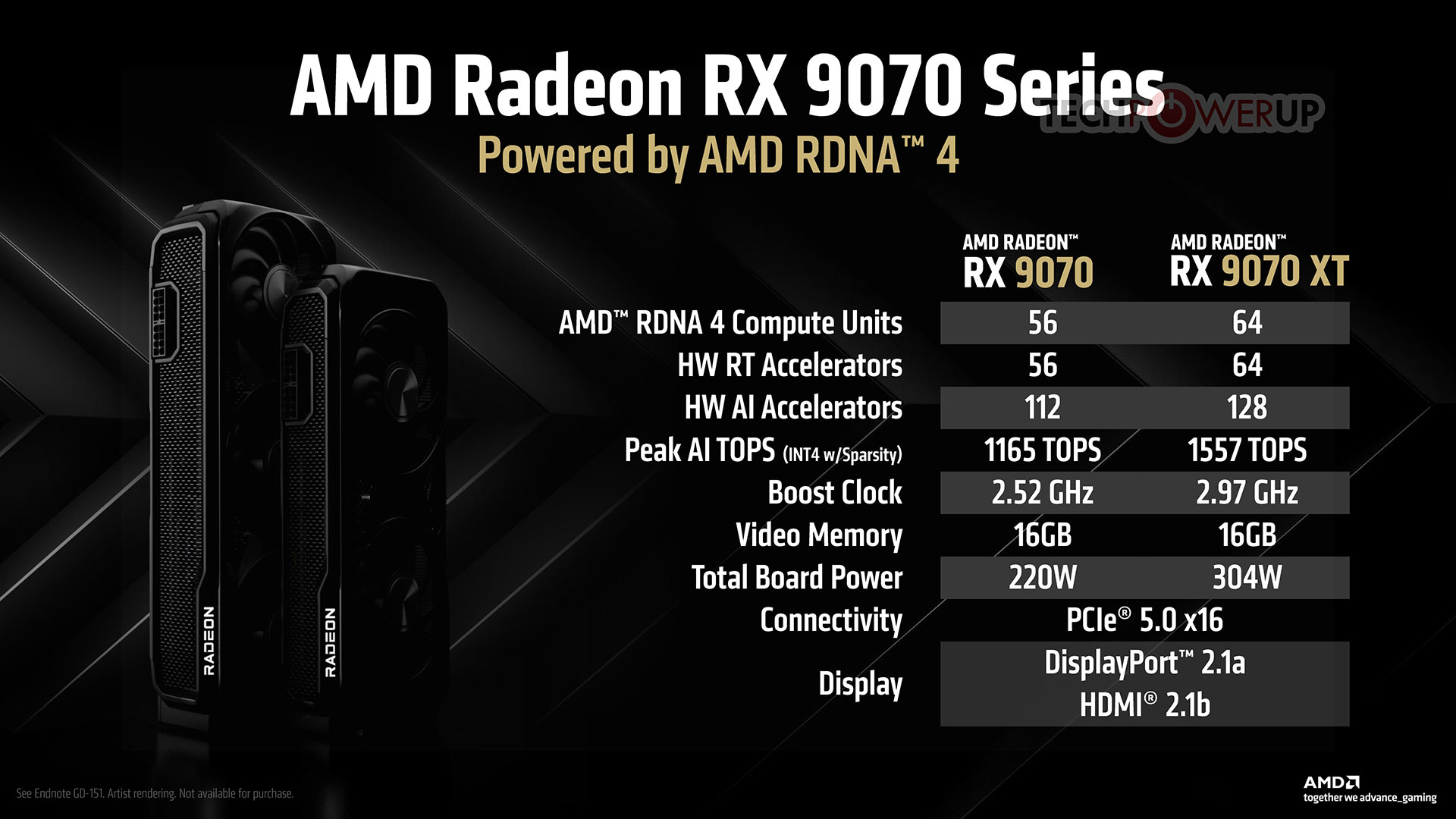
The series consists of just two SKUs for now, the top $600 Radeon RX 9070 XT, and the next-best $550 Radeon RX 9070, both are performance-segment products based on a common silicon, the 4 nm Navi 48.

The Navi 48 silicon is technically a performance-segment chip, logically its predecessors would have to be the Navi 32, the Navi 22, and the Navi 10, but there's more to this story because AMD changed the nomenclature of Radeon RX with this generation.

The Navi 48 silicon physically has 64 compute units, and a 256-bit wide GDDR6 memory bus driving 16 GB of memory on both cards. The RX 9070 XT maxes it out, enabling all 64 CUs (4,096 stream processors), and the highest possible clock speeds, while the RX 9070 gets 56 CU (3,584 stream processors).
The RX 9070 XT also comes with 128 AI accelerators, and 64 RT accelerators, besides 256 TMUs and 128 ROPs. The RX 9070, on the other hand, offers 112 AI accelerators, 56 RT accelerators, 224 TMUs, and 128 ROPs. The RX 9070 XT boosts up to 2.97 GHz, while the RX 9070 goes up to 2.52 GHz.


The RX 9070 XT has a power limit of 304 W, making it possible for both reference-spec and overclocked cards to make do with just two class 8-pin PCIe power connectors, while the RX 9070 has a total board power of just 220 W, making it technically possible for compact cards with a single 8-pin power connector.
The Navi 48 silicon is AMD's first gaming GPU to implement PCI-Express 5.0, both SKUs come with a PCI-Express 5.0 x16 host interface that's backwards-compatible with all older generations of PCIe. The display I/O remains contemporary, with DisplayPort 2.1a and HDMI 2.1b, making it possible to drive 8K displays with a single cable.
New Naming Scheme
With the RX 9000 series, AMD has changed the naming scheme of its gaming GPU SKUs. AMD says that this has been done to make it easier for customers to identify a product from a performance class, and to compare the SKUs better with "the competition's" (NVIDIA's). The RX 9070 series would logically be AMD's analog to the GeForce RTX 5070 series, with the RX 9070 XT squaring off against the RTX 5070 Ti, and the RX 9070 against the upcoming RTX 5070.Had AMD stuck with the old naming scheme, the RX 9070 XT would have to be named something along the lines of the "RX 9800 XT," and the RX 9070 something like the "RX 9700 XT," causing some kinds of buyers compare the "RX 9700 XT" with the RTX 5070 Ti and the "RX 9800 XT" with the RTX 5080, and find both lagging in performance and hence undesirable. This is essentially what happened with the RX 7800 XT and RX 7700 XT, compared to the RTX 4080 and RTX 4070 Ti, respectively. The new naming scheme fixes this.
Our Patreon Silver Supporters can read articles in single-page format.
Nov 18th, 2026 06:19 CST
change timezone
Latest GPU Drivers
New Forum Posts
- Time to upgrade CPU and MOBO (6)
- Wireless Internet sharing between PC and router both-ways, is it possible? (14)
- Will zen 6 mobos have anything extra vs current ones? (55)
- [Poll] 12V-2x6 Connector Protection: What Are You Using? (WireView / Ampinel / Equalizer / Other / Nothing) (33)
- Without Jensen, PC gaming will be (41)
- GIGABYTE - H55N-USB3 ITX Upgrade experience (3)
- What are you playing? (26233)
- DTS DCH Driver for Realtek HDA [DTS:X APO4 + DTS Interactive] (2811)
- Gacha Games - Discussions, Pulls, Updates, etc. (1155)
- RX 580 2048SP 8GB Samsung – Black Screens in Games, Looking for a Compatible BIOS (1)
Popular Reviews
- Acemagic Retro X3 Review
- Upcoming Hardware Launches 2027 (Updated Nov 2026)
- AMD Zen 6 Technical Deep Dive
- ASUS ROG Strix B850-I Gaming Wi-Fi7 W Review
- Corsair HX1000i Shift Crystal Review
- Chieftec Iceberg PRO 360 DARK Review
- AMD Ryzen 7 9800X3D Review - The Best Gaming Processor
- Biwin Black Opal NV7400 2 TB Review
- Phantom Blade Zero Performance Benchmark Review - 35 GPUs Tested
- Montech King 95 3D PRO Review
TPU on YouTube
Controversial News Posts
- NVIDIA Co-Founder and CEO Jensen Huang Officially Resigns (468)
- Open Letter Asking NVIDIA to Reinstate Jensen Huang Passes 115,000 Signatures (184)
- Report: Jensen Huang Eyes NVIDIA Comeback (162)
- OpenAI CEO Argues Home PCs Waste the World's Limited DRAM Supply (152)
- NVIDIA Launches Investigation Into Jensen Huang's Relationship With Suspected Chinese Spy (136)
- Intel "Raptor Lake Next" 16-Core and 20-Core CPUs Surface (130)
- Legendary Game Studio BioWare Shuts Down Following EA Layoffs (104)
- Dell CEO Says the Memory Shortage Will Get Worse in 2027 (95)