 39
AMD Ryzen 3 1200 3.1 GHz Review
(39 Comments) »Introduction

The largest slice of the client CPU market is the sub-$150 market segment, and its buyers cover everything from budget desktops to entry mainstream gaming PCs. Although AMD has sold several of its recent FX-series and A-series models for under $150, they did not receive the kind of market attention AMD had hoped for, which is in part due to a large per-core performance leadership by Intel, and aggressive pricing. The software and games intended for these markets ran perfectly fine on these chips, with the occasional nudge, such as games beginning to require at least 4 logical CPUs, forcing Intel to deploy HyperThreading on even its Pentium and Celeron-branded dual-core parts. The slightly higher range of these dual-core parts has been dominated by the Intel Core i3 brand. Equipped with HyperThreading and 3-4 MB of L3 cache, these chips provide single-core performance that's in league with pricier chips and good enough multi-threaded performance to keep AMD at bay. This is the segment AMD wants to carve up, riding on the success of its new "Zen" CPU architecture.
AMD already launched sub-$170 quad-core Ryzen 5 series processors, which feature SMT, enabling 8 logical CPUs, something Intel reserves for >$290 SKUs. The Ryzen 5 1500X presented an interesting value proposition, while the Ryzen 5 1400 came across as a little underpowered despite its $20 lower price. The quad-core Ryzen 5 series duo put a dent into the overall value of competing lower-end Core i5 quad-core chips. AMD needed something to take on the sub-$150 dual-core Core i3 parts and hence created the Ryzen 3 series.
What sets the Ryzen 3 series quad-core chips apart from their Ryzen 5 series quad-core siblings is the lack of SMT. The main pitch here is four real cores at a price Intel asks for two. There are two other key features Intel's competing offerings lack - a fully unlocked base-clock multiplier, which makes overclocking a breeze, and 8 MB of L3 cache, which at least looks better on paper than the 3-4 MB from Intel. You get support for the full spectrum of high-speed DDR4-3200 memory. The chips also feature a reasonable TDP rating of 65W, which makes them fit for SFF builds with small coolers.
AMD carved the Ryzen 3 series quad-core chips out of its 14 nm "Summit Ridge" silicon by disabling two cores per CCX (quad-core compute complex), resulting in four cores, and by disabling 4 MB of L3 cache per CCX, resulting in a total of 8 MB of L3 cache. The line-up consists of the faster Ryzen 3 1300X priced at $129 and the slightly slower Ryzen 3 1200, priced at $109, which we're reviewing today. Their main respective competitors from Intel are the Core i3-7300 and i3-7100. The cheapest quad-core from Intel will continue to elude you in the sub-$150 segment, forcing you to front at least $189 for the i5-7400, and so AMD's idea here is to convincingly beat Core i3 dual-core parts and take a swing at Intel's entry-level Core i5 quad-core parts in at least some multi-threaded scenarios; with unlocked multipliers and large L3 caches sweetening the deal a little.

The Ryzen 3 1200 we're reviewing today ticks at 3.10 GHz, with 3.40 GHz boost, and if your CPU cooling is up to the task, the XFR (extended frequency range) feature will add another 50 MHz to the boost frequency for a single core. The chip is effectively 450 MHz slower than the 1300X, which can run as high as 3.90 GHz with XFR (single core). The socket AM4 chip is compatible with all motherboards based on the A320, B350, and X370 chipsets, although you'll need either the B350 or X370 chipset for CPU overclocking. The chip is priced at $109 and includes the new AMD Wraith Stealth cooling solution, a compact fan-heatsink that has been tuned for low noise. In this review, we compare the Ryzen 3 1200 with its main competitor, the Core i3-7100, and most other rivals.
| Pentium G4560 | Core i3-7100 | Ryzen 3 1200 | Core i3-7300 | Ryzen 3 1300X | Ryzen 5 1400 | Core i5-7400 | Core i5-7500 | Ryzen 5 1500X | Ryzen 5 1600 | |
|---|---|---|---|---|---|---|---|---|---|---|
| Cores / Threads | 2 / 4 | 2 / 4 | 4 / 4 | 2 / 4 | 4 / 4 | 4 / 8 | 4 / 4 | 4 / 4 | 4 / 8 | 6 / 12 |
| Base Clock | 3.5 GHz | 3.9 GHz | 3.1 GHz | 4.0 GHz | 3.4 GHz | 3.2 GHz | 3.0 GHz | 3.4 GHz | 3.5 GHz | 3.2 GHz |
| Max. Boost | N/A | N/A | 3.4 GHz | N/A | 3.7 GHz | 3.4 GHz | 3.5 GHz | 3.8 GHz | 3.7 GHz | 3.6 GHz |
| L3 Cache | 3 MB | 3 MB | 8 MB | 4 MB | 8 MB | 8 MB | 6 MB | 6 MB | 16 MB | 16 MB |
| TDP | 54 W | 51 W | 65 W | 51 W | 65 W | 65 W | 65 W | 65 W | 65 W | 65 W |
| Process | 14 nm | 14 nm | 14 nm | 14 nm | 14 nm | 14 nm | 14 nm | 14 nm | 14 nm | 14 nm |
| Socket | LGA 1151 | LGA 1151 | AM4 | LGA 1151 | AM4 | AM4 | LGA 1151 | LGA 1151 | AM4 | AM4 |
| Price | $80 | $120 | $110 | $160 | $130 | $170 | $190 | $200 | $190 | $220 |
A Closer Look
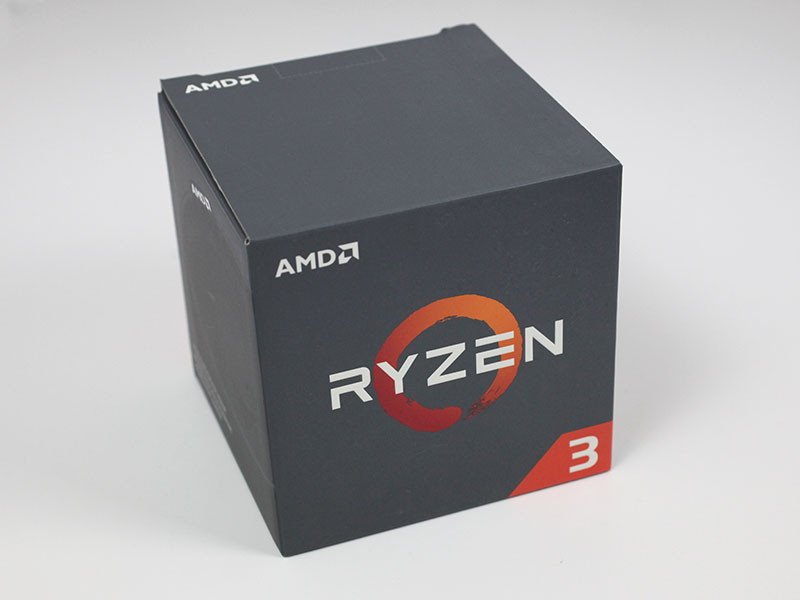
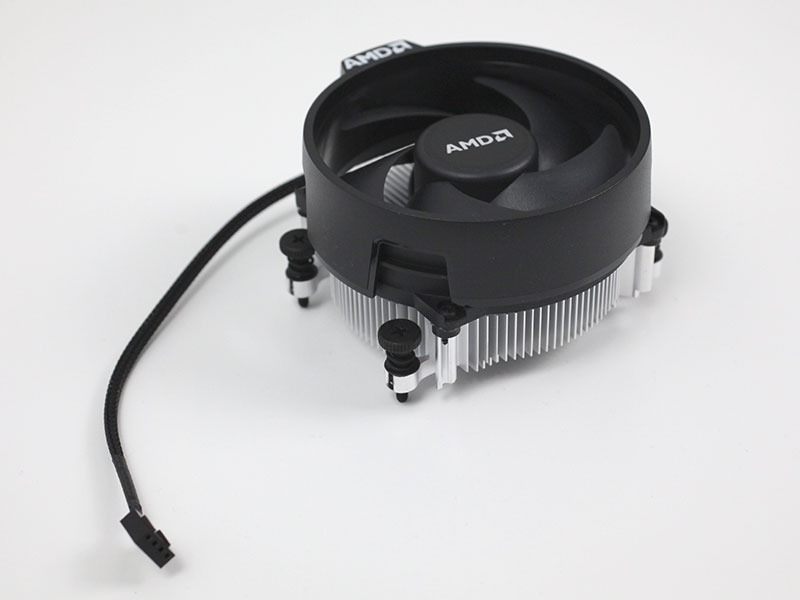
The Ryzen 3 1200 retail package includes AMD's new Wraith Stealth cooling solution. This is a slightly more compact variant of the Wraith Spire cooler AMD includes with pricier chips, such as the Ryzen 5 1600 and Ryzen 7 1700. The cooler features a cylindrical heatsink with radially projecting fins and is ventilated by a large fan. AMD has optimized the fan for low noise. AMD feels this cooler should suffice for the 65W TDP of the Ryzen 3 1200.


Topside, the Ryzen chip looks quite similar to every AMD desktop processor since the Athlon64. A large, thick, integrated heatspreader tops off the chip. Underneath, you see the chip's PGA (pin grid array). AM4 consists of 1,331 pins, and these pins are a lot finer than those you find on AM3+ FX-series processors, so handle these chips with extreme care.
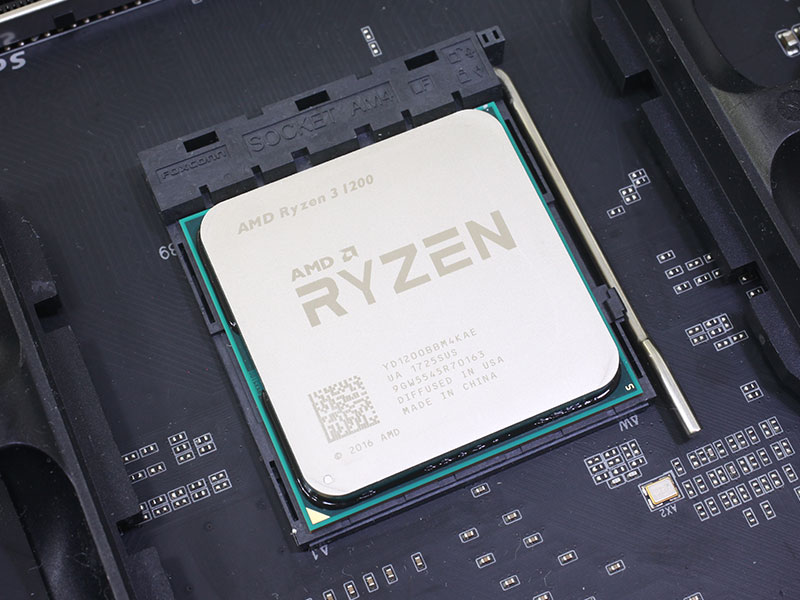
AM4 still has a rectangular cooler-mount-hole layout (as opposed to the square ones on Intel LGA platforms). AMD should have switched to a square layout to make it easier to orient tower-type coolers to blow hot air out the rear of the case. Current AM4-ready tower coolers have elaborate retention module kits that let you do so. Most popular cooler vendors are either selling or giving away AM4 retention modules for free. You often also have to remove the plastic retention module motherboards ship with to install certain kinds of coolers.
The "Zen" Architecture
The oldest reports about AMD working on the "Zen" architecture date back to 2012, when AMD re-hired CPU core designer Jim Keller, credited with the original winning K8 and K9 architecture designs, to work on a new core architecture to succeed "Bulldozer." AMD continued to invest in the "Bulldozer" IP in the form of incremental core updates, hoping that trends in the software industry towards parallelization would improve, giving it a big break in price/performance. Those trends, in the form of DirectX 12 and Vulkan 3D APIs being multi-core friendly, came in a tad late (towards late 2016). Four years of work by a team dedicated to its development, led by Jim Keller, resulted in the "Zen" core.


At the heart of the "Zen" core are two very important innovations - a very "intelligent" branch-prediction system that uses neural nets (yes, of the same kind that power deep-learning machinery) to predict branches in code and load the most appropriate instructions and allocation of core resources; and there's a 1.5X increase in issue width and execution resources, besides a 1.75X increase in the instruction scheduler window. Intel had been beating AMD in core performance and efficiency in exactly these two areas, and AMD finally addressed it instead of throwing in many more hardware resources without addressing the branch-prediction issues. "Zen" also features an up-to-date ISA instruction set including AVX2, FMA3, and SHA.

All Ryzen processors are based on the 14 nm "Summit Ridge" silicon built at GlobalFoundries' swanky new facility in Upstate New York. One look at the die shot will show you that the CPU cores are clumped into two groups each. One such group is called a quad-core complex (CCX). There is no specific reason as to why AMD chose groups of four cores, other than four being a manageable number of cores for AMD's product managers. Each individual core in a CCX can be disabled and doesn't share anything with its neighboring core except for an 8 MB block of L3 cache. Each core has its own dedicated 512 KB L2 cache. The two CCX units talk to each other over AMD Infinity Fabric, a new high-bandwidth interconnect that succeeds HyperTransport. For the Ryzen 3 1200, AMD disabled two cores per CCX and reduced the L3 cache amount to 4 MB per CCX.
The AM4 Platform
What sets "Summit Ridge" apart from Intel dies, such as "Kaby Lake," is that it is a full-fledged SoC (system-on-chip). It integrates both the northbridge and southbridge. In addition to memory and PCIe, socket AM4 processors also put out USB 3.0 and two SATA 6 Gb/s ports. The platform still has something called a "chipset," but it only serves to increase connectivity options, such as adding more SATA ports, USB 3.1 ports, and a few more general-purpose PCIe lanes. On Intel's platforms, the PCH (platform controller hub) serves the functions of the southbridge, while the northbridge is fully integrated with the processor.
AMD has five chipsets for Ryzen - the X370 for high-end desktops, which supports proprietary multi-GPU technologies such as NVIDIA SLI, the mid-tier B350 chipset with a slimmer connectivity feature set, and the entry-level A320 chipset for low-cost desktops. There's also the X300 and A300. We doubt you can even call these a chipset because they don't even have an A-link chipset bus to the SoC and only talk over legacy SPI pins, and they have simple components to keep the platform ticking. What sets the two apart is the lack of CPU overclocking support on the A300. On machines with the X300 and A300 (such as SFF desktops), all the connectivity is handled by the SoC.
Our Patreon Silver Supporters can read articles in single-page format.
Nov 14th, 2026 12:11 CST
change timezone
Latest GPU Drivers
New Forum Posts
- Tell me about your favourite graphics card (56)
- Slow SSD read speeds - help! (7)
- What can the FX 8320 do today? Here is the answer. (29)
- What card do I get for VR? (29)
- Ddr4 instead of ddr5 for 9060xt 8 gb over 5060 8 gb (7)
- Your PC ATM (36414)
- TPU's Nostalgic Hardware Club (22161)
- Microsoft Exchange/365 outages? (62)
- Opinion on Monitor Replacement (7)
- Show us your collections thread!! (366)
Popular Reviews
- AMD Zen 6 Technical Deep Dive
- Corsair HX1000i Shift Crystal Review
- ASUS ROG Strix B850-I Gaming Wi-Fi7 W Review
- NZXT C1200 Platinum Review
- Upcoming Hardware Launches 2027 (Updated Nov 2026)
- Montech King 95 3D PRO Review
- NZXT H7 RGB+ Review
- NZXT H5 Review
- Phantom Blade Zero Performance Benchmark Review - 35 GPUs Tested
- XPG NIMBUS PLUS Review - Mid-range Chair With Strong Competitors
TPU on YouTube
Controversial News Posts
- NVIDIA Co-Founder and CEO Jensen Huang Officially Resigns (399)
- OpenAI CEO Argues Home PCs Waste the World's Limited DRAM Supply (152)
- NVIDIA Launches Investigation Into Jensen Huang's Relationship With Suspected Chinese Spy (136)
- Intel "Raptor Lake Next" 16-Core and 20-Core CPUs Surface (130)
- Legendary Game Studio BioWare Shuts Down Following EA Layoffs (104)
- Dell CEO Says the Memory Shortage Will Get Worse in 2027 (95)
- NVIDIA GeForce RTX 50-Series Scheduled for up to $500 Price Hike This Week (89)
- Modder Fits RTX 5090 With Four 8-Pin Connectors, Halving Current per Wire (80)