 20
AMD Ryzen 3 2200G 3.5 GHz with Vega 8 Graphics Review
(20 Comments) »Introduction

AMD today released its Ryzen 2000 family of processors with integrated AMD Radeon Vega graphics, with the Ryzen 3 2200G and Ryzen 5 2400G. Of the two, the Ryzen 3 2200G is priced at an attractive $99.99. AMD priced its previous-generation APUs with similar specs almost $50 higher. 2017 was probably the best year in a decade for AMD's processor business. The Ryzen family of desktop processors, powered by the latest "Zen" microarchitecture, is surprisingly fast and stirred up competition enough to force Intel to increase CPU core-counts to catch up. AMD now has a reasonably competitive processor for every price point from $120 to $999, including HEDT processors, to compete with Intel's Core X family. The trouble is none of these chips come with integrated graphics, a department in which AMD has traditionally outclassed Intel ever since it started making APUs.
The company took the logical step of combining its latest CPU microarchitecture with its latest GPU architecture, "Vega," to create its new 14 nm "Raven Ridge" silicon. Why "Vega" and not "Polaris," you ask? Because "Vega" has AMD's 6th generation Graphics CoreNext compute units (you'd want the most IPC from your limited SIMD resources). The company debuted this chip in the mobile space in late-2017 and is now launching it in the desktop segment with two SKUs - the Ryzen 3 2200G and Ryzen 5 2400G. This review covers the $99 2200G.

Both models combine a quad-core "Zen" CPU with a "Vega" based integrated graphics core (iGPU), a dual-channel DDR4 integrated memory controller, and a platform I/O interface. Differentiating the two SKUs, the Ryzen 5 2400G gets SMT (AMD's equivalent of HyperThreading) and more iGPU stream processors, besides higher CPU and iGPU clock speeds. AMD surprised us with a larger-than-expected iGPU and a smaller-than-expected CPU. The iGPU is endowed with 8 "Vega" NGCUs (next-generation compute units), which translate into 512 stream processors and 32 TMUs. The CPU component is smaller than expected. With this generation, we expected AMD to increase core-counts on its APUs from the traditionally quad-core setups. This is still quad-core, but the L3 cache is just 4 MB, half that of quad-core SKUs based on the iGPU-devoid "Summit Ridge" silicon, such as the Ryzen 3 1200.
Both the Ryzen 3 2200G and Ryzen 4 2400G work on existing socket AM4 motherboards based on AMD 300-series chipset, provided they have the latest BIOS. You can finally plug your monitor to the display connectors of your motherboard and not end up with a blank screen. AMD recommends the A320 and B350 chipsets as the ideal companions for these two chips, although the high-end X370 chipset will very much support it.
AMD is pricing the Ryzen 3 2200G and Ryzen 5 2400G rather conservatively. The 2200G is priced at US$99, and the 2400G at US$169. AMD is hedging its bets on the entry-level crowd that combines a $70-ish Pentium/Celeron processor with an entry-level graphics card such as the GeForce GT 1300 or the Radeon RX 550. This chip will prove particularly appealing to entry-level PC builders and the DIY HTPC crowd. The iGPU features hardware-acceleration and DRM support for the latest video formats and display standards.
| Price | Cores / Threads | Base Clock | Max. Boost | L3 Cache | TDP | Architecture | Process | Socket | |
|---|---|---|---|---|---|---|---|---|---|
| Pentium G4560 | $100 | 2 / 4 | 3.5 GHz | N/A | 3 MB | 54 W | Kaby Lake | 14 nm | LGA 1151 |
| Ryzen 3 1200 | $110 | 4 / 4 | 3.1 GHz | 3.4 GHz | 8 MB | 65 W | Zen | 14 nm | AM4 |
| Ryzen 3 2200G | $100 | 4 / 4 | 3.5 GHz | 3.7 GHz | 4 MB | 65 W | Zen | 14 nm | AM4 |
| Core i3-7100 | $120 | 2 / 4 | 3.9 GHz | N/A | 3 MB | 51 W | Kaby Lake | 14 nm | LGA 1151 |
| Ryzen 3 1300X | $130 | 4 / 4 | 3.4 GHz | 3.7 GHz | 8 MB | 65 W | Zen | 14 nm | AM4 |
| Core i3-7300 | $160 | 2 / 4 | 4.0 GHz | N/A | 4 MB | 51 W | Kaby Lake | 14 nm | LGA 1151 |
| Ryzen 5 1400 | $165 | 4 / 8 | 3.2 GHz | 3.4 GHz | 8 MB | 65 W | Zen | 14 nm | AM4 |
| Ryzen 5 2400G | $170 | 4 / 8 | 3.6 GHz | 3.9 GHz | 4 MB | 65 W | Zen | 14 nm | AM4 |
| Core i3-8350K | $180 | 4 / 4 | 4.0 GHz | N/A | 8 MB | 91 W | Coffee Lake | 14 nm | LGA 1151 |
| Ryzen 5 1500X | $180 | 4 / 8 | 3.5 GHz | 3.7 GHz | 16 MB | 65 W | Zen | 14 nm | AM4 |
| Core i5-7400 | $190 | 4 / 4 | 3.0 GHz | 3.5 GHz | 6 MB | 65 W | Kaby Lake | 14 nm | LGA 1151 |
| Core i5-8400 | $190 | 6 / 6 | 2.8 GHz | 4.0 GHz | 9 MB | 65 W | Coffee Lake | 14 nm | LGA 1151 |
| Core i5-7500 | $205 | 4 / 4 | 3.4 GHz | 3.8 GHz | 6 MB | 65 W | Kaby Lake | 14 nm | LGA 1151 |
A Closer Look

The Ryzen 3 2200G comes in a fairly big cubical box characteristic of Ryzen. You can tell that it comes with integrated graphics by looking at the silver bands on the box with that catchy AMD Vega logo.


AMD is including a Wraith Stealth cooling solution with the 2400G and 2200G. This is the smallest stock cooling solution by AMD for this generation (after Wraith Max and Wraith Spire), but AMD feels it is sufficient for the 65W TDP of these chips. The design focus is still on low noise.


The Ryzen 3 2200G package looks just like any other Ryzen socket AM4 processor. You can install it on any AM4 motherboard if its BIOS is up to date.

AMD continues to use the AM4 socket, which means all existing Ryzen motherboards will be compatible with Ryzen G (after a BIOS update). The company also plans to stick to AM4 for the rest of this decade, so there's a pretty long upgrade path ahead for this platform.
AM4 still has a rectangular cooler-mount-hole layout (as opposed to the square ones on Intel LGA platforms). AMD should have switched to a square layout to make it easier to orient tower-type coolers to blow hot air out the rear of the case. Current AM4-ready tower coolers have elaborate retention module kits that let you do so. Most popular cooler vendors are either selling or giving away AM4 retention modules for free. You often also have to remove the plastic retention module motherboards ship with to install certain kinds of coolers.
Architecture
At the heart of the Ryzen 3 2200G is the new 14 nm "Raven Ridge" silicon. This chip is a full-fledged SoC which combines a CPU, an integrated GPU (iGPU), a dual-channel DDR4 memory controller, platform I/O, and integrated southbridge. Unlike the 8-core "Summit Ridge" silicon AMD launched the "Zen" CPU microarchitecture with, "Raven Ridge" has just four "Zen" CPU cores, but a rather large iGPU based on the "Vega" graphics architecture.Before its debut late-2017 in its mobile avatar, we were expecting AMD to increase CPU core-counts for its first "Zen" based APU. Unfortunately, that wasn't to be, but the quad-core CPU you do get has SMT (multi-threading) enabled on the Ryzen 3 2200G. Why four cores? This is partially because of the way AMD designed multi-core chips using its "Zen" micro-architecture.
AMD decided that four "Zen" CPU cores group better for its product managers to carve out SKUs with when designing the CCX (CPU complex). Each CCX has four CPU cores, each with dedicated L2 caches and a shared L3 cache. "Summit Ridge" has two CCX units running in a 2+2 configuration; while "Raven Ridge" combines one CCX (4+0) with the Vega 11 iGPU.


It's important to note that the CCX of "Raven Ridge" is slightly different than the one found on "Summit Ridge" because its shared L3 cache is halved to just 4 MB. This is also why you can't directly compare CPU performance of the Ryzen 3 2200G clock-for-clock with the Ryzen 3 1200 "Summit Ridge," which has two cores enabled per CCX and 4 MB of L3 cache per CCX. It's the "4+0 vs. 2+2" face-off we wanted, though 4+0 doesn't have the same amount of cache as 2+2. Each of the four cores still has 512 KB of dedicated L2 cache. The 2400G features SMT, while the 2200G lacks it.
Another major difference between "Summit Ridge" and "Raven Ridge" is the latter's smaller PCI-Express (PCIe) root complex. While "Summit Ridge" features 16 PCIe gen 3.0 lanes toward PEG (PCI-Express Graphics), in addition to 4 lanes allocated to the chipset-bus and another 4 lanes driving an M.2 NVMe slot, "Raven Ridge" puts out just 8 lanes toward PEG, besides 4 lanes as chipset-bus and 4 lanes for the M.2 NVMe slot. What this means is that the second PCI-Express 3.0 x16 slot on X370 chipset motherboards won't work, and whatever graphics card you install on the first slot will run at PCI-Express 3.0 x8 (half bandwidth). This design choice is bewildering due to the potential PR drama. The actual performance lost from PCIe x8 3.0 vs PCIe x16 3.0 is minimal. The Vega integrated graphics is connected to the CPU using Infinity Fabric.
The iGPU implements AMD's latest "Vega" architecture, with separate regions on the "Raven Ridge" silicon for the iGPU's key components and the display controllers with multimedia processing. It is endowed with up to 704 stream processors spread across 11 compute units, 44 TMUs, and 16 ROPs. It features DirectX 12 and Vulkan support and is capable of hardware-accelerated decoding of HEVC/x265/VP10. It has the necessary DRM features to enable playback of Netflix 4K-HDR and other emerging high-resolution content services. Its display controllers support 4K Ultra HD and 5K displays through DisplayPort 1.4.
The Zen Architecture
The oldest reports about AMD working on the "Zen" architecture date back to 2012, when AMD re-hired CPU core designer Jim Keller credited with the original winning K8 and K9 architecture designs to work on a new core architecture to succeed "Bulldozer." AMD continued to invest in the "Bulldozer" IP in the form of incremental core updates, hoping that trends in the software industry towards parallelization would improve, giving it a big break in price/performance. Those trends, in the form of DirectX 12 and Vulkan 3D APIs being multi-core friendly, came in a tad late (towards late 2016). Four years of work by a team dedicated to its development, led by Jim Keller, resulted in the "Zen" core.
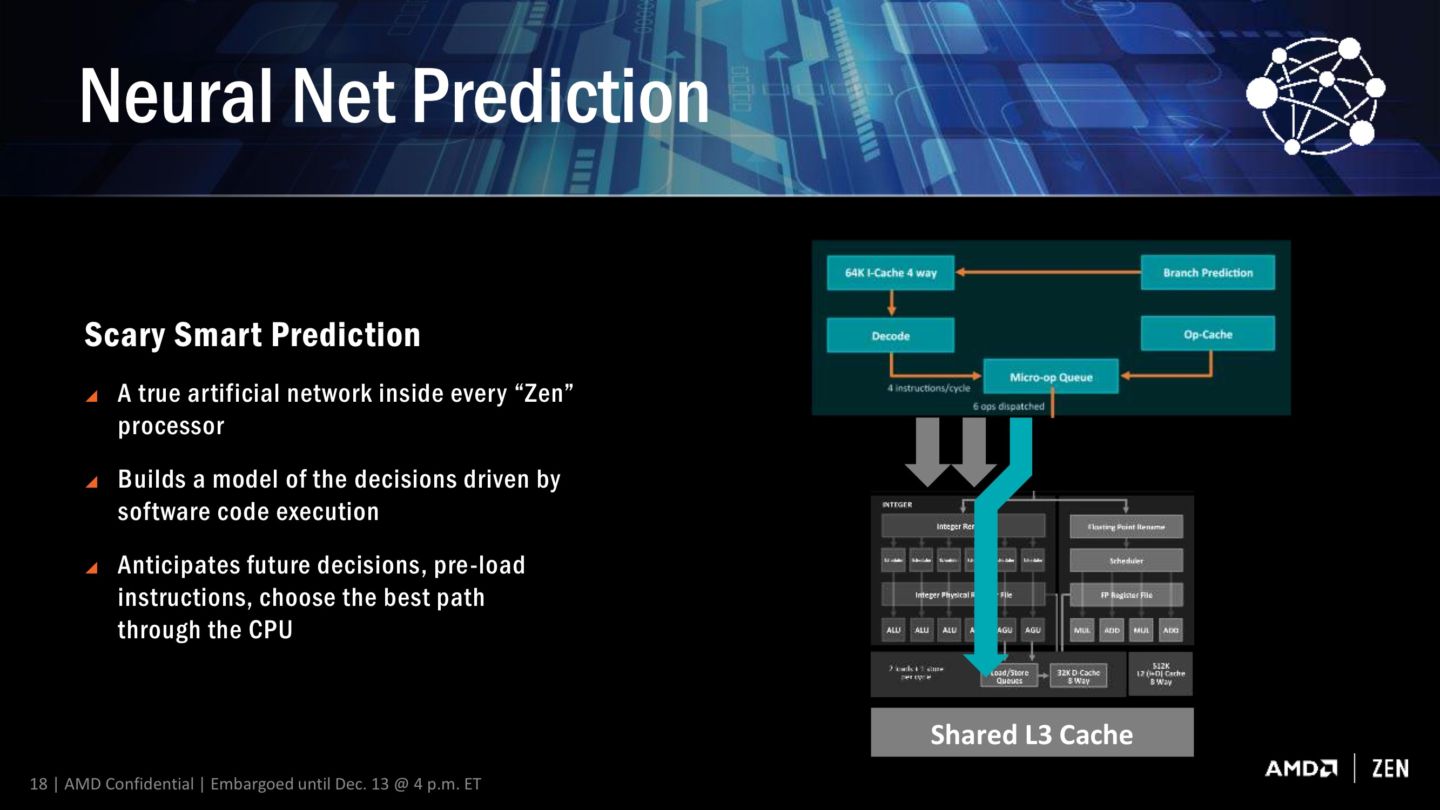
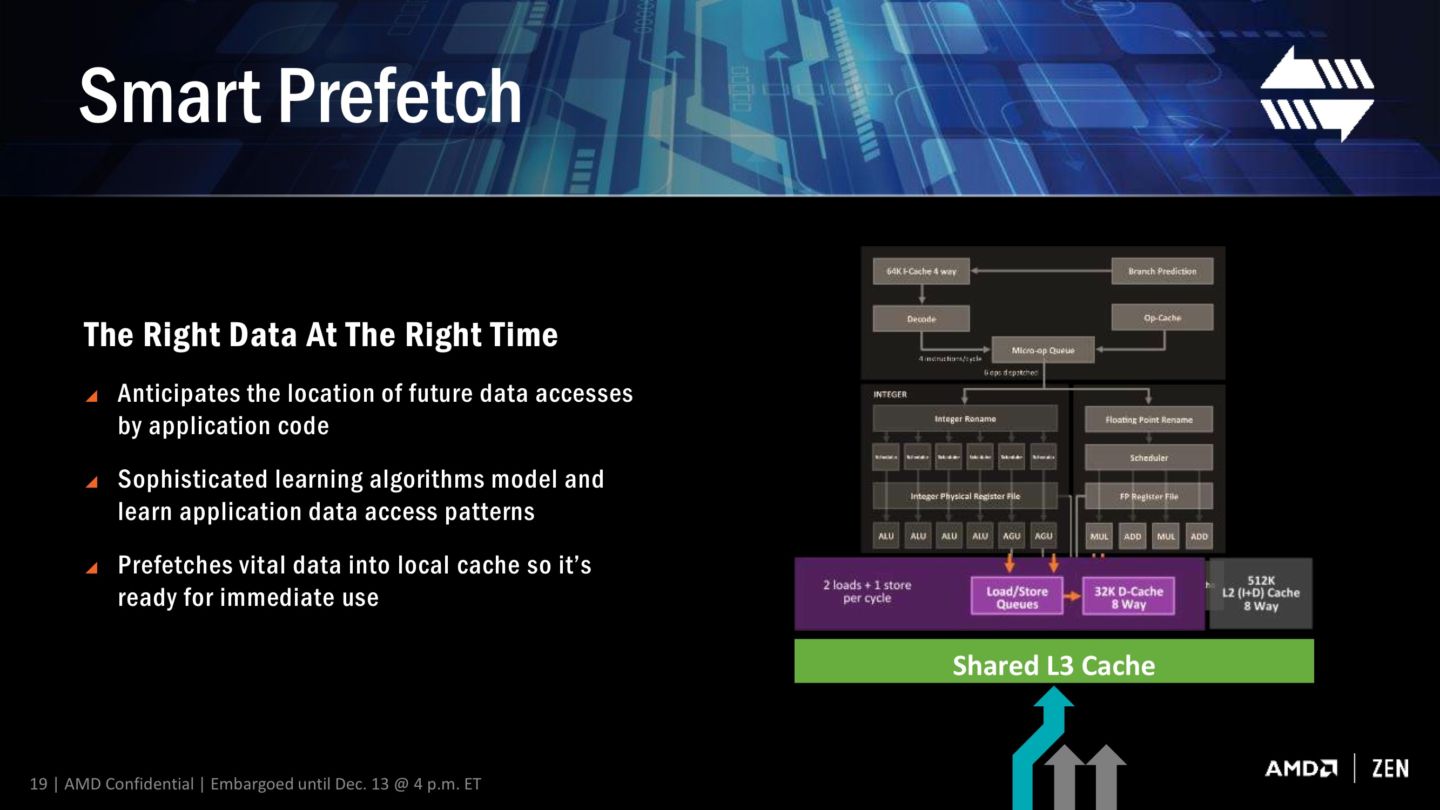
At the heart of the "Zen" core are two very important innovations - a very "intelligent" branch-prediction system that uses neural nets (yes, of the same kind that power deep-learning machinery) to predict branches in code and load the most appropriate instructions and allocation of core resources and a 1.5X increase in issue width and execution resources, besides a 1.75X increase in the instruction scheduler window. Intel had been beating AMD in core performance and efficiency in exactly these two areas, and AMD finally addressed it instead of throwing in many more hardware resources without addressing the branch-prediction issues. "Zen" also features an up-to-date ISA instruction set including AVX2, FMA3, and SHA.


Interestingly, AMD talks about refinements to the micro-architecture itself in its Ryzen 2000G press deck for these processors, which speak of improvements to the various SenseMI components.
The AM4 Platform
What sets "Summit Ridge" apart from Intel dies, such as "Kaby Lake," is that it is a full-fledged SoC (system-on-chip). It integrates both the northbridge and southbridge. In addition to memory and PCIe, socket AM4 processors also put out USB 3.0 and two SATA 6 Gb/s ports. The platform still has something called a "chipset," but it only serves to increase connectivity options, such as adding more SATA ports, USB 3.1 ports, and a few more general-purpose PCIe lanes. On Intel's platforms, the PCH (platform controller hub) serves the functions of the southbridge, while the northbridge is fully integrated with the processor.
AMD has three chipsets for Ryzen - the X370 for high-end desktops, which supports proprietary multi-GPU technologies, such as NVIDIA SLI, the mid-tier B350 chipset with a slimmer connectivity feature set, and the entry-level A320 chipset for low-cost desktops (which lacks multiplier overclocking support). NVIDIA SLI will not work on X370 chipset motherboards if paired with "Raven Ridge" processors due to the PCIe lane limitation of the processor.
Our Patreon Silver Supporters can read articles in single-page format.
Nov 17th, 2026 17:00 CST
change timezone
Latest GPU Drivers
New Forum Posts
- [testers wanted] Qsurfer My own QNAP Nas explorer/Search tool (6)
- Honestly, do you care about GTA VI? (129)
- Help with fixing Overclock (7)
- 9070 GRE 3.9ghz validation reached. (17)
- Local LLM General Discussion (692)
- ProArt X870E-CREATOR WIFI - Bifurcation~Complication (13)
- Last game you purchased? (1403)
- Without Jensen, PC gaming will be (33)
- [Poll] 12V-2x6 Connector Protection: What Are You Using? (WireView / Ampinel / Equalizer / Other / Nothing) (27)
- What is the latest game you finished or 100% (204)
Popular Reviews
- Acemagic Retro X3 Review
- Corsair HX1000i Shift Crystal Review
- Upcoming Hardware Launches 2027 (Updated Nov 2026)
- AMD Zen 6 Technical Deep Dive
- ASUS ROG Strix B850-I Gaming Wi-Fi7 W Review
- AMD Ryzen 7 9800X3D Review - The Best Gaming Processor
- Phantom Blade Zero Performance Benchmark Review - 35 GPUs Tested
- Chieftec Iceberg PRO 360 DARK Review
- Montech King 95 3D PRO Review
- NZXT C1200 Platinum Review
TPU on YouTube
Controversial News Posts
- NVIDIA Co-Founder and CEO Jensen Huang Officially Resigns (457)
- Open Letter Asking NVIDIA to Reinstate Jensen Huang Passes 115,000 Signatures (184)
- OpenAI CEO Argues Home PCs Waste the World's Limited DRAM Supply (152)
- NVIDIA Launches Investigation Into Jensen Huang's Relationship With Suspected Chinese Spy (136)
- Report: Jensen Huang Eyes NVIDIA Comeback (135)
- Intel "Raptor Lake Next" 16-Core and 20-Core CPUs Surface (130)
- Legendary Game Studio BioWare Shuts Down Following EA Layoffs (104)
- Dell CEO Says the Memory Shortage Will Get Worse in 2027 (95)