 153
AMD Ryzen 7 5800X3D 10th Anniversary Review
Performance Summary »Clock Frequencies
The following chart shows how well the processor sustains its clock frequency and which boost clock speeds are achieved at various thread counts. This test uses a custom-coded application that mimics real-life performance—it is not a stress test like Prime95. Modern processors change their clocking behavior depending on the type of load, which is why we provide three plots with classic floating point math, SSE SIMD code, and modern AVX vector instructions. Each of the three test runs calculates the same result using the same algorithm, just with a different CPU instruction set.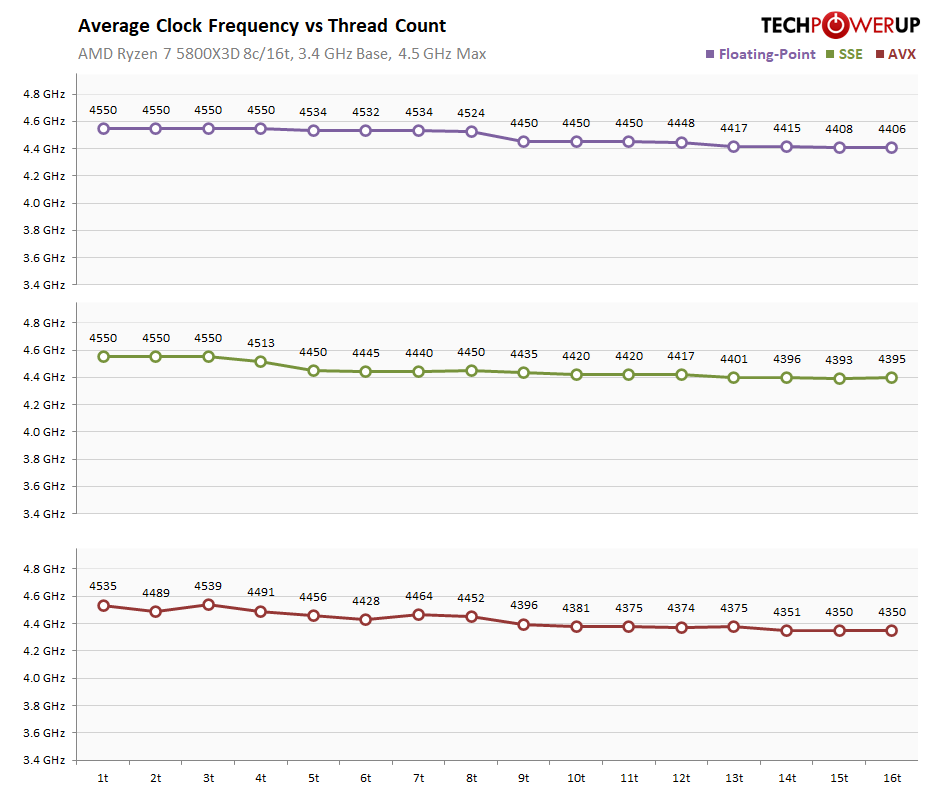
The most important takeaway is the ceiling: the Ryzen 7 5800X3D tops out right around its rated 4.50 GHz boost and reaches that maximum almost immediately, even under light multithreaded load, holding it in a nearly flat line. It lands a little lower than AMD's non-3D Zen 3 parts on purpose—the stacked cache die sitting on top of the cores limits how much voltage, and therefore how much clock, the processor can safely run. The regular 5800X boosts to 4.70 GHz with a fully unlocked multiplier on top; the 5800X3D trades that headroom for its 64 MB of extra L3, and in games that's a trade very much worth making.
Overclocking
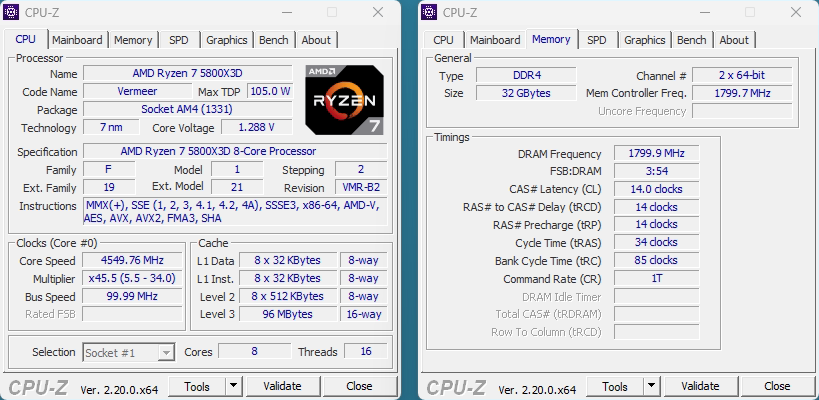
True overclocking of the Ryzen 7 5800X3D is still not possible. AMD locks the multiplier: the BIOS exposes the usual ratio options, but changing it has no effect, and reducing it to underclock does nothing either. Adjusting the base clock even slightly, from 100 MHz to 103 MHz, wouldn't POST on our sample. The 4.5 GHz boost ceiling is a hard cap—because the stacked cache die can't tolerate more than about 1.35 V, AMD fixed the maximum frequency and there's no way to raise it, so removing the power and current limits or dialing in a positive PBO frequency offset changes nothing.
What has changed since 2022 is Curve Optimizer. At launch, the 5800X3D was completely locked down, but mature AGESA and BIOS versions now expose per-core Curve Optimizer, and here it's actually worth setting. It's technically an undervolt rather than a frequency overclock—but on a voltage-limited chip that distinction blurs. In practice, the net result is like an overclock: multithreaded workloads pick up a bit, as the lower voltage lets the cores hold their clocks a little better under sustained load. Single-threaded workloads see no improvement though, because a single core cannot hit any limit either way.
The bigger and more consistent win is efficiency—power draw drops under load and at idle, which in turn lowers temperatures and fan noise in most, though not all, scenarios. It's worth mentioning that the Curve Optimizer range is artificially limited by AMD. The offset is capped at "30" in either direction: -30 for undervolting and +30 for overvolting, in both all-core and per-core modes—so there's simply no way to dial in more than that, no matter how much headroom the silicon might actually have. Our sample wasn't quite stable at the full -30 and ran -25 all-core rock solid. Memory is the other lever: on AM4 the Infinity Fabric realistically tops out around 1800 MHz, so DDR4-3600 at a 1:1 FCLK ratio with tightened timings is the practical sweet spot. It's not a big-headroom tweaker's chip, but it's no longer the completely locked box it was in 2022.
Nov 27th, 2026 05:42 CST
change timezone
Latest GPU Drivers
New Forum Posts
- Mouse Pad advice - Shidenkai out of production? (12)
- What's your main Black Friday / Cyber Monday purchase? (28)
- Wireless Internet sharing between PC and router both-ways, is it possible? (31)
- Using sodimm+adapter instead of full size dimm DDR5? (103)
- SABRENT AIC's (no bifurcation) Black Friday deals (0)
- Found Out Why My FygoOS Transfers Were Stuck at 11 MB/s (0)
- X79 and/or rampage IV OC'ing thread for those of us still left.... (2461)
- Will zen 6 mobos have anything extra vs current ones? (63)
- Dell Dimension E510 Retro Gaming PC Upgrade & Modification (3)
- Gacha Games - Discussions, Pulls, Updates, etc. (1166)
Popular Reviews
- VZMORE AX9 Max Review
- Upcoming Hardware Launches 2027 (Updated Nov 2026)
- ASRock X870E Challenger Wi-Fi White Review
- AMD Ryzen 7 9800X3D Review - The Best Gaming Processor
- Microsoft Surface Laptop Ultra Review - The Next-gen Arm Laptop
- AMD Zen 6 Technical Deep Dive
- Montech CyberFlow ARGB 360 Review
- Phantom Blade Zero Performance Benchmark Review - 35 GPUs Tested
- Corsair RM1200e (Second Generation) Review
- ORICO Obook15 AI Review
TPU on YouTube
Controversial News Posts
- Jensen Huang Reinstated as CEO of NVIDIA (618)
- NVIDIA Co-Founder and CEO Jensen Huang Officially Resigns (492)
- Report: Jensen Huang Eyes NVIDIA Comeback (281)
- Open Letter Asking NVIDIA to Reinstate Jensen Huang Passes 115,000 Signatures (184)
- OpenAI CEO Argues Home PCs Waste the World's Limited DRAM Supply (152)
- NVIDIA Launches Investigation Into Jensen Huang's Relationship With Suspected Chinese Spy (136)
- Intel Razor Lake Gets a 12 P-Core bLLC Chip With No E-Cores, Per Leak (94)
- NVIDIA GeForce RTX 50-Series Scheduled for up to $500 Price Hike This Week (89)