 164
AMD Ryzen 9 9950X3D Review - Great for Gaming and Productivity
Performance Summary »Clock Frequencies
The following chart shows how well the processor sustains its clock frequency and which boost clock speeds are achieved at various thread counts. This test uses a custom-coded application that mimics real-life performance—it is not a stress test like Prime95. Modern processors change their clocking behavior depending on the type of load, which is why we provide three plots with classic floating point math, SSE SIMD code, and modern AVX vector instructions. Each of the three test runs calculates the same result using the same algorithm, just with a different CPU instruction set.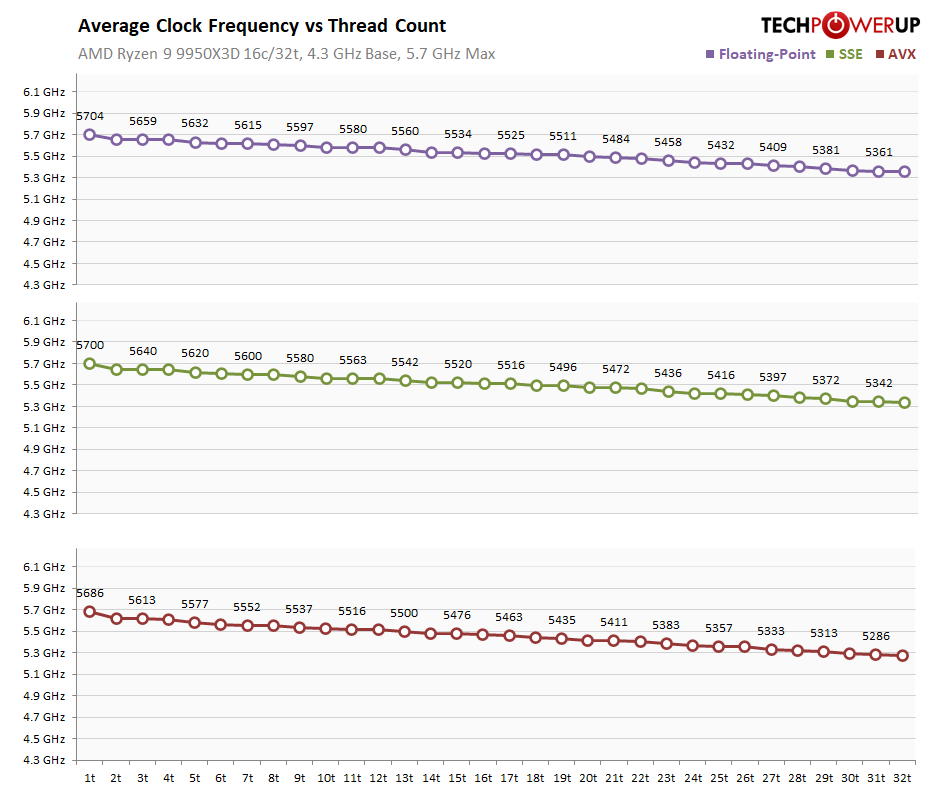
Nice, a gradual reduction of frequencies as load increases. Please note that the cores with 3D V-Cache are clocked a bit lower than the cores without cache. That's why we tested the cores without cache first for the low-threaded results. The rated 5.7 GHz is reached only with a single non-cache core loaded, and the typical operating frequency is closer to 5.5 GHz or so.
Overclocking

While overclocking was disabled on previous X3D processors, this is fully supported on the 9950X3D. One important development for this ability is that AMD has now placed the 3D V-Cache tile under the CCD with the CPU cores, instead of on top of it. This improves thermals, because heat doesn't have to travel through the X3D's cache silicon anymore.
As previous reviews have shown, the right way to overclock these processors is by using AMD Precision Boost Overdrive (PBO):
- Set PBO mode to "manual"
- Then, I removed all the power and current limits
- I also set +200 MHz with a scalar of x10
- Last but not least, I set Curve Optimizer to -10 all cores
- That turned out to be fully stable, so I set -15, -20 and -25 with quick stability testing at each setting
- At -30 the CPU was unstable, so I settled for -25
- The benchmark charts include a full run at this setting (blue bar)
Nov 18th, 2026 23:56 PST
change timezone
Latest GPU Drivers
New Forum Posts
- [Poll] 12V-2x6 Connector Protection: What Are You Using? (WireView / Ampinel / Equalizer / Other / Nothing) (43)
- Windows HDR on = Tinted colors (5)
- Time to upgrade CPU and MOBO (42)
- Without Jensen, PC gaming will be (47)
- WarpCoreBench scores! (68)
- Honestly, do you care about GTA VI? (155)
- Very unusual two gaming-pc scenarios. (13)
- TPU's Nostalgic Hardware Club (22168)
- Dual B70 or Dual R9700 Pro on Linux (7)
- Windows 11 General Discussion (7730)
Popular Reviews
- Acemagic Retro X3 Review
- Ugreen NASync DXP4800 GT Review
- Upcoming Hardware Launches 2027 (Updated Nov 2026)
- AMD Zen 6 Technical Deep Dive
- Pulsar Office Tour & First Look at P1 Dual-Sensor Mouse
- Biwin Black Opal NV7400 2 TB Review
- Sapphire Radeon RX 7700 XT Pure Review
- Sapphire Radeon RX 7700 XT Pulse Review
- Chieftec Iceberg PRO 360 DARK Review
- ASUS ROG Strix B850-I Gaming Wi-Fi7 W Review
TPU on YouTube
Controversial News Posts
- NVIDIA Co-Founder and CEO Jensen Huang Officially Resigns (483)
- Report: Jensen Huang Eyes NVIDIA Comeback (196)
- Open Letter Asking NVIDIA to Reinstate Jensen Huang Passes 115,000 Signatures (184)
- OpenAI CEO Argues Home PCs Waste the World's Limited DRAM Supply (152)
- NVIDIA Launches Investigation Into Jensen Huang's Relationship With Suspected Chinese Spy (136)
- Intel "Raptor Lake Next" 16-Core and 20-Core CPUs Surface (130)
- Legendary Game Studio BioWare Shuts Down Following EA Layoffs (104)
- Dell CEO Says the Memory Shortage Will Get Worse in 2027 (95)