 13
APNX V2 Review
(13 Comments) »Value and Conclusion
- The APNX V2 has a MSRP of US$159.99 excl. taxes.
- Very well priced
- Three glass panels with 85% surface coverage
- Unique interior layout to take advantage of the glass
- Very solid metal build quality
- Very good out-of-the-box thermals
- Functional GPU support bracket included
- Fully-fledged 10-port PWM and ARGB hub
- Can hold long PSUs of up to 270 mm in length
- Includes plenty of internal Velcro strips
- Exterior cable management
- Four 140 mm fans included
- BTF opening cover is a nice touch
- Unique cable covers that work well with the case
- Can hold up to 10 fans
- Underside dust filter easy to pull out for cleaning
- Could hold two PSUs for extreme build scenarios
- Functional AIO tube clip a nice touch
- 3 mm glass makes us a bit nervous handling such large panes
- Fans are not quiet under load
- Cable management is cramped into a small space and rather difficult
- ARGB hub connected to the HDD cage, restricting internal access
- ARGB hub is actually a controller, but the case has no inbuilt way of controlling it
- Top gray cable cover hinged and comes off that hinge easily
- Some extra Velcro strips for external cable management would have been nice
First off, lets talk about pricing. The APNX V2 clocks in at $160. This is a very good price for the chassis, as APNX includes four fans and a controller.
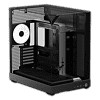
While the V2 may seem like just another fish tank case with three glass panels, APNX has managed to engineer a very well-thought-out interior that doesn't just look different from the competition, but also provides lots of functional USPs. Starting with the cooling layout, the V2 has the ability to still install up to 10 fans, despite having three glass panels with 85% coverage. To top it all off, APNX has just gone ahead and included four 140 mm ARGB equipped FB3 fans right out of the box, so would only need two more to max out the cooling potential alongside a 360 mm AIO. Speaking of which: that plastic clip to hold the tubing of your liquid cooler is not necessary, but is such a nice touch.
What is usually a dual chamber case with a wall dividing the entire case into two areas, has been reduced to just the motherboard tray, framed in a metal cable cover, which is so smartly designed that you won't see the cables hidden away behind it. That is a good thing, as you will have to wrangle it all in there. That experience is the biggest issue we can see with this case, as we've found really no meaningful way to get it as clean in that much smaller volume than with those cases that are divided fully in two, the front and center PWM and ARGB hub doesn't help either. We are calling it a hub—even though it is technically a controller—because the V2 has no wiring or button to control it, which is something APNX could have easily added. That said, omitting this was likely a cost saving measure.
Similarly, the glass is on the thin side—while not a functional issue—will likely make you nervous when handling the panels. Slightly thicker 4 mm panes would have felt better, but also mean an increased the cost and weight of the APNX V2.
Besides the wiring, building inside the case is a breeze thanks to the removable glass panes. While you essentially get a nearly freestanding motherboard tray, the result of the build is still gorgeous and clean, with views from three angles making it a perfect chassis to showcase hardware and themes you may build your system around.
For the attractive price you get a ton of uniqueness, an excellent functional set of features, tons of glass, and a case that punches well above its weight class. So it is deserving of the trio of awards.



While the V2 may seem like just another fish tank case with three glass panels, APNX has managed to engineer a very well-thought-out interior that doesn't just look different from the competition, but also provides lots of functional USPs. Starting with the cooling layout, the V2 has the ability to still install up to 10 fans, despite having three glass panels with 85% coverage. To top it all off, APNX has just gone ahead and included four 140 mm ARGB equipped FB3 fans right out of the box, so would only need two more to max out the cooling potential alongside a 360 mm AIO. Speaking of which: that plastic clip to hold the tubing of your liquid cooler is not necessary, but is such a nice touch.
What is usually a dual chamber case with a wall dividing the entire case into two areas, has been reduced to just the motherboard tray, framed in a metal cable cover, which is so smartly designed that you won't see the cables hidden away behind it. That is a good thing, as you will have to wrangle it all in there. That experience is the biggest issue we can see with this case, as we've found really no meaningful way to get it as clean in that much smaller volume than with those cases that are divided fully in two, the front and center PWM and ARGB hub doesn't help either. We are calling it a hub—even though it is technically a controller—because the V2 has no wiring or button to control it, which is something APNX could have easily added. That said, omitting this was likely a cost saving measure.
Similarly, the glass is on the thin side—while not a functional issue—will likely make you nervous when handling the panels. Slightly thicker 4 mm panes would have felt better, but also mean an increased the cost and weight of the APNX V2.
Besides the wiring, building inside the case is a breeze thanks to the removable glass panes. While you essentially get a nearly freestanding motherboard tray, the result of the build is still gorgeous and clean, with views from three angles making it a perfect chassis to showcase hardware and themes you may build your system around.
For the attractive price you get a ton of uniqueness, an excellent functional set of features, tons of glass, and a case that punches well above its weight class. So it is deserving of the trio of awards.
Nov 29th, 2026 16:47 CST
change timezone
Latest GPU Drivers
New Forum Posts
- Minimax H3 bench (5)
- -18C on GPU by moving it to the front of the case. (46)
- What's your main Black Friday / Cyber Monday purchase? (57)
- Which Xfinity modem/router setup supports network printing/scanning between a wired PC and a Wi-Fi Brother MFC-L8900CDW printer? (5)
- Asus XG27AQWMG-R none of the oled care features work except for the proximity sensor but nonexistent grey banding to my eyes. (7)
- The Official Linux/Unix Desktop Screenshots Megathread (917)
- What are you playing? (26269)
- X79 and/or rampage IV OC'ing thread for those of us still left.... (2462)
- ASUS Prime 5060 ti 16gb x4 instead of x8 PCIe (14)
- V Rising Lycanthropy Club (24)
Popular Reviews
- Upcoming Hardware Launches 2027 (Updated Nov 2026)
- Moaiplay Ora Pro G1 850 Review
- Montech CyberFlow ARGB 360 Review
- AMD Ryzen 7 9800X3D Review - The Best Gaming Processor
- ORICO Obook15 AI Review
- AMD Zen 6 Technical Deep Dive
- VZMORE AX9 Max Review
- Acemagic Retro X3 Review
- Phantom Blade Zero Performance Benchmark Review - 35 GPUs Tested
- Microsoft Surface Laptop Ultra Review - The Next-gen Arm Laptop
TPU on YouTube
Controversial News Posts
- Jensen Huang Reinstated as CEO of NVIDIA (637)
- NVIDIA Co-Founder and CEO Jensen Huang Officially Resigns (492)
- Report: Jensen Huang Eyes NVIDIA Comeback (281)
- Open Letter Asking NVIDIA to Reinstate Jensen Huang Passes 115,000 Signatures (184)
- OpenAI CEO Argues Home PCs Waste the World's Limited DRAM Supply (155)
- NVIDIA Launches Investigation Into Jensen Huang's Relationship With Suspected Chinese Spy (136)
- Intel Razor Lake Gets a 12 P-Core bLLC Chip With No E-Cores, Per Leak (94)
- NVIDIA GeForce RTX 50-Series Scheduled for up to $500 Price Hike This Week (89)