 10
ARYE RCC-1 Review
(10 Comments) »Value and Conclusion
- The ARYE RCC-1 is available for $1299.00 HKD, which roughly equals $165 USD.
- True 8000 Hz polling
- Good sensor performance
- Very low click latency
- Mostly high button quality
- Very good scroll wheel
- Good choice of components
- Lightweight
- Nicely gliding mouse feet
- Full software customizability
- Set of replacement mouse feet included
- Very pricey
- Somewhat mushy and muted main buttons
- Minor polling instability in wireless operation
- Stiff charging cable
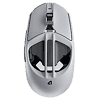
In its original announcement, the RCC-1 (or FCC-1, as it was called) was planned to be made of forged carbon fiber. However, ARYE ultimately had to give up on this intention, and instead settled for a carbon fiber composite, similarly to the Finalmouse ULX, Pwnage StormBreaker Max CF, or Arbiter Studio AKITSU. Compared to these, the material composition of the RCC-1 appears to differ, in that the (top) shell is far more rigid yet the surface not as cold to the touch. In terms of build quality, my sample of the RCC-1 is flawless. There is no rattle when shaking, no creaking or flexing of the shell when applying lateral pressure, and actuating the side buttons by pressing below them is impossible regardless of force. The design of the RCC-1 is peculiar: the carbon fiber composite top shell has a large cutout where otherwise the hump would be, with two rails going across it. Through these cutouts, the plastic frame that is screwed to the top shell is visible, which provides the support structure for the main button pieces and has the battery attached to it. The bottom shell is made of regular ABS plastic and likewise has large cutouts for weight savings. Functionally, the design isn't to be faulted, but one could make an argument that at 48 g, the RCC-1 isn't quite as light as it possibly should be, given how even the carbon fiber, solid-shell ASUS ROG Harpe Ace Extreme weighs less at 47 g while being significantly larger, and even plain ABS plastic mice from SCYROX or G-Wolves land around or below 40 g while having either fully solid or solid top shells.
The shape of the RCC-1 is also rather unique. Essentially, the RCC-1 is best thought of as an amalgamation of the Logitech G303 and G305. The progressively narrowing front is clearly identifiable as the G303's, whereas the back could be likened to the G305, albeit with several caveats. Most notably, the RCC-1 effectively lacks an actual hump, as where the hump would typically be located, the RCC-1 has a large cutout. This is in line with ARYE's idea to have only those portions that are touched be solid, and this area isn't meant to be touched when applying a typical claw or fingertip grip. Another notable difference to the G305 are the sides, which are almost entirely straight, and since the base is narrower than the base, the grip width of the RCC-1 likewise ends up being on the lower end of the typical range. Though the sides in particular deviate greatly from the G303, the RCC-1 effectively doesn't handle that differently, and as someone who has always been fond of the G303, I can say with confidence that the RCC-1 manages to replicate some of what made the G303 special.
For the main buttons, ARYE has opted for a pair of Omron D2FP-FN2 optical switches, which are known for their highly snappy actuation. On the RCC-1, however, I've found these to be somewhat muted and mushy. When pressed towards the back, the rigidity imparted by the shell feels "just right," but when pressed at the front, which is where one's fingers will typically sit when applying a claw grip, the buttons lack tensioning. Pre-travel being moderate and post-travel being high doesn't help in this regard, though the amount of lateral button movement at least is appreciably low even when explicitly provoked. For the side buttons, a set of low-profile, 2-pin switches from TTC (brown, blue plunger) see use, and whereas the forward button can score with low pre- and post-travel, moderate pre- and post-travel has the back side button feel rather mushy, though the actuation point is even still. The scroll wheel encoder is a TTC Gold (blue, yellow core) in the 9 mm size, whose rather low noise levels and good level of tactility make for pleasant and controlled scrolling. By default, the RCC-1 has no skates installed, leaving the choice between a set of larger fitted feet, a set of smaller fitted feet, and a set of dots to the player. The former two are made of non-dyed PTFE and glide very well, so no complaints in this regard.
In terms of internals, the RCC-1 is more standard. The sensor is PixArt's PAW3950 coupled with an nRF52840 MCU from Nordic, while the firmware and software solution comes from CompX. Coincidentally, not just the specifications but also the performance closely match recent Pulsar offerings such as the Susanto-X, which utilizes a near-identical firmware solution. On the RCC-1, CPI deviation is low, and general tracking shows no issues, irrespective of whether MotionSync is enabled or not. Much like on the Susanto-X, one can enable a so-called "Boost Mode," which sets sensor framerate to the maximum value of roughly 20,500 Hz instead of the default 13,500 Hz, and enables the corded sensor run mode if it isn't engaged already by virtue of polling rate being set to 2000 Hz or higher. Hence, the biggest upside of the setting would be present at 1000 Hz, as motion delay should benefit from the switch to corded mode, yet in testing, I've found there to be no difference at all, leaving the usefulness of the Boost Mode dubious. Motion delay in general is merely decent on the RCC-1, matching the Susanto-X in this regard. Without MotionSync, the RCC-1 is ahead of the Logitech G403 (control subject) by 0.5 ms at 2000, 4000, and 8000 Hz, falling short of the best in this category such as the Endgame Gear XM2w 4K, which achieves a 1.0 ms advantage. Polling stability isn't all that great either: 2000 Hz is mostly stable, though occasionally variance will be elevated, whereas at 4000 Hz, variance will frequently be elevated, such that the RCC-1 typically alternates between polls of 0.375 ms and 0.125 ms instead of the target interval of 0.250 ms. 8000 Hz doesn't have these issues, but there are missed polls throughout. In terms of click latency, the RCC-1 by and large delivers the usual CompX standard, which is 0.4 ms at 8000 Hz with 0 ms debounce time, and since the RCC-1 utilizes optical switches for the main buttons and has a flawlessly implemented slam-click prevention algorithm, there is no reason not to use 0 ms. Somewhat curiously, click latency at 2000 Hz is marginally higher than at 1000 Hz.
The software is the usual standard UI from CompX already familiar from many other releases such as those from LAMZU, Zaopin, Fantech, and so on. All relevant settings are present, and resource usage is pleasantly low. The software also includes a percentage-based battery life indicator with single-digit increments, which isn't particularly reliable or accurate, but sufficiently so to allow giving a rough battery life estimate. For every two and a half hours of continuous usage at 8000 Hz and with Boost Mode enabled, the indicator went down by 15%, suggesting an expected battery life of around 15 hours, which would be roughly in line with expectations given the 300 mAh battery. Charging speed is average, but the charging cable is rather stiff, preventing playing while charging without feeling overly restricted almost entirely.
Overall, the RCC-1 is a fine mouse that does some new things and most of them well. At the same time, "fine" falls short of what one would expect from a mouse costing a converted $165 USD, which is simply too much for a mouse whose firmware solution is essentially shared with the $69.99 SCYROX V6/V8. In that regard, the RCC-1 suffers the same fate as the Pulsar Susanto-X, though the RCC-1 ends up costing yet another $35 more. Still, for those who crave a shape that is at least tangentially similar to the G303, or those who want a shell that is fundamentally more rigid than normal ABS plastic, the RCC-1 is worth a look nevertheless.
Nov 20th, 2026 15:35 PST
change timezone
Latest GPU Drivers
New Forum Posts
- How to prevent OLED burn damage due to PC freezes or power outtages? (49)
- RX 9000 series GPU Owners Club (2249)
- WarpCoreBench scores! (82)
- Honestly, do you care about GTA VI? (209)
- Logitech Headsets Modded Driver — Unlock Dolby in G HUB (23)
- 1 - 5 person file storage server equivalent accasible from anywhere + general VM server. (1)
- When you could finally run Crysis maxed out? (63)
- GTA VI (20)
- Anthrophics IPO (25)
- GeekMagic Ultra Smart WiFi Weather Station (8)
Popular Reviews
- AMD Zen 6 Technical Deep Dive
- Microsoft Surface Laptop Ultra Review - The Next-gen Arm Laptop
- Ugreen NASync DXP4800 GT Review
- Corsair RM1200e (Second Generation) Review
- Acemagic Retro X3 Review
- Upcoming Hardware Launches 2027 (Updated Nov 2026)
- Pulsar Office Tour & First Look at P1 Dual-Sensor Mouse
- Biwin Black Opal NV7400 2 TB Review
- AMD Ryzen 7 9800X3D Memory Performance Scaling
- AMD Ryzen 7 9800X3D Review - The Best Gaming Processor
TPU on YouTube
Controversial News Posts
- NVIDIA Co-Founder and CEO Jensen Huang Officially Resigns (491)
- Report: Jensen Huang Eyes NVIDIA Comeback (256)
- Open Letter Asking NVIDIA to Reinstate Jensen Huang Passes 115,000 Signatures (184)
- OpenAI CEO Argues Home PCs Waste the World's Limited DRAM Supply (152)
- NVIDIA Launches Investigation Into Jensen Huang's Relationship With Suspected Chinese Spy (136)
- Intel "Raptor Lake Next" 16-Core and 20-Core CPUs Surface (130)
- Legendary Game Studio BioWare Shuts Down Following EA Layoffs (104)
- Dell CEO Says the Memory Shortage Will Get Worse in 2027 (95)